MyCompetitiveExams Logo MyCompetitiveExams
Search 1,140+ Questions
Chapters, formulas, speed tricks
→
⚡ Brahmastra NEET 2027
720 MARKS

Dynamic 180-question full-length simulator mixed dynamically from all 6 years for 2027 & 2026 aspirants.

Launch Brahmastra 2027 Test →
Start Practice →
100% Free · No Login Required
Q.89 Chemistry ⭐ 360° Option Elimination Active
Vault ↗

NEET 2025 Chemistry Question 89 Solution

Topic: Chemical Kinetics · Official NTA Booklet Code 45
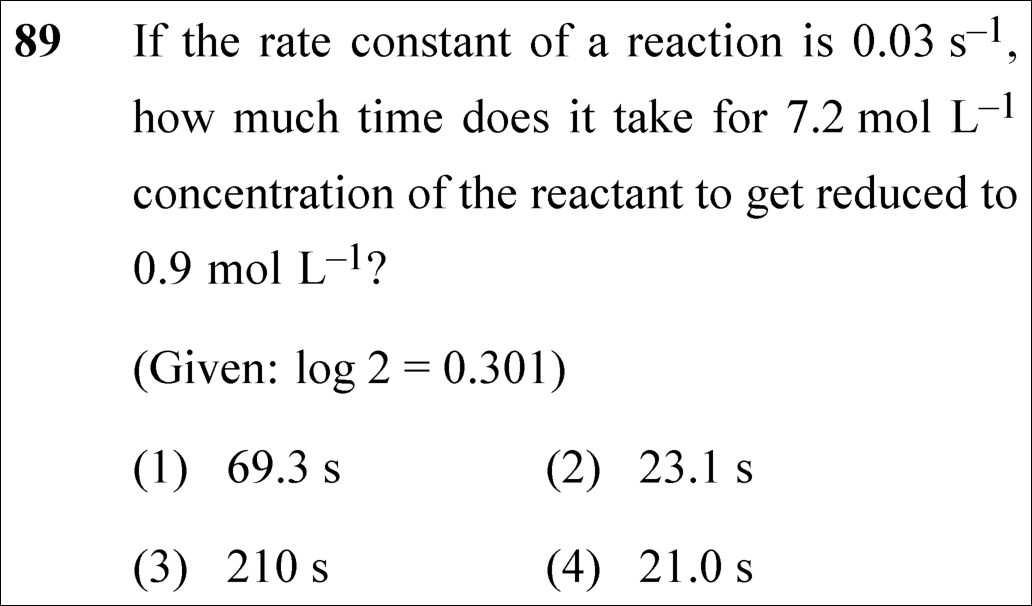
NEET 2025 Chemistry Question 89: Time Required for Reactant Concentration Reduction from 7.2 to 0.9 mol L⁻¹

Question

If the rate constant of a reaction is 0.03 s⁻¹, how much time does it take for 7.2 mol L⁻¹ concentration of the reactant to get reduced to 0.9 mol L⁻¹? (Given: log 2 = 0.301)

✓
Verified Against NTA Final Answer Key
Option (1) : 69.3 s
📚 Chemical Kinetics Easy
📋 Given Parameters & Problem Setup
Rate Constant (k) 0.03 s⁻¹ (First order reaction, unit s⁻¹)
Initial Concentration ([R]₀) 7.2 mol L⁻¹
Final Concentration ([R]_t) 0.9 mol L⁻¹
Given Constant log 2 = 0.301
⚡

The 30-Second Exam Hall Shortcut: ⚡ Integer Half-Life Doubling Shortcut

⏱️ Save ~35 seconds

[R]₀ / [R]_t = 7.2 / 0.9 = 8 = 2³ ⟹ Exactly 3 HALF-LIVES! t_{1/2} = 0.693 / 0.03 = 23.1 s! Total time t = 3 × 23.1 s = 69.3 s!

1 Notice unit of k is s⁻¹ ⟹ Reaction is strictly First Order.
2 Compute ratio of initial to final concentration: [R]₀ / [R]_t = 7.2 / 0.9 = 8.
3 Express 8 as a power of 2: 8 = 2³ ⟹ exactly 3 half-lives have elapsed (n = 3).
4 Calculate half-life: t_{1/2} = 0.693 / k = 0.693 / 0.03 = 69.3 / 3 = 23.1 seconds.
5 Calculate total time: t = n × t_{1/2} = 3 × 23.1 s = 69.3 seconds.
6 Match Option (1) in under 10 seconds!
🛡️
Why You Can 100% Trust This Shortcut: First-Order Rate Law & Half-Life Dynamics (NCERT Chemistry · Chemical Kinetics: [A] = [A]₀ e^(-kt)).
📐

Step-by-Step Rigorous Workflow & Mathematical Proof

Step 1

Identify Reaction Order and State Integrated Rate Law

The rate constant k has units of s⁻¹, which uniquely characterizes a first-order chemical reaction:

t=2.303klog⁡10([R]0[R]t)t = \frac{2.303}{k} \log_{10}\left(\frac{[R]_0}{[R]_t}\right)
  • • Given [R]₀ = 7.2 mol L⁻¹ and [R]_t = 0.9 mol L⁻¹.
  • • Ratio [R]₀ / [R]_t = 7.2 / 0.9 = 8 = 2³.
Step 2

Calculate Time Using Logarithmic Formulation

Substitute the given value log 2 = 0.301 into the integrated rate law:

t=2.3030.03 s−1log⁡10(23)=2.303×3×0.3010.03=3×0.69320.03=3×23.106 s=69.32 st = \frac{2.303}{0.03\text{ s}^{-1}} \log_{10}(2^3) = \frac{2.303 \times 3 \times 0.301}{0.03} = \frac{3 \times 0.6932}{0.03} = 3 \times 23.106\text{ s} = 69.32\text{ s}
  • • Rounding to three significant digits yields 69.3 s.
Step 3

Alternative Verification via Half-Life Multiplier

Confirm via consecutive half-lives:

7.2→t1/23.6→t1/21.8→t1/20.9  ⟹  3 half-lives7.2 \xrightarrow{t_{1/2}} 3.6 \xrightarrow{t_{1/2}} 1.8 \xrightarrow{t_{1/2}} 0.9 \implies 3\text{ half-lives}
  • • t_{1/2} = 0.693 / 0.03 = 23.1 s.
  • • Total time = 3 × 23.1 s = 69.3 s.
  • • Matches Option (1) exactly.
⭐

360° Option Elimination Engine Key Feature

Diagnose every choice: Know exactly why the right option works and why distractors fail.

4-Option Deep Scan
1 A
✓ 100% Correct
Verdict & Scientific Reason:

100% correct. Exactly 3 half-lives: 3 × (0.693 / 0.03) = 69.3 s.

💡
Why this is airtight: None; flawless kinetics calculation.
2 B
✗ Incorrect
Verdict & Scientific Reason:

Incorrect. This is the duration of a single half-life (reduction from 7.2 to 3.6 mol L⁻¹).

⚠️
Student Fallacy (Why candidates pick this trap): Stopping after finding t_{1/2} without multiplying by 3.
3 C
✗ Incorrect
Verdict & Scientific Reason:

Incorrect. Order of magnitude error.

⚠️
Student Fallacy (Why candidates pick this trap): Dividing 7.2 - 0.9 by 0.03 directly (treating as zero-order reaction).
4 D
✗ Incorrect
Verdict & Scientific Reason:

Incorrect. Arithmetic slip in evaluating zero-order formula: (7.2 - 0.9) / 0.03 = 210, then dividing by 10.

⚠️
Student Fallacy (Why candidates pick this trap): Confusing zero order with first order kinetics.
⚠️

NTA Trap Alert: Stopping at a Single Half-Life (23.1 s Trap)

Option 2 (23.1 s) is exactly one half-life (0.693 / 0.03). Students who compute t_{1/2} and hastily spot 23.1 s in the options often select it before multiplying by the 3 half-lives needed to reach 0.9 mol/L!

🛡️ How to avoid the -1 mark: Trace the concentrations: 7.2 ⟶ 3.6 (1) ⟶ 1.8 (2) ⟶ 0.9 (3) ⟹ Multiply by 3!
📖

Core NEET Syllabus Standard

NEET Chemistry Core Syllabus · Chemical Kinetics Standard Benchmark
Core Scientific Principle Tested:

"t = (2.303 / k) log([R]₀ / [R]_t) = n × t_{1/2}."

Syllabus Focus: Integrated Rate Law for First Order Reactions
✓ Core NEET UG Syllabus Anchor Syllabus & Academic Standards ↗
7.2 / 0.9 = 8 = 2³ ⟹ 3 Half-Lives = 3 × 23.1 = 69.3 s (Option 1)!

Ready to attempt under real exam pressure?

Test your speed and accuracy in the authentic 180-minute timed NTA simulator.

Launch NEET 2025 CBT Test →

Spotted a mistake in this solution? Report an error (support@mycompetitiveexams.com)

⚖️ Legal & Fair Dealing Notice: Sourced from publicly released NEET 2025 question papers and NEET answer keys for private study, research, and non-commercial educational practice under Fair Dealing (Section 52(1)(a) of the Indian Copyright Act, 1957). Not affiliated with or endorsed by NTA or NMC.

Solve 4 NEET Questions a Day — One per Subject

Cover all 1,140 official NEET questions in 285 days at your own pace. Progress is saved on your device. No login needed.