MyCompetitiveExams Logo MyCompetitiveExams
Search 1,140+ Questions
Chapters, formulas, speed tricks
→
⚡ Brahmastra NEET 2027
720 MARKS

Dynamic 180-question full-length simulator mixed dynamically from all 6 years for 2027 & 2026 aspirants.

Launch Brahmastra 2027 Test →
Start Practice →
100% Free · No Login Required
Q.60 Chemistry ⭐ 360° Option Elimination Active
Vault ↗

NEET 2026 Chemistry Question 60 Solution

Topic: Chemical Kinetics · Official NTA Booklet Code 50
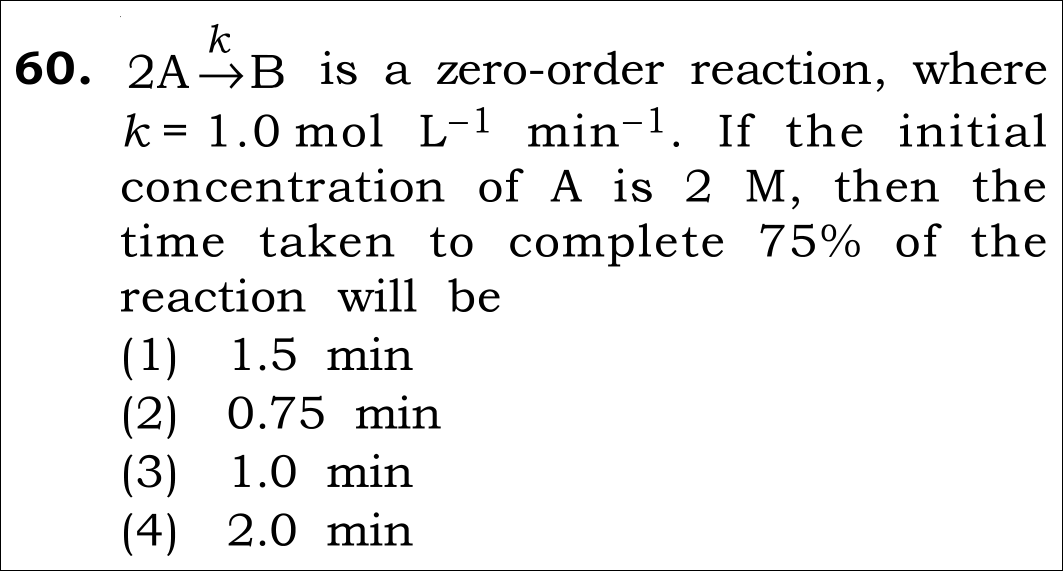
NEET 2026 Chemistry Question 60: Integrated Rate Law & Stoichiometric Coefficients in Zero-Order Reactions

Question

2A →(k) B is a zero-order reaction, where k = 1.0 mol L⁻¹ min⁻¹. If the initial concentration of A is 2 M, then the time taken to complete 75% of the reaction will be

✓
Verified Against NTA Final Answer Key
Option (2) : 0.75 min
📚 Chemical Kinetics Medium
📋 Given Parameters & Problem Setup
Reaction 2A → B (Zero-order reaction)
Rate Constant (k) 1.0 mol L⁻¹ min⁻¹
Initial Concentration [A]₀ 2.0 M
Target Completion Time taken to complete 75% of the reaction (t_75%)
⚡

The 30-Second Exam Hall Shortcut: ⚡ The Stoichiometric Factor in Differential Rates

⏱️ Save ~60 seconds

Watch the stoichiometric 2 in front of A! Rate = -(1/2) d[A]/dt = k ⇒ -d[A]/dt = 2k!

1 75% completion means 75% of [A]₀ has reacted: Amount consumed = 0.75 × 2.0 M = 1.5 M.
2 Differential rate equation: Rate = -(1/2) d[A]/dt = k ⇒ -d[A]/dt = 2k.
3 Integrated zero-order form: [A]₀ - [A]_t = 2 k t.
4 Substitute: 1.5 = 2 × (1.0) × t ⇒ t = 1.5 / 2 = 0.75 min!
5 Option (2) is nailed down in 15 seconds!
🛡️
Why You Can 100% Trust This Shortcut: By international and IUPAC kinetic convention, Rate of Reaction = -(1/a) d[A]/dt = k. For a = 2, disappearance of A proceeds at twice the rate of the reaction constant k.
📐

Step-by-Step Rigorous Workflow & Mathematical Proof

Step 1

Formulate the Rate Law with Stoichiometric Coefficient

For the chemical reaction 2A → B, the rate of reaction is defined with respect to the disappearance of reactant A divided by its stoichiometric coefficient: Rate = - (1/2) (d[A]/dt)

Rate=−12d[A]dt=k[A]0=k\text{Rate} = -\frac{1}{2}\frac{d[\text{A}]}{dt} = k [\text{A}]^0 = k
  • • Order = 0.
  • • Rate constant k = 1.0 mol L⁻¹ min⁻¹.
  • • -d[A]/dt = 2k.
Step 2

Integrate the Differential Rate Equation

Separate variables and integrate from time t = 0 to time t: - ∫_{[A]₀}^{[A]_t} d[A] = 2k ∫_0^t dt

[A]0−[A]t=2kt[\text{A}]_0 - [\text{A}]_t = 2kt
  • • Linear relationship between concentration consumed and time.
Step 3

Calculate the Time for 75% Completion

75% completion means 75% of the initial reactant has been consumed: [A]₀ - [A]_t = 0.75 × [A]₀ = 0.75 × 2.0 M = 1.5 M Substitute this into the integrated rate law: 1.5 M = 2 × (1.0 mol L⁻¹ min⁻¹) × t

t=1.52×1.0=1.52.0=0.75 mint = \frac{1.5}{2 \times 1.0} = \frac{1.5}{2.0} = 0.75\text{ min}
  • • Time required = 0.75 min.
  • • Matches Option (2).
⭐

360° Option Elimination Engine Key Feature

Diagnose every choice: Know exactly why the right option works and why distractors fail.

4-Option Deep Scan
1 A
✗ Incorrect
Verdict & Scientific Reason:

The classic trap! Forgetting the stoichiometric coefficient 2 of reactant A: t = 1.5 / 1.0 = 1.5 min.

⚠️
Student Fallacy (Why candidates pick this trap): Omitting the stoichiometric factor (1/2) in the rate expression.
2 B
✓ 100% Correct
Verdict & Scientific Reason:

Mathematically exact, incorporating the stoichiometric factor of 2 in 2A → B.

💡
Why this is airtight: None; rigorous kinetic derivation.
3 C
✗ Incorrect
Verdict & Scientific Reason:

Incorrect. Corresponds to 50% completion (half-life): t_50% = 1.0 / 2 = 0.5 min or miscalculated half-life.

⚠️
Student Fallacy (Why candidates pick this trap): Confusing 75% completion with other percentage conversions.
4 D
✗ Incorrect
Verdict & Scientific Reason:

Incorrect. Corresponds to 100% completion of A if the factor of 2 was omitted: t_100% = 2.0 / 1.0 = 2.0 min.

⚠️
Student Fallacy (Why candidates pick this trap): Calculating total reaction completion time without stoichiometric division.
⚠️

NTA Trap Alert: Neglecting the Stoichiometric Coefficient in Rate Expressions

The classic kinetic trap: students write [A]₀ - [A]_t = kt and compute 1.5 / 1.0 = 1.5 min (Option 1). When the equation has 2A, the rate of disappearance is 2k, cutting the time in half!

🛡️ How to avoid the -1 mark: Always write the general relation: [A]₀ - [A]_t = a·k·t, where a is the stoichiometric coefficient of reactant A.
📖

Core NEET Syllabus Standard

NEET Chemistry Core Syllabus · Chemical Kinetics Standard Benchmark
Core Scientific Principle Tested:

"The rate of disappearance of a reactant A with coefficient a is a times the rate constant k."

Syllabus Focus: Integrated rate law for zero-order reactions and effect of stoichiometry
✓ Core NEET UG Syllabus Anchor Syllabus & Academic Standards ↗
Two moles of A burn twice as fast: t = (Amount reacted) / (2k)!

Ready to attempt under real exam pressure?

Test your speed and accuracy in the authentic 180-minute timed NTA simulator.

Launch NEET 2026 CBT Test →

Spotted a mistake in this solution? Report an error (support@mycompetitiveexams.com)

⚖️ Legal & Fair Dealing Notice: Sourced from publicly released NEET 2026 question papers and NEET answer keys for private study, research, and non-commercial educational practice under Fair Dealing (Section 52(1)(a) of the Indian Copyright Act, 1957). Not affiliated with or endorsed by NTA or NMC.

Solve 4 NEET Questions a Day — One per Subject

Cover all 1,140 official NEET questions in 285 days at your own pace. Progress is saved on your device. No login needed.