The 30-Second Exam Hall Shortcut: ⚡ Universal Bohr Magneton Resonance
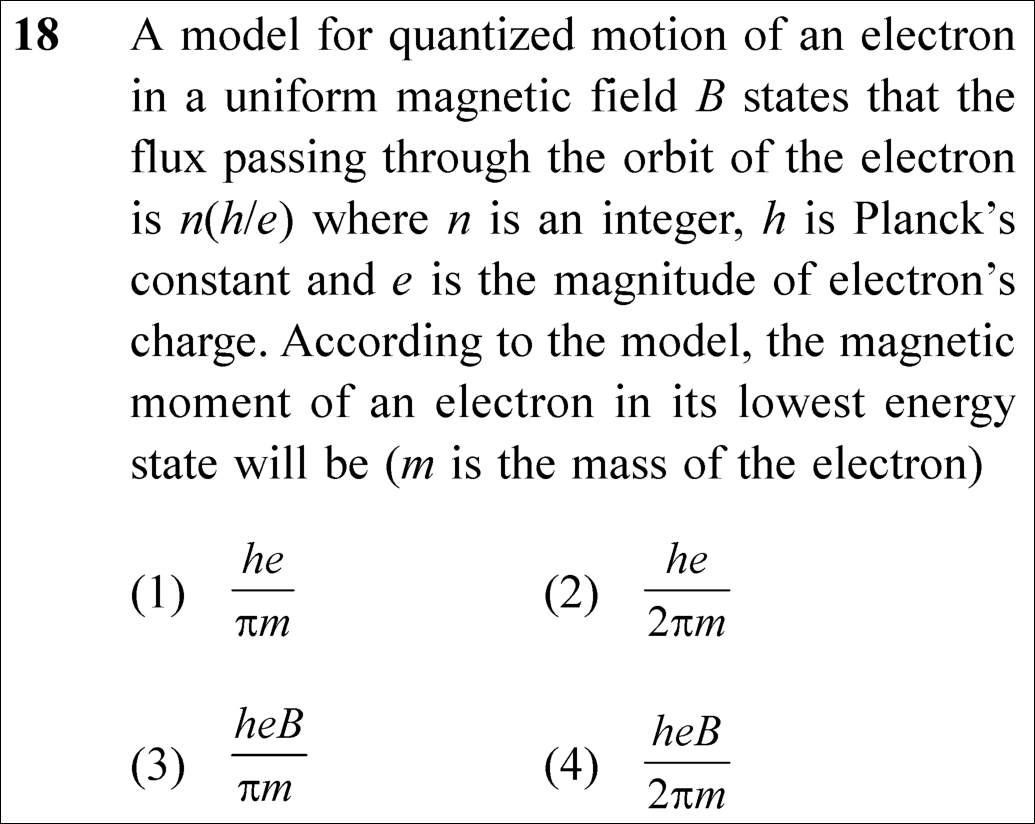
Flux Φ = B(πr²) = h/e ⟹ πr² = h / (eB). Orbital Current I = e(eB/2πm) ⟹ μ = I(πr²) = [e²B / (2πm)] × [h / (eB)] = he / (2πm)!
Step-by-Step Rigorous Workflow & Mathematical Proof
Apply the Flux Quantization Rule
The problem defines that the magnetic flux passing through the circular orbit of the electron is quantized as Φ = n(h/e). For the ground state (lowest energy state, n = 1):
- • A = πr² is the orbital area enclosed by the electron path.
Derive Equivalent Orbital Current
Under the magnetic Lorentz force F = e v B = m v² / r, the angular frequency of the electron is the cyclotron frequency ω = eB / m. The equivalent steady electric current loop formed by the circulating electron is:
- • T is the cyclotron orbital period.
Calculate the Magnetic Dipole Moment
The magnetic dipole moment μ of a planar current loop is the product of current and enclosed area:
- • Magnetic field B cancels cleanly from numerator and denominator.
- • Notice this fundamental result is directly proportional to the Bohr magneton μ_B = eh / (4πm) with factor of 2.
360° Option Elimination Engine Key Feature
Diagnose every choice: Know exactly why the right option works and why distractors fail.
Incorrect. Missing the factor of 2 in the denominator.
100% mathematically and physically exact. Derived from Φ = h/e and cyclotron current I = e²B / (2πm).
Incorrect. Magnetic moment cannot depend on B because B cancels out, and factor of 2 is missing.
Incorrect. Contains an extraneous factor of B.
NTA Trap Alert: Extraneous Magnetic Field B Trap
Options (3) and (4) include B in the numerator. But as B increases, the orbit shrinks (A ∝ 1/B) while current increases (I ∝ B), making the product μ = I A completely independent of B!
Core NEET Syllabus Standard
"Magnetic dipole moment of orbital motion is μ = I A; flux quantization determines orbital area."