MyCompetitiveExams Logo MyCompetitiveExams
Search 1,140+ Questions
Chapters, formulas, speed tricks
→
⚡ Brahmastra NEET 2027
720 MARKS

Dynamic 180-question full-length simulator mixed dynamically from all 6 years for 2027 & 2026 aspirants.

Launch Brahmastra 2027 Test →
Start Practice →
100% Free · No Login Required
Q.30 Physics ⭐ 360° Option Elimination Active
Vault ↗

NEET 2025 Physics Question 30 Solution

Topic: Atoms · Official NTA Booklet Code 45
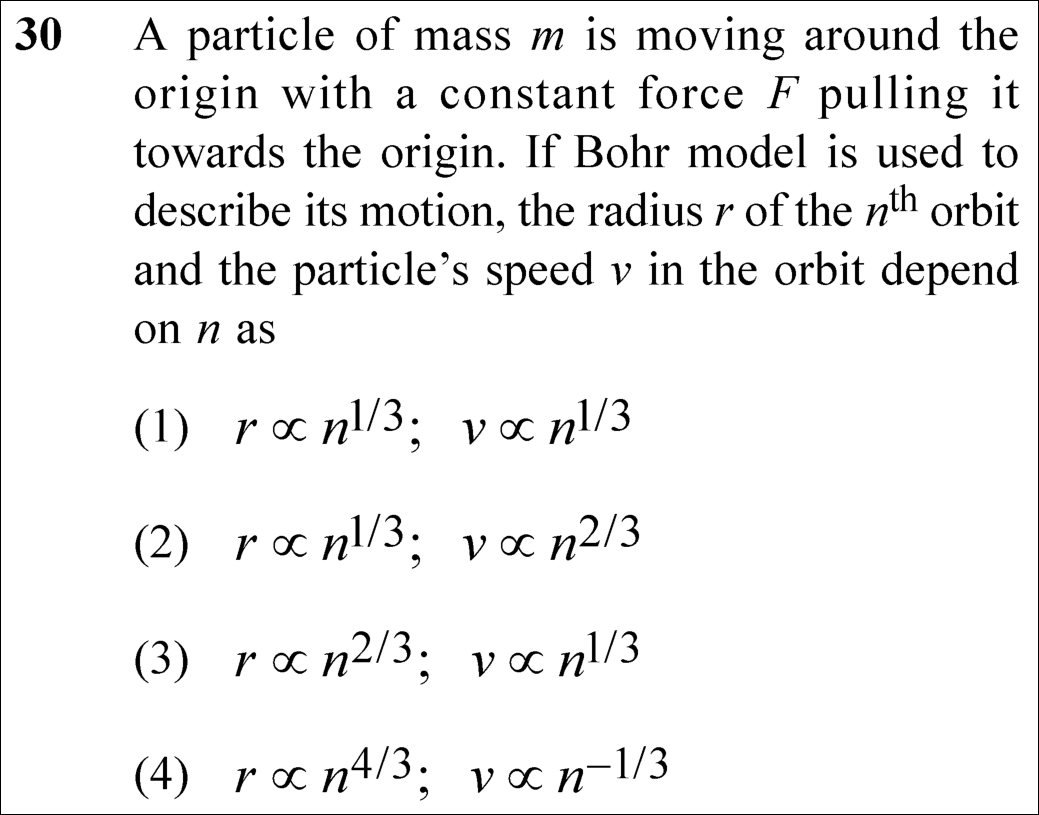
NEET 2025 Physics Question 30: Bohr Quantization with Constant Inward Central Force

Question

A particle of mass m is moving around the origin with a constant force F pulling it towards the origin. If Bohr model is used to describe its motion, the radius r of the nth orbit and the particle's speed v in the orbit depend on n as

✓
Verified Against NTA Final Answer Key
Option (3) : r \propto n^{2/3}; \quad v \propto n^{1/3}
📚 Atoms Medium
📋 Given Parameters & Problem Setup
Force Law Constant magnitude central pulling force F (independent of r)
Theoretical Framework Bohr atomic quantization model
Target Variables Orbital radius r(n) and orbital speed v(n) scaling with quantum number n
⚡

The 30-Second Exam Hall Shortcut: ⚡ Centripetal vs. Angular Momentum Power Matching

⏱️ Save ~45 seconds

F = m v² / r = const ⟹ v ∝ r^(1/2). Bohr condition: m v r = n ħ ⟹ r · r^(1/2) ∝ n ⟹ r^(3/2) ∝ n ⟹ r ∝ n^(2/3) and v ∝ n^(1/3)!

1 Condition 1 (Centripetal equilibrium): m v² / r = F (constant) ⟹ v² ∝ r ⟹ v ∝ r^(1/2).
2 Condition 2 (Bohr quantization): Angular momentum L = m v r = n (h / 2π) ⟹ v r ∝ n.
3 Substitute v ∝ r^(1/2): r^(1/2) · r ∝ n ⟹ r^(3/2) ∝ n ⟹ r ∝ n^(2/3).
4 Find speed scaling: v ∝ r^(1/2) ∝ (n^(2/3))^(1/2) = n^(1/3).
5 Result: r ∝ n^(2/3) and v ∝ n^(1/3).
6 Match Option (3) in under 20 seconds!
🛡️
Why You Can 100% Trust This Shortcut: Bohr’s Postulates applied to Generalized Central Potentials (NCERT Atoms).
📐

Step-by-Step Rigorous Workflow & Mathematical Proof

Step 1

Relate Speed and Radius via Centripetal Force

The particle of mass m moves in a circular orbit of radius r under the action of a constant inward radial force F. Equating centripetal force to F:

mv2r=F  ⟹  v2=Fmr  ⟹  v=Fm r1/2∝r1/2\frac{m v^2}{r} = F \implies v^2 = \frac{F}{m} r \implies v = \sqrt{\frac{F}{m}} \, r^{1/2} \propto r^{1/2}
  • • Because F and m are constant, orbital speed is proportional to the square root of radius: v ∝ r^(1/2).
Step 2

Apply Bohr’s Angular Momentum Quantization

According to Bohr’s postulate, the orbital angular momentum is an integral multiple of h / 2π:

L=mvr=nh2π=nℏL = m v r = n \frac{h}{2\pi} = n \hbar
  • • Substitute v ∝ r^(1/2) into the angular momentum equation:
  • • m (C r^(1/2)) r = n ħ ⟹ r^(3/2) ∝ n.
Step 3

Derive the Exponents for r and v

Solve for r and v as functions of the principal quantum number n:

r3/2∝n  ⟹  r∝n2/3r^{3/2} \propto n \implies r \propto n^{2/3}
  • • Now substitute r ∝ n^(2/3) back into the speed relation:
  • • v ∝ r^(1/2) ∝ (n^(2/3))^(1/2) = n^(1/3).
  • • Thus: r ∝ n^(2/3) and v ∝ n^(1/3), corresponding to Option (3).
⭐

360° Option Elimination Engine Key Feature

Diagnose every choice: Know exactly why the right option works and why distractors fail.

4-Option Deep Scan
1 A
✗ Incorrect
Verdict & Scientific Reason:

Incorrect. If r ∝ n^(1/3), then mvr ∝ n^(1/3) · n^(1/3) = n^(2/3) ≠ n.

⚠️
Student Fallacy (Why candidates pick this trap): Failing to balance angular momentum product.
2 B
✗ Incorrect
Verdict & Scientific Reason:

Incorrect. Swapped exponents of r and v.

⚠️
Student Fallacy (Why candidates pick this trap): Inverting the relation between velocity and radius.
3 C
✓ 100% Correct
Verdict & Scientific Reason:

100% correct. v ∝ r^(1/2) and v·r ∝ n gives r ∝ n^(2/3) and v ∝ n^(1/3).

💡
Why this is airtight: None; textbook non-Coulombic Bohr orbit derivation.
4 D
✗ Incorrect
Verdict & Scientific Reason:

Incorrect. Corresponds to Coulomb potential (where F ∝ 1/r² ⟹ r ∝ n² and v ∝ 1/n).

⚠️
Student Fallacy (Why candidates pick this trap): Conflating Coulomb 1/r² force with constant force.
⚠️

NTA Trap Alert: Assuming Standard Coulomb Orbit Results (r ∝ n²)

Students often memorize standard hydrogen atom results (r ∝ n² and v ∝ 1/n) from Coulomb potential F ∝ 1/r². Here the force is CONSTANT (F = const), so you MUST re-derive using v² ∝ r!

🛡️ How to avoid the -1 mark: Never use hydrogen formulas when the force law is modified; always set m v² / r = F_given.
📖

Core NEET Syllabus Standard

NEET Physics Core Syllabus · Atoms Standard Benchmark
Core Scientific Principle Tested:

"Bohr quantization condition mvr = nħ applied to arbitrary central force law F(r)."

Syllabus Focus: Bohr’s Model of the Atom
✓ Core NEET UG Syllabus Anchor Syllabus & Academic Standards ↗
v² ∝ r ⟹ v·r = r^(3/2) ∝ n ⟹ r ∝ n^(2/3) and v ∝ n^(1/3)!

Ready to attempt under real exam pressure?

Test your speed and accuracy in the authentic 180-minute timed NTA simulator.

Launch NEET 2025 CBT Test →

Spotted a mistake in this solution? Report an error (support@mycompetitiveexams.com)

⚖️ Legal & Fair Dealing Notice: Sourced from publicly released NEET 2025 question papers and NEET answer keys for private study, research, and non-commercial educational practice under Fair Dealing (Section 52(1)(a) of the Indian Copyright Act, 1957). Not affiliated with or endorsed by NTA or NMC.

Solve 4 NEET Questions a Day — One per Subject

Cover all 1,140 official NEET questions in 285 days at your own pace. Progress is saved on your device. No login needed.