MyCompetitiveExams Logo MyCompetitiveExams
Search 1,140+ Questions
Chapters, formulas, speed tricks
→
⚡ Brahmastra NEET 2027
720 MARKS

Dynamic 180-question full-length simulator mixed dynamically from all 6 years for 2027 & 2026 aspirants.

Launch Brahmastra 2027 Test →
Start Practice →
100% Free · No Login Required
🧪 Chemistry ⭐ High Weightage (~2–3 Qs/Year)

NEET Alcohols, Phenols and Ethers Previous Year Questions with Solutions

Complete repository of official NTA NEET questions for Alcohols, Phenols and Ethers from 2020 to 2026. Every question includes 30-second elimination tricks, step-by-step NCERT solutions, option-by-option traps, and official answer keys.

9 Questions 5 Exam Years (2025, 2024, 2023, 2021, 2020) 5 Easy · 3 Medium · 1 Challenging
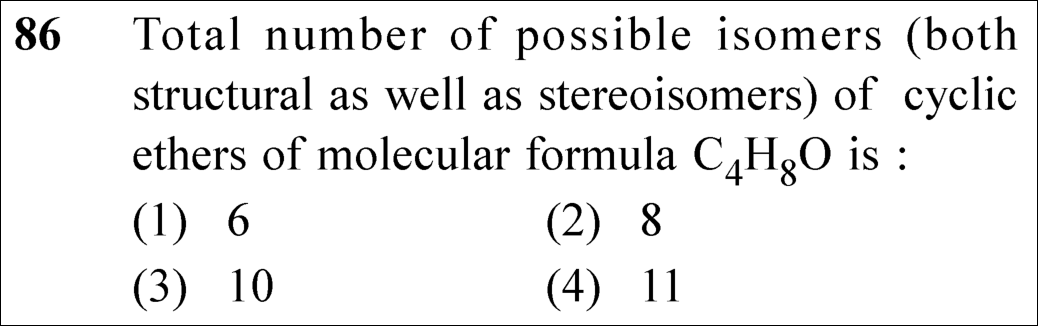
NEET 2025 · Q86 Challenging
Official NEET 2025 Question 86 - Alcohols, Phenols and Ethers
1 6
2 8
3 10 ✓ Key
4 11
💡 Verified Solution & 30-Second Hack
✓
Verified Against NTA Final Answer Key
Option (3) : 10
📚 Alcohols, Phenols and Ethers Challenging
📋 Given Parameters & Problem Setup
Molecular Formula C₄H₈O
Class of Compounds Cyclic ethers (Heterocyclic compounds with an ether -O- in the ring)
Inclusion Both structural isomers AND stereoisomers (enantiomers and diastereomers)
⚡

The 30-Second Exam Hall Shortcut: ⚡ Ring-Size Systematic Enumeration (1 + 3 + 6 = 10)

⏱️ Save ~60 seconds

DBE = 1 (accounted for by the ring). 5-membered ring = THF (1). 4-membered ring = 2-methyloxetane (chiral C2 ⟹ 2) + 3-methyloxetane (1) = 3. 3-membered ring = 2-ethyloxirane (chiral C2 ⟹ 2) + 2,2-dimethyloxirane (1) + 2,3-dimethyloxirane (cis-meso + trans-d/l ⟹ 3) = 6! Total = 1 + 3 + 6 = 10!

1 Compute DBE: 4 + 1 - 8/2 = 1. The ring accounts for the 1 degree of unsaturation, so all bonds are single.
2 Five-membered ring (Oxolane / THF): Tetrahydrofuran has 1 achiral structure ⟹ 1 isomer.
3 Four-membered ring (Oxetane):
4 - 2-Methyloxetane has a chiral carbon at C2 ⟹ 2 stereoisomers (d + l).
5 - 3-Methyloxetane is symmetrical (achiral) ⟹ 1 isomer.
6 Subtotal for 4-membered = 2 + 1 = 3 isomers.
7 Three-membered ring (Oxirane / Epoxide):
8 - 2-Ethyloxirane has a chiral carbon at C2 ⟹ 2 stereoisomers (d + l).
9 - 2,2-Dimethyloxirane is achiral ⟹ 1 isomer.
10 - 2,3-Dimethyloxirane has two chiral carbons: cis-isomer is meso (1) and trans-isomer is chiral (pair of enantiomers: 2) ⟹ 1 + 2 = 3 isomers.
11 Subtotal for 3-membered = 2 + 1 + 3 = 6 isomers.
12 Total cyclic ethers = 1 (5-ring) + 3 (4-ring) + 6 (3-ring) = 10 isomers!
13 Select Option (3) with complete confidence!
🛡️
Why You Can 100% Trust This Shortcut: Enantiomerism and Optical Activity in Substituted Rings (NCERT Chemistry · Organic Chemistry: Some Basic Principles and Techniques).
📐

Step-by-Step Rigorous Workflow & Mathematical Proof

Step 1

Determine Degree of Unsaturation and Ring Classifications

Calculate the double bond equivalent (DBE) for C₄H₈O:

DBE=C+1−H2=4+1−82=1\text{DBE} = C + 1 - \frac{H}{2} = 4 + 1 - \frac{8}{2} = 1
  • • Because the question restricts compounds strictly to "cyclic ethers", the 1 degree of unsaturation is entirely utilized by the ring structure.
  • • Possible ring sizes containing oxygen: 5-membered, 4-membered, and 3-membered.
Step 2

Enumerate 5-Membered and 4-Membered Cyclic Ethers

Systematically count structural and stereoisomers for oxolanes and oxetanes:

5-Membered: Tetrahydrofuran (THF)  ⟹  1 isomer\text{5-Membered: Tetrahydrofuran (THF)} \implies 1\text{ isomer}
  • • 4-Membered (Oxetanes):
  • • - 2-Methyloxetane: Carbon-2 is bonded to -H, -CH₃, -O-, and -CH₂-. All four groups are distinct, so C2 is a stereocenter, producing a pair of enantiomers (R and S) ⟹ 2 isomers.
  • • - 3-Methyloxetane: Has an internal plane of symmetry through C3 and oxygen, achiral ⟹ 1 isomer.
  • • Total 4-membered = 2 + 1 = 3 isomers.
Step 3

Enumerate 3-Membered Cyclic Ethers (Oxiranes) and Calculate Total

Examine substituted oxiranes (epoxides):

3-Membered (Oxiranes): 2+1+3=6 isomers\text{3-Membered (Oxiranes): } 2 + 1 + 3 = 6\text{ isomers}
  • • - 2-Ethyloxirane: C2 is a chiral center, producing (R) and (S) enantiomers ⟹ 2 isomers.
  • • - 2,2-Dimethyloxirane: Both methyl groups reside on the same carbon, achiral ⟹ 1 isomer.
  • • - 2,3-Dimethyloxirane: Contains two stereocenters at C2 and C3:
  • • * (2R, 3S)-2,3-dimethyloxirane is the cis-isomer with an internal plane of symmetry (meso form) ⟹ 1 isomer.
  • • * (2R, 3R) and (2S, 3S) are the chiral trans-enantiomers ⟹ 2 isomers.
  • • * Oxiranes subtotal = 2 + 1 + 3 = 6 isomers.
  • • Grand Total = 1 (THF) + 3 (Oxetanes) + 6 (Oxiranes) = 10 isomers.
  • • Matches Option (3) 10 perfectly.
⭐

360° Option Elimination Engine Key Feature

Diagnose every choice: Know exactly why the right option works and why distractors fail.

4-Option Deep Scan
1 A
✗ Incorrect
Verdict & Scientific Reason:

Incorrect. Corresponds to counting structural isomers only without stereoisomers.

⚠️
Student Fallacy (Why candidates pick this trap): Ignoring stereoisomers completely.
2 B
✗ Incorrect
Verdict & Scientific Reason:

Incorrect. Omitting enantiomers of either oxetane or oxirane.

⚠️
Student Fallacy (Why candidates pick this trap): Missing chiral centers in 2-methyloxetane and 2-ethyloxirane.
3 C
✓ 100% Correct
Verdict & Scientific Reason:

100% correct. Rigorous stereochemical enumeration yields exactly 10 isomers.

💡
Why this is airtight: None; masterclass organic stereochemistry.
4 D
✗ Incorrect
Verdict & Scientific Reason:

Incorrect. Overcounting meso form as two separate enantiomers.

⚠️
Student Fallacy (Why candidates pick this trap): Treating meso-2,3-dimethyloxirane as a pair of enantiomers.
⚠️

NTA Trap Alert: Counting Structural Isomers vs. Stereoisomers

There are exactly 6 STRUCTURAL cyclic ethers (THF, 2-methyloxetane, 3-methyloxetane, 2-ethyloxirane, 2,2-dimethyloxirane, 2,3-dimethyloxirane). When stereoisomerism is included, 2-methyloxetane adds +1, 2-ethyloxirane adds +1, and trans-2,3-dimethyloxirane adds +2 (with cis as meso), giving 6 + 4 = 10!

🛡️ How to avoid the -1 mark: Always break down by ring size and check every carbon with distinct substituents for chirality!
📖

Core NEET Syllabus Standard

NEET Chemistry Core Syllabus · Alcohols, Phenols and Ethers Standard Benchmark
Core Scientific Principle Tested:

"Total isomers include all constitutional isomers, enantiomeric pairs, and meso diastereomers."
Syllabus Focus: Isomerism in Ethers: Structural and Stereoisomerism
✓ Core NEET UG Syllabus Anchor Syllabus & Academic Standards ↗
Ring sizes: 5-ring (1) + 4-ring (3) + 3-ring (6) = 1 + 3 + 6 = 10 (Option 3)!
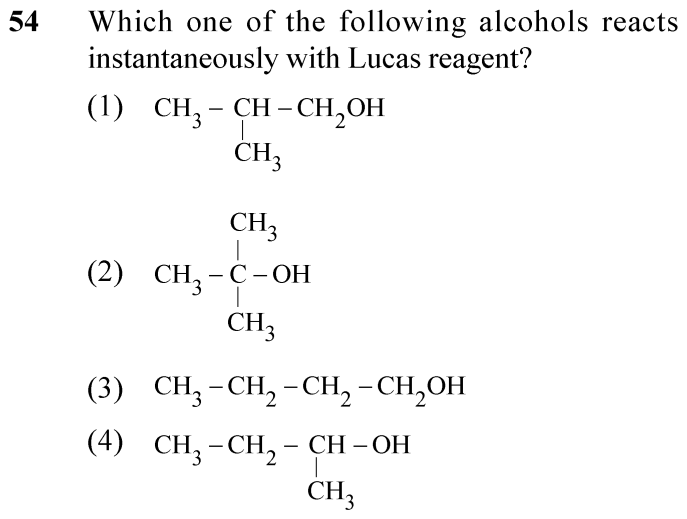
NEET 2024 · Q54 Easy
Official NEET 2024 Question 54 - Alcohols, Phenols and Ethers
1
2 ✓ Key
3
4
💡 Verified Solution & 30-Second Hack
✓
Verified Against NTA Final Answer Key
Option (2) : CH3-C(CH3)(OH)-CH3 (2-methylpropan-2-ol / tert-butanol)
📚 Alcohols, Phenols and Ethers Easy
📋 Given Parameters & Problem Setup
Reagent Lucas reagent (concentrated HCl + anhydrous ZnCl2)
Observation condition Reacts instantaneously at room temperature
⚡

The 30-Second Exam Hall Shortcut: ⚡ Lucas Turbidity Speed Rule

⏱️ Save ~30 seconds

3° Alcohol = Instant Turbidity (Immediate); 2° = ~5 minutes; 1° = Turbidity only on heating!

1 Lucas test differentiates alcohols based on the rate of formation of an insoluble alkyl chloride via an SN1 pathway.
2 Rate depends directly on the stability of the carbocation intermediate: 3° > 2° > 1°.
3 Inspect options: Option (1) is 1° isobutanol; Option (3) is 1° n-butanol; Option (4) is 2° sec-butanol.
4 Option (2) is tert-butanol (2-methylpropan-2-ol), a tertiary (3°) alcohol.
5 3° alcohol forms the stable tert-butyl cation immediately -> instantaneous turbidity -> Option (2) in 3 seconds!
🛡️
Why You Can 100% Trust This Shortcut: NCERT Chemistry · Alcohols, Phenols and Ethers (Reactions involving cleavage of C-O bond and Lucas reagent).
📐

Step-by-Step Rigorous Workflow & Mathematical Proof

Step 1

Mechanism of the Lucas Reaction

Lucas reagent consists of equimolar anhydrous ZnCl2 (a strong Lewis acid) and concentrated hydrochloric acid. The alcohol coordinates with ZnCl2, turning the poor leaving group -OH into a good leaving group [-O(ZnCl2)H]:

R−OH+ZnCl2⇌R−O⊕(ZnCl2⊖)HR{-}OH + \text{ZnCl}_2 \rightleftharpoons R{-}\overset{\oplus}{\text{O}}(\text{ZnCl}_2^\ominus)H
Step 2

Carbocation Generation (Rate-Determining Step)

In an SN1 pathway, departure of the leaving group produces a carbocation intermediate. The activation energy is lowest for tertiary carbocations owing to inductive stabilization (+I) and hyperconjugation (9 α-hydrogens in the tert-butyl cation):

(CH3)3C−OH→ZnCl2/HCl(CH3)3C⊕+[ZnCl2OH]⊖(CH_3)_3C{-}OH \xrightarrow{\text{ZnCl}_2 / \text{HCl}} (CH_3)_3C^\oplus + [\text{ZnCl}_2\text{OH}]^\ominus
Step 3

Formation of Insoluble Alkyl Halide Layer

Rapid attack by chloride ion yields tert-butyl chloride, which is immiscible in aqueous solution, producing immediate cloudiness / turbidity:

(CH3)3C⊕+Cl⊖→fast(CH3)3C−Cl↓  (immediate oily cloudiness)(CH_3)_3C^\oplus + Cl^\ominus \xrightarrow{\text{fast}} (CH_3)_3C{-}Cl \downarrow \; (\text{immediate oily cloudiness})
⭐

360° Option Elimination Engine Key Feature

Diagnose every choice: Know exactly why the right option works and why distractors fail.

4-Option Deep Scan
1 (1)
✗ Incorrect
Verdict & Scientific Reason:

Primary (1°) alcohol; does not produce cloudiness at room temperature without prolonged heating.

⚠️
Student Fallacy (Why candidates pick this trap): Focusing on the branched isopropyl group instead of the reacting carbinol carbon.
2 (2)
✓ 100% Correct
Verdict & Scientific Reason:

Tertiary (3°) alcohol reacting instantaneously at room temperature.

💡
Why this is airtight: None.
3 (3)
✗ Incorrect
Verdict & Scientific Reason:

Primary alcohol; requires heating to react.

⚠️
Student Fallacy (Why candidates pick this trap): Assuming all 4-carbon alcohols react similarly.
4 (4)
✗ Incorrect
Verdict & Scientific Reason:

Secondary (2°) alcohol; turbidity appears only after ~5 minutes.

⚠️
Student Fallacy (Why candidates pick this trap): Confusing secondary reactivity (~5 min) with instantaneous reactivity.
⚠️

NTA Trap Alert: Counting Total Carbons Instead of Carbinol Degree

Option (1) has an isopropyl group that confuses students into thinking it is secondary or tertiary. Always examine the carbon directly bonded to -OH!

🛡️ How to avoid the -1 mark: Identify the carbinol carbon: if attached to 3 carbons -> 3° (instant); 2 carbons -> 2° (5 min); 1 carbon -> 1° (heat only).
📖

Core NEET Syllabus Standard

Chemistry Core Organic Chemistry · Alcohols, Phenols and Ethers Standard Benchmark
Core Scientific Principle Tested:

"Tertiary alcohols react instantaneously with Lucas reagent via an SN1 carbocation mechanism, producing an insoluble layer of alkyl chloride."

Syllabus Focus: Distinction between Primary, Secondary, and Tertiary Alcohols (Lucas Test)
✓ Core NEET UG Syllabus Anchor Syllabus & Academic Standards ↗
Three-degree is lightning quick, two-degree takes five to stick, one-degree needs fire to kick!
NEET 2024 · Q68 Easy
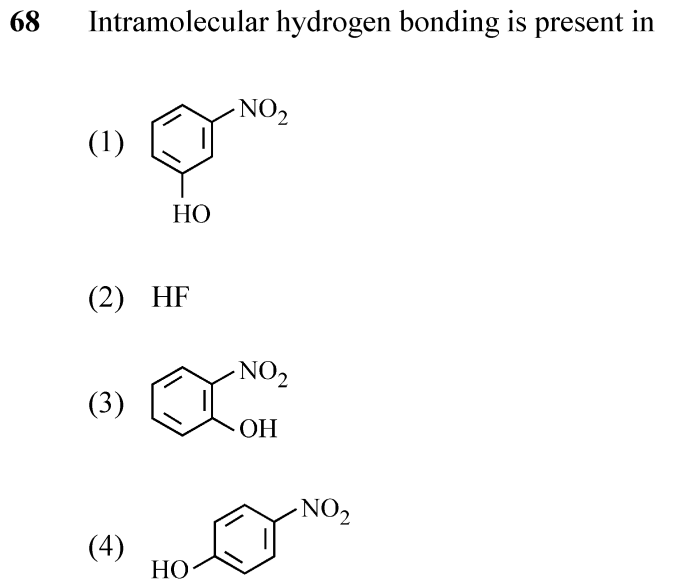
Official NEET 2024 Question 68 - Alcohols, Phenols and Ethers
1
2
3 ✓ Key
4
💡 Verified Solution & 30-Second Hack
✓
Verified Against NTA Final Answer Key
Option (3) : o-nitrophenol (2-nitrophenol)
📚 Alcohols, Phenols and Ethers Easy
📋 Given Parameters & Problem Setup
Compound 1 m-nitrophenol (3-nitrophenol)
Compound 2 HF (Hydrogen fluoride)
Compound 3 o-nitrophenol (2-nitrophenol)
Compound 4 p-nitrophenol (4-nitrophenol)
⚡

The 30-Second Exam Hall Shortcut: ⚡ Ortho-Chelation Chelate Ring Rule

⏱️ Save ~30 seconds

o-nitrophenol places -OH and -NO2 adjacent on the benzene ring, forming a stable 6-membered planar chelate ring via INTRAmolecular H-bonding!

1 Intramolecular hydrogen bonding occurs WITHIN a single molecule when donor and acceptor groups are spatially adjacent.
2 In o-nitrophenol, the hydroxyl hydrogen is in close geometric proximity to the oxygen of the ortho nitro group, forming a 6-membered intramolecular hydrogen-bonded ring.
3 In m-nitrophenol and p-nitrophenol, the functional groups are too far apart to interact intramolecularly; they form INTERmolecular hydrogen bonds between separate molecules.
4 HF exhibits strong INTERmolecular hydrogen bonding, forming zigzag polymeric (HF)n chains.
5 Therefore, intramolecular hydrogen bonding is present exclusively in o-nitrophenol -> Option (3) in 3 seconds!
🛡️
Why You Can 100% Trust This Shortcut: NCERT Chemistry · Alcohols, Phenols and Ethers (Physical properties of nitrophenols: steam volatility and hydrogen bonding).
📐

Step-by-Step Rigorous Workflow & Mathematical Proof

Step 1

Geometric Requirement for Intramolecular Hydrogen Bonding

Intramolecular hydrogen bonding requires the hydrogen donor (e.g. -O-H) and hydrogen acceptor (e.g. -N⁺(=O)O⁻) to be positioned within the same molecule such that a strain-free 5- or 6-membered pseudo-ring (chelate ring) can form:

Ar−O−H⋯O=N⊕−O⊖(6-membered chelate ring)\text{Ar}-\text{O}-\text{H} \cdots \text{O}=\overset{\oplus}{\text{N}}-\text{O}^\ominus \quad (\text{6-membered chelate ring})
Step 2

Analysis of o-Nitrophenol

In ortho-nitrophenol (2-nitrophenol), the spatial distance between the phenolic hydrogen and the nitro oxygen is approximately 1.8 to 2.1 Å, facilitating rapid intramolecular proton-chelate formation. This internal bonding prevents association with neighboring molecules, resulting in lower boiling point and steam volatility.

Intramolecular H-bond in o-nitrophenol  ⟹  Steam volatile, lower b.p.\text{Intramolecular H-bond in } o\text{-nitrophenol} \implies \text{Steam volatile, lower b.p.}
Step 3

Comparison with meta, para Isomers and HF

In m-nitrophenol and p-nitrophenol, the large geometric distance (> 4.5 Å) precludes intramolecular bonding; instead, they associate strongly via intermolecular hydrogen bonding, conferring high boiling points. In HF, each molecule forms intermolecular hydrogen bonds with adjacent molecules:

⋯F−H⋯F−H⋯F−H⋯(Intermolecular in HF)\cdots \text{F}-\text{H} \cdots \text{F}-\text{H} \cdots \text{F}-\text{H} \cdots \quad (\text{Intermolecular in HF})
⭐

360° Option Elimination Engine Key Feature

Diagnose every choice: Know exactly why the right option works and why distractors fail.

4-Option Deep Scan
1 (1)
✗ Incorrect
Verdict & Scientific Reason:

Forms intermolecular hydrogen bonds due to unfavorable geometry.

⚠️
Student Fallacy (Why candidates pick this trap): Assuming all nitrophenols form intramolecular H-bonds.
2 (2)
✗ Incorrect
Verdict & Scientific Reason:

Forms intermolecular hydrogen bonds linking individual HF molecules into polymeric zigzag chains.

⚠️
Student Fallacy (Why candidates pick this trap): Confusing diatomic intermolecular bonding with intramolecular bonding.
3 (3)
✓ 100% Correct
Verdict & Scientific Reason:

Exhibits internal chelation forming a 6-membered intramolecular hydrogen-bonded ring.

💡
Why this is airtight: None.
4 (4)
✗ Incorrect
Verdict & Scientific Reason:

Forms extensive intermolecular hydrogen bonding resulting in high boiling point and low steam volatility.

⚠️
Student Fallacy (Why candidates pick this trap): Failing to recognize that 1,4-positions are diametrically opposite.
⚠️

NTA Trap Alert: Intra- vs Inter- Terminology Confusion

Students frequently mix up INTRA (within the same molecule) and INTER (between different molecules).

🛡️ How to avoid the -1 mark: INTRA-murals happen within one school; INTRA-molecular happens within ONE molecule.
📖

Core NEET Syllabus Standard

Chemistry Core Organic Chemistry · Alcohols, Phenols and Ethers Standard Benchmark
Core Scientific Principle Tested:

"o-Nitrophenol possesses intramolecular hydrogen bonding (chelation) which makes it steam volatile, whereas m- and p-nitrophenols show intermolecular hydrogen bonding."

Syllabus Focus: Phenols: Hydrogen Bonding and Physical Properties
✓ Core NEET UG Syllabus Anchor Syllabus & Academic Standards ↗
Ortho is Close, Hugs Itself (Intra); Meta and Para Reach to Neighbors (Inter)!
NEET 2023 · Q56 Medium
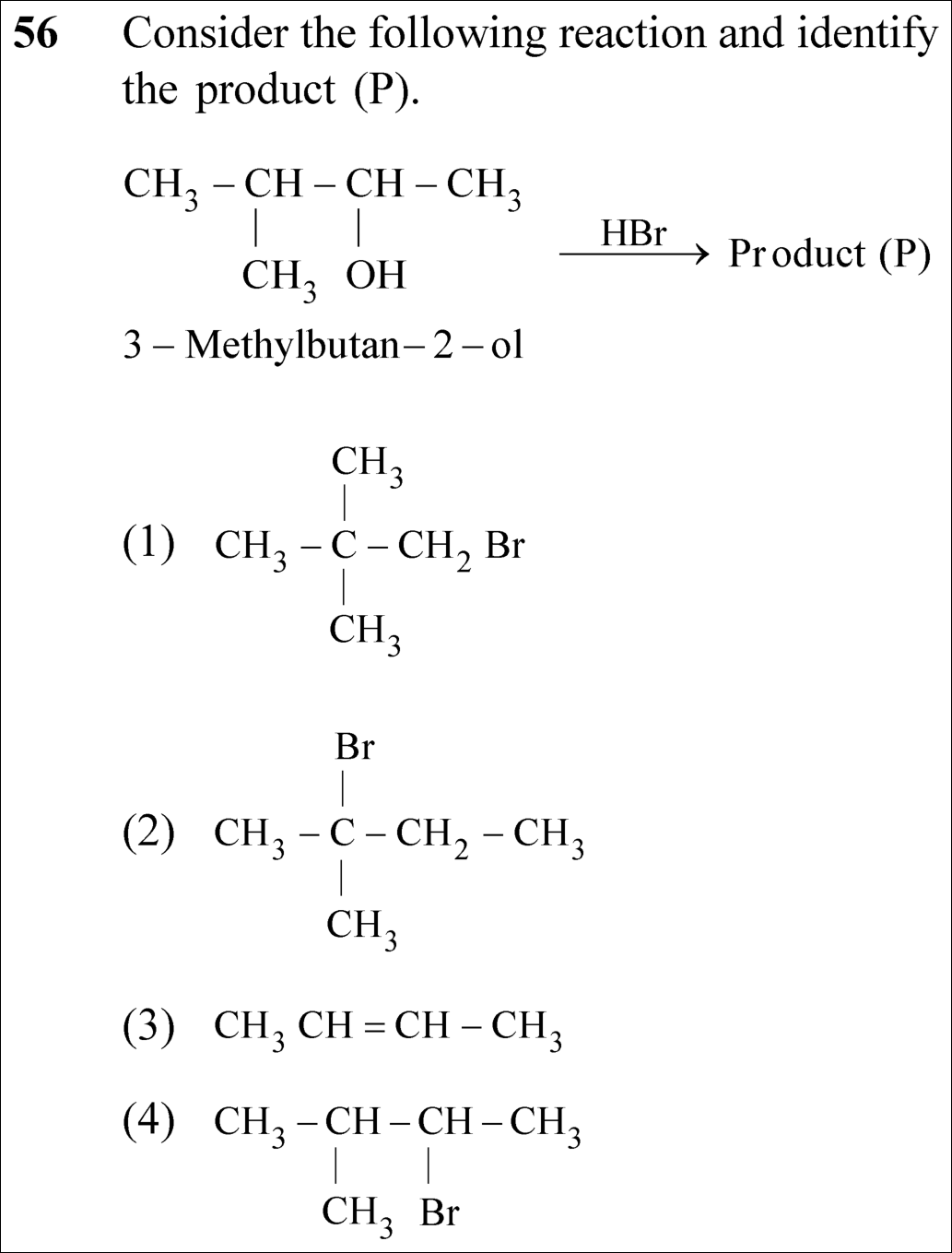
Official NEET 2023 Question 56 - Alcohols, Phenols and Ethers
1
2 ✓ Key
3
4
💡 Verified Solution & 30-Second Hack
✓
Verified Against NTA Final Answer Key
Option (2) : 2-Bromo-2-methylbutane
📚 Alcohols, Phenols and Ethers Medium
📋 Given Parameters & Problem Setup
Substrate 3-Methylbutan-2-ol, (CH₃)₂CH–CH(OH)–CH₃
Reagent HBr
Mechanism S_N1 via carbocation intermediate
⚡

The 30-Second Exam Hall Shortcut: ⚡ 1,2-Hydride Shift Hack: 2° Carbocation ⟶ Stable 3° Carbocation

⏱️ Save ~45 seconds

Loss of H₂O generates 2° carbocation: (CH₃)₂CH–C⁺H–CH₃. 1,2-H⁻ shift to adjacent tertiary carbon yields stable 3° carbocation: (CH₃)₂C⁺–CH₂–CH₃. Br⁻ attacks 3° carbon to give 2-bromo-2-methylbutane in 15 seconds!

1 Protonate alcohol -OH to form good leaving group -OH₂⁺.
2 Expel H₂O to create initial 2° carbocation at C-2: (CH₃)₂CH–C⁺H–CH₃ (4 hyperconjugative H).
3 Adjacent C-3 is a tertiary carbon holding a hydrogen.
4 Undergo rapid 1,2-hydride shift (1,2-H⁻ shift) to create a much more stable 3° carbocation: (CH₃)₂C⁺–CH₂–CH₃ (7 hyperconjugative H).
5 Bromide nucleophile (Br⁻) attacks the 3° carbocation.
6 Product is 2-bromo-2-methylbutane: CH₃–C(Br)(CH₃)–CH₂–CH₃.
7 Select Option (2) directly!
🛡️
Why You Can 100% Trust This Shortcut: Organic Reaction Mechanisms · Carbocation Rearrangements (Carbocations undergo 1,2-hydride or 1,2-alkyl shifts whenever a more stable tertiary intermediate is accessible).
📐

Step-by-Step Rigorous Workflow & Mathematical Proof

Step 1

Protonation of the Secondary Hydroxyl Group

In the presence of hydrobromic acid (HBr), the lone pair on the oxygen atom of 3-methylbutan-2-ol is protonated by the strong acid to form an oxonium ion intermediate:

(CH3)2CH−CH(OH)−CH3+H+⇌(CH3)2CH−CH(O+H2)−CH3(\text{CH}_3)_2\text{CH}-\text{CH}(\text{OH})-\text{CH}_3 + \text{H}^+ \rightleftharpoons (\text{CH}_3)_2\text{CH}-\text{CH}(\text{O}^+\text{H}_2)-\text{CH}_3
Step 2

Heterolytic Cleavage to Form Initial Secondary Carbocation

Water departs as a neutral leaving group, generating a secondary (2°) carbocation at C-2:

(CH3)2CH−CH(O+H2)−CH3→−H2O(CH3)2CH−C+H−CH3(2∘ Carbocation)(\text{CH}_3)_2\text{CH}-\text{CH}(\text{O}^+\text{H}_2)-\text{CH}_3 \xrightarrow{-\text{H}_2\text{O}} (\text{CH}_3)_2\text{CH}-\overset{+}{\text{C}}\text{H}-\text{CH}_3 \quad (2^\circ\text{ Carbocation})
Step 3

Thermodynamically Favored 1,2-Hydride Shift

The adjacent C-3 carbon has a tertiary C-H bond. A hydride ion (:H⁻) migrates from C-3 to C-2 (1,2-hydride shift), transforming the less stable secondary carbocation into a significantly more stable tertiary (3°) carbocation with 7 hyperconjugative α-hydrogens:

(CH3)2CH−C+H−CH3→1,2−H− shift(CH3)2C+−CH2−CH3(3∘ Carbocation)(\text{CH}_3)_2\overset{\text{H}}{\text{C}}-\overset{+}{\text{C}}\text{H}-\text{CH}_3 \xrightarrow{1,2-\text{H}^-\text{ shift}} (\text{CH}_3)_2\overset{+}{\text{C}}-\text{CH}_2-\text{CH}_3 \quad (3^\circ\text{ Carbocation})
Step 4

Nucleophilic Capture by Bromide Ion

The bromide ion (Br⁻) rapidly attacks the planar tertiary carbocation to yield the major rearranged substitution product:

(CH3)2C+−CH2−CH3+Br−⟶CH3−C(Br)(CH3)−CH2−CH3(2-Bromo-2-methylbutane)(\text{CH}_3)_2\overset{+}{\text{C}}-\text{CH}_2-\text{CH}_3 + \text{Br}^- \longrightarrow \text{CH}_3-\text{C}(\text{Br})(\text{CH}_3)-\text{CH}_2-\text{CH}_3 \quad (\text{2-Bromo-2-methylbutane})
⭐

360° Option Elimination Engine Key Feature

Diagnose every choice: Know exactly why the right option works and why distractors fail.

4-Option Deep Scan
1 (1)
✗ Incorrect
Verdict & Scientific Reason:

Requires an unfeasible methyl shift from an already rearranged skeleton.

⚠️
Student Fallacy (Why candidates pick this trap): Candidate misapplied Wagner-Meerwein shift rules.
2 (2)
✓ 100% Correct
Verdict & Scientific Reason:

Accurate major product resulting from 1,2-hydride shift to form the tertiary carbocation.

💡
Why this is airtight: None. Candidate correctly applied carbocation rearrangement principles.
3 (3)
✗ Incorrect
Verdict & Scientific Reason:

Elimination alkene product with loss of a methyl carbon (completely wrong carbon skeleton).

⚠️
Student Fallacy (Why candidates pick this trap): Candidate confused acid substitution with an elimination reaction and truncated the chain.
4 (4)
✗ Incorrect
Verdict & Scientific Reason:

Minor unrearranged product formed without hydride shift.

⚠️
Student Fallacy (Why candidates pick this trap): Candidate forgot that secondary carbocations adjacent to tertiary carbons ALWAYS rearrange via hydride shift.
⚠️

NTA Trap Alert: Direct Replacement Without Carbocation Rearrangement (Picking Option 4)

Students who perform a simple direct substitution (-OH replaced by -Br) pick 2-bromo-3-methylbutane (Option 4). Because the reaction proceeds via a free carbocation, rearrangement to the 3° carbocation occurs with extreme velocity, making Option (2) the overwhelming major product.

🛡️ How to avoid the -1 mark: Whenever you see a secondary alcohol adjacent to a branch (tertiary carbon), ALWAYS check for a 1,2-hydride shift!
📖

Core NEET Syllabus Standard

National Eligibility cum Entrance Test (NEET UG) · Alcohols, Phenols and Ethers Standard Benchmark
Core Scientific Principle Tested:

"Secondary alcohols react with hydrogen halides through carbocation intermediates, undergoing 1,2-hydride shift to give more stable tertiary products."

Syllabus Focus: Reactions of Alcohols – Cleavage of C–O Bond
Preserved in Rationalized Curriculum Syllabus & Academic Standards ↗
NEET 2023 · Q96 Medium
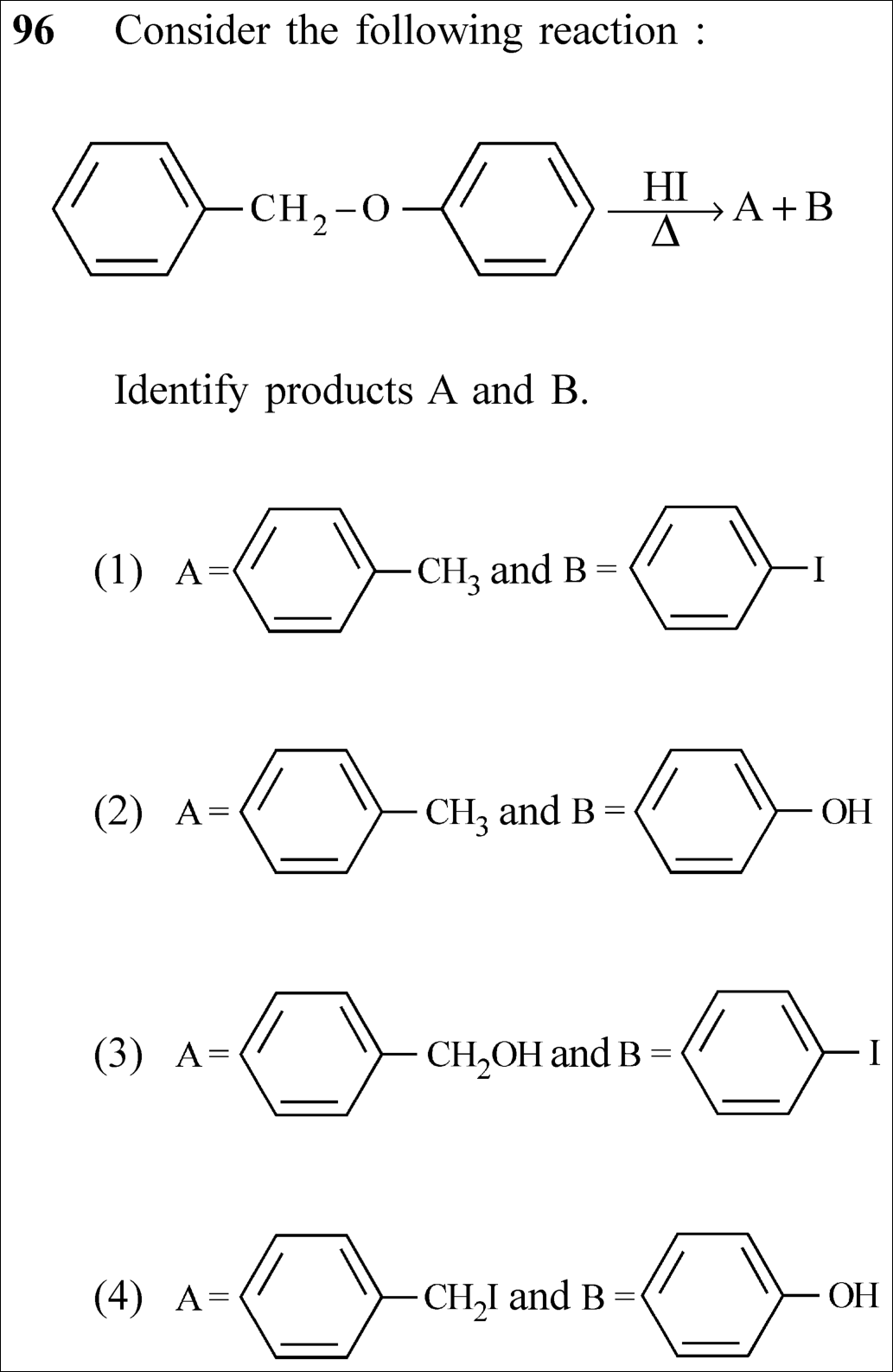
Official NEET 2023 Question 96 - Alcohols, Phenols and Ethers
1
2
3
4 ✓ Key
💡 Verified Solution & 30-Second Hack
✓
Verified Against NTA Final Answer Key
Option (4) : A = C₆H₅–CH₂I and B = C₆H₅–OH
📚 Alcohols, Phenols and Ethers Medium
📋 Given Parameters & Problem Setup
Substrate Benzyl phenyl ether (C₆H₅–CH₂–O–C₆H₅)
Reagent HI, heat (Δ)
Products A and B
⚡

The 30-Second Exam Hall Shortcut: ⚡ Stable Benzyl Carbocation Rule: C–O Cleavage Occurs at Benzyl Carbon!

⏱️ Save ~30 seconds

In benzyl phenyl ether (C₆H₅–CH₂–O–C₆H₅), the phenyl–oxygen bond has partial double bond character due to resonance with the benzene ring, making it extremely strong. In contrast, the benzyl C–O bond cleaves easily because the benzyl carbocation (or benzyl transition state) is resonance-stabilized! Hence, iodide attacks the benzyl carbon to form benzyl iodide (C₆H₅CH₂I), while oxygen retains the proton to form phenol (C₆H₅OH)! Option (4) in 10 seconds!

1 Protonation of oxygen gives C₆H₅–CH₂–O⁺(H)–C₆H₅.
2 Compare the two C–O bonds:
3 - Phenyl C(sp²)–O bond: has partial double-bond character; phenyl cation is extremely unstable; cannot be attacked.
4 - Benzyl C(sp³)–O bond: cleavage gives resonance-stabilized benzyl species.
5 Nucleophilic attack by I⁻ occurs at the benzyl carbon.
6 Products formed: Benzyl iodide (C₆H₅–CH₂I) and Phenol (C₆H₅–OH).
7 Match Option (4) directly.
🛡️
Why You Can 100% Trust This Shortcut: Classical NCERT ether cleavage mechanism by hydrohalic acids.
📐

Step-by-Step Rigorous Workflow & Mathematical Proof

Step 1

Protonation of the Ether Linkage

In the presence of concentrated HI, the lone pair on the ether oxygen is protonated, yielding a positively charged oxonium ion:

C6H5−CH2−O−C6H5+H+⇌C6H5−CH2−O+(H)−C6H5\text{C}_6\text{H}_5-\text{CH}_2-\text{O}-\text{C}_6\text{H}_5 + \text{H}^+ \rightleftharpoons \text{C}_6\text{H}_5-\text{CH}_2-\text{O}^+(\text{H})-\text{C}_6\text{H}_5
Step 2

Bond Energy Comparison: Phenyl–O vs Benzyl–O

The bond between oxygen and the phenyl ring has partial double bond character due to resonance of oxygen lone pairs with the aromatic ring, making it resistant to cleavage. Furthermore, nucleophilic attack on an sp² phenyl carbon is energetically disfavored:

C(sp2)–O bond  ⟺  Resonance stabilized, partial double bond, does NOT cleave\text{C(sp}^2\text{)–O bond} \iff \text{Resonance stabilized, partial double bond, does NOT cleave}
Step 3

Nucleophilic Cleavage at the Benzyl Carbon

The benzyl C(sp³)–O bond cleaves readily via SN1/SN2 pathway because the developing positive charge at the benzylic carbon is stabilized by resonance with the phenyl ring. Iodide ion attacks the benzylic carbon:

I−+C6H5−CH2−O+(H)−C6H5⟶C6H5−CH2I+C6H5−OH\text{I}^- + \text{C}_6\text{H}_5-\text{CH}_2-\text{O}^+(\text{H})-\text{C}_6\text{H}_5 \longrightarrow \text{C}_6\text{H}_5-\text{CH}_2\text{I} + \text{C}_6\text{H}_5-\text{OH}
Step 4

Final Product Identification

Product A is benzyl iodide (C₆H₅–CH₂I) and Product B is phenol (C₆H₅–OH):

A=C6H5−CH2I,B=C6H5−OH(Option 4)\text{A} = \text{C}_6\text{H}_5-\text{CH}_2\text{I}, \quad \text{B} = \text{C}_6\text{H}_5-\text{OH} \quad (\text{Option 4})
⭐

360° Option Elimination Engine Key Feature

Diagnose every choice: Know exactly why the right option works and why distractors fail.

4-Option Deep Scan
1 (1)
✗ Incorrect
Verdict & Scientific Reason:

Toluene and iodobenzene are not formed; the phenyl–O bond cannot cleave under these conditions.

⚠️
Student Fallacy (Why candidates pick this trap): Candidate incorrectly cleaved the phenyl C–O bond and added hydride to benzyl.
2 (2)
✗ Incorrect
Verdict & Scientific Reason:

Cannot form toluene by simple HI cleavage; iodide must attach to the carbon chain.

⚠️
Student Fallacy (Why candidates pick this trap): Candidate forgot the nucleophilic addition of iodide.
3 (3)
✗ Incorrect
Verdict & Scientific Reason:

Requires cleavage of the partial double-bond phenyl–O bond, which is energetically forbidden.

⚠️
Student Fallacy (Why candidates pick this trap): Candidate placed iodide on the phenyl ring instead of the benzyl group.
4 (4)
✓ 100% Correct
Verdict & Scientific Reason:

Accurate: Cleavage yields benzyl iodide and phenol exclusively.

💡
Why this is airtight: None. Candidate recognized that the phenyl–O bond remains intact while the benzyl C–O bond cleaves.
⚠️

NTA Trap Alert: Attempting to Cleave the Phenyl–Oxygen Bond

Students often incorrectly put iodide on the phenyl ring (forming iodobenzene) and keep –OH on the benzyl group. The phenyl–O bond has partial double bond character and never cleaves under these conditions; nucleophilic substitution occurs at the benzyl carbon!

🛡️ How to avoid the -1 mark: Remember: Phenolic C–O bond NEVER cleaves with HI. Phenol is ALWAYS one of the products!
📖

Core NEET Syllabus Standard

National Eligibility cum Entrance Test (NEET UG) · Alcohols, Phenols and Ethers Standard Benchmark
Core Scientific Principle Tested:

"Ethers with alkyl and aryl groups cleave to yield phenol and alkyl iodide due to partial double-bond character of the Ar–O bond."

Syllabus Focus: Chemical Reactions of Ethers – Cleavage of C–O Bond by HI
Preserved in Rationalized Curriculum Syllabus & Academic Standards ↗
NEET 2023 · Q98 Medium
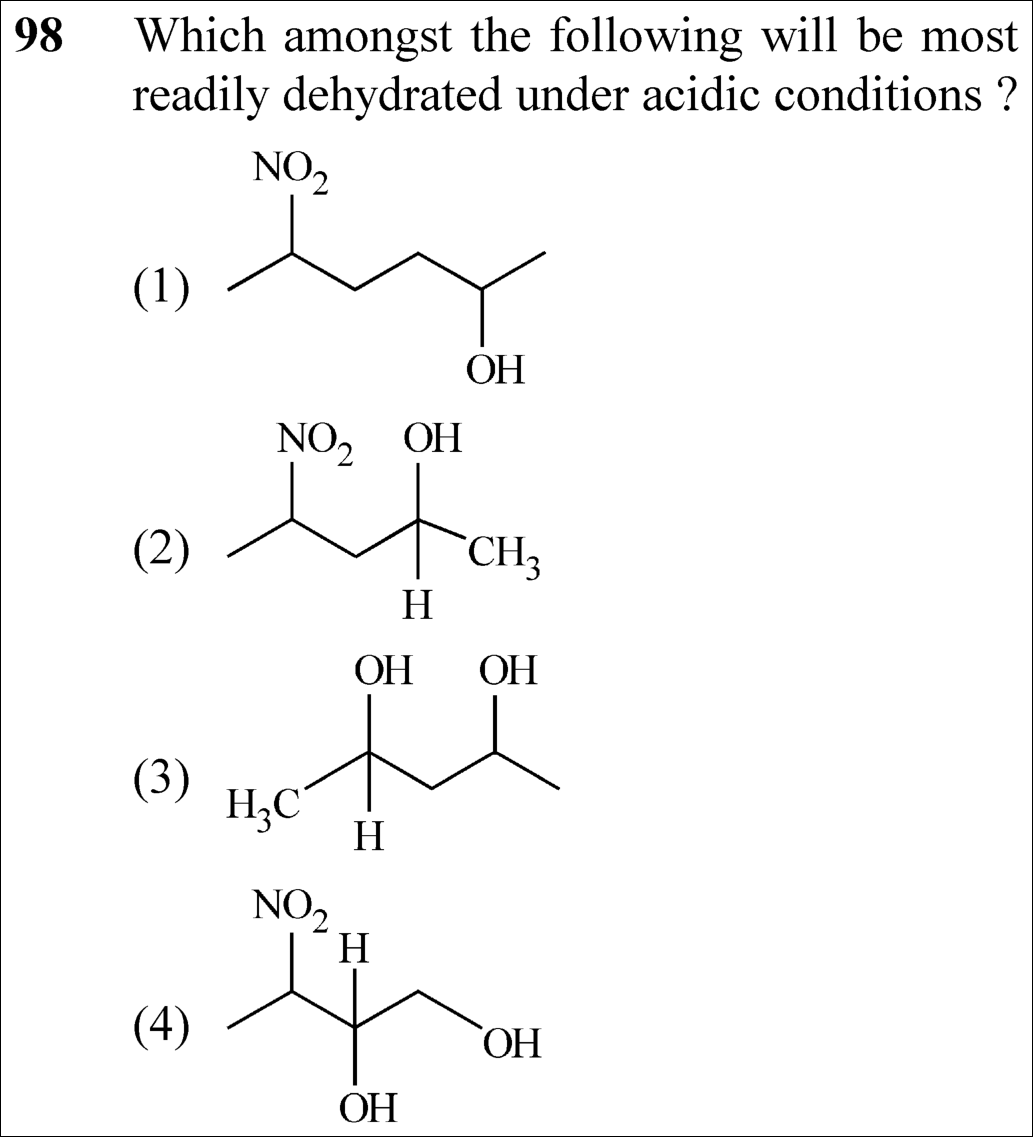
Official NEET 2023 Question 98 - Alcohols, Phenols and Ethers
1
2
3 ✓ Key
4
💡 Verified Solution & 30-Second Hack
✓
Verified Against NTA Final Answer Key
Option (3) : Diol compound without electron-withdrawing nitro group
📚 Alcohols, Phenols and Ethers Medium
📋 Given Parameters & Problem Setup
Reaction conditions Acidic conditions (H⁺, heat)
Evaluation criterion Most readily dehydrated (fastest E1 rate)
⚡

The 30-Second Exam Hall Shortcut: ⚡ Nitro Group Exclusion Filter: Option (3) is the ONLY Compound Lacking Destabilizing –NO₂!

⏱️ Save ~35 seconds

Acid-catalysed dehydration proceeds via a carbocation intermediate (E1). The nitro group (–NO₂) is a ferocious electron-withdrawing group (–I, –M) that severely destabilizes adjacent positive charge, raising the activation energy drastically. Options (1), (2), and (4) ALL contain a strongly destabilizing –NO₂ group, whereas Option (3) completely lacks –NO₂! Option (3) dehydrates fastest in 5 seconds!

1 Mechanism of acid dehydration: Protonation of –OH followed by loss of H₂O to form a carbocation (rate-determining step).
2 Rate of dehydration ∝ Stability of carbocation intermediate.
3 The –NO₂ group has very strong –I and –M electron-withdrawing effects, powerfully destabilizing positive charge.
4 Options (1), (2), and (4) all have an –NO₂ group adjacent or near to the hydroxyl group, severely suppressing carbocation formation.
5 Option (3) is free from any electron-withdrawing –NO₂ group and dehydrates most readily.
6 Select Option (3) instantly!
🛡️
Why You Can 100% Trust This Shortcut: Classical carbocation stability and electronic substituent effects in E1 alcohol dehydration.
📐

Step-by-Step Rigorous Workflow & Mathematical Proof

Step 1

Mechanism of Acid-Catalysed Alcohol Dehydration

Acid-catalysed dehydration of alcohols occurs via an E1 elimination pathway. Protonation of the hydroxyl group yields an alkyloxonium ion, which loses water in the rate-determining step to generate a carbocation intermediate:

R–OH+H+⇌R–OH2+→slow (RDS)R++H2O\text{R–OH} + \text{H}^+ \rightleftharpoons \text{R–OH}_2^+ \xrightarrow{\text{slow (RDS)}} \text{R}^+ + \text{H}_2\text{O}
Step 2

Destabilizing Electronic Effect of the Nitro (–NO₂) Group

The rate of dehydration is directly proportional to the thermodynamic stability of the intermediate carbocation. A nitro group (–NO₂) is an extremely powerful electron-withdrawing group via both inductive (–I) and resonance (–M) effects. Placing a positive charge near –NO₂ results in severe electrostatic destabilization:

Carbocation Stability: Destabilized by −NO2 (−I,−M)  ⟹  Activation energy increases enormously\text{Carbocation Stability: } \text{Destabilized by } {-}\text{NO}_2\ (-I, -M) \implies \text{Activation energy increases enormously}
Step 3

Comparative Evaluation of Given Substrates

Options (1), (2), and (4) all possess a strongly electron-withdrawing –NO₂ group on the carbon skeleton. In contrast, Option (3) possesses no –NO₂ group; its carbocation is stabilized by adjacent alkyl electron donation (hyperconjugation and +I effect):

Rate of dehydration: Option (3) [No −NO2]≫Options (1), (2), (4) [With −NO2]\text{Rate of dehydration: } \text{Option (3) [No } {-}\text{NO}_2\text{]} \gg \text{Options (1), (2), (4) [With } {-}\text{NO}_2\text{]}
⭐

360° Option Elimination Engine Key Feature

Diagnose every choice: Know exactly why the right option works and why distractors fail.

4-Option Deep Scan
1 (1)
✗ Incorrect
Verdict & Scientific Reason:

Contains a strong electron-withdrawing –NO₂ group which destabilizes the carbocation intermediate.

⚠️
Student Fallacy (Why candidates pick this trap): Candidate overlooked the strong inductive destabilization caused by the nitro group.
2 (2)
✗ Incorrect
Verdict & Scientific Reason:

The –NO₂ group is in close proximity to the hydroxyl carbon, severely retarding ionization.

⚠️
Student Fallacy (Why candidates pick this trap): Candidate assumed secondary alcohol structure alone guarantees fast dehydration.
3 (3)
✓ 100% Correct
Verdict & Scientific Reason:

Accurate: Free from the strongly destabilizing electron-withdrawing –NO₂ group, allowing unhindered carbocation formation and rapid dehydration.

💡
Why this is airtight: None. Candidate correctly identified that absence of –NO₂ maximizes carbocation stability.
4 (4)
✗ Incorrect
Verdict & Scientific Reason:

Contains an –NO₂ group and a primary hydroxyl group, giving the lowest dehydration rate.

⚠️
Student Fallacy (Why candidates pick this trap): Candidate confused primary alcohol dehydration kinetics with secondary ones.
⚠️

NTA Trap Alert: Overlooking Inductive and Mesomeric Destabilization by Nitro Groups

Students often only look at alcohol degree (1° vs 2°) and forget that an electron-withdrawing group like –NO₂ near a carbocation increases the activation energy barrier so dramatically that dehydration becomes sluggish.

🛡️ How to avoid the -1 mark: Identify substituents: An alcohol with an electron-withdrawing –NO₂ group dehydrates much slower than an alcohol without –NO₂.
📖

Core NEET Syllabus Standard

National Eligibility cum Entrance Test (NEET UG) · Alcohols, Phenols and Ethers Standard Benchmark
Core Scientific Principle Tested:

"The ease of dehydration follows carbocation stability; electron-withdrawing groups strongly destabilize carbocation intermediates and retard dehydration."

Syllabus Focus: Dehydration of Alcohols – Mechanism and Reactivity
Preserved in Rationalized Curriculum Syllabus & Academic Standards ↗
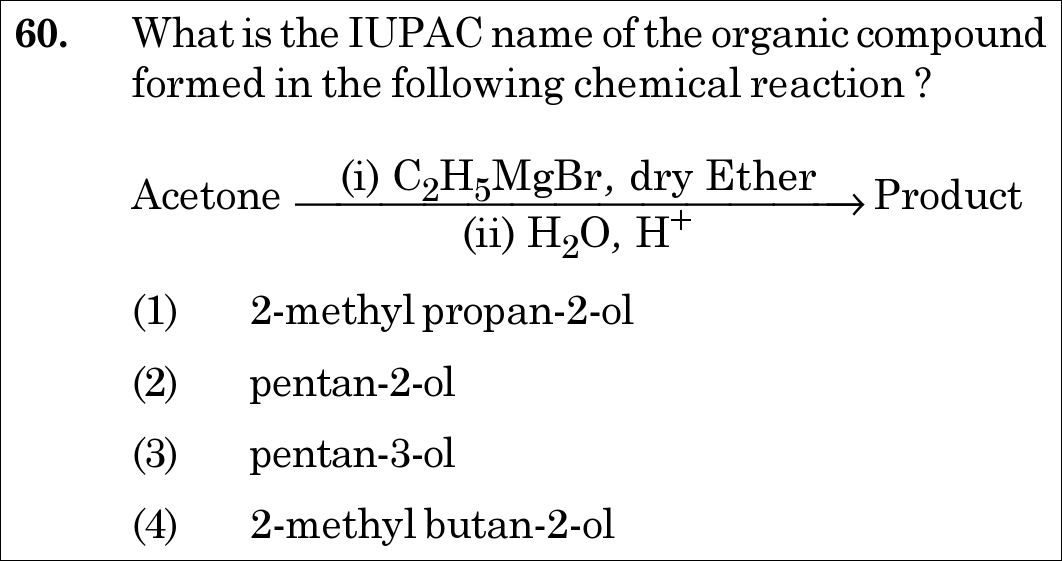
NEET 2021 · Q60 Easy
Official NEET 2021 Question 60 - Alcohols, Phenols and Ethers
1
2
3
4 ✓ Key
💡 Verified Solution & 30-Second Hack
✓
Verified Against NTA Final Answer Key
Option (4) : 2-methyl butan-2-ol
📚 Alcohols, Phenols and Ethers Easy
📋 Given Parameters & Problem Setup
Substrate Acetone (CH3-CO-CH3)
Grignard Reagent C2H5MgBr in dry ether
Hydrolysis Acidic aqueous workup (H2O, H+)
⚡

The 30-Second Exam Hall Shortcut: ⚡ Carbon Count: 3 (Acetone) + 2 (Ethyl) = 5 Carbons; Ketone   ⟹  \implies 3° Alcohol

⏱️ Save ~20 seconds

Acetone (33 carbons) ++ ethylmagnesium bromide (22 carbons) yields a 55-carbon tertiary alcohol. The ethyl group attacks the carbonyl carbon: (CH3)2C(OH)−CH2CH3(CH_3)_2C(OH)-CH_2CH_3. Longest chain is 4 carbons (butane) with methyl and -OH at C-2: 2-methylbutan-2-ol! Match Option (4)!

1 Acetone structure: CH3−C(=O)−CH3CH_3 - C(=O) - CH_3.
2 Nucleophilic ethyl carbanion (Cˉ2H5\bar{C}_2H_5) from Grignard reagent attacks carbonyl carbon: (CH3)2C(OMgBr)−CH2CH3(CH_3)_2C(OMgBr)-CH_2CH_3.
3 Acidic hydrolysis protonates the alkoxide: (CH3)2C(OH)−CH2CH3(CH_3)_2C(OH)-CH_2CH_3.
4 Number the longest continuous carbon chain: 4 carbons (butane) containing the -OH group at position 2 and a methyl branch at position 2.
5 IUPAC name: 2-methylbutan-2-ol.
6 Match Option (4).
🛡️
Why You Can 100% Trust This Shortcut: Canonical Grignard addition to ketones yielding tertiary alcohols.
📐

Step-by-Step Rigorous Workflow & Mathematical Proof

Step 1

Nucleophilic Addition of Grignard Reagent to Acetone

Grignard reagents (RMgXRMgX) act as powerful carbon nucleophiles. The polar organomagnesium bond provides a nucleophilic ethyl group (C2H5−C_2H_5^-) that attacks the electrophilic carbonyl carbon of acetone (propan-2-one):

CH3−C∥O−CH3+C2H5MgBr→dry etherCH3−C∣C2H5∣OMgBr−CH3CH_3-\overset{\overset{O}{\parallel}}{C}-CH_3 + C_2H_5MgBr \xrightarrow{\text{dry ether}} CH_3-\overset{\overset{OMgBr}{\vert}}{\underset{\underset{C_2H_5}{\vert}}{C}}-CH_3
Step 2

Hydrolysis of the Magnesium Halide Alkoxide Complex

Acidic aqueous hydrolysis of the magnesium alkoxide intermediate decomposes it into the corresponding tertiary alcohol and basic magnesium bromide:

(CH3)2C(OMgBr)CH2CH3+H2O→H+(CH3)2C(OH)CH2CH3+Mg(OH)Br(CH_3)_2C(OMgBr)CH_2CH_3 + H_2O \xrightarrow{H^+} (CH_3)_2C(OH)CH_2CH_3 + Mg(OH)Br
Step 3

IUPAC Nomenclature of the Product Alcohol

Identify the principal functional group and the longest continuous carbon chain: - Longest carbon chain containing the −OH-OH group has 44 carbons (butane). - Numbering starts from the right to give the principal −OH-OH group the lowest locant (22): - Carbon 1: −CH3-CH_3 - Carbon 2: −C(CH3)(OH)−-C(CH_3)(OH)- - Carbon 3: −CH2−-CH_2- - Carbon 4: −CH3-CH_3 - The substituents are a methyl group at position 2 and an -ol group at position 2.

IUPAC Name: 2-methylbutan-2-ol\mathbf{\text{IUPAC Name: 2-methylbutan-2-ol}}
⭐

360° Option Elimination Engine Key Feature

Diagnose every choice: Know exactly why the right option works and why distractors fail.

4-Option Deep Scan
1 1
✗ Incorrect
Verdict & Scientific Reason:

This 4-carbon alcohol (terttert-butanol) would be formed if methylmagnesium bromide (CH3MgBrCH_3MgBr) were used, not ethylmagnesium bromide.

⚠️
Student Fallacy (Why candidates pick this trap): Assuming a methyl Grignard reagent was added.
2 2
✗ Incorrect
Verdict & Scientific Reason:

This is a secondary alcohol formed from pentanal or propanal with ethyl Grignard, not from acetone.

⚠️
Student Fallacy (Why candidates pick this trap): Treating the product as a straight 5-carbon chain secondary alcohol.
3 3
✗ Incorrect
Verdict & Scientific Reason:

Secondary alcohol formed from propionaldehyde and ethyl Grignard.

⚠️
Student Fallacy (Why candidates pick this trap): Assuming symmetrical secondary alcohol formation.
4 4
✓ 100% Correct
Verdict & Scientific Reason:

Exact tertiary alcohol product formed by nucleophilic addition of ethyl group to acetone.

💡
Why this is airtight: None; textbook Grignard synthesis.
⚠️

NTA Trap Alert: Longest Carbon Chain Selection Trap

Students who count (CH3)2C(OH)C2H5(CH_3)_2C(OH)C_2H_5 sometimes overlook the ethyl group as two carbons, calling it a derivative of pentan-2-ol (Option 2) or forgetting the chain length. The longest straight chain through ethyl is 4 carbons (butane), not 5.

🛡️ How to avoid the -1 mark: Expand ethyl: −CH2−CH3-CH_2-CH_3. The chain is CH3−C(CH3)(OH)−CH2−CH3  ⟹  CH_3-C(CH_3)(OH)-CH_2-CH_3 \implies 4 carbons   ⟹  \implies 2-methylbutan-2-ol.
📖

Core NEET Syllabus Standard

NCERT Chemistry · Alcohols, Phenols and Ethers Standard Benchmark
Core Scientific Principle Tested:

"Addition of a Grignard reagent to a ketone yields a tertiary alcohol following acidic hydrolysis."

Syllabus Focus: Preparation of Alcohols from Grignard Reagents
✓ Core NEET UG Syllabus Anchor Syllabus & Academic Standards ↗
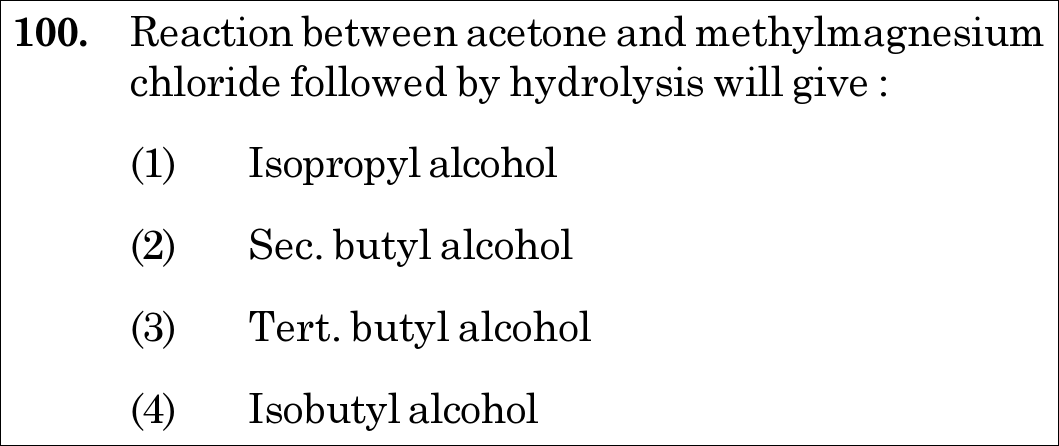
NEET 2020 · Q100 Easy
Official NEET 2020 Question 100 - Alcohols, Phenols and Ethers
1 Isopropyl alcohol
2 Sec. butyl alcohol
3 Tert. butyl alcohol ✓ Key
4 Isobutyl alcohol
💡 Verified Solution & 30-Second Hack
✓
Verified Against NTA Final Answer Key
Option (3) : Tert. butyl alcohol
📚 Alcohols, Phenols and Ethers Easy
📋 Given Parameters & Problem Setup
Substrate Acetone (CH3-CO-CH3, propan-2-one)
Grignard Reagent Methylmagnesium chloride (CH3MgCl)
Second Step Aqueous acid hydrolysis (H3O+)
Question Objective Identify the alcohol produced
⚡

The 30-Second Exam Hall Shortcut: ⚡ "Formaldehyde -> 1° Alcohol; Other Aldehydes -> 2° Alcohol; Ketones -> 3° Alcohol!"

⏱️ 20 seconds

Acetone is a ketone (CH3−CO−CH3CH_3-CO-CH_3). Reaction of any ketone with a Grignard reagent yields a TERTIARY (3°) alcohol upon hydrolysis. Here, acetone (3 carbons) + methyl Grignard (1 carbon) produces 2-methylpropan-2-ol, commonly known as Tertiary Butyl Alcohol (4 carbons)! Mark Tert. butyl alcohol (Option 3) in 5 seconds.

1 Formaldehyde + RMgX -> 1° alcohol.
2 Any other aldehyde + RMgX -> 2° alcohol.
3 Ketone (Acetone) + RMgX -> 3° alcohol.
4 Acetone (CH3COCH3) + CH3MgCl -> (CH3)3C-OMgCl.
5 Hydrolysis with H2O -> (CH3)3C-OH (Tert-butyl alcohol).
6 Select Option (3).
🛡️
Why You Can 100% Trust This Shortcut: NCERT Chemistry · Alcohols, Phenols and Ethers (Preparation of Alcohols: From Grignard Reagents)
📐

Step-by-Step Rigorous Workflow & Mathematical Proof

Step 1

Nucleophilic Addition of Grignard Reagent

The polarized carbon-magnesium bond in methylmagnesium chloride (CH3δ−−MgClδ+\text{CH}_3^{\delta-} - \text{MgCl}^{\delta+}) acts as a strong nucleophile. The carbanion (CH3−\text{CH}_3^-) attacks the electrophilic carbonyl carbon of acetone: CH3−CO−CH3+CH3MgCl→dry ether(CH3)3C-OMgCl\text{CH}_3-\text{CO}-\text{CH}_3 + \text{CH}_3\text{MgCl} \xrightarrow{\text{dry ether}} (\text{CH}_3)_3\text{C-OMgCl} This forms a magnesium alkoxide addition complex.

Step 2

Hydrolysis to Alcohol

Subsequent hydrolysis with water in mildly acidic medium cleaves the oxygen-magnesium bond: (CH3)3C-OMgCl+H2O→(CH3)3C-OH+Mg(OH)Cl(\text{CH}_3)_3\text{C-OMgCl} + \text{H}_2\text{O} \to (\text{CH}_3)_3\text{C-OH} + \text{Mg(OH)Cl} The resulting product is 2-methylpropan-2-ol, whose common IUPAC/trivial name is tertiary butyl alcohol (tert-butyl alcohol).

Step 3

Classification of the Product Alcohol

The hydroxyl (-OH) group is attached to a tertiary carbon that is bonded to three other methyl carbon atoms. Thus, it is an unambiguous 3° alcohol.

Step 4

Eliminate Other Options

Isopropyl alcohol (2-propanol) is a 2° alcohol formed from acetaldehyde + methyl Grignard; sec-butyl alcohol (2-butanol) is formed from propanal + methyl Grignard or acetaldehyde + ethyl Grignard; isobutyl alcohol is a 1° alcohol.

⭐

360° Option Elimination Engine Key Feature

Diagnose every choice: Know exactly why the right option works and why distractors fail.

4-Option Deep Scan
1 A
✗ Incorrect
Verdict & Scientific Reason:

Incorrect; isopropyl alcohol (CH3−CH(OH)−CH3CH_3-CH(OH)-CH_3) has 3 carbons and is formed from acetaldehyde (CH3CHOCH_3CHO) + CH3MgXCH_3MgX, not acetone.

⚠️
Student Fallacy (Why candidates pick this trap): Forgetting that acetone already contains 3 carbons, so adding a methyl group gives 4 carbons.
2 B
✗ Incorrect
Verdict & Scientific Reason:

Incorrect; sec-butyl alcohol (CH3−CH(OH)−CH2−CH3CH_3-CH(OH)-CH_2-CH_3) is a 2° alcohol formed by reacting acetaldehyde with ethyl Grignard.

⚠️
Student Fallacy (Why candidates pick this trap): Confusing 2° butyl alcohol with 3° butyl alcohol.
3 C
✓ 100% Correct
Verdict & Scientific Reason:

Factually and chemically exact; nucleophilic addition of methyl group to acetone followed by protonation gives 2-methylpropan-2-ol (tert-butyl alcohol).

💡
Why this is airtight: None; classic organic synthesis rule.
4 D
✗ Incorrect
Verdict & Scientific Reason:

Incorrect; isobutyl alcohol ((CH3)2CH−CH2OH(CH_3)_2CH-CH_2OH) is a primary alcohol, which cannot be formed from a ketone.

⚠️
Student Fallacy (Why candidates pick this trap): Confusing branched primary alcohol with tertiary alcohol.
⚠️

NTA Trap Alert: Carbon Count & Degree of Alcohol with Grignard

Ketone + Grignard = ALWAYS 3° (Tertiary) alcohol! Acetone has 3 carbons + Grignard has 1 carbon = 4 carbons (Tert-butyl alcohol).

🛡️ How to avoid the -1 mark: Ketone gives TERTIARY alcohol! Acetone gives Tert-butyl alcohol!
📖

Core NEET Syllabus Standard

Chemistry · Alcohols, Phenols and Ethers Standard Benchmark
Core Scientific Principle Tested:

""

Syllabus Focus: Grignard Reaction with Ketones: Acetone Yields Tertiary Butyl Alcohol
✓ Core NEET UG Syllabus Anchor Syllabus & Academic Standards ↗
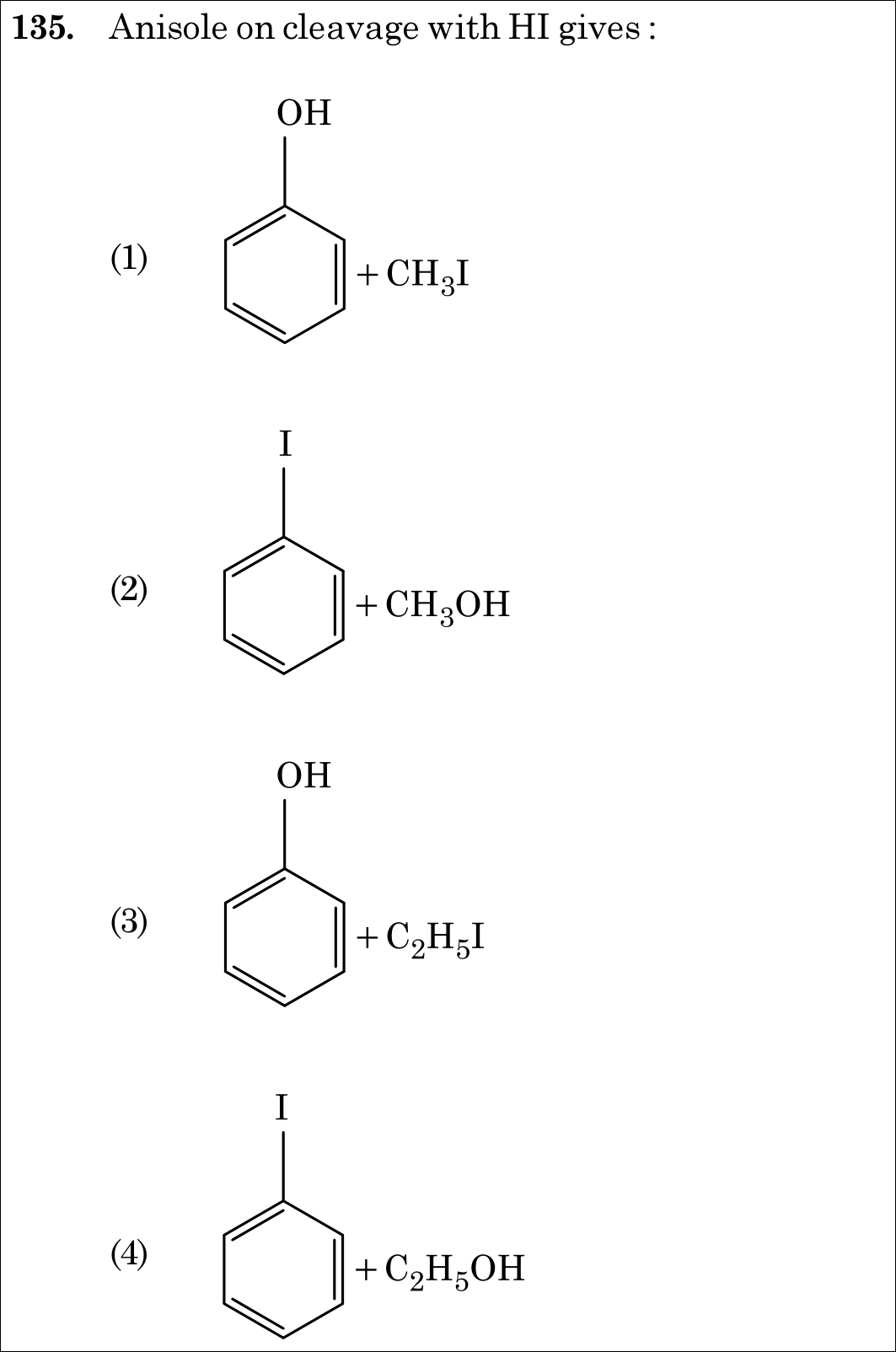
NEET 2020 · Q135 Easy
Official NEET 2020 Question 135 - Alcohols, Phenols and Ethers
1 ✓ Key
2
3
4
💡 Verified Solution & 30-Second Hack
✓
Verified Against NTA Final Answer Key
Option (1) : Phenol + Methyl iodide (C6H5-OH + CH3I)
📚 Alcohols, Phenols and Ethers Easy
📋 Given Parameters & Problem Setup
Substrate Anisole (Methoxybenzene, C6H5-O-CH3)
Reagent Concentrated Hydrogen Iodide (HI)
Question Objective Identify the products formed upon cleavage
⚡

The 30-Second Exam Hall Shortcut: ⚡ "Phenol-Oxygen Bond Has Partial Double Bond Character: Cleavage ALWAYS Gives PHENOL + Methyl Iodide!"

⏱️ 20 seconds

In anisole (C6H5−O−CH3C_6H_5-O-CH_3), the lone pair on oxygen is delocalised into the benzene ring by resonance, giving the Caromatic−OC_{\text{aromatic}}-O bond partial double bond character (strong and resistant to cleavage). When protonated by HI, the iodide nucleophile (I−I^-) attacks the smaller methyl carbon via SN2S_N2, breaking the alkyl-oxygen bond. The products are PHENOL and METHYL IODIDE (CH3ICH_3I)! Mark Option (1) in 5 seconds.

1 Anisole is protonated by H+ to form oxonium ion: C6H5-O+(H)-CH3.
2 The C(phenyl)-O bond has partial double bond character due to resonance and is very strong.
3 Iodide ion (I-) attacks methyl carbon by SN2 displacement.
4 Products formed: C6H5-OH (Phenol) and CH3I (Methyl iodide).
5 Iodobenzene and methanol are NEVER formed.
6 Select Option (1).
🛡️
Why You Can 100% Trust This Shortcut: NCERT Chemistry · Alcohols, Phenols and Ethers (Ethers: Chemical Reactions - Cleavage of C-O Bond by Hydrogen Halides)
📐

Step-by-Step Rigorous Workflow & Mathematical Proof

Step 1

Protonation of the Ether Oxygen

In the presence of hydrogen iodide (HI\text{HI}), anisole (methoxybenzene) is first protonated at the ether oxygen to form a methylphenyl oxonium ion: C6H5−O−CH3+HI⇌C6H5−O+(H)−CH3+I−\text{C}_6\text{H}_5-\text{O}-\text{CH}_3 + \text{HI} \rightleftharpoons \text{C}_6\text{H}_5-\text{O}^+(\text{H})-\text{CH}_3 + \text{I}^-

Step 2

Evaluate Bond Strengths of the Two C-O Bonds

The oxonium ion has two different C−O\text{C}-\text{O} bonds: 1. The Cphenyl−O\text{C}_{\text{phenyl}}-\text{O} bond: Due to resonance with the benzene ring, this bond has partial double bond character (sp2sp^2 hybridized carbon) and a shorter bond length (136 pm136\text{ pm}), making it exceptionally strong and resistant to cleavage. 2. The Cmethyl−O\text{C}_{\text{methyl}}-\text{O} bond: This is a weaker, single σ\sigma-bond (sp3sp^3 hybridized carbon).

Step 3

Nucleophilic SN2 Attack by Iodide

The nucleophilic iodide ion (I−\text{I}^-) selectively attacks the less sterically hindered methyl carbon via an SN2S_N2 pathway, displacing phenol as the neutral leaving group: I−+CH3−O+(H)−C6H5→SN2CH3I+C6H5OH\text{I}^- + \text{CH}_3-\text{O}^+(\text{H})-\text{C}_6\text{H}_5 \xrightarrow{S_N2} \text{CH}_3\text{I} + \text{C}_6\text{H}_5\text{OH} Phenol does not react further with HI because the hydroxyl group cannot be displaced by iodide from the sp2\text{sp}^2 phenyl ring.

Step 4

Conclude Products

The cleavage products are unequivocally Phenol (C6H5OH\text{C}_6\text{H}_5\text{OH}) and Methyl iodide (CH3I\text{CH}_3\text{I}), corresponding to Option (1).

⭐

360° Option Elimination Engine Key Feature

Diagnose every choice: Know exactly why the right option works and why distractors fail.

4-Option Deep Scan
1 A
✓ 100% Correct
Verdict & Scientific Reason:

Factually and mechanistically exact; resonance stabilizes the phenyl-oxygen bond, directing cleavage to yield phenol and methyl iodide.

💡
Why this is airtight: None; quintessential textbook ether reaction.
2 B
✗ Incorrect
Verdict & Scientific Reason:

Incorrect; requires cleavage of the partial double bond between phenyl ring and oxygen via nucleophilic aromatic substitution (SNArS_NAr), which is energetically unfeasible.

⚠️
Student Fallacy (Why candidates pick this trap): Assuming iodide attacks the phenyl ring instead of the methyl group.
3 C
✗ Incorrect
Verdict & Scientific Reason:

Incorrect; iodide ion must covalently bond with the cleaved methyl group to form methyl iodide.

⚠️
Student Fallacy (Why candidates pick this trap): Confusing basic hydrolysis with HI cleavage.
4 D
✗ Incorrect
Verdict & Scientific Reason:

Incorrect; the phenolic oxygen is not displaced by iodide.

⚠️
Student Fallacy (Why candidates pick this trap): Assuming exhaustive iodination.
⚠️

NTA Trap Alert: Phenol Stays Intact with HI

Alkyl aryl ethers (Ar−O−R\text{Ar}-\text{O}-\text{R}) ALWAYS yield PHENOL (Ar−OH\text{Ar}-\text{OH}) and ALKYL HALIDE (R−X\text{R}-\text{X}) when cleaved with halogen acids! Iodobenzene is NEVER formed.

🛡️ How to avoid the -1 mark: Remember: Phenol never loses its OH to HI! Product is Phenol + CH3I!
📖

Core NEET Syllabus Standard

Chemistry · Alcohols, Phenols and Ethers Standard Benchmark
Core Scientific Principle Tested:

""

Syllabus Focus: Cleavage of Alkyl Aryl Ethers by HI: Anisole Yields Phenol and Methyl Iodide
✓ Core NEET UG Syllabus Anchor Syllabus & Academic Standards ↗

Solve 4 NEET Questions a Day — One per Subject

Cover all 1,140 official NEET questions in 285 days at your own pace. Progress is saved on your device. No login needed.