NEET 2021 Chemistry Question 60 Solution
Question
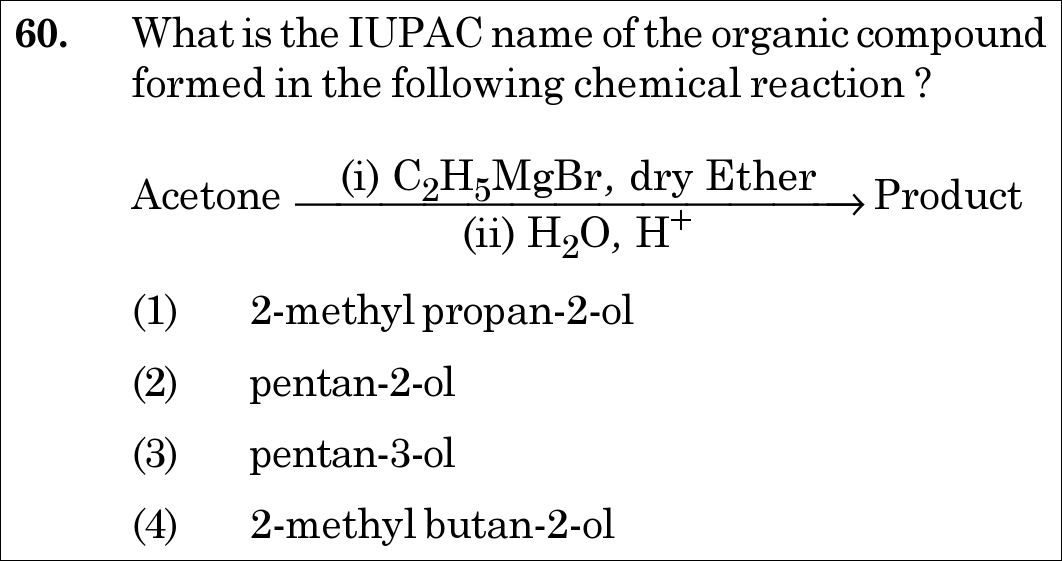
What is the IUPAC name of the organic compound formed in the following chemical reaction? Acetone → (i) C₂H₅MgBr, dry Ether (ii) H₂O, H⁺ → Product
Dynamic 180-question full-length simulator mixed dynamically from all 6 years for 2027 & 2026 aspirants.
What is the IUPAC name of the organic compound formed in the following chemical reaction? Acetone → (i) C₂H₅MgBr, dry Ether (ii) H₂O, H⁺ → Product
Acetone ( carbons) ethylmagnesium bromide ( carbons) yields a -carbon tertiary alcohol. The ethyl group attacks the carbonyl carbon: . Longest chain is 4 carbons (butane) with methyl and -OH at C-2: 2-methylbutan-2-ol! Match Option (4)!
Grignard reagents () act as powerful carbon nucleophiles. The polar organomagnesium bond provides a nucleophilic ethyl group () that attacks the electrophilic carbonyl carbon of acetone (propan-2-one):
Acidic aqueous hydrolysis of the magnesium alkoxide intermediate decomposes it into the corresponding tertiary alcohol and basic magnesium bromide:
Identify the principal functional group and the longest continuous carbon chain: - Longest carbon chain containing the group has carbons (butane). - Numbering starts from the right to give the principal group the lowest locant (): - Carbon 1: - Carbon 2: - Carbon 3: - Carbon 4: - The substituents are a methyl group at position 2 and an -ol group at position 2.
Diagnose every choice: Know exactly why the right option works and why distractors fail.
This 4-carbon alcohol (-butanol) would be formed if methylmagnesium bromide () were used, not ethylmagnesium bromide.
This is a secondary alcohol formed from pentanal or propanal with ethyl Grignard, not from acetone.
Secondary alcohol formed from propionaldehyde and ethyl Grignard.
Exact tertiary alcohol product formed by nucleophilic addition of ethyl group to acetone.
Students who count sometimes overlook the ethyl group as two carbons, calling it a derivative of pentan-2-ol (Option 2) or forgetting the chain length. The longest straight chain through ethyl is 4 carbons (butane), not 5.
"Addition of a Grignard reagent to a ketone yields a tertiary alcohol following acidic hydrolysis."
Test your speed and accuracy in the authentic 200-minute timed NTA simulator.
Spotted a mistake in this solution? Report an error (support@mycompetitiveexams.com)
Cover all 1,140 official NEET questions in 285 days at your own pace. Progress is saved on your device. No login needed.