The 30-Second Exam Hall Shortcut: ⚡ Brewster’s Tan Law & Polarization Rule
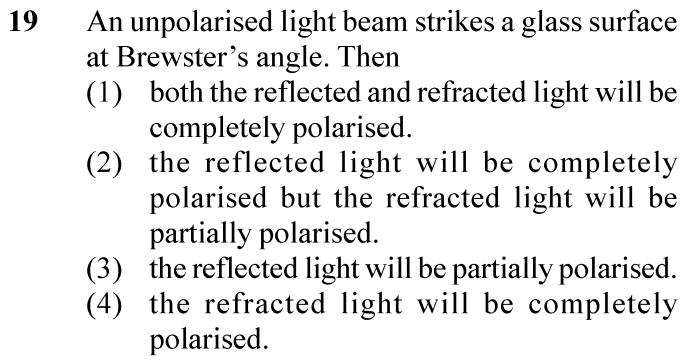
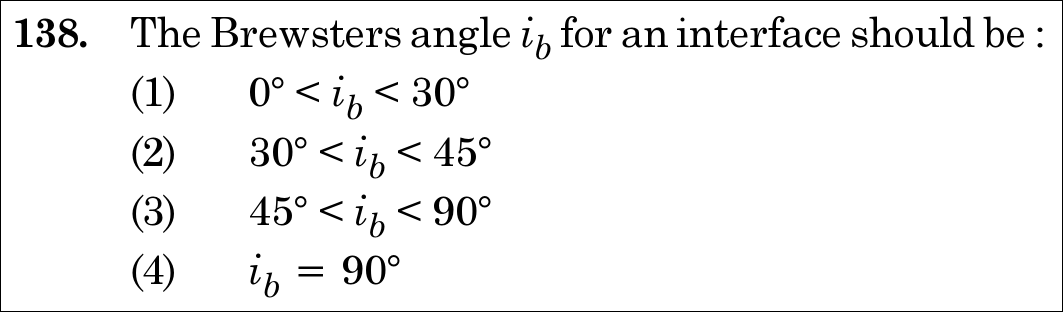
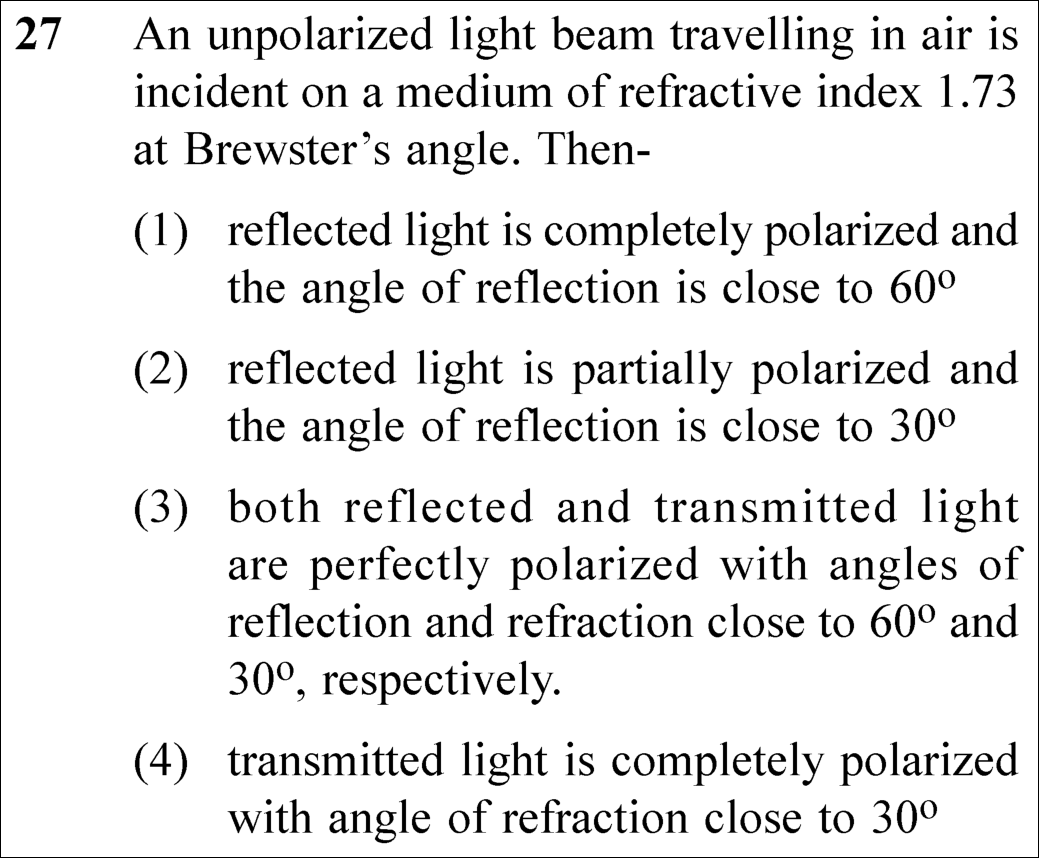
tan i_B = μ = 1.73 = √3 ⟹ i_B = 60° ⟹ Angle of reflection = 60° and Reflected ray is 100% COMPLETELY POLARIZED!
Step-by-Step Rigorous Workflow & Mathematical Proof
Calculate Brewster’s Angle of Incidence
Brewster’s law states that when light is incident at a polarizing angle i_B, the tangent of the polarizing angle is equal to the refractive index μ of the reflecting medium:
- • By the fundamental law of reflection, angle of reflection equals angle of incidence: r' = i_B = 60°.
State of Polarization of Reflected vs. Transmitted Light
At Brewster’s angle, the reflected and refracted rays are mutually perpendicular (i_B + r = 90°). Electrons oscillating parallel to the refracted ray cannot radiate along their axis of oscillation towards the reflected direction.
- • Therefore, the reflected light contains only vibrations perpendicular to the plane of incidence (s-polarization) and is completely plane polarized.
- • The transmitted light contains both parallel and residual perpendicular components, making it only partially polarized.
360° Option Elimination Engine Key Feature
Diagnose every choice: Know exactly why the right option works and why distractors fail.
100% correct. i_B = 60°, angle of reflection is 60°, and reflected light is completely plane polarized.
Incorrect. Reflected light is completely (not partially) polarized, and angle of reflection is 60° (30° is angle of refraction).
Incorrect. Transmitted light is only partially polarized; it is never completely polarized by a single Brewster reflection.
Incorrect. Transmitted light is partially polarized.
NTA Trap Alert: Transmitted Light Polarization Fallacy
A major trap in wave optics: Candidates assume that if reflected light is completely polarized, transmitted light must also be completely polarized. Transmitted light is PARTIALLY polarized because only a fraction of the perpendicular component reflects.
Core NEET Syllabus Standard
"At Brewster’s angle tan i_B = μ, reflected light is completely plane-polarized perpendicular to the plane of incidence."