MyCompetitiveExams Logo MyCompetitiveExams
Search 1,140+ Questions
Chapters, formulas, speed tricks
→
⚡ Brahmastra NEET 2027
720 MARKS

Dynamic 180-question full-length simulator mixed dynamically from all 6 years for 2027 & 2026 aspirants.

Launch Brahmastra 2027 Test →
Start Practice →
100% Free · No Login Required
Q.27 Physics ⭐ 360° Option Elimination Active
Vault ↗

NEET 2025 Physics Question 27 Solution

Topic: Wave Optics · Official NTA Booklet Code 45
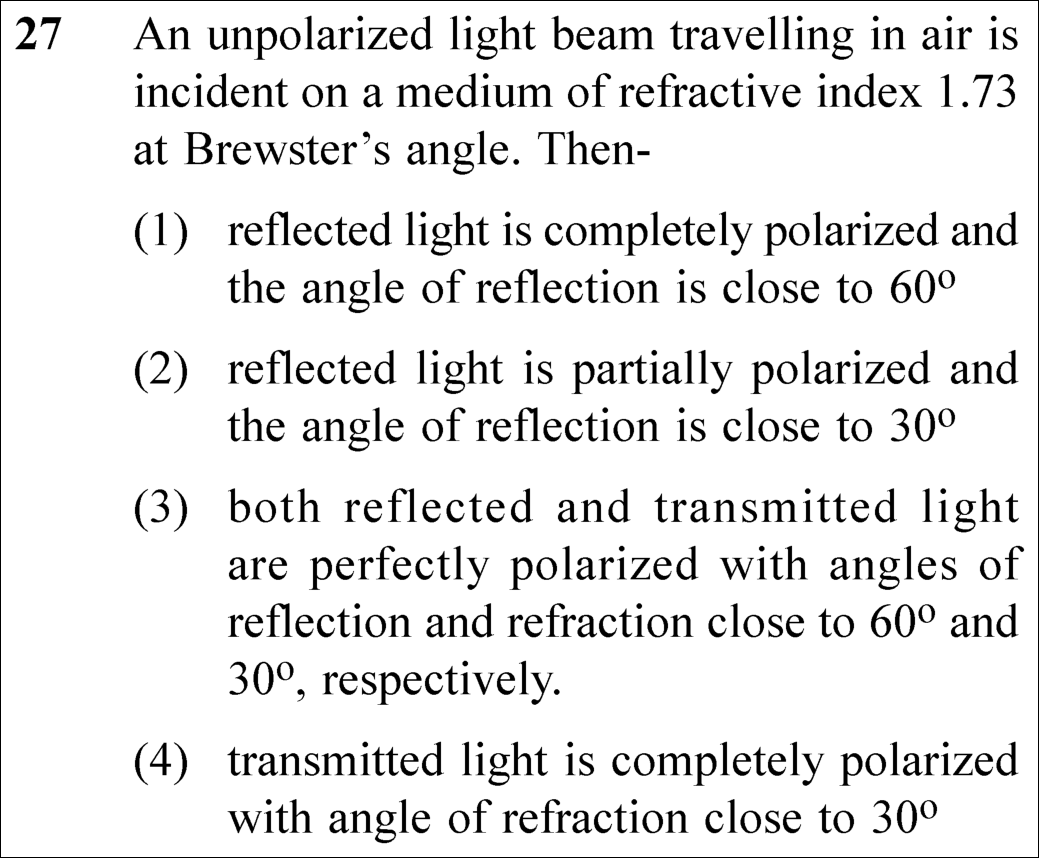
NEET 2025 Physics Question 27: Brewster’s Law, Angle of Polarization & State of Reflected/Refracted Rays

Question

An unpolarized light beam travelling in air is incident on a medium of refractive index 1.73 at Brewster's angle. Then

✓
Verified Against NTA Final Answer Key
Option (1) : reflected light is completely polarized and the angle of reflection is close to 60°
📚 Wave Optics Easy
📋 Given Parameters & Problem Setup
Refractive Index of Medium (μ) 1.73 (≈ √3)
Incident Light Unpolarized light travelling in air
Incident Condition Incident at Brewster’s angle (i_B)
⚡

The 30-Second Exam Hall Shortcut: ⚡ Brewster’s Tan Law & Polarization Rule

⏱️ Save ~40 seconds

tan i_B = μ = 1.73 = √3 ⟹ i_B = 60° ⟹ Angle of reflection = 60° and Reflected ray is 100% COMPLETELY POLARIZED!

1 Apply Brewster’s Law: tan i_B = μ = 1.73 ≈ √3.
2 Angle of incidence: i_B = arctan(√3) = 60°.
3 Law of reflection: Angle of reflection r' = i_B = 60°.
4 Brewster’s Postulate: At Brewster’s angle, the REFLECTED beam is COMPLETELY plane polarized (electric vector perpendicular to plane of incidence).
5 The transmitted (refracted) beam is only PARTIALLY polarized.
6 Match Option (1) directly in under 10 seconds!
🛡️
Why You Can 100% Trust This Shortcut: Brewster’s Law of Polarization (NCERT Physics · Wave Optics: μ = tan(i_p)).
📐

Step-by-Step Rigorous Workflow & Mathematical Proof

Step 1

Calculate Brewster’s Angle of Incidence

Brewster’s law states that when light is incident at a polarizing angle i_B, the tangent of the polarizing angle is equal to the refractive index μ of the reflecting medium:

tan⁡iB=μ=1.73≈3  ⟹  iB=60∘\tan i_B = \mu = 1.73 \approx \sqrt{3} \implies i_B = 60^\circ
  • • By the fundamental law of reflection, angle of reflection equals angle of incidence: r' = i_B = 60°.
Step 2

State of Polarization of Reflected vs. Transmitted Light

At Brewster’s angle, the reflected and refracted rays are mutually perpendicular (i_B + r = 90°). Electrons oscillating parallel to the refracted ray cannot radiate along their axis of oscillation towards the reflected direction.

iB+r=90∘  ⟹  r=90∘−60∘=30∘i_B + r = 90^\circ \implies r = 90^\circ - 60^\circ = 30^\circ
  • • Therefore, the reflected light contains only vibrations perpendicular to the plane of incidence (s-polarization) and is completely plane polarized.
  • • The transmitted light contains both parallel and residual perpendicular components, making it only partially polarized.
⭐

360° Option Elimination Engine Key Feature

Diagnose every choice: Know exactly why the right option works and why distractors fail.

4-Option Deep Scan
1 A
✓ 100% Correct
Verdict & Scientific Reason:

100% correct. i_B = 60°, angle of reflection is 60°, and reflected light is completely plane polarized.

💡
Why this is airtight: None; textbook Brewster’s law.
2 B
✗ Incorrect
Verdict & Scientific Reason:

Incorrect. Reflected light is completely (not partially) polarized, and angle of reflection is 60° (30° is angle of refraction).

⚠️
Student Fallacy (Why candidates pick this trap): Confusing angle of reflection with angle of refraction.
3 C
✗ Incorrect
Verdict & Scientific Reason:

Incorrect. Transmitted light is only partially polarized; it is never completely polarized by a single Brewster reflection.

⚠️
Student Fallacy (Why candidates pick this trap): Falsely assuming transmitted light is also completely polarized.
4 D
✗ Incorrect
Verdict & Scientific Reason:

Incorrect. Transmitted light is partially polarized.

⚠️
Student Fallacy (Why candidates pick this trap): Swapping the polarization state between reflected and transmitted beams.
⚠️

NTA Trap Alert: Transmitted Light Polarization Fallacy

A major trap in wave optics: Candidates assume that if reflected light is completely polarized, transmitted light must also be completely polarized. Transmitted light is PARTIALLY polarized because only a fraction of the perpendicular component reflects.

🛡️ How to avoid the -1 mark: Remember: Reflected = 100% Completely polarized; Transmitted = Only Partially polarized!
📖

Core NEET Syllabus Standard

NEET Physics Core Syllabus · Wave Optics Standard Benchmark
Core Scientific Principle Tested:

"At Brewster’s angle tan i_B = μ, reflected light is completely plane-polarized perpendicular to the plane of incidence."

Syllabus Focus: Polarization by Reflection & Brewster’s Law
✓ Core NEET UG Syllabus Anchor Syllabus & Academic Standards ↗
tan 60° = √3 = 1.73 ⟹ Reflected is 100% Polarized at 60°!

Ready to attempt under real exam pressure?

Test your speed and accuracy in the authentic 180-minute timed NTA simulator.

Launch NEET 2025 CBT Test →

Spotted a mistake in this solution? Report an error (support@mycompetitiveexams.com)

⚖️ Legal & Fair Dealing Notice: Sourced from publicly released NEET 2025 question papers and NEET answer keys for private study, research, and non-commercial educational practice under Fair Dealing (Section 52(1)(a) of the Indian Copyright Act, 1957). Not affiliated with or endorsed by NTA or NMC.

Solve 4 NEET Questions a Day — One per Subject

Cover all 1,140 official NEET questions in 285 days at your own pace. Progress is saved on your device. No login needed.