MyCompetitiveExams Logo MyCompetitiveExams
Search 1,140+ Questions
Chapters, formulas, speed tricks
→
⚡ Brahmastra NEET 2027
720 MARKS

Dynamic 180-question full-length simulator mixed dynamically from all 6 years for 2027 & 2026 aspirants.

Launch Brahmastra 2027 Test →
Start Practice →
100% Free · No Login Required
Q.61 Chemistry ⭐ 360° Option Elimination Active
Vault ↗

NEET 2026 Chemistry Question 61 Solution

Topic: The d- and f-Block Elements · Official NTA Booklet Code 50
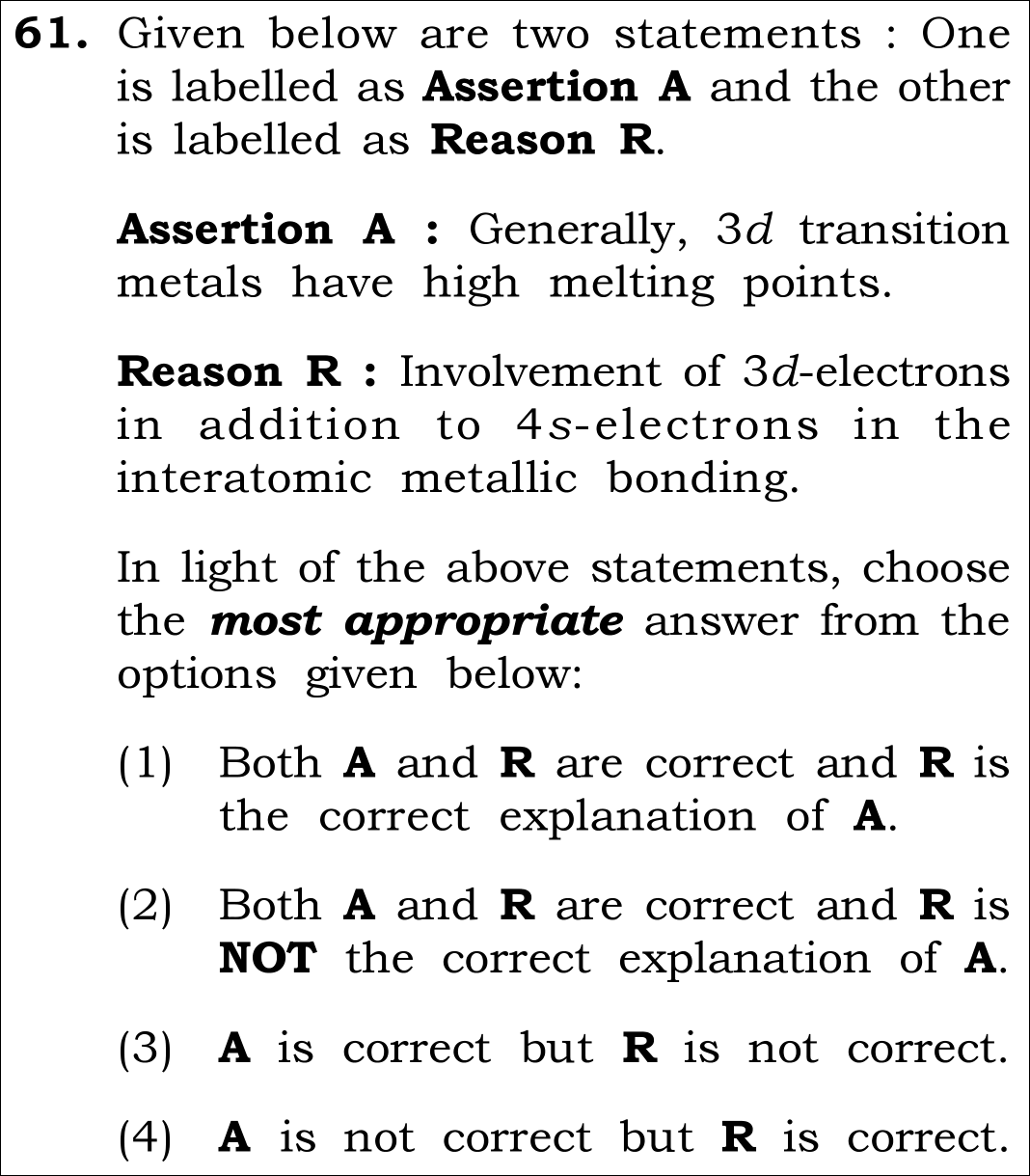
NEET 2026 Chemistry Question 61: High Melting Points of 3d Transition Metals (Assertion-Reason)

Question

Given below are two statements: One is labelled as Assertion A and the other is labelled as Reason R. Assertion A: Generally, 3d transition metals have high melting points. Reason R: Involvement of 3d-electrons in addition to 4s-electrons in the interatomic metallic bonding. In light of the above statements, choose the most appropriate answer from the options given below:

  1. (1)Both A and R are correct and R is the correct explanation of A.
  2. (2)Both A and R are correct and R is NOT the correct explanation of A.
  3. (3)A is correct but R is not correct.
  4. (4)A is not correct but R is correct.
✓
Verified Against NTA Final Answer Key
Option (1) : Both A and R are correct and R is the correct explanation of A.
📚 The d- and f-Block Elements Easy
📋 Given Parameters & Problem Setup
Assertion (A) Generally, 3d transition metals have high melting points.
Reason (R) Involvement of 3d-electrons in addition to 4s-electrons in the interatomic metallic bonding.
⚡

The 30-Second Exam Hall Shortcut: ⚡ Transition Metal Binding Rule

⏱️ Save ~45 seconds

More unpaired d-electrons + s-electrons = ultra-strong metallic lattice -> High melting point!

1 Recall Assertion A: Transition metals (like Ti, V, Cr, Fe) are well known for high melting points (above 1000 °C - 1900 °C) -> TRUE.
2 Recall Reason R: In main group s-block metals, only ns electrons participate. In transition metals, both (n-1)d and ns electrons participate in metallic bonding, vastly multiplying bond density -> TRUE.
3 Does R explain A? Yes, the greater number of valence bonding electrons directly causes the high lattice cohesive energy and high melting points!
4 Select Option (1) in 10 seconds!
🛡️
Why You Can 100% Trust This Shortcut: Verbatim NCERT d-block text: The high melting points of transition metals are attributed to the involvement of a greater number of electrons from (n-1)d in addition to the ns electrons in interatomic metallic bonding.
📐

Step-by-Step Rigorous Workflow & Mathematical Proof

Step 1

Evaluate Assertion A (Melting Points of 3d Metals)

Transition elements have exceptionally high melting and boiling points compared to s-block elements in the same period. For example, Vanadium melts at 1910 °C and Chromium at 1907 °C.

Tm(Transition Metals)≫Tm(s-block metals)T_m(\text{Transition Metals}) \gg T_m(\text{s-block metals})
  • • Assertion A is factually correct.
Step 2

Evaluate Reason R (Role of 3d and 4s Electrons in Metallic Bonding)

Metallic bonding strength is directly proportional to the number of valence electrons per atom available for delocalization throughout the crystal lattice. In 3d transition metals, the energies of 3d and 4s subshells are very close, allowing both 4s and (n-1)d electrons (especially unpaired d-electrons) to participate in covalent interatomic bonding and metallic lattice cohesion.

Cohesive Energy∝nbonding electrons=n(4s)+n(3dunpaired)\text{Cohesive Energy} \propto n_{\text{bonding electrons}} = n(4s) + n(3d_{\text{unpaired}})
  • • Reason R is factually correct.
Step 3

Determine Explanation Validity

Because the interatomic bonding is reinforced by the dual participation of (n-1)d and ns electrons, immense thermal energy is required to break the lattice bonds. Thus, Reason R is the precise, direct scientific explanation of Assertion A.

Both A and R are correct and R is the correct explanation of A (Option 1)\text{Both A and R are correct and R is the correct explanation of A (Option 1)}
  • • Matches Option (1).
⭐

360° Option Elimination Engine Key Feature

Diagnose every choice: Know exactly why the right option works and why distractors fail.

4-Option Deep Scan
1 A
✓ 100% Correct
Verdict & Scientific Reason:

Scientifically flawless and aligns verbatim with NCERT d- and f-Block Chemistry.

💡
Why this is airtight: None; fundamental concept of transition metal cohesion.
2 B
✗ Incorrect
Verdict & Scientific Reason:

Incorrect. R directly explains why the melting points are high.

⚠️
Student Fallacy (Why candidates pick this trap): Believing that d-electron participation is an unrelated property rather than the direct causal mechanism.
3 C
✗ Incorrect
Verdict & Scientific Reason:

Incorrect. Reason R is an established physical principle of transition metal chemistry.

⚠️
Student Fallacy (Why candidates pick this trap): Assuming only outer 4s electrons can participate in metallic bonding.
4 D
✗ Incorrect
Verdict & Scientific Reason:

Incorrect. 3d transition metals clearly possess high melting points.

⚠️
Student Fallacy (Why candidates pick this trap): Confusing 3d metals with low-melting zinc group (Zn, Cd, Hg).
⚠️

NTA Trap Alert: Confusing Transition Metals Generally with Group 12 (Zn, Cd, Hg)

Students sometimes think of Zinc or Mercury (which have low melting points due to fully filled d¹⁰ configurations with no unpaired d-electrons) and doubt Assertion A. The assertion states "Generally", which is true for the 3d series.

🛡️ How to avoid the -1 mark: Remember that Zn, Cd, Hg are pseudo-transition metals with full d¹⁰ subshells; all true transition metals (Sc to Cu) have high melting points.
📖

Core NEET Syllabus Standard

NEET Chemistry Core Syllabus · The d- and f-Block Elements Standard Benchmark
Core Scientific Principle Tested:

"Participation of both (n-1)d and ns electrons maximizes metallic bond enthalpy and melting temperature."

Syllabus Focus: General properties of transition elements - Melting points and metallic bonding
✓ Core NEET UG Syllabus Anchor Syllabus & Academic Standards ↗
Both 3d and 4s join hands: melting points soar across the lands!

Ready to attempt under real exam pressure?

Test your speed and accuracy in the authentic 180-minute timed NTA simulator.

Launch NEET 2026 CBT Test →

Spotted a mistake in this solution? Report an error (support@mycompetitiveexams.com)

⚖️ Legal & Fair Dealing Notice: Sourced from publicly released NEET 2026 question papers and NEET answer keys for private study, research, and non-commercial educational practice under Fair Dealing (Section 52(1)(a) of the Indian Copyright Act, 1957). Not affiliated with or endorsed by NTA or NMC.

Solve 4 NEET Questions a Day — One per Subject

Cover all 1,140 official NEET questions in 285 days at your own pace. Progress is saved on your device. No login needed.