MyCompetitiveExams Logo MyCompetitiveExams
Search 1,140+ Questions
Chapters, formulas, speed tricks
→
⚡ Brahmastra NEET 2027
720 MARKS

Dynamic 180-question full-length simulator mixed dynamically from all 6 years for 2027 & 2026 aspirants.

Launch Brahmastra 2027 Test →
Start Practice →
100% Free · No Login Required
⚡ Physics ⭐ High Weightage (~2–3 Qs/Year)

NEET Motion in a Straight Line Previous Year Questions with Solutions

Complete repository of official NTA NEET questions for Motion in a Straight Line from 2020 to 2026. Every question includes 30-second elimination tricks, step-by-step NCERT solutions, option-by-option traps, and official answer keys.

8 Questions 5 Exam Years (2025, 2024, 2023, 2021, 2020) 6 Easy · 2 Medium · 0 Challenging
NEET 2025 · Q15 Easy
Official NEET 2025 Question 15 - Motion in a Straight Line
1
2 ✓ Key
3
4
💡 Verified Solution & 30-Second Hack
✓
Verified Against NTA Final Answer Key
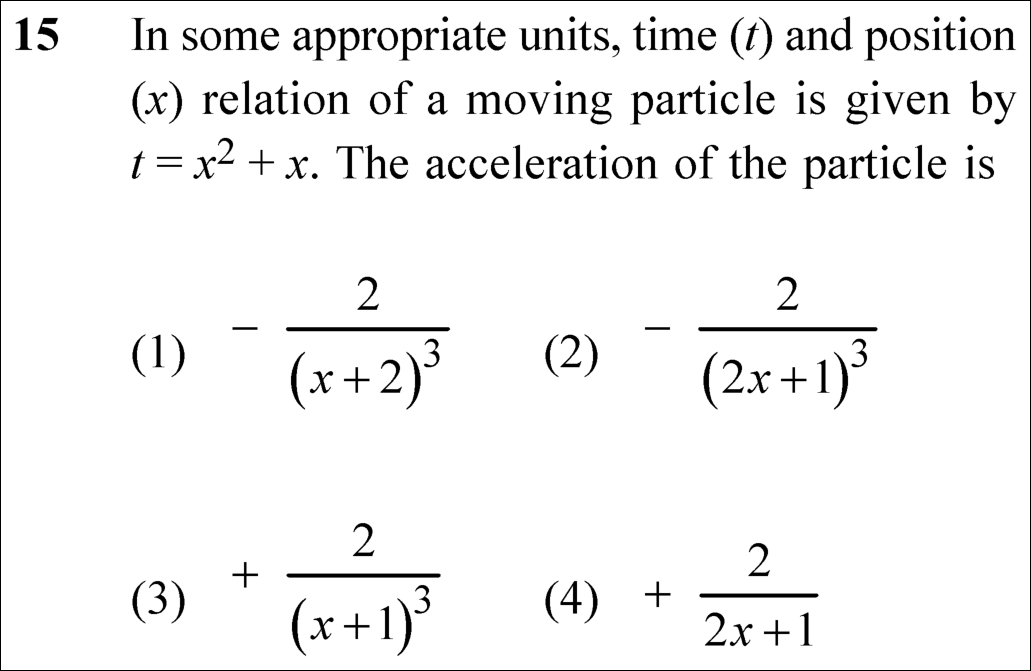
Option (2) : -\frac{2}{(2x + 1)^3}
📚 Motion in a Straight Line Easy
📋 Given Parameters & Problem Setup
Time-Position Relation t = x² + x
Target Variable Acceleration of the particle a(x)
⚡

The 30-Second Exam Hall Shortcut: ⚡ v(dv/dx) Chain Rule Shortcut

⏱️ Save ~40 seconds

dt/dx = 2x + 1 ⟹ v = (2x + 1)⁻¹ ⟹ a = v(dv/dx) = (2x + 1)⁻¹ · [-2(2x + 1)⁻²] = -2 / (2x + 1)³!

1 Differentiate given equation with respect to x: dt/dx = 2x + 1.
2 Velocity is the reciprocal of dt/dx: v = dx/dt = 1 / (2x + 1) = (2x + 1)⁻¹.
3 Acceleration formula in terms of position: a = v (dv/dx).
4 Differentiate v with respect to x: dv/dx = -2 (2x + 1)⁻².
5 Multiply: a = (2x + 1)⁻¹ × [-2 (2x + 1)⁻²] = -2 / (2x + 1)³ (or -2 v³).
6 Select Option (2) in under 15 seconds!
🛡️
Why You Can 100% Trust This Shortcut: Kinematics Calculus Relation (NCERT Physics · Motion in a Straight Line: a = v dv/dx).
📐

Step-by-Step Rigorous Workflow & Mathematical Proof

Step 1

Find Velocity as a Function of Position

Given the implicit trajectory relation t = x² + x, differentiate both sides with respect to time t using the chain rule:

dtdt=1=ddt(x2+x)=(2x+1)dxdt=(2x+1)v  ⟹  v=12x+1\frac{dt}{dt} = 1 = \frac{d}{dt}(x^2 + x) = (2x + 1) \frac{dx}{dt} = (2x + 1) v \implies v = \frac{1}{2x + 1}
  • • v can be written in power notation: v = (2x + 1)⁻¹.
Step 2

Calculate Acceleration Using a = v (dv/dx)

Differentiate velocity with respect to position x:

dvdx=ddx(2x+1)−1=−1(2x+1)−2⋅ddx(2x+1)=−2(2x+1)2\frac{dv}{dx} = \frac{d}{dx}(2x + 1)^{-1} = -1(2x + 1)^{-2} \cdot \frac{d}{dx}(2x + 1) = -\frac{2}{(2x + 1)^2}
  • • Now substitute into the kinematic identity for acceleration: a = v (dv/dx).
Step 3

Consolidate Acceleration Expression

Multiply velocity by its spatial derivative:

a=vdvdx=(12x+1)(−2(2x+1)2)=−2(2x+1)3=−2v3a = v \frac{dv}{dx} = \left(\frac{1}{2x + 1}\right) \left(-\frac{2}{(2x + 1)^2}\right) = -\frac{2}{(2x + 1)^3} = -2v^3
  • • The negative sign indicates retardation.
  • • Matches Option (2) perfectly.
⭐

360° Option Elimination Engine Key Feature

Diagnose every choice: Know exactly why the right option works and why distractors fail.

4-Option Deep Scan
1 A
✗ Incorrect
Verdict & Scientific Reason:

Incorrect. Base has (x + 2) instead of (2x + 1).

⚠️
Student Fallacy (Why candidates pick this trap): Algebraic slip in the derivative of x² + x.
2 B
✓ 100% Correct
Verdict & Scientific Reason:

100% correct. a = v(dv/dx) = -2 / (2x + 1)³.

💡
Why this is airtight: None; textbook calculus.
3 C
✗ Incorrect
Verdict & Scientific Reason:

Incorrect. Sign is positive and denominator is wrong.

⚠️
Student Fallacy (Why candidates pick this trap): Missing the negative sign from power rule and wrong base.
4 D
✗ Incorrect
Verdict & Scientific Reason:

Incorrect. This represents 2v, not acceleration.

⚠️
Student Fallacy (Why candidates pick this trap): Failing to take the second derivative.
⚠️

NTA Trap Alert: Missing Negative Sign & Power Slip

Differentiating (2x + 1)⁻¹ yields a negative sign: d/dx[(u)⁻¹] = -u⁻² u'. Forgetting the negative sign leads students to choose positive options.

🛡️ How to avoid the -1 mark: Power rule: exponent -1 brings down a factor of -1!
📖

Core NEET Syllabus Standard

NEET Physics Core Syllabus · Motion in a Straight Line Standard Benchmark
Core Scientific Principle Tested:

"Acceleration in terms of position is a = v (dv/dx) = -2v³."
Syllabus Focus: Kinematics of Non-Uniform Acceleration
✓ Core NEET UG Syllabus Anchor Syllabus & Academic Standards ↗
t = x² + x ⟹ v = (2x + 1)⁻¹ ⟹ a = -2 / (2x + 1)³ = -2v³!
NEET 2025 · Q21 Medium
Official NEET 2025 Question 21 - Motion in a Straight Line
1
2
3
4 ✓ Key
💡 Verified Solution & 30-Second Hack
✓
Verified Against NTA Final Answer Key
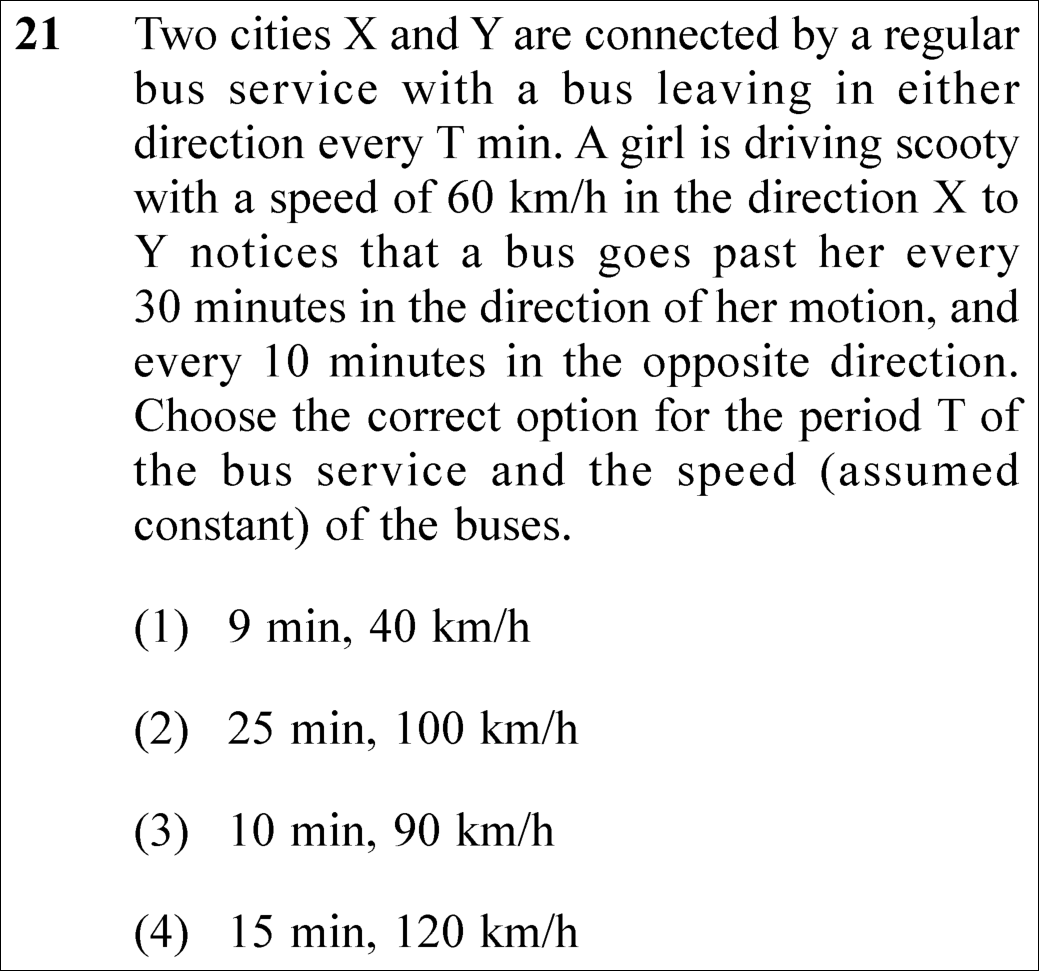
Option (4) : 15 min, 120 km/h
📚 Motion in a Straight Line Medium
📋 Given Parameters & Problem Setup
Bus Interval Leaves every T minutes in either direction
Girl’s Speed (v_g) 60 km/h from X to Y
Overtaking Interval (Same Direction) t₁ = 30 minutes
Crossing Interval (Opposite Direction) t₂ = 10 minutes
⚡

The 30-Second Exam Hall Shortcut: ⚡ Bus Schedule Sum-and-Difference Rule

⏱️ Save ~50 seconds

(v_b - 60) × 30 = (v_b + 60) × 10 ⟹ 3(v_b - 60) = v_b + 60 ⟹ 2v_b = 240 ⟹ v_b = 120 km/h! T = (120 - 60) × 30 / 120 = 15 min!

1 Spatial distance between consecutive buses in same direction: d = v_b · T.
2 In same direction: relative speed is (v_b - 60), time is 30 min ⟹ d = (v_b - 60) × 30.
3 In opposite direction: relative speed is (v_b + 60), time is 10 min ⟹ d = (v_b + 60) × 10.
4 Equate: 30(v_b - 60) = 10(v_b + 60) ⟹ 3v_b - 180 = v_b + 60 ⟹ 2v_b = 240 ⟹ v_b = 120 km/h.
5 Calculate T: d = 120 × T = (120 - 60) × 30 = 1800 ⟹ T = 1800 / 120 = 15 min.
6 Pick Option (4) in under 25 seconds!
🛡️
Why You Can 100% Trust This Shortcut: Equations of Motion under Constant Acceleration (NCERT Physics · Motion in a Straight Line: v = u + at, s = ut + ½at²).
📐

Step-by-Step Rigorous Workflow & Mathematical Proof

Step 1

Formulate Distance Between Consecutive Buses

Buses depart in either direction every T minutes at constant speed v_b. The spatial separation between any two successive buses traveling in the same direction is constant:

d=vb⋅Td = v_b \cdot T
  • • T is in minutes; v_b is in km/h.
Step 2

Equations of Relative Motion

For motion in the same direction, the relative speed is (v_b - 60) km/h and the time taken to cover distance d is 30 minutes. For motion in the opposite direction, relative speed is (v_b + 60) km/h and time is 10 minutes:

d=(vb−60)×30=(vb+60)×10d = (v_b - 60) \times 30 = (v_b + 60) \times 10
  • • 3(v_b - 60) = v_b + 60 ⟹ 3v_b - 180 = v_b + 60 ⟹ 2v_b = 240 ⟹ v_b = 120 km/h.
Step 3

Calculate Bus Departure Interval T

Substitute v_b = 120 km/h back into either distance expression:

120⋅T=(120−60)×30=60×30=1800  ⟹  T=1800120=15 minutes120 \cdot T = (120 - 60) \times 30 = 60 \times 30 = 1800 \implies T = \frac{1800}{120} = 15\text{ minutes}
  • • Bus speed = 120 km/h, Bus interval T = 15 min.
  • • Corresponds uniquely to Option (4).
⭐

360° Option Elimination Engine Key Feature

Diagnose every choice: Know exactly why the right option works and why distractors fail.

4-Option Deep Scan
1 A
✗ Incorrect
Verdict & Scientific Reason:

Incorrect. A bus speed of 40 km/h is less than the girl’s speed (60 km/h), so buses going in her direction could never overtake her.

⚠️
Student Fallacy (Why candidates pick this trap): Ignoring the physical constraint that v_b must exceed v_girl to overtake.
2 B
✗ Incorrect
Verdict & Scientific Reason:

Incorrect. Does not satisfy relative distance equations.

⚠️
Student Fallacy (Why candidates pick this trap): Arbitrary guess.
3 C
✗ Incorrect
Verdict & Scientific Reason:

Incorrect. For v_b = 90 km/h, same-direction relative speed is 30 km/h; ratio would not yield 30 min.

⚠️
Student Fallacy (Why candidates pick this trap): Algebraic slip in 2v_b = 240.
4 D
✓ 100% Correct
Verdict & Scientific Reason:

100% correct. v_b = 120 km/h and T = 15 min satisfy both relative motion equations.

💡
Why this is airtight: None; classic NCERT problem.
⚠️

NTA Trap Alert: v_bus Less Than v_girl Impossibility

Option (1) gives v_b = 40 km/h. If the bus travels at 40 km/h and the girl travels at 60 km/h, a bus behind her could NEVER overtake her! Eliminating options with v_b ≤ 60 immediately rules out Option 1.

🛡️ How to avoid the -1 mark: Sanity check: Overtaking requires v_bus > v_girl.
📖

Core NEET Syllabus Standard

NEET Physics Core Syllabus · Motion in a Straight Line Standard Benchmark
Core Scientific Principle Tested:

"Relative velocity v_rel = v₁ - v₂ for same direction and v₁ + v₂ for opposite direction."

Syllabus Focus: Relative Velocity in One Dimension
✓ Core NEET UG Syllabus Anchor Syllabus & Academic Standards ↗
30(v - 60) = 10(v + 60) ⟹ 2v = 240 ⟹ v = 120 km/h and T = 15 min!
NEET 2024 · Q41 Easy
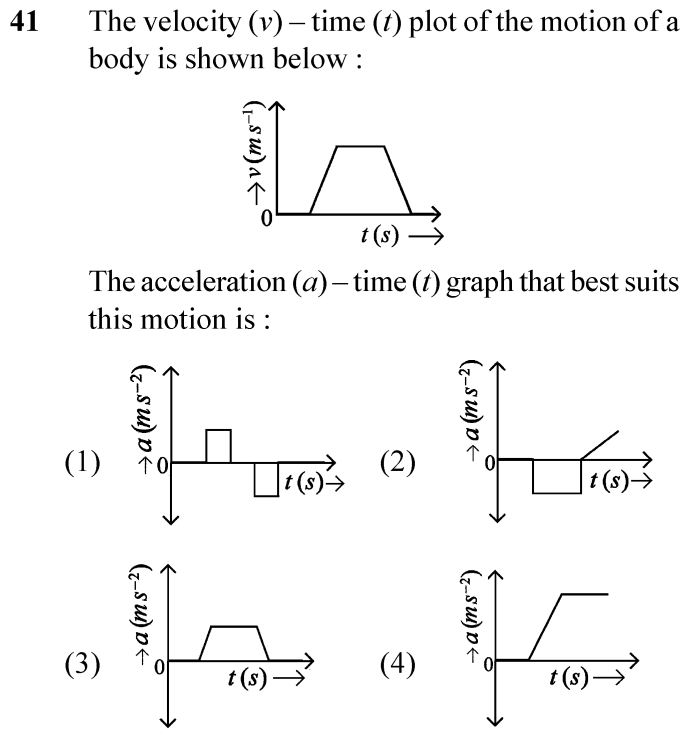
Official NEET 2024 Question 41 - Motion in a Straight Line
1 ✓ Key
2
3
4
💡 Verified Solution & 30-Second Hack
✓
Verified Against NTA Final Answer Key
Option (1) : Graph showing zero, positive rectangular pulse, zero, negative rectangular pulse, zero
📚 Motion in a Straight Line Easy
📋 Given Parameters & Problem Setup
Initial stage v = 0 for initial time interval
Stage 1 Linear increase in v (positive constant slope)
Stage 2 Flat plateau (constant velocity, zero slope)
Stage 3 Linear decrease in v (negative constant slope)
Final stage v = 0
⚡

The 30-Second Exam Hall Shortcut: ⚡ Slope-to-Acceleration Step Rule

⏱️ Save ~40 seconds

Acceleration is the slope of v-t curve! Slope is (+const) -> zero -> (-const) -> Matches Graph (1) with positive pulse, zero, negative pulse!

1 Recall that acceleration is the derivative (slope) of the velocity-time graph: a = dv/dt.
2 First segment: v increases at a constant rate -> Slope is a POSITIVE constant (rectangular block above axis).
3 Second segment: v is constant (horizontal line) -> Slope dv/dt = 0 (a = 0 on axis).
4 Third segment: v decreases at a constant rate -> Slope is a NEGATIVE constant (rectangular block below axis).
5 Only Graph (1) displays this sequence: positive pulse, zero, negative pulse!
6 Option (1) in under 5 seconds!
🛡️
Why You Can 100% Trust This Shortcut: Calculus Definition of Linear Acceleration (a = dv/dt = instantaneous slope of v-t graph).
📐

Step-by-Step Rigorous Workflow & Mathematical Proof

Step 1

Mathematical Relation Between v-t and a-t Graphs

The instantaneous acceleration a(t) is the first time derivative of velocity, which corresponds graphically to the slope of the tangent to the velocity-time graph at that instant:

a(t)=dvdta(t) = \frac{dv}{dt}
Step 2

Segment-by-Segment Slope Analysis

Analyzing the given trapezoidal v-t curve: 1. 0≤t<t10 \le t < t_1: v=0  ⟹  a=0v = 0 \implies a = 0. 2. t1≤t<t2t_1 \le t < t_2: vv is an upward inclined straight line with constant positive slope: a=dvdt=+a0=constant>0a = \frac{dv}{dt} = +a_0 = \text{constant} > 0 3. t2≤t<t3t_2 \le t < t_3: vv is a horizontal plateau with zero slope: a=dvdt=0a = \frac{dv}{dt} = 0 4. t3≤t<t4t_3 \le t < t_4: vv is a downward inclined straight line with constant negative slope: a=dvdt=−a0=constant<0a = \frac{dv}{dt} = -a_0 = \text{constant} < 0 5. t≥t4t \ge t_4: v=0  ⟹  a=0v = 0 \implies a = 0.

a(t)={+a0t1≤t<t20t2≤t<t3−a0t3≤t<t4a(t) = \begin{cases} +a_0 & t_1 \le t < t_2 \\ 0 & t_2 \le t < t_3 \\ -a_0 & t_3 \le t < t_4 \end{cases}
Step 3

Matching with Option Graphs

The corresponding a-t graph consists of a positive rectangular pulse, followed by a flat zero line, followed by an equal negative rectangular pulse below the time axis. This uniquely matches Graph (1).

Graph (1) is the exact match\text{Graph (1) is the exact match}
⭐

360° Option Elimination Engine Key Feature

Diagnose every choice: Know exactly why the right option works and why distractors fail.

4-Option Deep Scan
1 (1)
✓ 100% Correct
Verdict & Scientific Reason:

Accurately represents the piecewise constant slopes of the v-t graph.

💡
Why this is airtight: None.
2 (2)
✗ Incorrect
Verdict & Scientific Reason:

Inverts the sign of the initial acceleration.

⚠️
Student Fallacy (Why candidates pick this trap): Assuming initial motion is retarding.
3 (3)
✗ Incorrect
Verdict & Scientific Reason:

This would represent the derivative of a cubic velocity profile, not piecewise linear.

⚠️
Student Fallacy (Why candidates pick this trap): Copying the shape of the v-t graph directly onto the a-t graph.
4 (4)
✗ Incorrect
Verdict & Scientific Reason:

Entirely above axis; ignores deceleration.

⚠️
Student Fallacy (Why candidates pick this trap): Failing to realize that slowing down produces negative acceleration.
⚠️

NTA Trap Alert: Shape-Copying Fallacy

Untrained students often pick Graph (3) because its trapezoidal shape resembles the given v-t curve.

🛡️ How to avoid the -1 mark: The derivative of a linear ramp (slope) is a FLAT CONSTANT (rectangle), not another ramp!
📖

Core NEET Syllabus Standard

Physics Core Kinematics · Motion in a Straight Line Standard Benchmark
Core Scientific Principle Tested:

"The acceleration-time graph is the derivative of the velocity-time graph; straight-line segments with constant slope become constant horizontal steps in the a-t graph."

Syllabus Focus: Kinematic Graphs and Slope Relationships
✓ Core NEET UG Syllabus Anchor Syllabus & Academic Standards ↗
Ramp up is positive block; Flat is zero clock; Ramp down is negative shock!
NEET 2023 · Q12 Easy
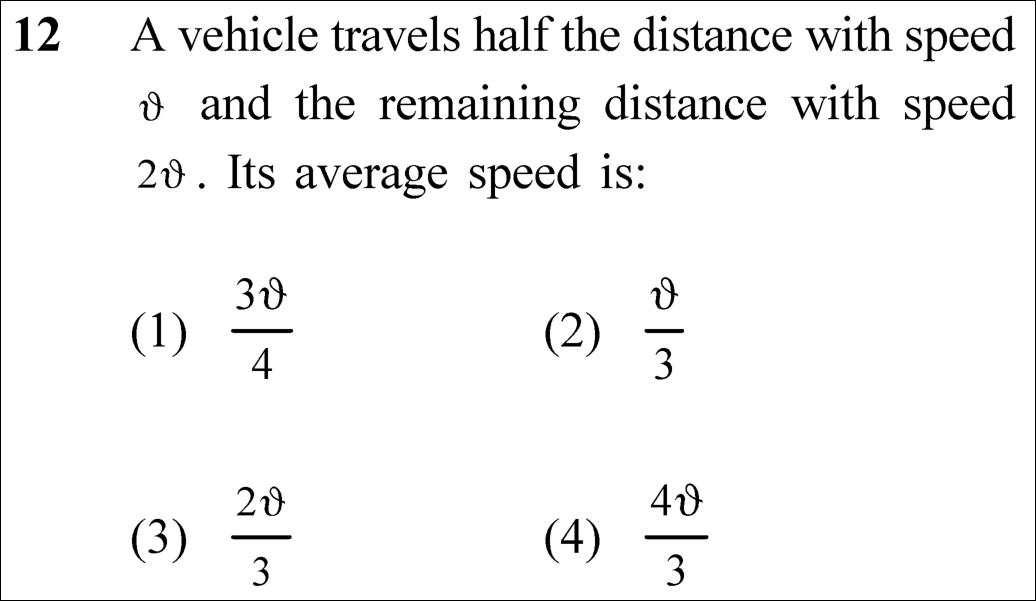
Official NEET 2023 Question 12 - Motion in a Straight Line
1
2
3
4 ✓ Key
💡 Verified Solution & 30-Second Hack
✓
Verified Against NTA Final Answer Key
Option (4) : 4ϑ / 3
📚 Motion in a Straight Line Easy
📋 Given Parameters & Problem Setup
First Segment Distance Half the total distance (d)
First Segment Speed ϑ
Second Segment Distance Remaining half distance (d)
Second Segment Speed 2ϑ
⚡

The 30-Second Exam Hall Shortcut: ⚡ Harmonic Mean Formula for Equal Distance Halves

⏱️ Save ~40 seconds

For equal distance halves, average speed is the harmonic mean: v_avg = 2 v₁ v₂ / (v₁ + v₂) = 2(ϑ)(2ϑ) / (3ϑ) = 4ϑ/3 in 10 seconds!

1 Recognize that the distance segments are equal (d₁ = d₂ = d).
2 Use the standard harmonic mean shortcut: v_avg = 2 v₁ v₂ / (v₁ + v₂).
3 Substitute v₁ = ϑ and v₂ = 2ϑ: v_avg = 2(ϑ)(2ϑ) / (ϑ + 2ϑ) = 4ϑ² / (3ϑ) = 4ϑ / 3.
4 Avoid the arithmetic mean trap (3ϑ/2 = 1.5ϑ); harmonic mean is always less than arithmetic mean!
5 Immediately pick Option (4)!
🛡️
Why You Can 100% Trust This Shortcut: Fundamental Kinematics · Rectilinear Motion (Harmonic mean of speeds for equal distance intervals: v_avg = 2 v₁ v₂ / (v₁ + v₂)).
📐

Step-by-Step Rigorous Workflow & Mathematical Proof

Step 1

Definition of Average Speed

Average speed is fundamentally defined as total distance travelled divided by total time elapsed:

vavg=Total DistanceTotal Timev_{\text{avg}} = \frac{\text{Total Distance}}{\text{Total Time}}
Step 2

Time Calculation for Each Distance Half

Let the total distance be 2d. Each half of the journey has distance d:

t1=dϑ,t2=d2ϑt_1 = \frac{d}{\vartheta}, \qquad t_2 = \frac{d}{2\vartheta}
Step 3

Total Time Calculation

Add the two time intervals together using a common denominator:

ttotal=t1+t2=dϑ+d2ϑ=2d+d2ϑ=3d2ϑt_{\text{total}} = t_1 + t_2 = \frac{d}{\vartheta} + \frac{d}{2\vartheta} = \frac{2d + d}{2\vartheta} = \frac{3d}{2\vartheta}
Step 4

Evaluation of Average Speed

Divide total distance 2d by total time:

vavg=2d3d2ϑ=2d×2ϑ3d=4ϑ3v_{\text{avg}} = \frac{2d}{\frac{3d}{2\vartheta}} = 2d \times \frac{2\vartheta}{3d} = \frac{4\vartheta}{3}
⭐

360° Option Elimination Engine Key Feature

Diagnose every choice: Know exactly why the right option works and why distractors fail.

4-Option Deep Scan
1 (1)
✗ Incorrect
Verdict & Scientific Reason:

Inverted reciprocal of 4/3.

⚠️
Student Fallacy (Why candidates pick this trap): Candidate inverted the numerator and denominator, calculating Total Time / Total Distance.
2 (2)
✗ Incorrect
Verdict & Scientific Reason:

Severe underestimation, smaller than both individual speeds.

⚠️
Student Fallacy (Why candidates pick this trap): Candidate subtracted speeds or miscalculated intermediate fractions.
3 (3)
✗ Incorrect
Verdict & Scientific Reason:

Missing factor of 2 in total distance numerator.

⚠️
Student Fallacy (Why candidates pick this trap): Candidate forgot that total distance is 2d (d + d) and used d in the numerator (d / (3d/2ϑ) = 2ϑ/3).
4 (4)
✓ 100% Correct
Verdict & Scientific Reason:

Accurate harmonic mean average speed for two equal distance segments.

💡
Why this is airtight: None. Candidate correctly applied total distance over total time.
⚠️

NTA Trap Alert: Arithmetic Mean Trap vs Harmonic Mean (Picking 3ϑ/2)

Students frequently make the fatal mistake of simply averaging the two speeds: (ϑ + 2ϑ)/2 = 1.5ϑ. Arithmetic mean is ONLY valid for equal TIME intervals, never for equal DISTANCE intervals.

🛡️ How to avoid the -1 mark: Remember: Equal distance = Harmonic mean (2v₁v₂ / (v₁+v₂)). Equal time = Arithmetic mean ((v₁+v₂)/2).
📖

Core NEET Syllabus Standard

National Eligibility cum Entrance Test (NEET UG) · Motion in a Straight Line Standard Benchmark
Core Scientific Principle Tested:

"Average speed is total path length divided by total elapsed time. For equal distance intervals, v_avg is the harmonic mean of the speeds."

Syllabus Focus: Average Speed and Rectilinear Kinematics
Preserved in Rationalized Curriculum Syllabus & Academic Standards ↗
NEET 2023 · Q36 Medium
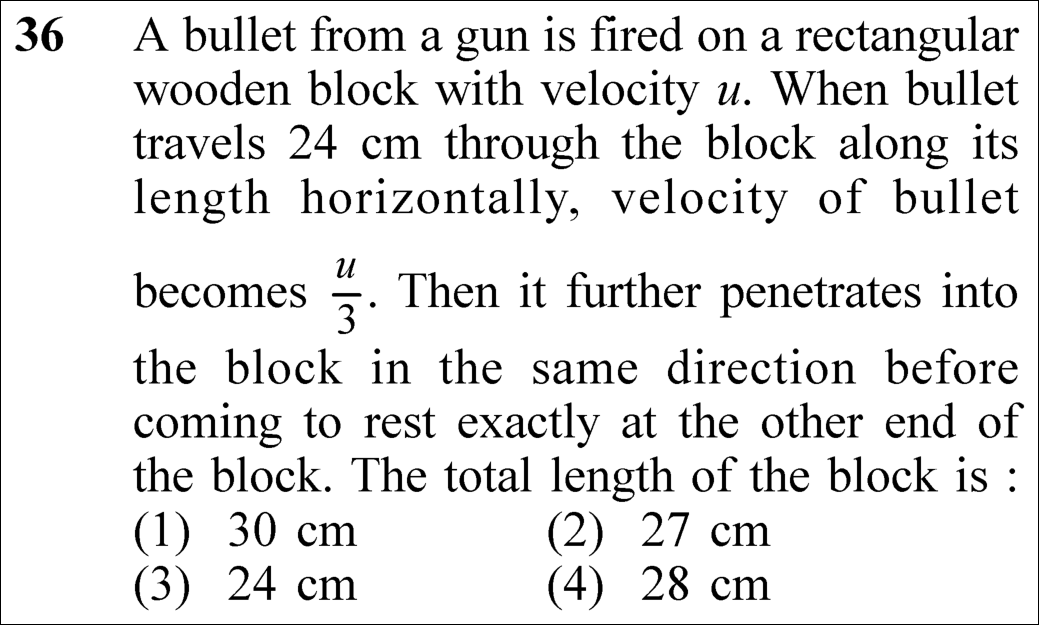
Official NEET 2023 Question 36 - Motion in a Straight Line
1
2 ✓ Key
3
4
💡 Verified Solution & 30-Second Hack
✓
Verified Against NTA Final Answer Key
Option (2) : 27 cm
📚 Motion in a Straight Line Medium
📋 Given Parameters & Problem Setup
Initial bullet velocity u
Distance travelled in stage 1 (s₁) 24 cm
Velocity after stage 1 (v₁) u / 3
Final velocity at other end (v₂) 0 (comes to rest)
⚡

The 30-Second Exam Hall Shortcut: ⚡ Kinematic Ratio Hack: v² = u² - 2as

⏱️ Save ~60 seconds

Kinetic energy lost in 24 cm is u² - (u/3)² = (8/9)u². Remaining KE is (1/9)u² (which is 1/8th of the lost KE). Thus extra distance = 24 / 8 = 3 cm. Total length = 24 + 3 = 27 cm in 20 seconds!

1 Work done by retarding force is proportional to distance: F · s = ΔK.
2 Initial KE is proportional to u².
3 After 24 cm, KE is proportional to (u/3)² = u² / 9.
4 KE lost over 24 cm = u² - u²/9 = (8/9) u² ⟹ (8/9) u² requires 24 cm.
5 Therefore, each (1/9) u² of kinetic energy requires 24 / 8 = 3 cm of penetration.
6 The remaining kinetic energy to be lost before stopping is exactly (1/9) u².
7 Additional distance = 3 cm ⟹ Total length of block = 24 cm + 3 cm = 27 cm.
8 Select Option (2) 27 cm!
🛡️
Why You Can 100% Trust This Shortcut: Work-Energy Theorem / Kinematics (Uniform retarding force produces uniform loss of kinetic energy directly proportional to penetration distance).
📐

Step-by-Step Rigorous Workflow & Mathematical Proof

Step 1

Application of Third Equation of Motion to First Stage

Assuming a uniform resisting force and therefore a constant deceleration a throughout the wooden block, use the third equation of motion v² = u² - 2as for the first stage where the bullet enters with velocity u, travels s₁ = 24 cm, and reduces its velocity to v₁ = u/3:

(u3)2=u2−2as1  ⟹  u29=u2−2a(24)\left(\frac{u}{3}\right)^2 = u^2 - 2a s_1 \implies \frac{u^2}{9} = u^2 - 2a (24)
Step 2

Isolation of Deceleration Term (2a)

Rearranging the equation to find the retarding acceleration term 2a:

48a=u2−u29=89u2  ⟹  2a=8u29×24=u22748a = u^2 - \frac{u^2}{9} = \frac{8}{9} u^2 \implies 2a = \frac{8 u^2}{9 \times 24} = \frac{u^2}{27}
Step 3

Calculation of Total Stopping Distance s

For the bullet to come to complete rest (v = 0) from its initial velocity u over the total length of the block s:

02=u2−2as  ⟹  2as=u2  ⟹  s=u22a0^2 = u^2 - 2a s \implies 2a s = u^2 \implies s = \frac{u^2}{2a}
Step 4

Substitution to Find Total Block Length

Substitute the value of 2a into the stopping distance equation:

s=u2u227=27 cms = \frac{u^2}{\frac{u^2}{27}} = 27\text{ cm}
⭐

360° Option Elimination Engine Key Feature

Diagnose every choice: Know exactly why the right option works and why distractors fail.

4-Option Deep Scan
1 (1)
✗ Incorrect
Verdict & Scientific Reason:

Overestimates stopping distance.

⚠️
Student Fallacy (Why candidates pick this trap): Candidate made an arithmetic error in the fraction.
2 (2)
✓ 100% Correct
Verdict & Scientific Reason:

Accurate total block length: 24 cm initial + 3 cm additional = 27 cm.

💡
Why this is airtight: None. Candidate correctly determined total stopping distance.
3 (3)
✗ Incorrect
Verdict & Scientific Reason:

This is merely the first-stage distance, not the total length.

⚠️
Student Fallacy (Why candidates pick this trap): Candidate mistook stage 1 distance for total length.
4 (4)
✗ Incorrect
Verdict & Scientific Reason:

Arithmetic slip.

⚠️
Student Fallacy (Why candidates pick this trap): Candidate incorrectly calculated extra distance as 4 cm instead of 3 cm.
⚠️

NTA Trap Alert: Reporting Additional Distance (3 cm) Instead of Total Length (27 cm)

Some candidates solve for the additional distance Δs = 3 cm, and looking for 3 cm get confused when it is not in the options, or add it incorrectly to 24. The question specifically asks for the "TOTAL length of the block", which is 24 + 3 = 27 cm.

🛡️ How to avoid the -1 mark: Read the question prompt carefully: "total length of the block" means total stopping distance s = 27 cm.
📖

Core NEET Syllabus Standard

National Eligibility cum Entrance Test (NEET UG) · Motion in a Straight Line Standard Benchmark
Core Scientific Principle Tested:

"Stopping distance under constant deceleration satisfies v² = u² - 2as, where distance is proportional to kinetic energy lost."

Syllabus Focus: Kinematic Equations for Uniformly Accelerated Motion
Preserved in Rationalized Curriculum Syllabus & Academic Standards ↗
NEET 2023 · Q38 Easy
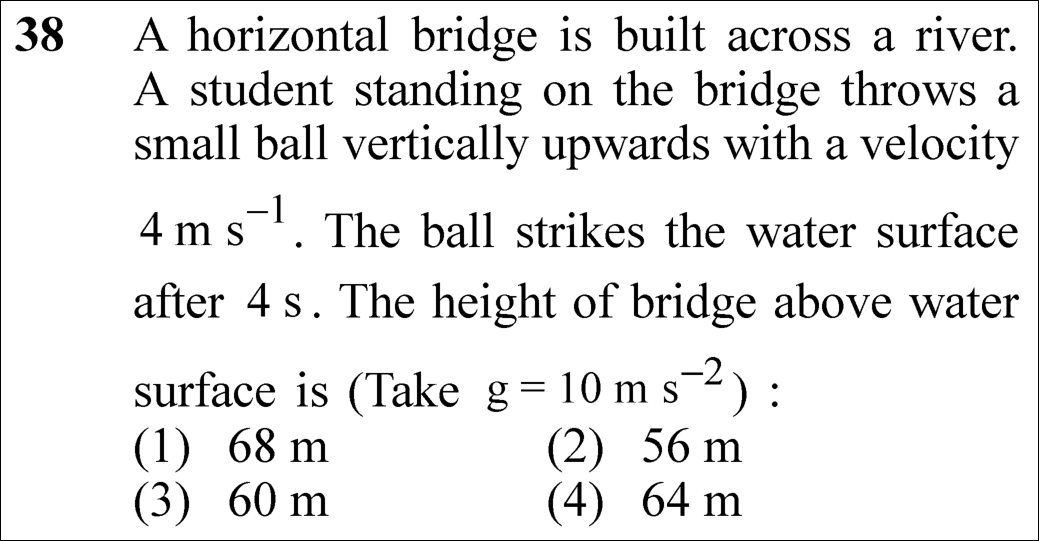
Official NEET 2023 Question 38 - Motion in a Straight Line
1
2
3
4 ✓ Key
💡 Verified Solution & 30-Second Hack
✓
Verified Against NTA Final Answer Key
Option (4) : 64 m
📚 Motion in a Straight Line Easy
📋 Given Parameters & Problem Setup
Initial upward velocity (u) +4 m s⁻¹
Acceleration due to gravity (g) -10 m s⁻² (downward)
Total time to strike water (t) 4 s
Height of bridge (h) To be determined (|s|)
⚡

The 30-Second Exam Hall Shortcut: ⚡ Single-Step Displacement Vector Hack: s = ut - ½gt²

⏱️ Save ~40 seconds

s = (+4)(4) - ½(10)(4²) = 16 - 80 = -64 m ⟹ Bridge height is exactly 64 m in 10 seconds! (No need to split into upward and downward stages).

1 Choose the bridge level as reference origin (y = 0) with upward direction positive.
2 Initial velocity u = +4 m/s; acceleration a = -g = -10 m/s²; time t = 4 s.
3 Use kinematic displacement formula: s = ut + ½at².
4 Substitute values: s = (4 × 4) - 0.5 × 10 × (4)² = 16 - 80 = -64 m.
5 The negative sign denotes that the water surface lies 64 m below the bridge.
6 Lock Option (4) 64 m immediately!
🛡️
Why You Can 100% Trust This Shortcut: Classical Kinematics · Vector Displacement Under Constant Acceleration (Displacement depends strictly on initial and final positions, regardless of path reversals).
📐

Step-by-Step Rigorous Workflow & Mathematical Proof

Step 1

Choice of Coordinate Reference Frame

Set the initial release point on the bridge as the coordinate origin y = 0. Choose the vertically upward direction as the positive y-axis. Downward vectors (acceleration due to gravity and downward displacement) carry a negative sign.

y0=0,u=+4 m s−1,a=−g=−10 m s−2y_0 = 0, \quad u = +4\text{ m s}^{-1}, \quad a = -g = -10\text{ m s}^{-2}
Step 2

Second Kinematic Equation for Net Displacement

The net vertical position (displacement) y(t) of a particle moving under constant gravitational acceleration at time t is governed by:

y(t)=ut+12at2=ut−12gt2y(t) = u t + \frac{1}{2} a t^2 = u t - \frac{1}{2} g t^2
Step 3

Substitution of Given Numerical Parameters

Substitute initial velocity u = 4 m s⁻¹, elapsed time t = 4 s, and g = 10 m s⁻²:

y(4)=(4)(4)−12(10)(4)2=16−5(16)=16−80=−64 my(4) = (4)(4) - \frac{1}{2}(10)(4)^2 = 16 - 5(16) = 16 - 80 = -64\text{ m}
Step 4

Physical Interpretation of Displacement Magnitude

The displacement y = -64 m signifies that the water surface lies 64 m below the level of the bridge. Therefore, the height h of the bridge above the water surface is:

h=∣y∣=64 mh = |y| = 64\text{ m}
⭐

360° Option Elimination Engine Key Feature

Diagnose every choice: Know exactly why the right option works and why distractors fail.

4-Option Deep Scan
1 (1)
✗ Incorrect
Verdict & Scientific Reason:

Result of adding velocities instead of squared time terms.

⚠️
Student Fallacy (Why candidates pick this trap): Candidate made an algebraic error in the displacement equation.
2 (2)
✗ Incorrect
Verdict & Scientific Reason:

Candidate subtracted 4² = 16 incorrectly or used g = 9.8 carelessly.

⚠️
Student Fallacy (Why candidates pick this trap): Arithmetic misstep during subtraction.
3 (3)
✗ Incorrect
Verdict & Scientific Reason:

Candidate computed 80 - 20 = 60 m by rounding initial velocity.

⚠️
Student Fallacy (Why candidates pick this trap): Candidate estimated ut as 20 m instead of 16 m.
4 (4)
✓ 100% Correct
Verdict & Scientific Reason:

Accurate bridge height derived from s = ut - ½gt² = 16 - 80 = -64 m.

💡
Why this is airtight: None. Candidate executed single-step vector displacement.
⚠️

NTA Trap Alert: Splitting into Upward and Downward Paths and Losing Time

Many candidates calculate time to peak (t_up = u/g = 0.4 s), peak height (H = u²/2g = 0.8 m), remaining time (4 - 0.4 = 3.6 s), and downward fall from rest. While physically valid, this multi-stage approach wastes valuable minutes and invites calculation errors.

🛡️ How to avoid the -1 mark: Use the vector displacement formula directly: s = ut + ½at² works across the entire trajectory regardless of turning points.
📖

Core NEET Syllabus Standard

National Eligibility cum Entrance Test (NEET UG) · Motion in a Straight Line Standard Benchmark
Core Scientific Principle Tested:

"Displacement under uniform acceleration is given by s = ut + ½at², preserving directional signs."

Syllabus Focus: Motion Under Gravity and Kinematic Equations
Preserved in Rationalized Curriculum Syllabus & Academic Standards ↗
NEET 2021 · Q8 Easy
Official NEET 2021 Question 8 - Motion in a Straight Line
1
2 ✓ Key
3
4
💡 Verified Solution & 30-Second Hack
✓
Verified Against NTA Final Answer Key
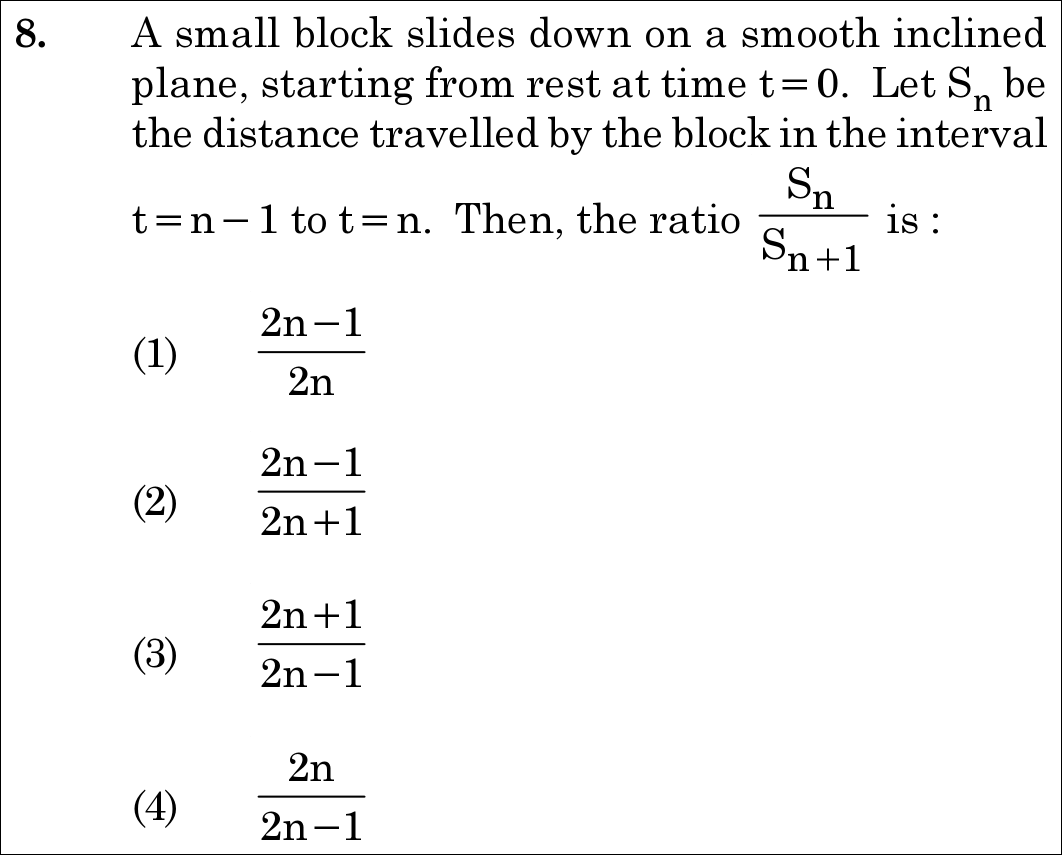
Option (2) : (2n - 1) / (2n + 1)
📚 Motion in a Straight Line Easy
📋 Given Parameters & Problem Setup
Initial Velocity (u) 0 (starts from rest)
Acceleration (a) g sin θ (constant down smooth incline)
Distance S_n Distance in interval t = n - 1 to t = n (n-th second)
Distance S_{n+1} Distance in interval t = n to t = n + 1 ((n+1)-th second)
⚡

The 30-Second Exam Hall Shortcut: ⚡ Galileo's Odd Number Rule for nth Second

⏱️ Save ~20 seconds

For any motion from rest under constant acceleration, distance in successive seconds follows odd integers: Sn∝(2n−1)S_n \propto (2n - 1). For the next second, replace nn with n+1n+1: Sn+1∝2(n+1)−1=2n+1S_{n+1} \propto 2(n+1) - 1 = 2n + 1. The ratio is directly 2n−12n+1\frac{2n - 1}{2n + 1}! Match Option (2)!

1 Standard formula for distance in the nn-th second starting from rest (u=0u = 0): Sn=a2(2n−1)S_n = \frac{a}{2}(2n - 1).
2 For (n+1)(n+1)-th second, replace nn with (n+1)(n+1): Sn+1=a2[2(n+1)−1]=a2(2n+1)S_{n+1} = \frac{a}{2}[2(n+1) - 1] = \frac{a}{2}(2n + 1).
3 Take the ratio: SnSn+1=a2(2n−1)a2(2n+1)=2n−12n+1\frac{S_n}{S_{n+1}} = \frac{\frac{a}{2}(2n - 1)}{\frac{a}{2}(2n + 1)} = \frac{2n - 1}{2n + 1}.
4 Match Option (2).
🛡️
Why You Can 100% Trust This Shortcut: Canonical kinematic equation for distance in the nth unit time interval.
📐

Step-by-Step Rigorous Workflow & Mathematical Proof

Step 1

Formula for Distance Travelled in the n-th Second

For an object moving with initial velocity uu and uniform acceleration aa, the distance covered between time t=n−1t = n-1 and t=nt = n is:

Sn=S(n)−S(n−1)=u+a2(2n−1)S_n = S(n) - S(n-1) = u + \frac{a}{2}(2n - 1)
Step 2

Applying Initial Conditions

Since the block starts from rest on a smooth inclined plane of angle θ\theta, u=0u = 0 and a=gsin⁡θa = g\sin\theta (constant):

Sn=a2(2n−1)S_n = \frac{a}{2}(2n - 1)
Step 3

Finding S_{n+1} and Computing the Ratio

In the interval t=nt = n to t=n+1t = n+1, the distance travelled is Sn+1S_{n+1}:

Sn+1=a2[2(n+1)−1]=a2(2n+1)S_{n+1} = \frac{a}{2}\left[2(n+1) - 1\right] = \frac{a}{2}(2n + 1)
Step 4

Final Ratio

Dividing SnS_n by Sn+1S_{n+1} cancels the common acceleration factor a/2a/2:

SnSn+1=2n−12n+1\frac{S_n}{S_{n+1}} = \frac{2n - 1}{2n + 1}
⭐

360° Option Elimination Engine Key Feature

Diagnose every choice: Know exactly why the right option works and why distractors fail.

4-Option Deep Scan
1 1
✗ Incorrect
Verdict & Scientific Reason:

Incorrect denominator: evaluates Sn+1S_{n+1} erroneously as 2n2n.

⚠️
Student Fallacy (Why candidates pick this trap): Writing 2n2n instead of 2(n+1)−1=2n+12(n+1)-1 = 2n+1.
2 2
✓ 100% Correct
Verdict & Scientific Reason:

Exact ratio of distances in nn-th and (n+1)(n+1)-th intervals.

💡
Why this is airtight: None; textbook kinematic derivation.
3 3
✗ Incorrect
Verdict & Scientific Reason:

Inverted ratio (Sn+1/SnS_{n+1} / S_n).

⚠️
Student Fallacy (Why candidates pick this trap): Inverting numerator and denominator.
4 4
✗ Incorrect
Verdict & Scientific Reason:

Inverted and miscalculated ratio.

⚠️
Student Fallacy (Why candidates pick this trap): Confusing total distance up to time nn with distance in nn-th second.
⚠️

NTA Trap Alert: Total Distance vs. Distance in nth Second Trap

Students frequently confuse total distance in nn seconds (S=12at2∝n2S = \frac{1}{2}at^2 \propto n^2) with distance in the nn-th second (Sn=a2(2n−1)S_n = \frac{a}{2}(2n-1)).

🛡️ How to avoid the -1 mark: The interval from n−1n-1 to nn is the nn-th second: Sn=a2(2n−1)S_n = \frac{a}{2}(2n-1).
📖

Core NEET Syllabus Standard

NCERT Physics · Motion in a Straight Line Standard Benchmark
Core Scientific Principle Tested:

"Distance travelled in the nn-th second of uniformly accelerated motion from rest is Sn=a2(2n−1)S_n = \frac{a}{2}(2n - 1)."

Syllabus Focus: Kinematic Equations for Uniformly Accelerated Motion
✓ Core NEET UG Syllabus Anchor Syllabus & Academic Standards ↗
NEET 2020 · Q177 Easy
Official NEET 2020 Question 177 - Motion in a Straight Line
1
2
3
4 ✓ Key
💡 Verified Solution & 30-Second Hack
✓
Verified Against NTA Final Answer Key
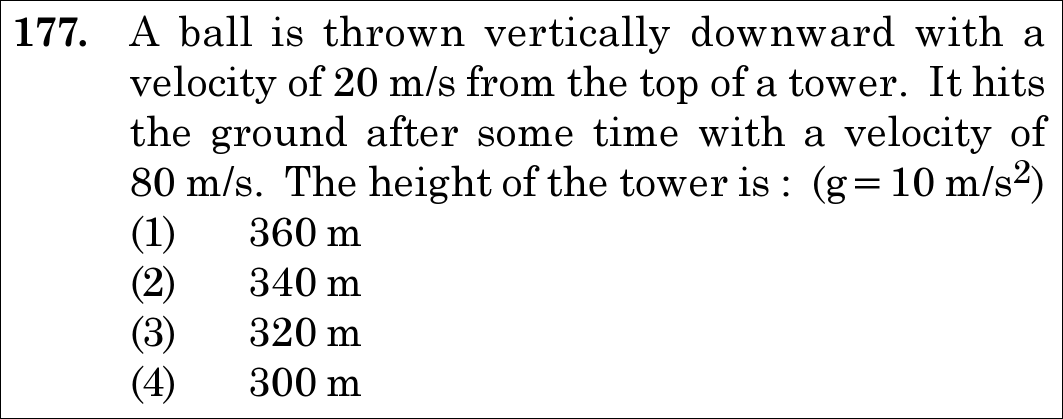
Option (4) : 300 m
📚 Motion in a Straight Line Easy
📋 Given Parameters & Problem Setup
Initial Downward Speed (u) 20 m/s
Final Speed on Ground (v) 80 m/s
Acceleration due to Gravity (g) 10 m/s^2
⚡

The 30-Second Exam Hall Shortcut: ⚡ "v^2 = u^2 + 2 g h => h = (v^2 - u^2) / (2g) = (80^2 - 20^2) / 20 = (6400 - 400) / 20 = 6000 / 20 = 300 m!"

⏱️ 20 seconds

Using the third kinematic relation v^2 = u^2 + 2gh: h = (v^2 - u^2) / (2g) = (80^2 - 20^2) / (2 × 10) = (6400 - 400) / 20 = 6000 / 20 = 300 m. Instant 5-second calculation for Option (4)!

1 Formula: v2=u2+2ghv^2 = u^2 + 2 g h.
2 Rearrange for height: h=v2−u22gh = \frac{v^2 - u^2}{2g}.
3 Substitute: v=80 m/sv = 80\text{ m/s}, u=20 m/su = 20\text{ m/s}, g=10 m/s2g = 10\text{ m/s}^2.
4 Compute: h=6400−40020=600020=300 mh = \frac{6400 - 400}{20} = \frac{6000}{20} = 300\text{ m}.
5 Select Option (4).
🛡️
Why You Can 100% Trust This Shortcut: NCERT Physics · Motion in a Straight Line (Kinematic Equations for Uniform Acceleration)
📐

Step-by-Step Rigorous Workflow & Mathematical Proof

Step 1

Identify Kinematic Parameters

Choose downward direction as positive: - Initial velocity: u=+20 m/su = +20\text{ m/s} - Final velocity upon hitting ground: v=+80 m/sv = +80\text{ m/s} - Acceleration: a=+g=+10 m/s2a = +g = +10\text{ m/s}^2 - Displacement: s=hs = h (height of the tower).

Step 2

Select Third Equation of Motion

Because time tt is not specified, use the work-energy / kinematic relation independent of time: v2=u2+2ghv^2 = u^2 + 2 g h.

Step 3

Solve for Height h

h=v2−u22g=(80)2−(20)22×10=6400−40020=600020=300 mh = \frac{v^2 - u^2}{2g} = \frac{(80)^2 - (20)^2}{2 \times 10} = \frac{6400 - 400}{20} = \frac{6000}{20} = 300\text{ m}.

Step 4

Conclude and Verify

Matches Option 4.

⭐

360° Option Elimination Engine Key Feature

Diagnose every choice: Know exactly why the right option works and why distractors fail.

4-Option Deep Scan
1 A
✗ Incorrect
Verdict & Scientific Reason:

Incorrect; arithmetic sign and calculation error.

⚠️
Student Fallacy (Why candidates pick this trap): Using (6400 + 400)/20 and miscalculating.
2 B
✗ Incorrect
Verdict & Scientific Reason:

Incorrect; mistakenly adds initial kinetic energy (v^2 + u^2)/20 = (6400 + 400)/20 = 340 m.

⚠️
Student Fallacy (Why candidates pick this trap): Adding instead of subtracting u^2.
3 C
✗ Incorrect
Verdict & Scientific Reason:

Incorrect; assumes the ball was dropped from rest (u = 0): 80^2 / 20 = 320 m.

⚠️
Student Fallacy (Why candidates pick this trap): Ignoring the initial downward speed of 20 m/s.
4 D
✓ 100% Correct
Verdict & Scientific Reason:

Accurate value; h = (80^2 - 20^2)/20 = 6000 / 20 = 300 m.

💡
Why this is airtight: None; correct application of v^2 = u^2 + 2gh.
⚠️

NTA Trap Alert: Dropped vs Thrown Downward

Students often assume u = 0, giving h = 80^2 / 20 = 320 m (Option C). The question clearly states it was THROWN downward with 20 m/s!

🛡️ How to avoid the -1 mark: Look for initial velocity keywords: 'dropped' means u = 0; 'thrown' means u != 0.
📖

Core NEET Syllabus Standard

Physics · Motion in a Straight Line Standard Benchmark
Core Scientific Principle Tested:

""

Syllabus Focus: Height of a Tower from Initial Downward Velocity and Impact Speed
✓ Core NEET UG Syllabus Anchor Syllabus & Academic Standards ↗

Solve 4 NEET Questions a Day — One per Subject

Cover all 1,140 official NEET questions in 285 days at your own pace. Progress is saved on your device. No login needed.