MyCompetitiveExams Logo MyCompetitiveExams
Search 1,140+ Questions
Chapters, formulas, speed tricks
→
⚡ Brahmastra NEET 2027
720 MARKS

Dynamic 180-question full-length simulator mixed dynamically from all 6 years for 2027 & 2026 aspirants.

Launch Brahmastra 2027 Test →
Start Practice →
100% Free · No Login Required
Q.21 Physics ⭐ 360° Option Elimination Active
Vault ↗

NEET 2025 Physics Question 21 Solution

Topic: Motion in a Straight Line · Official NTA Booklet Code 45
NEET 2025 Physics Question 21: Bus Service Scheduling & Relative Velocity

Question

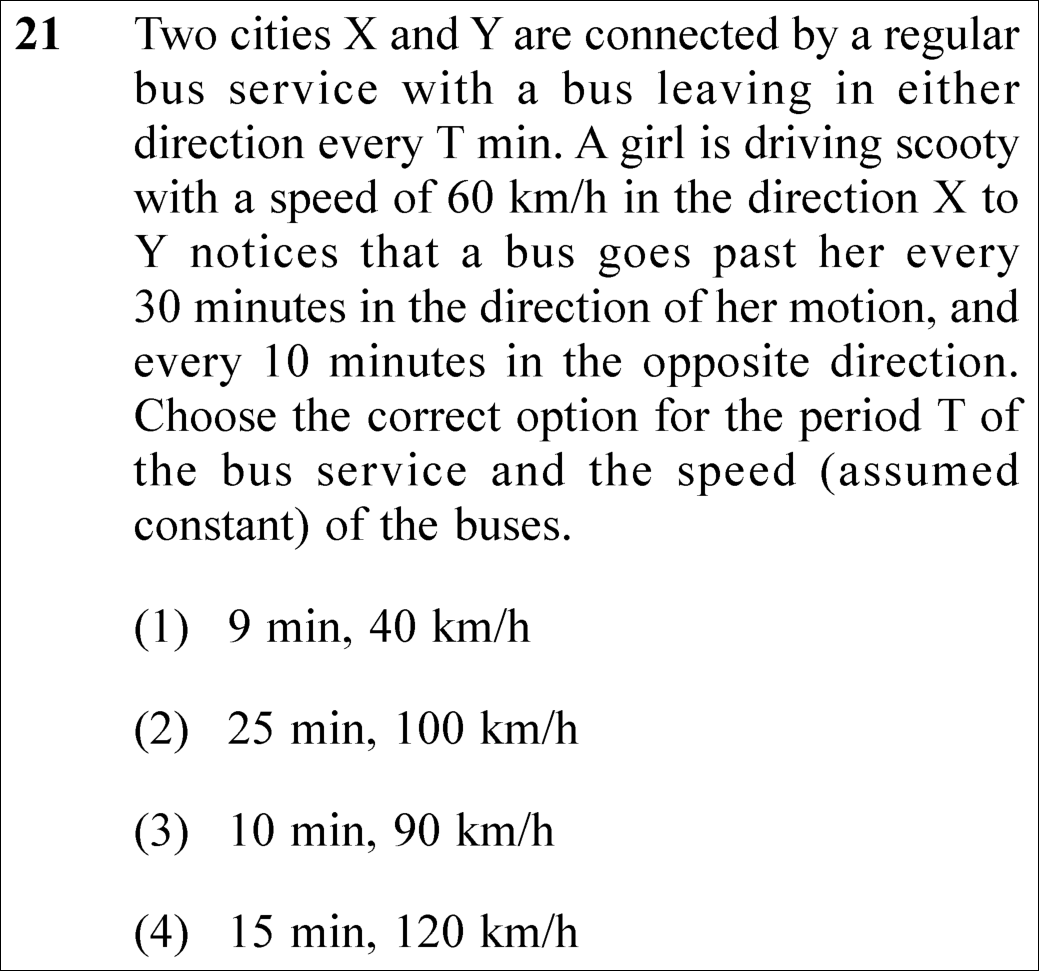
Two cities X and Y are connected by a regular bus service with a bus leaving in either direction every T min. A girl is driving scooty with a speed of 60 km/h in the direction X to Y notices that a bus goes past her every 30 minutes in the direction of her motion, and every 10 minutes in the opposite direction. Choose the correct option for the period T of the bus service and the speed (assumed constant) of the buses.

✓
Verified Against NTA Final Answer Key
Option (4) : 15 min, 120 km/h
📚 Motion in a Straight Line Medium
📋 Given Parameters & Problem Setup
Bus Interval Leaves every T minutes in either direction
Girl’s Speed (v_g) 60 km/h from X to Y
Overtaking Interval (Same Direction) t₁ = 30 minutes
Crossing Interval (Opposite Direction) t₂ = 10 minutes
⚡

The 30-Second Exam Hall Shortcut: ⚡ Bus Schedule Sum-and-Difference Rule

⏱️ Save ~50 seconds

(v_b - 60) × 30 = (v_b + 60) × 10 ⟹ 3(v_b - 60) = v_b + 60 ⟹ 2v_b = 240 ⟹ v_b = 120 km/h! T = (120 - 60) × 30 / 120 = 15 min!

1 Spatial distance between consecutive buses in same direction: d = v_b · T.
2 In same direction: relative speed is (v_b - 60), time is 30 min ⟹ d = (v_b - 60) × 30.
3 In opposite direction: relative speed is (v_b + 60), time is 10 min ⟹ d = (v_b + 60) × 10.
4 Equate: 30(v_b - 60) = 10(v_b + 60) ⟹ 3v_b - 180 = v_b + 60 ⟹ 2v_b = 240 ⟹ v_b = 120 km/h.
5 Calculate T: d = 120 × T = (120 - 60) × 30 = 1800 ⟹ T = 1800 / 120 = 15 min.
6 Pick Option (4) in under 25 seconds!
🛡️
Why You Can 100% Trust This Shortcut: Equations of Motion under Constant Acceleration (NCERT Physics · Motion in a Straight Line: v = u + at, s = ut + ½at²).
📐

Step-by-Step Rigorous Workflow & Mathematical Proof

Step 1

Formulate Distance Between Consecutive Buses

Buses depart in either direction every T minutes at constant speed v_b. The spatial separation between any two successive buses traveling in the same direction is constant:

d=vb⋅Td = v_b \cdot T
  • • T is in minutes; v_b is in km/h.
Step 2

Equations of Relative Motion

For motion in the same direction, the relative speed is (v_b - 60) km/h and the time taken to cover distance d is 30 minutes. For motion in the opposite direction, relative speed is (v_b + 60) km/h and time is 10 minutes:

d=(vb−60)×30=(vb+60)×10d = (v_b - 60) \times 30 = (v_b + 60) \times 10
  • • 3(v_b - 60) = v_b + 60 ⟹ 3v_b - 180 = v_b + 60 ⟹ 2v_b = 240 ⟹ v_b = 120 km/h.
Step 3

Calculate Bus Departure Interval T

Substitute v_b = 120 km/h back into either distance expression:

120⋅T=(120−60)×30=60×30=1800  ⟹  T=1800120=15 minutes120 \cdot T = (120 - 60) \times 30 = 60 \times 30 = 1800 \implies T = \frac{1800}{120} = 15\text{ minutes}
  • • Bus speed = 120 km/h, Bus interval T = 15 min.
  • • Corresponds uniquely to Option (4).
⭐

360° Option Elimination Engine Key Feature

Diagnose every choice: Know exactly why the right option works and why distractors fail.

4-Option Deep Scan
1 A
✗ Incorrect
Verdict & Scientific Reason:

Incorrect. A bus speed of 40 km/h is less than the girl’s speed (60 km/h), so buses going in her direction could never overtake her.

⚠️
Student Fallacy (Why candidates pick this trap): Ignoring the physical constraint that v_b must exceed v_girl to overtake.
2 B
✗ Incorrect
Verdict & Scientific Reason:

Incorrect. Does not satisfy relative distance equations.

⚠️
Student Fallacy (Why candidates pick this trap): Arbitrary guess.
3 C
✗ Incorrect
Verdict & Scientific Reason:

Incorrect. For v_b = 90 km/h, same-direction relative speed is 30 km/h; ratio would not yield 30 min.

⚠️
Student Fallacy (Why candidates pick this trap): Algebraic slip in 2v_b = 240.
4 D
✓ 100% Correct
Verdict & Scientific Reason:

100% correct. v_b = 120 km/h and T = 15 min satisfy both relative motion equations.

💡
Why this is airtight: None; classic NCERT problem.
⚠️

NTA Trap Alert: v_bus Less Than v_girl Impossibility

Option (1) gives v_b = 40 km/h. If the bus travels at 40 km/h and the girl travels at 60 km/h, a bus behind her could NEVER overtake her! Eliminating options with v_b ≤ 60 immediately rules out Option 1.

🛡️ How to avoid the -1 mark: Sanity check: Overtaking requires v_bus > v_girl.
📖

Core NEET Syllabus Standard

NEET Physics Core Syllabus · Motion in a Straight Line Standard Benchmark
Core Scientific Principle Tested:

"Relative velocity v_rel = v₁ - v₂ for same direction and v₁ + v₂ for opposite direction."

Syllabus Focus: Relative Velocity in One Dimension
✓ Core NEET UG Syllabus Anchor Syllabus & Academic Standards ↗
30(v - 60) = 10(v + 60) ⟹ 2v = 240 ⟹ v = 120 km/h and T = 15 min!

Ready to attempt under real exam pressure?

Test your speed and accuracy in the authentic 180-minute timed NTA simulator.

Launch NEET 2025 CBT Test →

Spotted a mistake in this solution? Report an error (support@mycompetitiveexams.com)

⚖️ Legal & Fair Dealing Notice: Sourced from publicly released NEET 2025 question papers and NEET answer keys for private study, research, and non-commercial educational practice under Fair Dealing (Section 52(1)(a) of the Indian Copyright Act, 1957). Not affiliated with or endorsed by NTA or NMC.

Solve 4 NEET Questions a Day — One per Subject

Cover all 1,140 official NEET questions in 285 days at your own pace. Progress is saved on your device. No login needed.