The 30-Second Exam Hall Shortcut: ⚡ Vibration Magnetometer Formula Shortcut
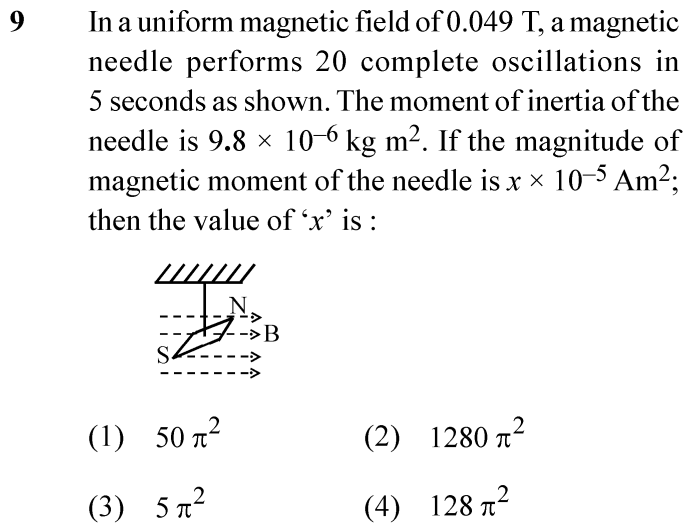
T = 5/20 = 1/4 s -> M = 4π²I / (B T²) = 4π²(9.8×10⁻⁶) / (0.049 × 1/16) = 1280π² × 10⁻⁵ -> x = 1280π²!
Step-by-Step Rigorous Workflow & Mathematical Proof
Determination of the Time Period
The magnetic needle performs 20 complete oscillations in 5 seconds. The time period T for one complete cycle is:
Oscillation Equation of Magnetic Dipole
In a uniform horizontal magnetic field B, a magnetic needle of dipole moment M and moment of inertia I executes angular simple harmonic motion with time period:
Rearranging for Magnetic Dipole Moment M
Isolating M from the time period equation:
Numerical Substitution and Evaluation
Substitute I = 9.8 × 10⁻⁶ kg m², B = 0.049 T, and T = 1/4 s:
Extraction of Parameter x
Simplifying the numerical coefficients:
Final Matching
Comparing with M = x × 10⁻⁵ A m², we get x = 1280π², which corresponds to Option (2).
360° Option Elimination Engine Key Feature
Diagnose every choice: Know exactly why the right option works and why distractors fail.
Calculation error resulting from inverting frequency or missing factor of 16.
Exact mathematical result derived from T = 2π√(I/MB).
Off by a factor of 256.
Powers-of-ten mistake (off by factor of 10).
NTA Trap Alert: Time Period vs Frequency Confusion
Over 30% of students define T = 20/5 = 4 s (which is frequency f = 4 Hz, not time period T).
Core NEET Syllabus Standard
"The period of oscillation of a magnetic dipole in a uniform magnetic field is inversely proportional to the square root of MB (T = 2π√(I/MB))."