MyCompetitiveExams Logo MyCompetitiveExams
Search 1,140+ Questions
Chapters, formulas, speed tricks
→
⚡ Brahmastra NEET 2027
720 MARKS

Dynamic 180-question full-length simulator mixed dynamically from all 6 years for 2027 & 2026 aspirants.

Launch Brahmastra 2027 Test →
Start Practice →
100% Free · No Login Required
🧪 Chemistry ⭐ High Weightage (~2–3 Qs/Year)

NEET Equilibrium Previous Year Questions with Solutions

Complete repository of official NTA NEET questions for Equilibrium from 2020 to 2026. Every question includes 30-second elimination tricks, step-by-step NCERT solutions, option-by-option traps, and official answer keys.

10 Questions 6 Exam Years (2026, 2025, 2024, 2023, 2021, 2020) 8 Easy · 2 Medium · 0 Challenging
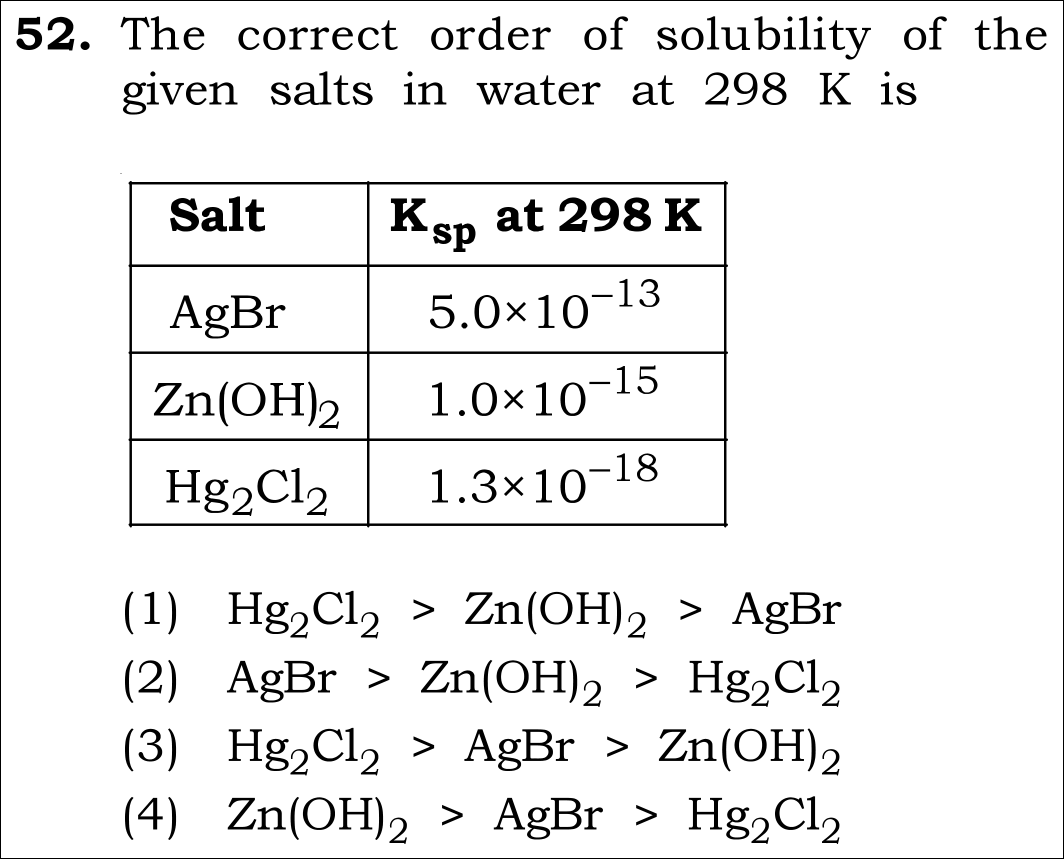
NEET 2026 · Q52 Medium
Official NEET 2026 Question 52 - Equilibrium
1
2
3
4 ✓ Key
💡 Verified Solution & 30-Second Hack
✓
Verified Against NTA Final Answer Key
Option (4) : Zn(OH)₂ > AgBr > Hg₂Cl₂
📚 Equilibrium Medium
📋 Given Parameters & Problem Setup
Salt 1: AgBr K_sp = 5.0 × 10⁻¹³
Salt 2: Zn(OH)₂ K_sp = 1.0 × 10⁻¹⁵
Salt 3: Hg₂Cl₂ K_sp = 1.3 × 10⁻¹⁸
Temperature 298 K
⚡

The 30-Second Exam Hall Shortcut: ⚡ Molar Solubility Cube-Root vs Square-Root Diagnostic

⏱️ Save ~75 seconds

Do NOT compare Ksp values directly for different salt stoichiometries!

1 AgBr is an AB type salt: S = sqrt(K_sp) = sqrt(5.0 × 10⁻¹³) = sqrt(50 × 10⁻¹⁴) ≈ 7.1 × 10⁻⁷ M.
2 Zn(OH)₂ is an AB₂ type salt: K_sp = 4S³ -> S = (1.0 × 10⁻¹⁵ / 4)^(1/3) = (250 × 10⁻¹⁸)^(1/3) ≈ 6.3 × 10⁻⁶ M.
3 Hg₂Cl₂ dissociates as Hg₂²⁺ + 2Cl⁻ (also 4S³): S = (1.3 × 10⁻¹⁸ / 4)^(1/3) = (0.325 × 10⁻¹⁸)^(1/3) ≈ 0.69 × 10⁻⁶ M = 6.9 × 10⁻⁷ M.
4 Compare: S[Zn(OH)₂] (~6.3 × 10⁻⁶) > S[AgBr] (~7.1 × 10⁻⁷) > S[Hg₂Cl₂] (~6.9 × 10⁻⁷).
5 Option (4) is undeniably the correct solubility order!
🛡️
Why You Can 100% Trust This Shortcut: Solubility must always be expressed as molar concentration S (mol/L) derived from the specific equilibrium dissociation equation of each electrolyte.
📐

Step-by-Step Rigorous Workflow & Mathematical Proof

Step 1

Calculate Molar Solubility of AgBr (AB-type electrolyte)

Silver bromide dissociates into one silver cation and one bromide anion.

AgBr(s)⇌Ag++Br−  ⟹  Ksp=S12\text{AgBr}(s) \rightleftharpoons \text{Ag}^+ + \text{Br}^- \implies K_{\text{sp}} = S_1^2
  • • S₁ = sqrt(5.0 × 10⁻¹³) = sqrt(50 × 10⁻¹⁴) ≈ 7.07 × 10⁻⁷ mol L⁻¹.
Step 2

Calculate Molar Solubility of Zn(OH)₂ (AB₂-type electrolyte)

Zinc hydroxide dissociates into one Zn²⁺ cation and two OH⁻ anions.

Zn(OH)2(s)⇌Zn2++2OH−  ⟹  Ksp=(S2)(2S2)2=4S23\text{Zn(OH)}_2(s) \rightleftharpoons \text{Zn}^{2+} + 2\text{OH}^- \implies K_{\text{sp}} = (S_2)(2S_2)^2 = 4S_2^3
  • • S₂³ = K_sp / 4 = (1.0 × 10⁻¹⁵) / 4 = 2.5 × 10⁻¹⁶ = 250 × 10⁻¹⁸.
  • • S₂ = (250)^(1/3) × 10⁻⁶ ≈ 6.30 × 10⁻⁶ mol L⁻¹.
Step 3

Calculate Molar Solubility of Hg₂Cl₂ (Calomel, [Hg₂]Cl₂ electrolyte)

Mercurous chloride contains the dimeric mercurous ion Hg₂²⁺ and two chloride ions Cl⁻.

Hg2Cl2(s)⇌Hg22++2Cl−  ⟹  Ksp=[Hg22+][Cl−]2=(S3)(2S3)2=4S33\text{Hg}_2\text{Cl}_2(s) \rightleftharpoons \text{Hg}_2^{2+} + 2\text{Cl}^- \implies K_{\text{sp}} = [\text{Hg}_2^{2+}][\text{Cl}^-]^2 = (S_3)(2S_3)^2 = 4S_3^3
  • • S₃³ = K_sp / 4 = (1.3 × 10⁻¹⁸) / 4 = 0.325 × 10⁻¹⁸.
  • • S₃ = (0.325)^(1/3) × 10⁻⁶ ≈ 0.687 × 10⁻⁶ mol L⁻¹ = 6.87 × 10⁻⁷ mol L⁻¹.
Step 4

Compare the Molar Solubilities

Arranging the three solubilities: S[Zn(OH)₂] = 63.0 × 10⁻⁷ M S[AgBr] = 7.07 × 10⁻⁷ M S[Hg₂Cl₂] = 6.87 × 10⁻⁷ M Therefore: Zn(OH)₂ > AgBr > Hg₂Cl₂.

6.30×10⁻⁶>7.07×10⁻⁷>6.87×10⁻⁷  ⟹  Zn(OH)2>AgBr>Hg2Cl26.30 \times 10^{-6} > 7.07 \times 10^{-7} > 6.87 \times 10^{-7} \implies \text{Zn(OH)}_2 > \text{AgBr} > \text{Hg}_2\text{Cl}_2
  • • Matches Option (4).
⭐

360° Option Elimination Engine Key Feature

Diagnose every choice: Know exactly why the right option works and why distractors fail.

4-Option Deep Scan
1 A
✗ Incorrect
Verdict & Scientific Reason:

Incorrect. Hg₂Cl₂ has the lowest solubility among the three.

⚠️
Student Fallacy (Why candidates pick this trap): Assuming higher ion count automatically yields greater solubility without calculating values.
2 B
✗ Incorrect
Verdict & Scientific Reason:

Incorrect. Students pick this if they directly compare Ksp exponents (10⁻¹³ > 10⁻¹⁵), which is invalid for different stoichiometries.

⚠️
Student Fallacy (Why candidates pick this trap): Comparing K_sp numerical values directly without accounting for square-root vs cube-root relationships.
3 C
✗ Incorrect
Verdict & Scientific Reason:

Incorrect. Reverses the true solubility order.

⚠️
Student Fallacy (Why candidates pick this trap): Erroneous mathematical computation of cube roots.
4 D
✓ 100% Correct
Verdict & Scientific Reason:

Exact mathematical result derived from stoichiometric equilibrium relations.

💡
Why this is airtight: None; rigorous calculation.
⚠️

NTA Trap Alert: Directly Comparing Ksp Values Without Stoichiometry

The number one trap in ionic equilibrium: comparing K_sp values of salts with different formulas (AB vs AB₂). A salt with a smaller K_sp can have a much LARGER solubility if it dissociates into more ions.

🛡️ How to avoid the -1 mark: Never rank solubility by K_sp alone unless salts have the identical formula type. Always calculate S.
📖

Core NEET Syllabus Standard

NEET Chemistry Core Syllabus · Equilibrium Standard Benchmark
Core Scientific Principle Tested:

"Solubility S must be calculated via K_sp = x^x y^y S^(x+y) for salt A_x B_y."
Syllabus Focus: Solubility equilibria of sparingly soluble salts
✓ Core NEET UG Syllabus Anchor Syllabus & Academic Standards ↗
Never judge solubility by Ksp magnitude; calculate S to see true altitude!
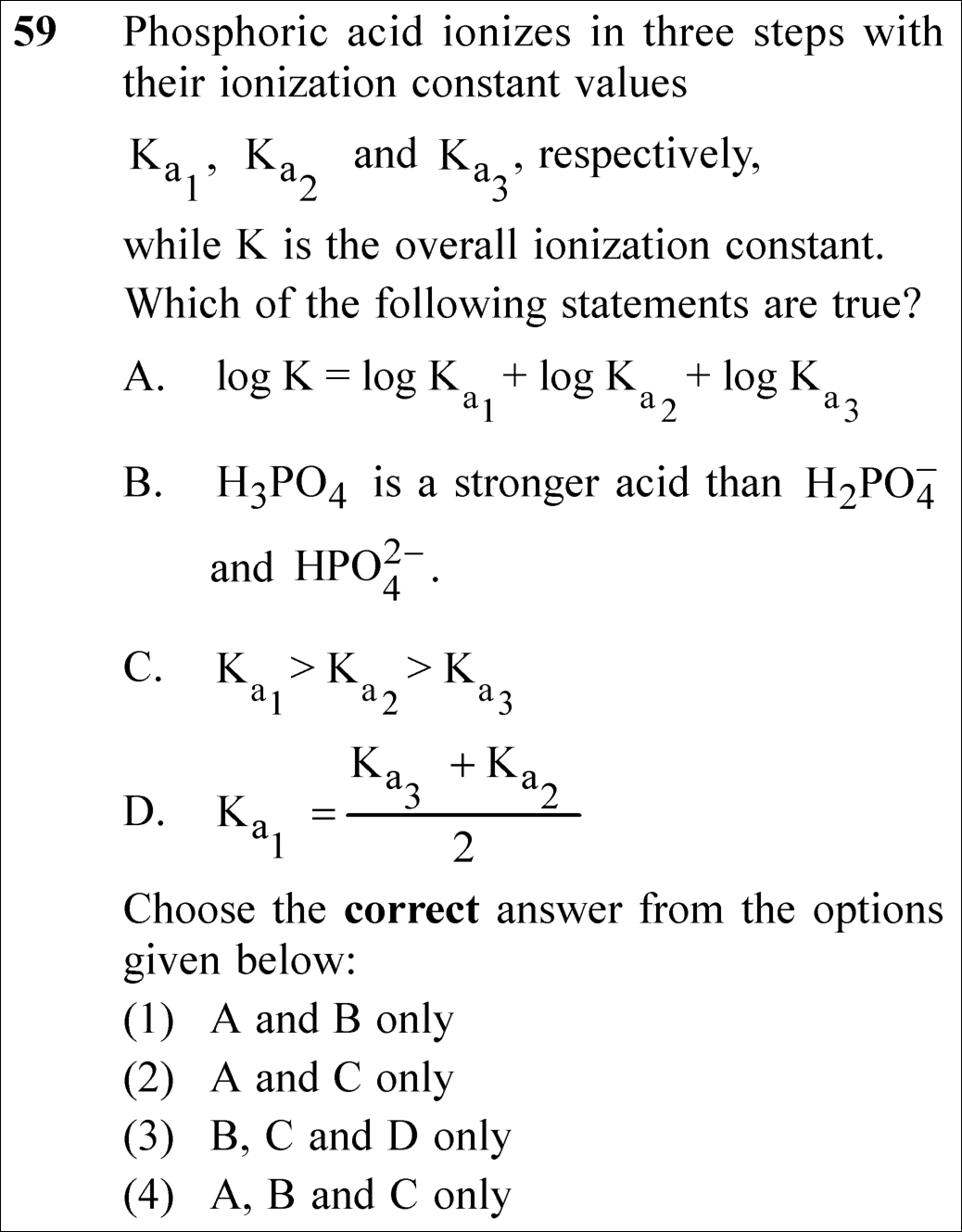
NEET 2025 · Q59 Easy
Official NEET 2025 Question 59 - Equilibrium
1
2
3
4 ✓ Key
💡 Verified Solution & 30-Second Hack
✓
Verified Against NTA Final Answer Key
Option (4) : A, B and C only
📚 Equilibrium Easy
📋 Given Parameters & Problem Setup
Step 1 Ionization Constant K_{a1}
Step 2 Ionization Constant K_{a2}
Step 3 Ionization Constant K_{a3}
Overall Constant K = K_{a1} · K_{a2} · K_{a3}
Statements A: log K = log K_{a1} + log K_{a2} + log K_{a3}; B: H₃PO₄ stronger than H₂PO₄⁻ and HPO₄²⁻; C: K_{a1} > K_{a2} > K_{a3}; D: K_{a1} = (K_{a3} + K_{a2})/2
⚡

The 30-Second Exam Hall Shortcut: ⚡ Polyprotic Acid Ionization Triad

⏱️ Save ~35 seconds

Overall K is the product: K = K₁ K₂ K₃ ⟹ log K = Σ log K_i (A is TRUE)! Neutral acid loses H⁺ much easier than negative anions ⟹ H₃PO₄ is strongest (B is TRUE)! Stepwise constants drop by orders of magnitude: K_{a1} >> K_{a2} >> K_{a3} (C is TRUE)! Arithmetic mean D is absurd! ⟹ A, B, and C only!

1 Recall polyprotic acid equilibrium: For multi-step ionization, the overall equilibrium constant is the PRODUCT of stepwise constants: K = K_{a1} × K_{a2} × K_{a3}.
2 Taking log on both sides: log K = log K_{a1} + log K_{a2} + log K_{a3}. Statement A is TRUE.
3 Acid strength comparison: Removing a proton from neutral H₃PO₄ requires far less energy than from negatively charged H₂PO₄⁻ or doubly charged HPO₄²⁻. Thus H₃PO₄ is a stronger acid than its conjugate species. Statement B is TRUE.
4 Stepwise constants: K_{a1} (7.5 × 10⁻³) >> K_{a2} (6.2 × 10⁻⁸) >> K_{a3} (4.2 × 10⁻¹³). Statement C is TRUE.
5 Statement D proposes an arithmetic average between constants differing by 10⁵, which is mathematically false.
6 Conclusion: A, B and C only are true.
7 Match Option (4) in under 15 seconds!
🛡️
Why You Can 100% Trust This Shortcut: Successive Ionization of Polybasic Acids (NCERT Chemistry · Equilibrium: K_a1 >> K_a2 >> K_a3).
📐

Step-by-Step Rigorous Workflow & Mathematical Proof

Step 1

Stepwise Dissociation of Phosphoric Acid and Product Rule

Phosphoric acid (H₃PO₄) is a tribasic mineral acid ionizing in three consecutive stages:

Overall: H3PO4⇌3H++PO43−,K=Ka1×Ka2×Ka3\text{Overall: } \text{H}_3\text{PO}_4 \rightleftharpoons 3\text{H}^+ + \text{PO}_4^{3-}, \quad K = K_{a1} \times K_{a2} \times K_{a3}
  • • Taking logarithms of both sides converts the multiplication into addition:
  • • \log K = \log K_{a1} + \log K_{a2} + \log K_{a3}.
  • • Thus Statement A is rigorously TRUE.
Step 2

Analyze Relative Acid Strengths (Statement B and C)

Electrostatic principles dictate the relative difficulty of successive proton removals:

Ka1(7.5×10⁻³)≫Ka2(6.2×10⁻⁸)≫Ka3(4.2×10⁻¹³)K_{a1} (7.5 \times 10^{-3}) \gg K_{a2} (6.2 \times 10^{-8}) \gg K_{a3} (4.2 \times 10^{-13})
  • • It is far easier to remove a positively charged proton from a neutral molecule (H₃PO₄) than from a negatively charged ion (H₂PO₄⁻), and even harder from a doubly negative ion (HPO₄²⁻).
  • • Consequently, H₃PO₄ is a significantly stronger acid than H₂PO₄⁻ and HPO₄²⁻ (Statement B is TRUE).
  • • The hierarchy K_{a1} > K_{a2} > K_{a3} holds universally for all polybasic acids (Statement C is TRUE).
Step 3

Evaluate Statement D and Select Option

Statement D asserts that K_{a1} = (K_{a3} + K_{a2}) / 2. Because these equilibrium constants differ by orders of magnitude (10⁻³ vs 10⁻⁸ vs 10⁻¹³), an arithmetic mean is physically and mathematically impossible. Statement D is FALSE.

Statements A, B, and C are TRUE; Statement D is FALSE  ⟹  Option (4)\text{Statements A, B, and C are TRUE; Statement D is FALSE} \implies \text{Option (4)}
  • • Matches Option (4) exactly.
⭐

360° Option Elimination Engine Key Feature

Diagnose every choice: Know exactly why the right option works and why distractors fail.

4-Option Deep Scan
1 A
✗ Incorrect
Verdict & Scientific Reason:

Incorrect. Statement C (K_{a1} > K_{a2} > K_{a3}) is also true.

⚠️
Student Fallacy (Why candidates pick this trap): Omitting statement C.
2 B
✗ Incorrect
Verdict & Scientific Reason:

Incorrect. Statement B is also true.

⚠️
Student Fallacy (Why candidates pick this trap): Doubting whether neutral acid is stronger than its conjugate bases.
3 C
✗ Incorrect
Verdict & Scientific Reason:

Incorrect. Statement D is false and A is omitted.

⚠️
Student Fallacy (Why candidates pick this trap): Believing in an arithmetic average relation between Ka values.
4 D
✓ 100% Correct
Verdict & Scientific Reason:

100% correct. Statements A (log product), B (acid strength), and C (stepwise hierarchy) are true.

💡
Why this is airtight: None; complete mastery of polyprotic acids.
⚠️

NTA Trap Alert: Second-Guessing Relative Acid Strength (Statement B)

Some students hesitate on Statement B, wondering if an amphiprotic anion could somehow act as a stronger acid. Electrostatic attraction ensures neutral parent acid is ALWAYS much stronger than its negative conjugate anions!

🛡️ How to avoid the -1 mark: Law of polyprotic acids: Neutral acid is always strongest: K_{a1} >> K_{a2} >> K_{a3}!
📖

Core NEET Syllabus Standard

NEET Chemistry Core Syllabus · Equilibrium Standard Benchmark
Core Scientific Principle Tested:

"K = K₁·K₂·K₃ ⟹ log K = Σ log K_i; K_{a1} > K_{a2} > K_{a3}."

Syllabus Focus: Ionization of Polybasic Acids and Overall Equilibrium Constant
✓ Core NEET UG Syllabus Anchor Syllabus & Academic Standards ↗
K multiplies (A), neutral is strongest (B), K drops stepwise (C) ⟹ A, B, C are TRUE!
NEET 2025 · Q73 Easy
Official NEET 2025 Question 73 - Equilibrium
1
2
3 ✓ Key
4
💡 Verified Solution & 30-Second Hack
✓
Verified Against NTA Final Answer Key
Option (3) : 0.033
📚 Equilibrium Easy
📋 Given Parameters & Problem Setup
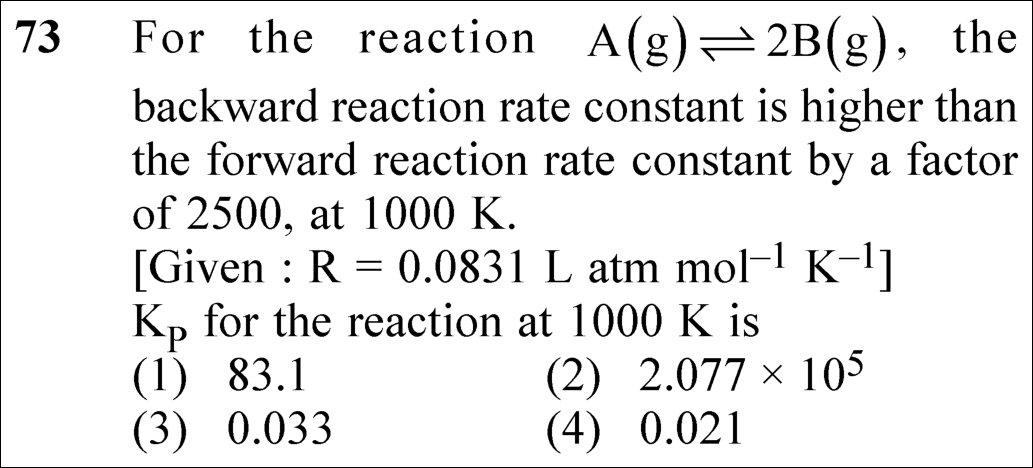
Reaction A(g) ⇌ 2B(g)
Temperature (T) 1000 K
Rate Constant Relation k_b = 2500 × k_f (backward rate constant is 2500 times forward)
Gas Constant (R) 0.0831 L atm mol⁻¹ K⁻¹
⚡

The 30-Second Exam Hall Shortcut: ⚡ K_c to K_p Rapid Conversion

⏱️ Save ~40 seconds

K_c = k_f / k_b = 1 / 2500. Δn_g = 2 - 1 = 1 ⟹ K_p = K_c (RT) = (1 / 2500) × (0.0831 × 1000) = 83.1 / 2500 = 0.03324 ≈ 0.033!

1 Recall definition of equilibrium constant from kinetic rates: K_c = k_forward / k_backward.
2 Given k_b = 2500 k_f ⟹ K_c = 1 / 2500 = 4 × 10⁻⁴.
3 Calculate change in gaseous moles: Δn_g = 2 - 1 = 1.
4 Relation between K_p and K_c: K_p = K_c (R T)^{Δn_g} = K_c (R T)¹.
5 Compute RT: 0.0831 × 1000 = 83.1 L atm mol⁻¹.
6 Compute K_p: K_p = 83.1 / 2500 = (83.1 × 4) / 10000 = 332.4 / 10000 = 0.03324 ≈ 0.033 atm.
7 Select Option (3) in under 15 seconds!
🛡️
Why You Can 100% Trust This Shortcut: Equilibrium Constant Thermodynamic Relationship (NCERT Chemistry · Equilibrium: K_p = K_c(RT)^(Δn_g)).
📐

Step-by-Step Rigorous Workflow & Mathematical Proof

Step 1

Calculate Equilibrium Constant K_c from Rate Constants

At dynamic chemical equilibrium, the rate of the forward reaction equals the rate of the backward reaction:

kf[A]=kb[B]2  ⟹  Kc=[B]2[A]=kfkbk_f [A] = k_b [B]^2 \implies K_c = \frac{[B]^2}{[A]} = \frac{k_f}{k_b}
  • • Given k_b = 2500 k_f, so:
  • • K_c = \frac{k_f}{2500 k_f} = \frac{1}{2500} = 4.0 \times 10^{-4}\text{ mol L}^{-1}.
Step 2

Determine Δn_g and State the K_p - K_c Equation

Calculate the difference between the number of moles of gaseous products and gaseous reactants:

Δng=np(g)−nr(g)=2−1=1\Delta n_g = n_p(g) - n_r(g) = 2 - 1 = 1
  • • The thermodynamic relationship linking K_p and K_c is:
  • • K_p = K_c (R T)^{\Delta n_g} = K_c (R T)^1.
Step 3

Calculate K_p at T = 1000 K

Substitute R = 0.0831 L atm mol⁻¹ K⁻¹, T = 1000 K, and K_c = 1/2500:

Kp=12500×(0.0831×1000)=83.12500=83.1×410000=332.410000=0.03324≈0.033 atmK_p = \frac{1}{2500} \times (0.0831 \times 1000) = \frac{83.1}{2500} = \frac{83.1 \times 4}{10000} = \frac{332.4}{10000} = 0.03324 \approx 0.033\text{ atm}
  • • Matches Option (3) 0.033.
⭐

360° Option Elimination Engine Key Feature

Diagnose every choice: Know exactly why the right option works and why distractors fail.

4-Option Deep Scan
1 A
✗ Incorrect
Verdict & Scientific Reason:

Incorrect. This is the product RT, omitting division by 2500.

⚠️
Student Fallacy (Why candidates pick this trap): Forgetting K_c = 1/2500.
2 B
✗ Incorrect
Verdict & Scientific Reason:

Incorrect. Obtained by multiplying 2500 by 83.1 (using K_c = k_b / k_f instead of k_f / k_b).

⚠️
Student Fallacy (Why candidates pick this trap): Inverting K_c definition as k_b / k_f.
3 C
✓ 100% Correct
Verdict & Scientific Reason:

100% correct. K_p = (1/2500) × 83.1 = 0.03324 ≈ 0.033.

💡
Why this is airtight: None; exact equilibrium kinetics calculation.
4 D
✗ Incorrect
Verdict & Scientific Reason:

Incorrect. Arithmetic approximation error.

⚠️
Student Fallacy (Why candidates pick this trap): Using wrong gas constant value.
⚠️

NTA Trap Alert: Inverting K_c (Multiplying by 2500 instead of Dividing)

The question states that the BACKWARD rate constant is higher than forward by 2500 (k_b = 2500 k_f). This means K_c = k_f / k_b = 1/2500. Candidates who hastily multiply 2500 × 83.1 get 2.077 × 10⁵ (Option 2)!

🛡️ How to avoid the -1 mark: Always write K_c = k_f / k_b: if backward is faster, K_c MUST be << 1!
📖

Core NEET Syllabus Standard

NEET Chemistry Core Syllabus · Equilibrium Standard Benchmark
Core Scientific Principle Tested:

"K_c = k_f / k_b and K_p = K_c (RT)^{Δn_g}."

Syllabus Focus: Relationship Between K_p and K_c
✓ Core NEET UG Syllabus Anchor Syllabus & Academic Standards ↗
Backward is faster ⟹ K_c = 1/2500 ⟹ K_p = 83.1 / 2500 = 0.033 (Option 3)!
NEET 2025 · Q88 Easy
Official NEET 2025 Question 88 - Equilibrium
1
2
3
4 ✓ Key
💡 Verified Solution & 30-Second Hack
✓
Verified Against NTA Final Answer Key
Option (4) : A, C, D only
📚 Equilibrium Easy
📋 Given Parameters & Problem Setup
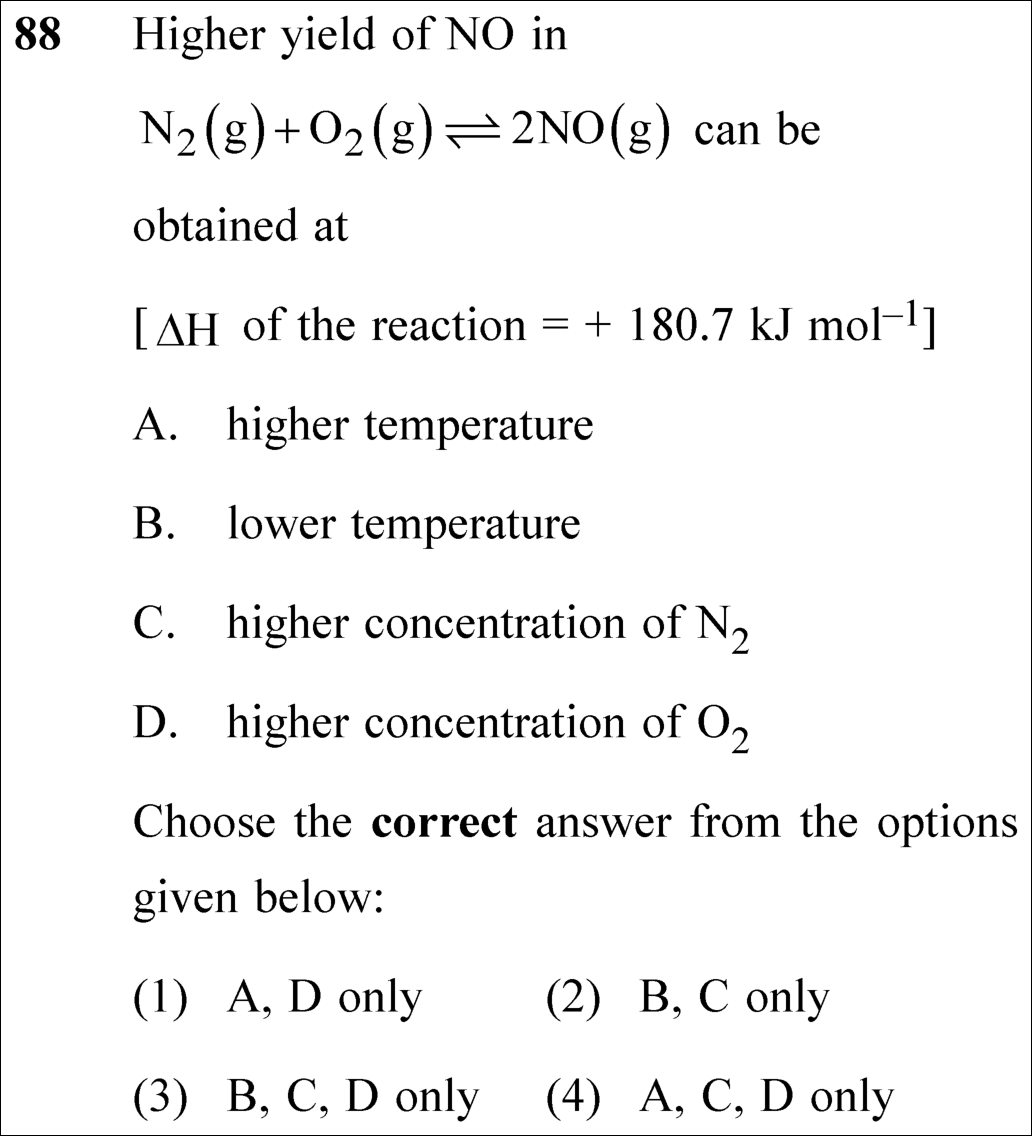
Reversible Reaction N₂(g) + O₂(g) ⇌ 2NO(g)
Reaction Enthalpy (ΔH) +180.7 kJ mol⁻¹ (Endothermic)
Conditions Evaluated A: Higher temperature, B: Lower temperature, C: Higher [N₂], D: Higher [O₂]
⚡

The 30-Second Exam Hall Shortcut: ⚡ Le Chatelier Forward Shift Rule

⏱️ Save ~25 seconds

ΔH is POSITIVE (+180.7 kJ/mol) ⟹ Forward reaction ABSORBS heat! Higher temperature shifts equilibrium FORWARD to higher yield (A is correct)! Adding reactants (higher [N₂] or [O₂]) shifts equilibrium FORWARD to consume them (C and D are correct)! ⟹ A, C, D only!

1 Examine reaction: N₂(g) + O₂(g) ⇌ 2NO(g) with ΔH = +180.7 kJ/mol (endothermic forward reaction).
2 Temperature effect: According to Le Chatelier’s principle, increasing temperature shifts equilibrium in the direction of the endothermic reaction (forward direction) ⟹ Higher yield of NO! Condition A is TRUE; B is FALSE.
3 Concentration effect: Increasing the concentration of reactants ([N₂] or [O₂]) disturbs equilibrium, causing the forward reaction to proceed to consume added reactants ⟹ Higher yield of NO! Conditions C and D are TRUE.
4 Conclusion: Higher yield of NO is obtained at A, C, and D only.
5 Select Option (4) in under 10 seconds!
🛡️
Why You Can 100% Trust This Shortcut: Le Chatelier’s Principle on Chemical Equilibria (NCERT Chemistry · Equilibrium).
📐

Step-by-Step Rigorous Workflow & Mathematical Proof

Step 1

Apply Le Chatelier’s Principle for Temperature Change

For an endothermic reversible reaction (ΔH > 0), absorption of heat accompanies the forward reaction:

N2(g)+O2(g)+Heat⇌2NO(g),ΔH=+180.7 kJ⋅mol−1\text{N}_2(g) + \text{O}_2(g) + \text{Heat} \rightleftharpoons 2\text{NO}(g), \quad \Delta H = +180.7\text{ kJ}\cdot\text{mol}^{-1}
  • • An increase in temperature supplies thermal energy, driving the system to absorb heat by shifting to the right (forward).
  • • Consequently, higher temperature (A) increases the equilibrium constant K_p and enhances the yield of NO.
  • • Condition A is correct; condition B is incorrect.
Step 2

Apply Le Chatelier’s Principle for Reactant Concentrations

Examine the reaction quotient Q_c when reactant concentrations are increased:

Qc=[NO]2[N2][O2]Q_c = \frac{[\text{NO}]^2}{[\text{N}_2][\text{O}_2]}
  • • Increasing [N₂] or [O₂] makes Q_c < K_c, driving the reaction in the forward direction until Q_c = K_c again.
  • • Therefore, higher concentration of N₂ (C) and higher concentration of O₂ (D) both increase the yield of NO.
Step 3

Synthesize the Resulting Favorable Conditions

Combine all favorable operational parameters:

Favorable conditions: Higher Temperature (A)∪Higher [N2] (C)∪Higher [O2] (D)\text{Favorable conditions: } \text{Higher Temperature (A)} \cup \text{Higher [N}_2\text{] (C)} \cup \text{Higher [O}_2\text{] (D)}
  • • Matches Option (4) A, C, D only.
⭐

360° Option Elimination Engine Key Feature

Diagnose every choice: Know exactly why the right option works and why distractors fail.

4-Option Deep Scan
1 A
✗ Incorrect
Verdict & Scientific Reason:

Incorrect. Omits higher concentration of N₂ (C).

⚠️
Student Fallacy (Why candidates pick this trap): Leaving out condition C.
2 B
✗ Incorrect
Verdict & Scientific Reason:

Incorrect. Lower temperature (B) favors the backward exothermic reaction, reducing NO yield.

⚠️
Student Fallacy (Why candidates pick this trap): Thinking lower temperature favors endothermic reactions.
3 C
✗ Incorrect
Verdict & Scientific Reason:

Incorrect. Includes lower temperature (B).

⚠️
Student Fallacy (Why candidates pick this trap): Confusing endothermic with exothermic temperature response.
4 D
✓ 100% Correct
Verdict & Scientific Reason:

100% correct. Higher temperature (endothermic shift) and higher reactant concentrations shift equilibrium to NO.

💡
Why this is airtight: None; flawless application of Le Chatelier’s principle.
⚠️

NTA Trap Alert: Confusing Endothermic with Haber Process (Exothermic)

In the Haber synthesis of NH₃, the reaction is EXOTHERMIC, so lower temperature gives higher yield. But NO formation is ENDOTHERMIC (+180.7 kJ/mol), so HIGHER temperature is required for high yield!

🛡️ How to avoid the -1 mark: Check the sign of ΔH: +ΔH means Heat is a reactant ⟹ Higher T shifts forward!
📖

Core NEET Syllabus Standard

NEET Chemistry Core Syllabus · Equilibrium Standard Benchmark
Core Scientific Principle Tested:

"For endothermic reactions (ΔH > 0), higher temperature and higher reactant concentrations increase product yield."

Syllabus Focus: Factors Affecting Equilibria: Le Chatelier’s Principle
✓ Core NEET UG Syllabus Anchor Syllabus & Academic Standards ↗
Heat is a reactant (+ΔH) ⟹ More Heat (A) + More Reactants (C, D) = More NO (Option 4)!
NEET 2024 · Q76 Easy
Official NEET 2024 Question 76 - Equilibrium
1 ✓ Key
2
3
4
💡 Verified Solution & 30-Second Hack
✓
Verified Against NTA Final Answer Key
Option (1) : Reaction has a tendency to go in backward direction.
📚 Equilibrium Easy
📋 Given Parameters & Problem Setup
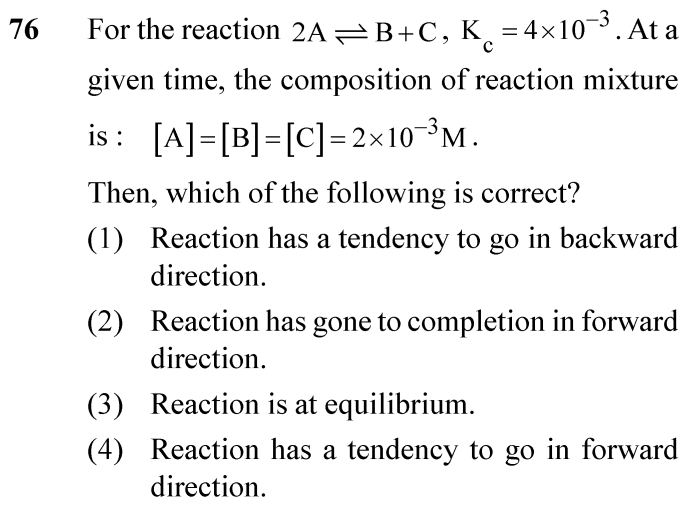
Reversible reaction 2A ⇌ B + C
Equilibrium constant (K_c) 4 × 10^-3
Composition at given time [A] = [B] = [C] = 2 × 10^-3 M
⚡

The 30-Second Exam Hall Shortcut: ⚡ Qc vs Kc Direction Rule

⏱️ Save ~35 seconds

Q_c = [B][C] / [A]² = (2e-3)(2e-3) / (2e-3)² = 1. Since Q_c = 1 >> K_c = 4 × 10⁻³, products are in excess -> Reversible reaction shifts BACKWARD!

1 Compute reaction quotient: Q_c = ([B] · [C]) / [A]².
2 Substitute given concentrations: Q_c = (2 × 10⁻³ · 2 × 10⁻³) / (2 × 10⁻³)² = 1.
3 Compare with equilibrium constant: Q_c = 1, K_c = 0.004.
4 Because Q_c > K_c, the system has excess products and must consume them by shifting in the reverse (backward) direction.
5 Option (1) in under 5 seconds!
🛡️
Why You Can 100% Trust This Shortcut: NCERT Chemistry · Equilibrium (Applications of equilibrium constant: predicting the direction of reaction using reaction quotient Qc).
📐

Step-by-Step Rigorous Workflow & Mathematical Proof

Step 1

Definition and Expression for Reaction Quotient Qc

For the generalized reversible reaction 2A ⇌ B + C, the reaction quotient Qc is defined using non-equilibrium instantaneous concentrations in the same functional form as the equilibrium constant:

Qc=[B][C][A]2Q_c = \frac{[B][C]}{[A]^2}
Step 2

Numerical Calculation of Qc

Substituting the instantaneous concentration values [A] = [B] = [C] = 2 × 10⁻³ M into the quotient expression:

Qc=(2×10⁻³)(2×10⁻³)(2×10⁻³)2=4×10−64×10−6=1Q_c = \frac{(2 \times 10^{-3})(2 \times 10^{-3})}{(2 \times 10^{-3})^2} = \frac{4 \times 10^{-6}}{4 \times 10^{-6}} = 1
Step 3

Comparison of Qc and Kc and Directional Deduction

Comparing the calculated reaction quotient with the given equilibrium constant: - Qc = 1.0 - Kc = 4 × 10⁻³ = 0.004 Because Qc > Kc, the current concentration ratio of products to reactants is significantly greater than that at equilibrium. To establish dynamic equilibrium, the reaction must proceed from right to left (backward direction) to consume B and C while producing A until Qc decreases to equal Kc.

Qc(1.0)>Kc(0.004)  ⟹  Reaction proceeds in BACKWARD directionQ_c (1.0) > K_c (0.004) \implies \text{Reaction proceeds in BACKWARD direction}
⭐

360° Option Elimination Engine Key Feature

Diagnose every choice: Know exactly why the right option works and why distractors fail.

4-Option Deep Scan
1 (1)
✓ 100% Correct
Verdict & Scientific Reason:

Exact thermodynamic deduction since Qc = 1 > Kc = 4 × 10⁻³.

💡
Why this is airtight: None.
2 (2)
✗ Incorrect
Verdict & Scientific Reason:

Reversible equilibrium reactions with finite Kc do not go to completion.

⚠️
Student Fallacy (Why candidates pick this trap): Assuming [A]=[B]=[C] implies completion.
3 (3)
✗ Incorrect
Verdict & Scientific Reason:

Equilibrium requires Qc = Kc; here Qc = 1 ≠ 0.004.

⚠️
Student Fallacy (Why candidates pick this trap): Assuming equal concentrations of all species means equilibrium.
4 (4)
✗ Incorrect
Verdict & Scientific Reason:

Forward direction occurs only when Qc < Kc.

⚠️
Student Fallacy (Why candidates pick this trap): Inverting the inequality comparison.
⚠️

NTA Trap Alert: Assuming [A] = [B] = [C] Means Equilibrium

Equilibrium does NOT mean equal concentrations of all species! Equilibrium means the specific ratio of products to reactants equals Kc.

🛡️ How to avoid the -1 mark: Always calculate Qc explicitly and compare: Qc > Kc -> Backward; Qc < Kc -> Forward; Qc = Kc -> Equilibrium.
📖

Core NEET Syllabus Standard

Chemistry Core Physical Chemistry · Equilibrium Standard Benchmark
Core Scientific Principle Tested:

"If Qc > Kc, the reaction proceeds in the direction of reactants (reverse direction) until Qc decreases to Kc."

Syllabus Focus: Predicting the Direction of Reaction: Reaction Quotient
✓ Core NEET UG Syllabus Anchor Syllabus & Academic Standards ↗
Q greater than K means products too high: Shift to the left, let reactants fly!
NEET 2024 · Q79 Easy
Official NEET 2024 Question 79 - Equilibrium
1
2
3 ✓ Key
4
💡 Verified Solution & 30-Second Hack
✓
Verified Against NTA Final Answer Key
Option (3) : PCl5(g) ⇌ PCl3(g) + Cl2(g)
📚 Equilibrium Easy
📋 Given Parameters & Problem Setup
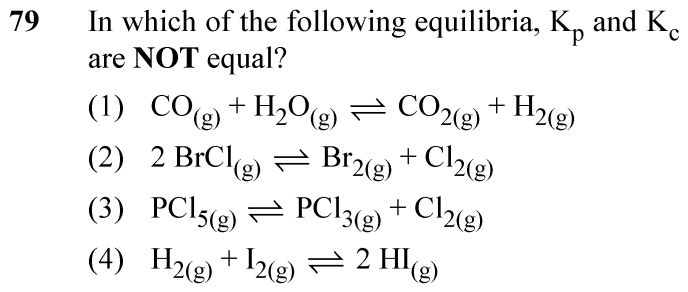
Core relationship K_p = K_c (RT)^Δn_g
Target condition Equilibria in which K_p and K_c are NOT equal (Δn_g ≠ 0)
⚡

The 30-Second Exam Hall Shortcut: ⚡ Δng ≠ 0 Instant Filter

⏱️ Save ~35 seconds

K_p = K_c when Δn_g = 0. In PCl5(g) ⇌ PCl3(g) + Cl2(g), Δn_g = (1 + 1) - 1 = +1 ≠ 0 -> K_p ≠ K_c!

1 Formula: K_p = K_c · (RT)^Δn_g, where Δn_g = (moles of gaseous products) - (moles of gaseous reactants).
2 K_p equals K_c ONLY when Δn_g = 0.
3 Check Option (1): CO(g) + H2O(g) ⇌ CO2(g) + H2(g) -> Δn_g = 2 - 2 = 0 (K_p = K_c).
4 Check Option (2): 2 BrCl(g) ⇌ Br2(g) + Cl2(g) -> Δn_g = 2 - 2 = 0 (K_p = K_c).
5 Check Option (3): PCl5(g) ⇌ PCl3(g) + Cl2(g) -> Δn_g = (1 + 1) - 1 = +1 ≠ 0 (K_p ≠ K_c).
6 Check Option (4): H2(g) + I2(g) ⇌ 2 HI(g) -> Δn_g = 2 - 2 = 0 (K_p = K_c).
7 Option (3) is the only equilibrium where K_p ≠ K_c in 5 seconds!
🛡️
Why You Can 100% Trust This Shortcut: NCERT Chemistry · Equilibrium (Relationship between equilibrium constant in terms of partial pressure Kp and molar concentration Kc).
📐

Step-by-Step Rigorous Workflow & Mathematical Proof

Step 1

Thermodynamic Derivation of Kp = Kc(RT)^Δng

For a general gas-phase equilibrium aA + bB ⇌ cC + dD, partial pressures relate to molar concentrations by the ideal gas law: p_i = [i]RT. Substituting this into the Kp expression yields:

Kp=Kc(RT)Δng,where Δng=(c+d)−(a+b)K_p = K_c(RT)^{\Delta n_g}, \quad \text{where } \Delta n_g = (c + d) - (a + b)
Step 2

Condition for Equality of Kp and Kc

For Kp to equal Kc identically (independent of temperature): (RT)^Δng = 1 ⟹ Δng = 0. Thus, Kp = Kc if and only if the total stoichiometric sum of gaseous product coefficients equals that of the gaseous reactants.

Kp=Kc  ⟺  Δng=0K_p = K_c \iff \Delta n_g = 0
Step 3

Evaluation of Δng for Each Given Equilibrium

Calculating Δng for all four reactions: 1. CO(g) + H2O(g) ⇌ CO2(g) + H2(g): Δng = (1 + 1) - (1 + 1) = 0 ⟹ Kp = Kc. 2. 2 BrCl(g) ⇌ Br2(g) + Cl2(g): Δng = (1 + 1) - 2 = 0 ⟹ Kp = Kc. 3. PCl5(g) ⇌ PCl3(g) + Cl2(g): Δng = (1 + 1) - 1 = +1 ⟹ Kp = Kc(RT) ≠ Kc! 4. H2(g) + I2(g) ⇌ 2 HI(g): Δng = 2 - (1 + 1) = 0 ⟹ Kp = Kc.

Δng(PCl5)=2−1=+1  ⟹  Kp=Kc(RT)≠Kc\Delta n_g(\text{PCl}_5) = 2 - 1 = +1 \implies K_p = K_c(RT) \neq K_c
⭐

360° Option Elimination Engine Key Feature

Diagnose every choice: Know exactly why the right option works and why distractors fail.

4-Option Deep Scan
1 (1)
✗ Incorrect
Verdict & Scientific Reason:

Δng = 0, so Kp = Kc.

⚠️
Student Fallacy (Why candidates pick this trap): Miscounting gaseous moles.
2 (2)
✗ Incorrect
Verdict & Scientific Reason:

Δng = 0, so Kp = Kc.

⚠️
Student Fallacy (Why candidates pick this trap): Forgetting coefficient of 2 for BrCl.
3 (3)
✓ 100% Correct
Verdict & Scientific Reason:

Δng = +1 ≠ 0, making Kp and Kc strictly unequal.

💡
Why this is airtight: None.
4 (4)
✗ Incorrect
Verdict & Scientific Reason:

Δng = 0, so Kp = Kc.

⚠️
Student Fallacy (Why candidates pick this trap): Thinking HI formation involves pressure change.
⚠️

NTA Trap Alert: Missing the Word "NOT"

The question asks where Kp and Kc are NOT equal. Three options have Kp = Kc, and only Option (3) has Kp ≠ Kc.

🛡️ How to avoid the -1 mark: Highlight the negative constraint "NOT equal" and immediately look for Δng ≠ 0.
📖

Core NEET Syllabus Standard

Chemistry Core Physical Chemistry · Equilibrium Standard Benchmark
Core Scientific Principle Tested:

"Kp equals Kc only when Δng = 0; when Δng ≠ 0 (as in PCl5 decomposition where Δng = +1), Kp ≠ Kc."

Syllabus Focus: Relationship Between Kp and Kc
✓ Core NEET UG Syllabus Anchor Syllabus & Academic Standards ↗
When gas moles on left and right agree, Kp equals Kc easily! When moles expand (1 to 2), Kp and Kc part ways anew!
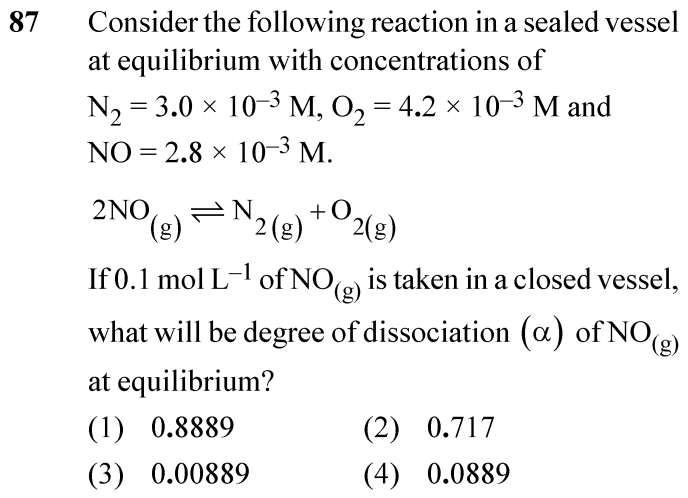
NEET 2024 · Q87 Medium
Official NEET 2024 Question 87 - Equilibrium
1
2 ✓ Key
3
4
💡 Verified Solution & 30-Second Hack
✓
Verified Against NTA Final Answer Key
Option (2) : 0.717
📚 Equilibrium Medium
📋 Given Parameters & Problem Setup
Equilibrium reaction 2 NO(g) ⇌ N2(g) + O2(g)
Given equilibrium concentrations [N2] = 3.0 × 10^-3 M, [O2] = 4.2 × 10^-3 M, [NO] = 2.8 × 10^-3 M
New initial condition 0.1 mol/L of NO(g) taken in a closed vessel
⚡

The 30-Second Exam Hall Shortcut: ⚡ Square Root Equilibrium Shortcut

⏱️ Save ~60 seconds

K_c = [N2][O2]/[NO]² = (3e-3 × 4.2e-3)/(2.8e-3)² = 12.6/7.84 = 1.607. For 2NO ⇌ N2 + O2, √K_c = α / [2(1 - α)]. √1.607 ≈ 1.268 -> α ≈ 0.717!

1 Compute K_c from first equilibrium: K_c = (3.0 × 10⁻³ × 4.2 × 10⁻³) / (2.8 × 10⁻³)² = 12.6 / 7.84 = 1.6071.
2 For dissociation of NO: 2 NO ⇌ N2 + O2. At equilibrium: [NO] = C(1 - α), [N2] = Cα/2, [O2] = Cα/2.
3 K_c = (Cα/2)² / [C(1 - α)]² = α² / [4(1 - α)²]. Note that concentration C cancels completely because Δn_g = 0!
4 Take square root: √K_c = α / [2(1 - α)].
5 Substitute: √1.6071 ≈ 1.2677 -> 2.5354(1 - α) = α -> 2.5354 = 3.5354 α.
6 α = 2.5354 / 3.5354 ≈ 0.717.
7 Option (2) in under 45 seconds!
🛡️
Why You Can 100% Trust This Shortcut: NCERT Chemistry · Equilibrium (Homogeneous chemical equilibria in gas phase and calculation of degree of dissociation α).
📐

Step-by-Step Rigorous Workflow & Mathematical Proof

Step 1

Determination of Equilibrium Constant Kc

For the gas-phase reaction 2 NO(g) ⇌ N2(g) + O2(g), the equilibrium constant expression is:

Kc=[N2][O2][NO]2=(3.0×10⁻³)(4.2×10⁻³)(2.8×10⁻³)2=12.6×10−67.84×10−6=1.6071K_c = \frac{[\text{N}_2][\text{O}_2]}{[\text{NO}]^2} = \frac{(3.0 \times 10^{-3})(4.2 \times 10^{-3})}{(2.8 \times 10^{-3})^2} = \frac{12.6 \times 10^{-6}}{7.84 \times 10^{-6}} = 1.6071
Step 2

ICE Table for Initial NO Concentration of 0.1 M

Let initial concentration of NO be C = 0.1 mol/L and degree of dissociation be α: - Initial: [NO] = C, [N2] = 0, [O2] = 0 - Change: [NO] = -Cα, [N2] = +Cα/2, [O2] = +Cα/2 - Equilibrium: [NO] = C(1 - α), [N2] = Cα/2, [O2] = Cα/2

[NO]=C(1−α),[N2]=Cα2,[O2]=Cα2[\text{NO}] = C(1 - \alpha), \quad [\text{N}_2] = \frac{C\alpha}{2}, \quad [\text{O}_2] = \frac{C\alpha}{2}
Step 3

Setting up Equilibrium Expression and Algebraic Solution

Substituting equilibrium expressions into Kc:

Kc=(Cα2)(Cα2)[C(1−α)]2=α24(1−α)2K_c = \frac{\left(\frac{C\alpha}{2}\right)\left(\frac{C\alpha}{2}\right)}{[C(1 - \alpha)]^2} = \frac{\alpha^2}{4(1 - \alpha)^2}
Step 4

Solving for α

Taking square roots on both sides:

Kc=α2(1−α)  ⟹  1.6071=1.2677=α2(1−α)\sqrt{K_c} = \frac{\alpha}{2(1 - \alpha)} \implies \sqrt{1.6071} = 1.2677 = \frac{\alpha}{2(1 - \alpha)}
Step 5

Final Arithmetic Simplification

Expanding and solving the linear equation in α:

2×1.2677×(1−α)=α  ⟹  2.5354−2.5354α=α  ⟹  3.5354α=2.5354  ⟹  α=2.53543.5354≈0.7172 \times 1.2677 \times (1 - \alpha) = \alpha \implies 2.5354 - 2.5354\alpha = \alpha \implies 3.5354\alpha = 2.5354 \implies \alpha = \frac{2.5354}{3.5354} \approx 0.717
⭐

360° Option Elimination Engine Key Feature

Diagnose every choice: Know exactly why the right option works and why distractors fail.

4-Option Deep Scan
1 (1)
✗ Incorrect
Verdict & Scientific Reason:

Result of omitting the stoichiometric factor of 2 in the denominator (writing Kc = α² / (1-α)²).

⚠️
Student Fallacy (Why candidates pick this trap): Forgetting that 2 NO produces 1/2 N2 and 1/2 O2.
2 (2)
✓ 100% Correct
Verdict & Scientific Reason:

Exact solution to the quadratic equilibrium expression.

💡
Why this is airtight: None.
3 (3)
✗ Incorrect
Verdict & Scientific Reason:

Off by two orders of magnitude due to improper square root extraction.

⚠️
Student Fallacy (Why candidates pick this trap): Assuming α ≪ 1 when Kc > 1.
4 (4)
✗ Incorrect
Verdict & Scientific Reason:

Decimal place calculation error.

⚠️
Student Fallacy (Why candidates pick this trap): Dividing by initial concentration C = 0.1 erroneously.
⚠️

NTA Trap Alert: Approximating (1 - α) ≈ 1 When Kc > 1

Because Kc = 1.607 is of order unity, α is very large (~72%). You CANNOT make the approximation 1 - α ≈ 1! You must solve the exact square-root equation.

🛡️ How to avoid the -1 mark: Only approximate 1 - α ≈ 1 when Kc is extremely small (e.g. < 10⁻⁵).
📖

Core NEET Syllabus Standard

Chemistry Core Physical Chemistry · Equilibrium Standard Benchmark
Core Scientific Principle Tested:

"For a symmetric reaction 2A ⇌ B + C, Kc = α² / [4(1-α)²], and the degree of dissociation α is independent of total pressure and initial concentration."

Syllabus Focus: Homogeneous Equilibrium: Evaluation of Equilibrium Constants
✓ Core NEET UG Syllabus Anchor Syllabus & Academic Standards ↗
Two moles to two moles: C disappears, root of 1.6 yields zero-point-seven-one-seven in clear cheers!
NEET 2023 · Q77 Easy
Official NEET 2023 Question 77 - Equilibrium
1
2
3
4 ✓ Key
💡 Verified Solution & 30-Second Hack
✓
Verified Against NTA Final Answer Key
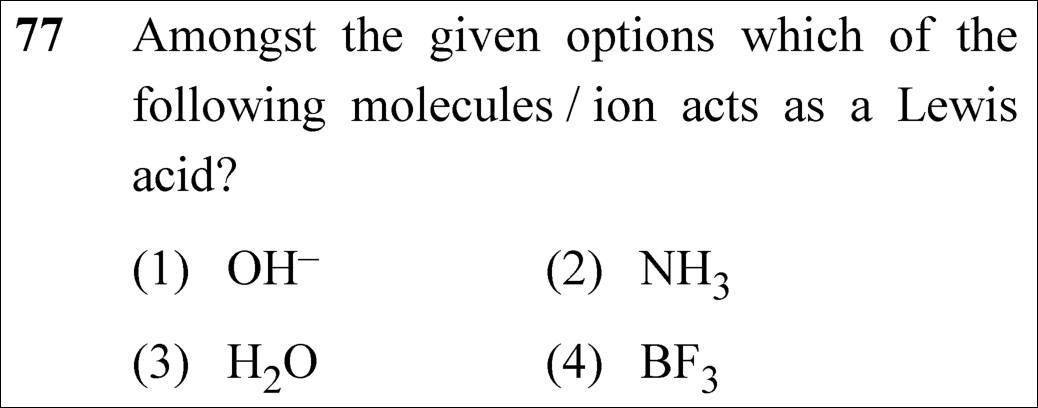
Option (4) : BF₃
📚 Equilibrium Easy
📋 Given Parameters & Problem Setup
Species evaluated OH⁻, NH₃, H₂O, BF₃
Criterion Acts as a Lewis acid (electron pair acceptor)
⚡

The 30-Second Exam Hall Shortcut: ⚡ Electron Pair Acceptor Scan: Incomplete Octet Boron

⏱️ Save ~25 seconds

OH⁻, NH₃, and H₂O all possess unshared lone pairs and act as Lewis bases! In BF₃, boron has only 6 valence electrons (vacant 2p orbital) and greedily accepts an electron pair ⟹ BF₃ is a Lewis acid in 5 seconds!

1 Recall Lewis definitions:
2 - Lewis Acid: Electron-pair ACCEPTOR (must have vacant orbital or incomplete octet).
3 - Lewis Base: Electron-pair DONOR (must have available unshared lone pair).
4 Evaluate the choices:
5 - OH⁻: Has negative charge and 3 lone pairs on oxygen ⟶ Lewis base / nucleophile.
6 - NH₃: Nitrogen has an unshared lone pair (:NH₃) ⟶ Lewis base.
7 - H₂O: Oxygen has two unshared lone pairs (H₂Ö:) ⟶ Lewis base.
8 - BF₃: Boron has 3 valence electrons, forming 3 B–F single bonds (total 6 electrons). It has an incomplete octet and an empty 2p orbital capable of accepting an electron pair ⟶ LEWIS ACID.
9 Lock Option (4) BF₃ immediately!
🛡️
Why You Can 100% Trust This Shortcut: Chemical Equilibrium · Lewis Acid-Base Concepts (Electron deficient molecules in which the central atom has an incomplete octet, such as BF₃ and AlCl₃, act as Lewis acids).
📐

Step-by-Step Rigorous Workflow & Mathematical Proof

Step 1

The Lewis Concept of Acids and Bases

According to G.N. Lewis (1923), an acid is defined as an electron-pair acceptor, and a base is defined as an electron-pair donor. A coordinate covalent (dative) bond is formed when a Lewis base donates its electron pair into a vacant orbital of a Lewis acid:

A (Lewis Acid: vacant orbital)+:B (Lewis Base: lone pair)⟶A←B (Adduct)\text{A (Lewis Acid: vacant orbital)} + :\text{B (Lewis Base: lone pair)} \longrightarrow \text{A}\leftarrow\text{B (Adduct)}
Step 2

Electronic Structure of Boron Trifluoride (BF₃)

Boron (Z = 5) has ground-state configuration 1s² 2s² 2p¹. In BF₃, boron undergoes sp² hybridization, forming three B–F σ-bonds. The central boron atom is surrounded by only 6 valence electrons, leaving one unhybridized 2p_z orbital completely empty:

Valence electrons around B in BF3=3×2=6 e−(Incomplete octet, vacant 2pz orbital)\text{Valence electrons around B in BF}_3 = 3 \times 2 = 6\ e^- \quad (\text{Incomplete octet, vacant } 2p_z \text{ orbital})
Step 3

Confirmation of Lewis Acidic Behavior

Because boron possesses an empty 2p orbital, BF₃ readily accepts an electron pair from Lewis bases (such as NH₃ or F⁻) to complete its stable octet (8 e⁻):

BF3+:NH3⟶F3B←NH3\text{BF}_3 + :\text{NH}_3 \longrightarrow \text{F}_3\text{B}\leftarrow\text{NH}_3
Step 4

Analysis of Distractors (Lewis Bases)

All other three species possess available lone pairs of electrons and act as electron-pair donors (Lewis bases):

OH−:Three lone pairs on oxygen, negatively charged donor (Lewis Base):NH3:One lone pair on nitrogen (Lewis Base)H2O::Two lone pairs on oxygen (Lewis Base)\begin{aligned} \text{OH}^- &: \text{Three lone pairs on oxygen, negatively charged donor } (\text{Lewis Base}) \\[4pt] :\text{NH}_3 &: \text{One lone pair on nitrogen } (\text{Lewis Base}) \\[4pt] \text{H}_2\text{O}: &: \text{Two lone pairs on oxygen } (\text{Lewis Base}) \end{aligned}
⭐

360° Option Elimination Engine Key Feature

Diagnose every choice: Know exactly why the right option works and why distractors fail.

4-Option Deep Scan
1 (1)
✗ Incorrect
Verdict & Scientific Reason:

Hydroxide ion is a strong Lewis base (electron pair donor).

⚠️
Student Fallacy (Why candidates pick this trap): Candidate confused Bronsted-Lowry base with Lewis acid.
2 (2)
✗ Incorrect
Verdict & Scientific Reason:

Ammonia has a lone pair on nitrogen and acts as a classic Lewis base.

⚠️
Student Fallacy (Why candidates pick this trap): Candidate forgot the lone pair on nitrogen.
3 (3)
✗ Incorrect
Verdict & Scientific Reason:

Water has two lone pairs on oxygen and acts as a Lewis base.

⚠️
Student Fallacy (Why candidates pick this trap): Candidate thought neutral amphoteric water is a Lewis acid.
4 (4)
✓ 100% Correct
Verdict & Scientific Reason:

Accurate: BF₃ is electron-deficient (6 valence electrons) with a vacant 2p orbital that accepts an electron pair.

💡
Why this is airtight: None. Candidate correctly identified the incomplete octet.
⚠️

NTA Trap Alert: Confusing Arrhenius/Bronsted Acidity with Lewis Acidity

Arrhenius and Bronsted acids must contain hydrogen (protons, H⁺). Lewis acids do NOT need hydrogen! BF₃ has no hydrogen at all, but is one of the strongest and most classic Lewis acids because of its empty 2p orbital.

🛡️ How to avoid the -1 mark: Lewis Acid = Electron pair ACCEPTOR. Look for incomplete octets (BF₃, AlCl₃, BCl₃) or cations.
📖

Core NEET Syllabus Standard

National Eligibility cum Entrance Test (NEET UG) · Equilibrium Standard Benchmark
Core Scientific Principle Tested:

"Species that can accept a pair of electrons are Lewis acids (e.g., BF₃, AlCl₃, Co³⁺)."

Syllabus Focus: Acids, Bases and Salts – Lewis Concept
Preserved in Rationalized Curriculum Syllabus & Academic Standards ↗
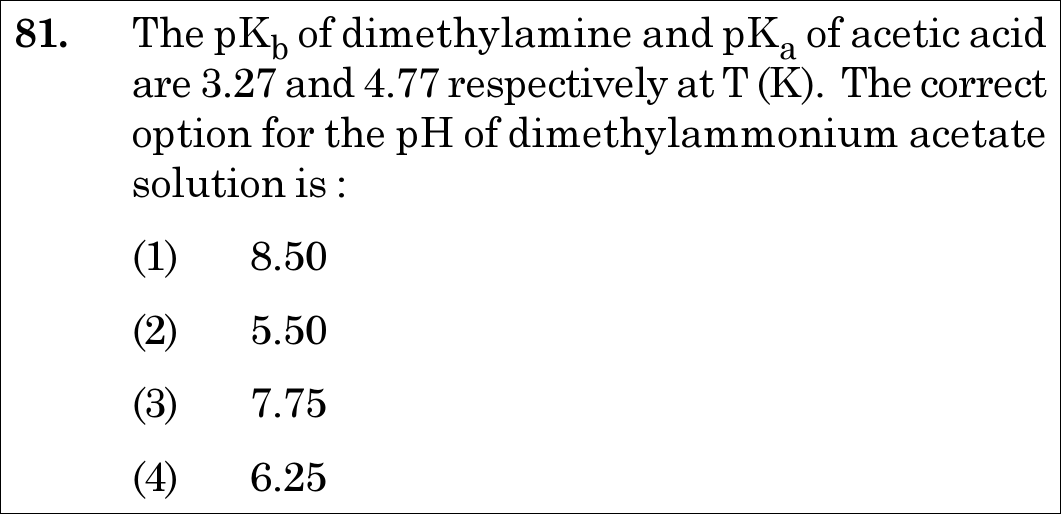
NEET 2021 · Q81 Easy
Official NEET 2021 Question 81 - Equilibrium
1 8.50
2 5.50
3 7.75 ✓ Key
4 6.25
💡 Verified Solution & 30-Second Hack
✓
Verified Against NTA Final Answer Key
Option (3) : 7.75
📚 Equilibrium Easy
📋 Given Parameters & Problem Setup
Salt Dimethylammonium acetate (CH3COO- NH2+(CH3)2)
pKb of Dimethylamine 3.27
pKa of Acetic Acid 4.77
⚡

The 30-Second Exam Hall Shortcut: ⚡ Weak Acid + Weak Base Formula: pH = 7 + ½(pKa - pKb)

⏱️ Save ~20 seconds

Dimethylammonium acetate is the salt of a weak acid (CH3COOHCH_3COOH) and weak base ((CH3)2NH(CH_3)_2NH). The universal Henderson-hydrolysis formula is pH=7+12(pKa−pKb)=7+12(4.77−3.27)=7+12(1.50)=7+0.75=7.75pH = 7 + \frac{1}{2}(pK_a - pK_b) = 7 + \frac{1}{2}(4.77 - 3.27) = 7 + \frac{1}{2}(1.50) = 7 + 0.75 = 7.75! Direct 10-second calculation matching Option (3)!

1 Identify salt type: Weak acid (CH3COOHCH_3COOH, pKa=4.77pK_a = 4.77) + Weak base ((CH3)2NH(CH_3)_2NH, pKb=3.27pK_b = 3.27).
2 Use standard salt hydrolysis formula: pH=12pKw+12pKa−12pKbpH = \frac{1}{2}pK_w + \frac{1}{2}pK_a - \frac{1}{2}pK_b.
3 Substitute standard pKw=14pK_w = 14: pH=7+12(4.77−3.27)pH = 7 + \frac{1}{2}(4.77 - 3.27).
4 Calculate: pH=7+0.75=7.75pH = 7 + 0.75 = 7.75.
5 Match Option (3).
🛡️
Why You Can 100% Trust This Shortcut: Canonical NCERT Ionic Equilibrium hydrolysis formula for salt of weak acid and weak base.
📐

Step-by-Step Rigorous Workflow & Mathematical Proof

Step 1

Classifying the Electrolyte Components of the Salt

Dimethylammonium acetate (CH3COONH2(CH3)2CH_3COONH_2(CH_3)_2) is formed by the neutralization of acetic acid (CH3COOHCH_3COOH, a weak acid with pKa=4.77pK_a = 4.77) and dimethylamine ((CH3)2NH(CH_3)_2NH, a weak base with pKb=3.27pK_b = 3.27). Both the cation and the anion undergo simultaneous hydrolysis in aqueous solution.

Step 2

Formulating the Hydrolysis Equilibrium and pH Equation

The hydrolysis equilibrium is: CH3COO−+(CH3)2NH2++H2O⇌CH3COOH+(CH3)2NHCH_3COO^- + (CH_3)_2NH_2^+ + H_2O \rightleftharpoons CH_3COOH + (CH_3)_2NH The hydronium ion concentration in such a solution is independent of salt concentration and given by: [H3O+]=Kw⋅KaKb[H_3O^+] = \sqrt{\frac{K_w \cdot K_a}{K_b}} Taking negative logarithms on both sides:

pH=12pKw+12pKa−12pKb=7+12(pKa−pKb)pH = \frac{1}{2} pK_w + \frac{1}{2} pK_a - \frac{1}{2} pK_b = 7 + \frac{1}{2}(pK_a - pK_b)
Step 3

Substituting the Numerical Values

Substitute pKa=4.77pK_a = 4.77 and pKb=3.27pK_b = 3.27:

pH=7+12(4.77−3.27)=7+12(1.50)=7+0.75=7.75pH = 7 + \frac{1}{2}(4.77 - 3.27) = 7 + \frac{1}{2}(1.50) = 7 + 0.75 = 7.75
⭐

360° Option Elimination Engine Key Feature

Diagnose every choice: Know exactly why the right option works and why distractors fail.

4-Option Deep Scan
1 1
✗ Incorrect
Verdict & Scientific Reason:

Result of adding 1.501.50 directly to 7 without the factor of 1/21/2 (7+1.50=8.507 + 1.50 = 8.50).

⚠️
Student Fallacy (Why candidates pick this trap): Forgetting to divide (pKa−pKb)(pK_a - pK_b) by 2.
2 2
✗ Incorrect
Verdict & Scientific Reason:

Result of subtracting 1.501.50 from 7 without factor of 1/21/2 (7−1.50=5.507 - 1.50 = 5.50).

⚠️
Student Fallacy (Why candidates pick this trap): Sign inversion and omission of half-factor.
3 3
✓ 100% Correct
Verdict & Scientific Reason:

Exact pH obtained by proper application of salt hydrolysis formula: 7+0.75=7.757 + 0.75 = 7.75.

💡
Why this is airtight: None; textbook ionic equilibrium calculation.
4 4
✗ Incorrect
Verdict & Scientific Reason:

Result of inverting signs: 7−0.75=6.257 - 0.75 = 6.25 (as if base were weaker than acid).

⚠️
Student Fallacy (Why candidates pick this trap): Swapping pKapK_a and pKbpK_b in the numerator.
⚠️

NTA Trap Alert: Sign Inversion and Factor-of-Half Traps

Two traps exist here: 1. Forgetting the factor of 1/21/2, leading to 7+1.50=8.507 + 1.50 = 8.50 (Option 1). 2. Inverting pKapK_a and pKbpK_b to get 7−0.75=6.257 - 0.75 = 6.25 (Option 4). Since pKb(3.27)<pKa(4.77)pK_b (3.27) < pK_a (4.77), the base is STRONGER than the acid, meaning the solution must be slightly basic (pH>7pH > 7).

🛡️ How to avoid the -1 mark: Sanity check: Dimethylamine (pKb=3.27pK_b = 3.27) is stronger as a base than acetic acid (pKa=4.77pK_a = 4.77) is as an acid   ⟹  \implies Solution must be basic (pH>7pH > 7). Only 7.757.75 and 8.508.50 are >7> 7. With the 1/21/2 factor, pH=7.75pH = 7.75.
📖

Core NEET Syllabus Standard

NCERT Chemistry · Equilibrium Standard Benchmark
Core Scientific Principle Tested:

"For a salt of weak acid and weak base, pH=7+12(pKa−pKb)pH = 7 + \frac{1}{2}(pK_a - pK_b), independent of salt concentration."

Syllabus Focus: Hydrolysis of Salts and the pH of their Solutions
✓ Core NEET UG Syllabus Anchor Syllabus & Academic Standards ↗
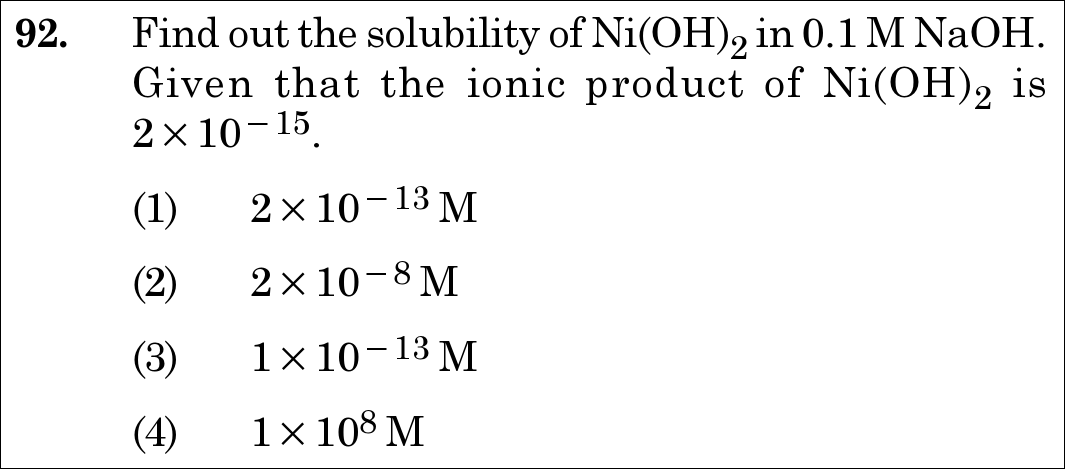
NEET 2020 · Q92 Easy
Official NEET 2020 Question 92 - Equilibrium
1 ✓ Key
2
3
4
💡 Verified Solution & 30-Second Hack
✓
Verified Against NTA Final Answer Key
Option (1) : 2×10⁻¹³ M
📚 Equilibrium Easy
📋 Given Parameters & Problem Setup
Salt Ni(OH)2 (Sparingly soluble base)
Ionic Product / Ksp Ksp = 2 × 10^-15
Medium 0.1 M NaOH (Strong electrolyte)
⚡

The 30-Second Exam Hall Shortcut: ⚡ "Common Ion Effect: s = Ksp / [OH-]^2 = (2 × 10^-15) / (0.1)^2 = 2 × 10^-13 M!"

⏱️ 25 seconds

In 0.1 M NaOH, the strong base completely dissociates, providing [OH−]=0.1 M=10−1 M[OH^-] = 0.1\text{ M} = 10^{-1}\text{ M}. The contribution of OH−OH^- from sparingly soluble Ni(OH)2Ni(OH)_2 (2s2s) is negligible (2s≪0.12s \ll 0.1). Thus: s=Ksp[OH−]2=2×10⁻¹⁵(10−1)2=2×10⁻¹³ Ms = \frac{K_{sp}}{[OH^-]^2} = \frac{2 \times 10^{-15}}{(10^{-1})^2} = 2 \times 10^{-13}\text{ M}. Mark Option (1) in 10 seconds!

1 Strong base dissociation: NaOH -> Na+ + OH-, so [OH-] = 0.1 M.
2 Ni(OH)2 dissolution equilibrium: Ni(OH)2 (s) <=> Ni2+ (aq) + 2OH- (aq).
3 Solubility expression: Ksp = [Ni2+][OH-]^2 = s × (0.1 + 2s)^2 ≈ s × (0.1)^2.
4 Solve for s: s = (2 × 10^-15) / (0.01) = 2 × 10^-13 M.
5 Select Option (1).
🛡️
Why You Can 100% Trust This Shortcut: NCERT Chemistry · Equilibrium (Ionic Equilibrium: Common Ion Effect on Solubility of Sparingly Soluble Salts)
📐

Step-by-Step Rigorous Workflow & Mathematical Proof

Step 1

Dissociation of Strong Electrolyte

Sodium hydroxide (NaOH) is a strong base that dissociates completely in aqueous solution: NaOH (aq)→Na+(aq)+OH−(aq)\text{NaOH (aq)} \to \text{Na}^+ \text{(aq)} + \text{OH}^- \text{(aq)} Given [NaOH]=0.1 M\text{[NaOH]} = 0.1\text{ M}, the contribution of hydroxide ions from NaOH is [OH−]NaOH=0.1 M=10−1 M[\text{OH}^-]_{\text{NaOH}} = 0.1\text{ M} = 10^{-1}\text{ M}.

Step 2

Solubility Equilibrium of Ni(OH)2

Nickel hydroxide is a sparingly soluble salt that establishes the following dissolution equilibrium: Ni(OH)2 (s)⇌Ni2+(aq)+2OH−(aq)\text{Ni(OH)}_2 \text{ (s)} \rightleftharpoons \text{Ni}^{2+} \text{(aq)} + 2\text{OH}^- \text{(aq)} If ss is the molar solubility of Ni(OH)2\text{Ni(OH)}_2 in this solution: [Ni2+]=s[\text{Ni}^{2+}] = s [OH−]=0.1+2s[\text{OH}^-] = 0.1 + 2s

Step 3

Apply Common Ion Approximation

Because Ksp=2×10⁻¹⁵K_{sp} = 2 \times 10^{-15} is extremely small, s≪0.1s \ll 0.1, and hence 2s2s is negligible compared to 0.10.1: [OH−]≈0.1 M=10−1 M[\text{OH}^-] \approx 0.1\text{ M} = 10^{-1}\text{ M}

Step 4

Solve for Molar Solubility

Substitute into the solubility product expression: Ksp=[Ni2+][OH−]2K_{sp} = [\text{Ni}^{2+}][\text{OH}^-]^2 2×10−15=s×(0.1)2=s×10−22 \times 10^{-15} = s \times (0.1)^2 = s \times 10^{-2} s=2×10−1510−2=2×10⁻¹³ Ms = \frac{2 \times 10^{-15}}{10^{-2}} = 2 \times 10^{-13}\text{ M} This confirms the approximation (2×(2×10−13)=4×10⁻¹³≪0.12 \times (2 \times 10^{-13}) = 4 \times 10^{-13} \ll 0.1).

⭐

360° Option Elimination Engine Key Feature

Diagnose every choice: Know exactly why the right option works and why distractors fail.

4-Option Deep Scan
1 A
✓ 100% Correct
Verdict & Scientific Reason:

Factually and mathematically exact; s=2×10⁻¹⁵(0.1)2=2×10⁻¹³ Ms = \frac{2 \times 10^{-15}}{(0.1)^2} = 2 \times 10^{-13}\text{ M}.

💡
Why this is airtight: None; straightforward common ion calculation.
2 B
✗ Incorrect
Verdict & Scientific Reason:

Incorrect; forgetting to square the hydroxide concentration gives s=2×10−150.1=2×10⁻¹⁴s = \frac{2 \times 10^{-15}}{0.1} = 2 \times 10^{-14}, or confusing with pure water solubility (4s3=Ksp4s^3 = K_{sp}).

⚠️
Student Fallacy (Why candidates pick this trap): Ignoring the stoichiometry coefficient 2 in [OH−]2[\text{OH}^-]^2.
3 C
✗ Incorrect
Verdict & Scientific Reason:

Incorrect; erroneously dividing by 2.

⚠️
Student Fallacy (Why candidates pick this trap): Incorrect coefficient arithmetic.
4 D
✗ Incorrect
Verdict & Scientific Reason:

Physically impossible; a positive exponent (108 M10^8\text{ M}) would represent a concentration higher than pure liquid density.

⚠️
Student Fallacy (Why candidates pick this trap): Sign error in exponent.
⚠️

NTA Trap Alert: Don't Forget to Square [OH-]!

The formula for Ni(OH)2Ni(OH)_2 has two hydroxides: Ksp=[Ni2+][OH−]2K_{sp} = [Ni^{2+}][OH^-]^2. You must divide KspK_{sp} by (0.1)2=10−2(0.1)^2 = 10^{-2}, NOT by 0.10.1!

🛡️ How to avoid the -1 mark: Write the Ksp expression clearly: [OH−]2[OH^-]^2 has the exponent 2!
📖

Core NEET Syllabus Standard

Chemistry · Equilibrium Standard Benchmark
Core Scientific Principle Tested:

""

Syllabus Focus: Common Ion Effect on Solubility: Solubility of Ni(OH)2 in Presence of NaOH
✓ Core NEET UG Syllabus Anchor Syllabus & Academic Standards ↗

Solve 4 NEET Questions a Day — One per Subject

Cover all 1,140 official NEET questions in 285 days at your own pace. Progress is saved on your device. No login needed.