MyCompetitiveExams Logo MyCompetitiveExams
Search 1,140+ Questions
Chapters, formulas, speed tricks
→
⚡ Brahmastra NEET 2027
720 MARKS

Dynamic 180-question full-length simulator mixed dynamically from all 6 years for 2027 & 2026 aspirants.

Launch Brahmastra 2027 Test →
Start Practice →
100% Free · No Login Required
Q.52 Chemistry ⭐ 360° Option Elimination Active
Vault ↗

NEET 2026 Chemistry Question 52 Solution

Topic: Equilibrium · Official NTA Booklet Code 50
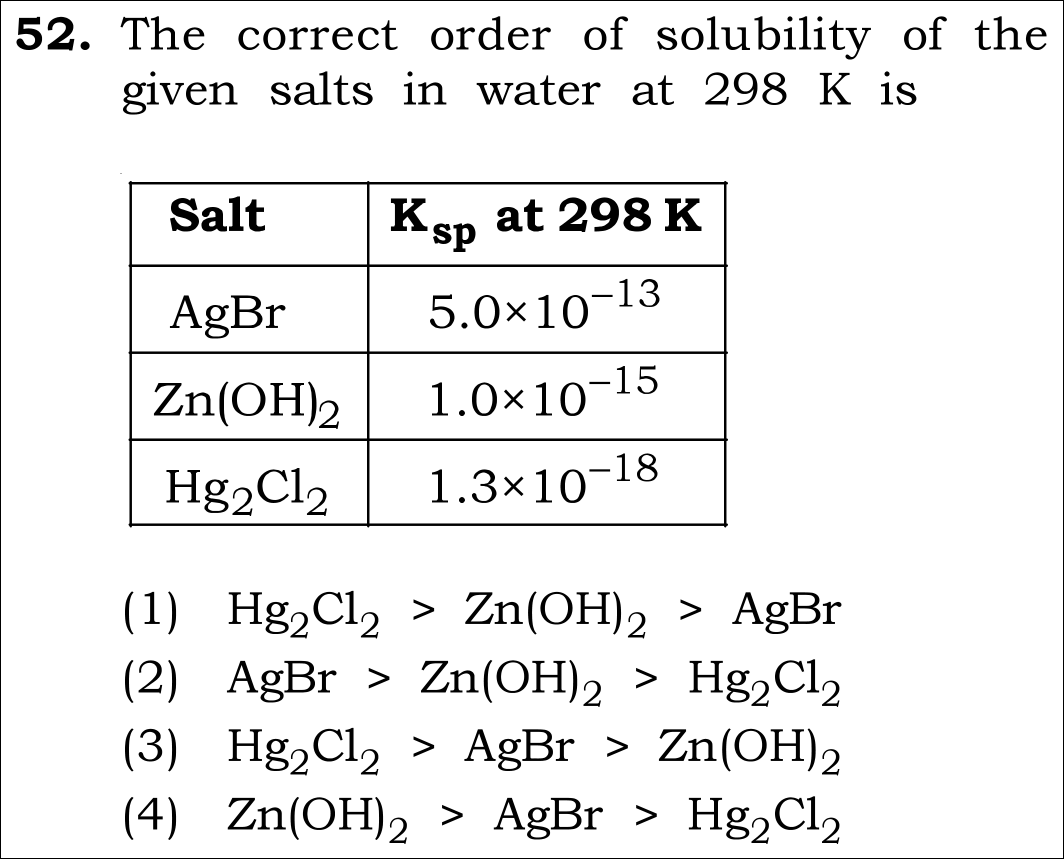
NEET 2026 Chemistry Question 52: Comparison of Molar Solubility from Solubility Product Constants (Ksp)

Question

The correct order of solubility of the given salts in water at 298 K is (Ksp at 298 K: AgBr = 5.0×10⁻¹³; Zn(OH)₂ = 1.0×10⁻¹⁵; Hg₂Cl₂ = 1.3×10⁻¹⁸)

✓
Verified Against NTA Final Answer Key
Option (4) : Zn(OH)₂ > AgBr > Hg₂Cl₂
📚 Equilibrium Medium
📋 Given Parameters & Problem Setup
Salt 1: AgBr K_sp = 5.0 × 10⁻¹³
Salt 2: Zn(OH)₂ K_sp = 1.0 × 10⁻¹⁵
Salt 3: Hg₂Cl₂ K_sp = 1.3 × 10⁻¹⁸
Temperature 298 K
⚡

The 30-Second Exam Hall Shortcut: ⚡ Molar Solubility Cube-Root vs Square-Root Diagnostic

⏱️ Save ~75 seconds

Do NOT compare Ksp values directly for different salt stoichiometries!

1 AgBr is an AB type salt: S = sqrt(K_sp) = sqrt(5.0 × 10⁻¹³) = sqrt(50 × 10⁻¹⁴) ≈ 7.1 × 10⁻⁷ M.
2 Zn(OH)₂ is an AB₂ type salt: K_sp = 4S³ -> S = (1.0 × 10⁻¹⁵ / 4)^(1/3) = (250 × 10⁻¹⁸)^(1/3) ≈ 6.3 × 10⁻⁶ M.
3 Hg₂Cl₂ dissociates as Hg₂²⁺ + 2Cl⁻ (also 4S³): S = (1.3 × 10⁻¹⁸ / 4)^(1/3) = (0.325 × 10⁻¹⁸)^(1/3) ≈ 0.69 × 10⁻⁶ M = 6.9 × 10⁻⁷ M.
4 Compare: S[Zn(OH)₂] (~6.3 × 10⁻⁶) > S[AgBr] (~7.1 × 10⁻⁷) > S[Hg₂Cl₂] (~6.9 × 10⁻⁷).
5 Option (4) is undeniably the correct solubility order!
🛡️
Why You Can 100% Trust This Shortcut: Solubility must always be expressed as molar concentration S (mol/L) derived from the specific equilibrium dissociation equation of each electrolyte.
📐

Step-by-Step Rigorous Workflow & Mathematical Proof

Step 1

Calculate Molar Solubility of AgBr (AB-type electrolyte)

Silver bromide dissociates into one silver cation and one bromide anion.

AgBr(s)⇌Ag++Br−  ⟹  Ksp=S12\text{AgBr}(s) \rightleftharpoons \text{Ag}^+ + \text{Br}^- \implies K_{\text{sp}} = S_1^2
  • • S₁ = sqrt(5.0 × 10⁻¹³) = sqrt(50 × 10⁻¹⁴) ≈ 7.07 × 10⁻⁷ mol L⁻¹.
Step 2

Calculate Molar Solubility of Zn(OH)₂ (AB₂-type electrolyte)

Zinc hydroxide dissociates into one Zn²⁺ cation and two OH⁻ anions.

Zn(OH)2(s)⇌Zn2++2OH−  ⟹  Ksp=(S2)(2S2)2=4S23\text{Zn(OH)}_2(s) \rightleftharpoons \text{Zn}^{2+} + 2\text{OH}^- \implies K_{\text{sp}} = (S_2)(2S_2)^2 = 4S_2^3
  • • S₂³ = K_sp / 4 = (1.0 × 10⁻¹⁵) / 4 = 2.5 × 10⁻¹⁶ = 250 × 10⁻¹⁸.
  • • S₂ = (250)^(1/3) × 10⁻⁶ ≈ 6.30 × 10⁻⁶ mol L⁻¹.
Step 3

Calculate Molar Solubility of Hg₂Cl₂ (Calomel, [Hg₂]Cl₂ electrolyte)

Mercurous chloride contains the dimeric mercurous ion Hg₂²⁺ and two chloride ions Cl⁻.

Hg2Cl2(s)⇌Hg22++2Cl−  ⟹  Ksp=[Hg22+][Cl−]2=(S3)(2S3)2=4S33\text{Hg}_2\text{Cl}_2(s) \rightleftharpoons \text{Hg}_2^{2+} + 2\text{Cl}^- \implies K_{\text{sp}} = [\text{Hg}_2^{2+}][\text{Cl}^-]^2 = (S_3)(2S_3)^2 = 4S_3^3
  • • S₃³ = K_sp / 4 = (1.3 × 10⁻¹⁸) / 4 = 0.325 × 10⁻¹⁸.
  • • S₃ = (0.325)^(1/3) × 10⁻⁶ ≈ 0.687 × 10⁻⁶ mol L⁻¹ = 6.87 × 10⁻⁷ mol L⁻¹.
Step 4

Compare the Molar Solubilities

Arranging the three solubilities: S[Zn(OH)₂] = 63.0 × 10⁻⁷ M S[AgBr] = 7.07 × 10⁻⁷ M S[Hg₂Cl₂] = 6.87 × 10⁻⁷ M Therefore: Zn(OH)₂ > AgBr > Hg₂Cl₂.

6.30×10⁻⁶>7.07×10⁻⁷>6.87×10⁻⁷  ⟹  Zn(OH)2>AgBr>Hg2Cl26.30 \times 10^{-6} > 7.07 \times 10^{-7} > 6.87 \times 10^{-7} \implies \text{Zn(OH)}_2 > \text{AgBr} > \text{Hg}_2\text{Cl}_2
  • • Matches Option (4).
⭐

360° Option Elimination Engine Key Feature

Diagnose every choice: Know exactly why the right option works and why distractors fail.

4-Option Deep Scan
1 A
✗ Incorrect
Verdict & Scientific Reason:

Incorrect. Hg₂Cl₂ has the lowest solubility among the three.

⚠️
Student Fallacy (Why candidates pick this trap): Assuming higher ion count automatically yields greater solubility without calculating values.
2 B
✗ Incorrect
Verdict & Scientific Reason:

Incorrect. Students pick this if they directly compare Ksp exponents (10⁻¹³ > 10⁻¹⁵), which is invalid for different stoichiometries.

⚠️
Student Fallacy (Why candidates pick this trap): Comparing K_sp numerical values directly without accounting for square-root vs cube-root relationships.
3 C
✗ Incorrect
Verdict & Scientific Reason:

Incorrect. Reverses the true solubility order.

⚠️
Student Fallacy (Why candidates pick this trap): Erroneous mathematical computation of cube roots.
4 D
✓ 100% Correct
Verdict & Scientific Reason:

Exact mathematical result derived from stoichiometric equilibrium relations.

💡
Why this is airtight: None; rigorous calculation.
⚠️

NTA Trap Alert: Directly Comparing Ksp Values Without Stoichiometry

The number one trap in ionic equilibrium: comparing K_sp values of salts with different formulas (AB vs AB₂). A salt with a smaller K_sp can have a much LARGER solubility if it dissociates into more ions.

🛡️ How to avoid the -1 mark: Never rank solubility by K_sp alone unless salts have the identical formula type. Always calculate S.
📖

Core NEET Syllabus Standard

NEET Chemistry Core Syllabus · Equilibrium Standard Benchmark
Core Scientific Principle Tested:

"Solubility S must be calculated via K_sp = x^x y^y S^(x+y) for salt A_x B_y."

Syllabus Focus: Solubility equilibria of sparingly soluble salts
✓ Core NEET UG Syllabus Anchor Syllabus & Academic Standards ↗
Never judge solubility by Ksp magnitude; calculate S to see true altitude!

Ready to attempt under real exam pressure?

Test your speed and accuracy in the authentic 180-minute timed NTA simulator.

Launch NEET 2026 CBT Test →

Spotted a mistake in this solution? Report an error (support@mycompetitiveexams.com)

⚖️ Legal & Fair Dealing Notice: Sourced from publicly released NEET 2026 question papers and NEET answer keys for private study, research, and non-commercial educational practice under Fair Dealing (Section 52(1)(a) of the Indian Copyright Act, 1957). Not affiliated with or endorsed by NTA or NMC.

Solve 4 NEET Questions a Day — One per Subject

Cover all 1,140 official NEET questions in 285 days at your own pace. Progress is saved on your device. No login needed.