MyCompetitiveExams Logo MyCompetitiveExams
Search 1,140+ Questions
Chapters, formulas, speed tricks
→
⚡ Brahmastra NEET 2027
720 MARKS

Dynamic 180-question full-length simulator mixed dynamically from all 6 years for 2027 & 2026 aspirants.

Launch Brahmastra 2027 Test →
Start Practice →
100% Free · No Login Required
Q.88 Chemistry ⭐ 360° Option Elimination Active
Vault ↗

NEET 2025 Chemistry Question 88 Solution

Topic: Equilibrium · Official NTA Booklet Code 45
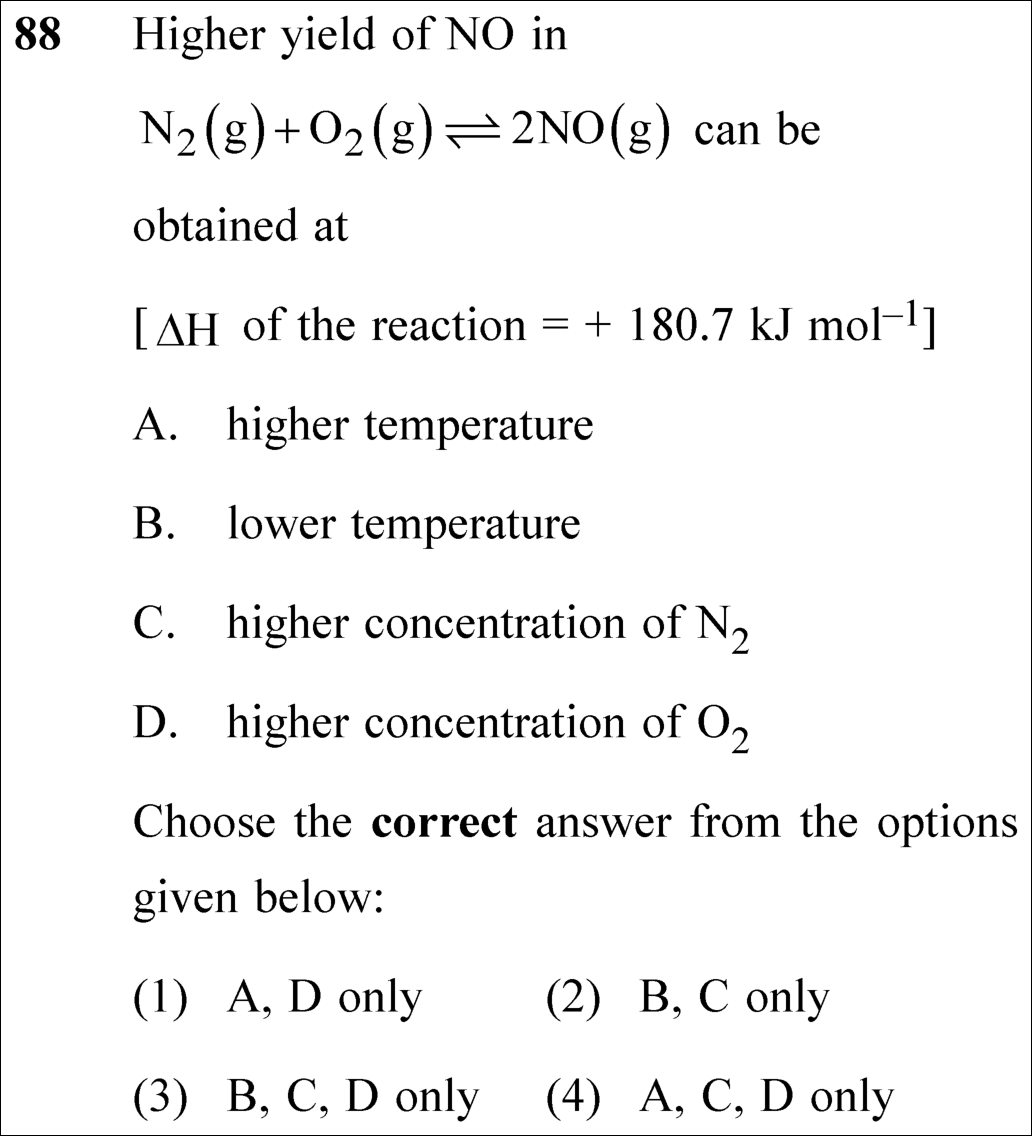
NEET 2025 Chemistry Question 88: Conditions for Higher Yield of NO in Endothermic Reaction N₂ + O₂ ⇌ 2NO

Question

Higher yield of NO in N₂(g) + O₂(g) ⇌ 2NO(g) can be obtained at [ΔH of the reaction = +180.7 kJ mol⁻¹] A. higher temperature B. lower temperature C. higher concentration of N₂ D. higher concentration of O₂ Choose the correct answer from the options given below:

✓
Verified Against NTA Final Answer Key
Option (4) : A, C, D only
📚 Equilibrium Easy
📋 Given Parameters & Problem Setup
Reversible Reaction N₂(g) + O₂(g) ⇌ 2NO(g)
Reaction Enthalpy (ΔH) +180.7 kJ mol⁻¹ (Endothermic)
Conditions Evaluated A: Higher temperature, B: Lower temperature, C: Higher [N₂], D: Higher [O₂]
⚡

The 30-Second Exam Hall Shortcut: ⚡ Le Chatelier Forward Shift Rule

⏱️ Save ~25 seconds

ΔH is POSITIVE (+180.7 kJ/mol) ⟹ Forward reaction ABSORBS heat! Higher temperature shifts equilibrium FORWARD to higher yield (A is correct)! Adding reactants (higher [N₂] or [O₂]) shifts equilibrium FORWARD to consume them (C and D are correct)! ⟹ A, C, D only!

1 Examine reaction: N₂(g) + O₂(g) ⇌ 2NO(g) with ΔH = +180.7 kJ/mol (endothermic forward reaction).
2 Temperature effect: According to Le Chatelier’s principle, increasing temperature shifts equilibrium in the direction of the endothermic reaction (forward direction) ⟹ Higher yield of NO! Condition A is TRUE; B is FALSE.
3 Concentration effect: Increasing the concentration of reactants ([N₂] or [O₂]) disturbs equilibrium, causing the forward reaction to proceed to consume added reactants ⟹ Higher yield of NO! Conditions C and D are TRUE.
4 Conclusion: Higher yield of NO is obtained at A, C, and D only.
5 Select Option (4) in under 10 seconds!
🛡️
Why You Can 100% Trust This Shortcut: Le Chatelier’s Principle on Chemical Equilibria (NCERT Chemistry · Equilibrium).
📐

Step-by-Step Rigorous Workflow & Mathematical Proof

Step 1

Apply Le Chatelier’s Principle for Temperature Change

For an endothermic reversible reaction (ΔH > 0), absorption of heat accompanies the forward reaction:

N2(g)+O2(g)+Heat⇌2NO(g),ΔH=+180.7 kJ⋅mol−1\text{N}_2(g) + \text{O}_2(g) + \text{Heat} \rightleftharpoons 2\text{NO}(g), \quad \Delta H = +180.7\text{ kJ}\cdot\text{mol}^{-1}
  • • An increase in temperature supplies thermal energy, driving the system to absorb heat by shifting to the right (forward).
  • • Consequently, higher temperature (A) increases the equilibrium constant K_p and enhances the yield of NO.
  • • Condition A is correct; condition B is incorrect.
Step 2

Apply Le Chatelier’s Principle for Reactant Concentrations

Examine the reaction quotient Q_c when reactant concentrations are increased:

Qc=[NO]2[N2][O2]Q_c = \frac{[\text{NO}]^2}{[\text{N}_2][\text{O}_2]}
  • • Increasing [N₂] or [O₂] makes Q_c < K_c, driving the reaction in the forward direction until Q_c = K_c again.
  • • Therefore, higher concentration of N₂ (C) and higher concentration of O₂ (D) both increase the yield of NO.
Step 3

Synthesize the Resulting Favorable Conditions

Combine all favorable operational parameters:

Favorable conditions: Higher Temperature (A)∪Higher [N2] (C)∪Higher [O2] (D)\text{Favorable conditions: } \text{Higher Temperature (A)} \cup \text{Higher [N}_2\text{] (C)} \cup \text{Higher [O}_2\text{] (D)}
  • • Matches Option (4) A, C, D only.
⭐

360° Option Elimination Engine Key Feature

Diagnose every choice: Know exactly why the right option works and why distractors fail.

4-Option Deep Scan
1 A
✗ Incorrect
Verdict & Scientific Reason:

Incorrect. Omits higher concentration of N₂ (C).

⚠️
Student Fallacy (Why candidates pick this trap): Leaving out condition C.
2 B
✗ Incorrect
Verdict & Scientific Reason:

Incorrect. Lower temperature (B) favors the backward exothermic reaction, reducing NO yield.

⚠️
Student Fallacy (Why candidates pick this trap): Thinking lower temperature favors endothermic reactions.
3 C
✗ Incorrect
Verdict & Scientific Reason:

Incorrect. Includes lower temperature (B).

⚠️
Student Fallacy (Why candidates pick this trap): Confusing endothermic with exothermic temperature response.
4 D
✓ 100% Correct
Verdict & Scientific Reason:

100% correct. Higher temperature (endothermic shift) and higher reactant concentrations shift equilibrium to NO.

💡
Why this is airtight: None; flawless application of Le Chatelier’s principle.
⚠️

NTA Trap Alert: Confusing Endothermic with Haber Process (Exothermic)

In the Haber synthesis of NH₃, the reaction is EXOTHERMIC, so lower temperature gives higher yield. But NO formation is ENDOTHERMIC (+180.7 kJ/mol), so HIGHER temperature is required for high yield!

🛡️ How to avoid the -1 mark: Check the sign of ΔH: +ΔH means Heat is a reactant ⟹ Higher T shifts forward!
📖

Core NEET Syllabus Standard

NEET Chemistry Core Syllabus · Equilibrium Standard Benchmark
Core Scientific Principle Tested:

"For endothermic reactions (ΔH > 0), higher temperature and higher reactant concentrations increase product yield."

Syllabus Focus: Factors Affecting Equilibria: Le Chatelier’s Principle
✓ Core NEET UG Syllabus Anchor Syllabus & Academic Standards ↗
Heat is a reactant (+ΔH) ⟹ More Heat (A) + More Reactants (C, D) = More NO (Option 4)!

Ready to attempt under real exam pressure?

Test your speed and accuracy in the authentic 180-minute timed NTA simulator.

Launch NEET 2025 CBT Test →

Spotted a mistake in this solution? Report an error (support@mycompetitiveexams.com)

⚖️ Legal & Fair Dealing Notice: Sourced from publicly released NEET 2025 question papers and NEET answer keys for private study, research, and non-commercial educational practice under Fair Dealing (Section 52(1)(a) of the Indian Copyright Act, 1957). Not affiliated with or endorsed by NTA or NMC.

Solve 4 NEET Questions a Day — One per Subject

Cover all 1,140 official NEET questions in 285 days at your own pace. Progress is saved on your device. No login needed.