MyCompetitiveExams Logo MyCompetitiveExams
Search 1,140+ Questions
Chapters, formulas, speed tricks
→
⚡ Brahmastra NEET 2027
720 MARKS

Dynamic 180-question full-length simulator mixed dynamically from all 6 years for 2027 & 2026 aspirants.

Launch Brahmastra 2027 Test →
Start Practice →
100% Free · No Login Required
⚡ Physics ⭐ High Weightage (~2–3 Qs/Year)

NEET Electromagnetic Waves Previous Year Questions with Solutions

Complete repository of official NTA NEET questions for Electromagnetic Waves from 2020 to 2026. Every question includes 30-second elimination tricks, step-by-step NCERT solutions, option-by-option traps, and official answer keys.

11 Questions 6 Exam Years (2026, 2025, 2024, 2023, 2021, 2020) 8 Easy · 2 Medium · 1 Challenging
NEET 2026 · Q38 Challenging
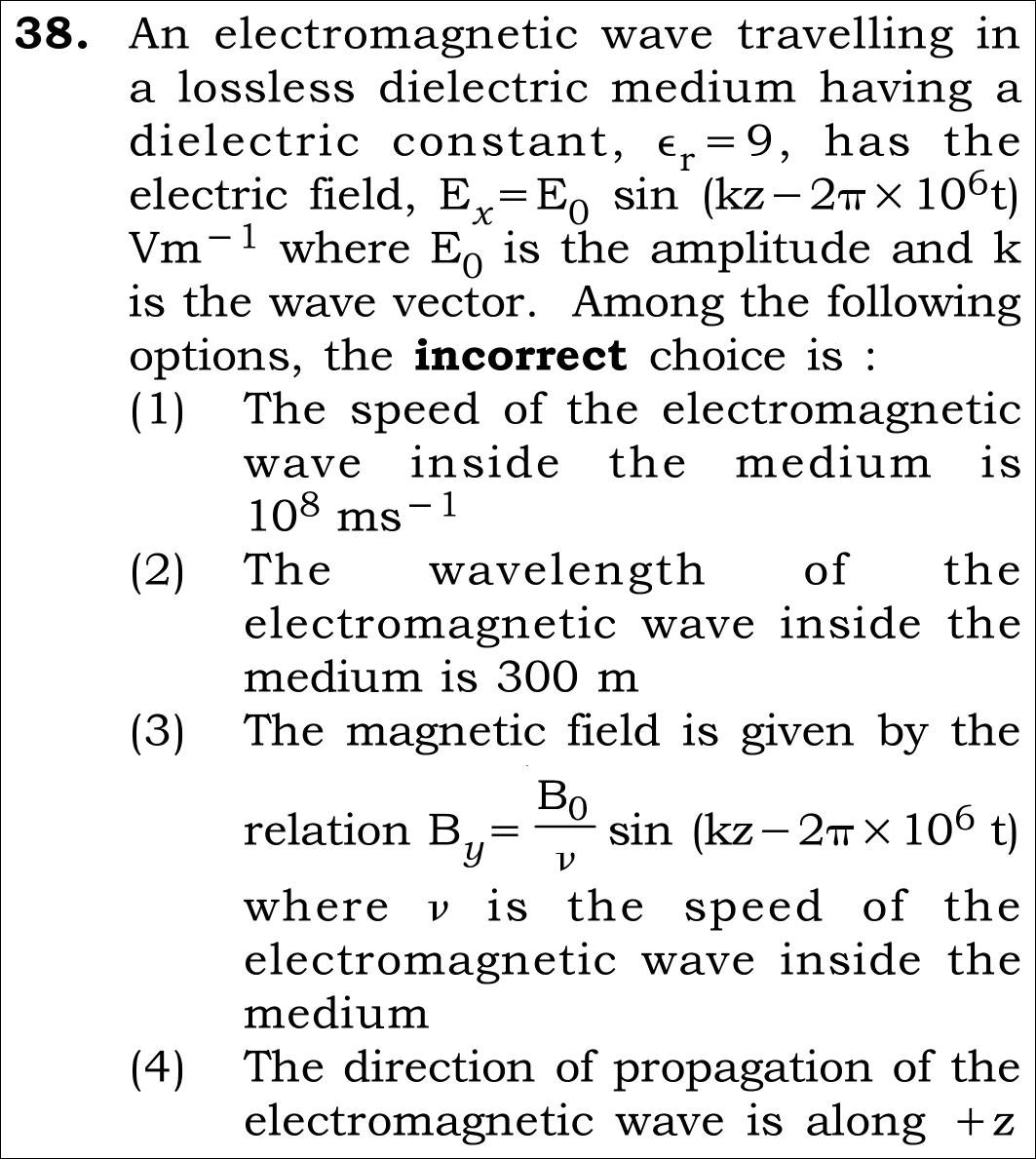
Official NEET 2026 Question 38 - Electromagnetic Waves
1
2 ✓ Key
3
4
💡 Verified Solution & 30-Second Hack
✓
Verified Against NTA Final Answer Key
Option (2) : Both Options (2) and (3) Accepted as Correct by NTA (Official Key: B,C)
📚 Electromagnetic Waves Challenging
📋 Given Parameters & Problem Setup
Medium Lossless dielectric with dielectric constant epsilon_r = 9 (relative permeability mu_r = 1)
Electric Field E_x = E_0 sin(kz - 2*pi*10^6 t) V/m
Wave Amplitude E_0
Angular Frequency omega = 2*pi*10^6 rad/s (frequency f = 10^6 Hz = 1 MHz)
Question Requirement Identify the INCORRECT statement among the given options
Official NTA Key B,C (both options 2 and 3 awarded marks)
⚡

The 30-Second Exam Hall Shortcut: ⚡ The Dual-Key Flaw Diagnostic (Why NTA Accepted Both 2 and 3)

⏱️ Essential exam-hall awareness of NTA multi-key questions.

Statements (2) and (3) are BOTH scientifically false!

1 Speed of wave in medium: v = c / sqrt(epsilon_r) = (3 * 10^8) / sqrt(9) = (3 * 10^8) / 3 = 10^8 m/s ==> Statement (1) is TRUE.
2 Direction of propagation: Phase is (kz - omega*t), so wave travels along +z ==> Statement (4) is TRUE.
3 Wavelength in medium: lambda = v / f = (10^8 m/s) / (10^6 Hz) = 100 m! But Statement (2) claims lambda = 300 m (which is vacuum wavelength!). Therefore Statement (2) is INCORRECT!
4 Magnetic field amplitude: E_0 / B_0 = v ==> B_0 = E_0 / v. Statement (3) writes B_y = (B_0 / v) sin(...), which has dimensionally WRONG units (divides B_0 by v again!). Therefore Statement (3) is ALSO INCORRECT!
5 Because the question asked for the INCORRECT choice, and both (2) and (3) are false, NTA officially accepted BOTH (2) and (3)!
🛡️
Why You Can 100% Trust This Shortcut: In a dielectric medium, speed reduces to v = c/n and wavelength reduces to lambda = lambda_0/n = 300/3 = 100 m. Furthermore, magnetic field amplitude is B_0 = E_0/v; the expression (B_0/v) violates dimensional homogeneity.
📐

Step-by-Step Rigorous Workflow & Mathematical Proof

Step 1

Determine Wave Speed and Verify Statement (1)

For a non-magnetic lossless dielectric with relative permittivity epsilon_r = 9 and mu_r = 1:

v=1μϵ=cμrϵr=3×1081×9=3×1083=108 m/sv = \frac{1}{\sqrt{\mu \epsilon}} = \frac{c}{\sqrt{\mu_r \epsilon_r}} = \frac{3 \times 10^8}{\sqrt{1 \times 9}} = \frac{3 \times 10^8}{3} = 10^8\text{ m/s}
  • • The speed of the wave inside the medium is exactly 10^8 m/s.
  • • Statement (1) is factually TRUE (hence not the answer to an "incorrect choice" question).
Step 2

Evaluate Wavelength and Prove Statement (2) is INCORRECT

From the wave equation E_x = E_0 \sin(kz - \omega t), angular frequency is omega = 2*pi*10^6 rad/s, so frequency f is:

f=ω2π=2π×1062π=106 Hz=1 MHzf = \frac{\omega}{2\pi} = \frac{2\pi \times 10^6}{2\pi} = 10^6\text{ Hz} = 1\text{ MHz}
  • • Wavelength inside the medium: \lambda_{\text{medium}} = \frac{v}{f} = \frac{10^8\text{ m/s}}{10^6\text{ Hz}} = 100\text{ m}.
  • • Statement (2) asserts that wavelength inside the medium is 300 m (which is the wavelength in free space c/f = 300 m).
  • • Therefore, Statement (2) is definitely INCORRECT.
Step 3

Evaluate Magnetic Field and Prove Statement (3) is ALSO INCORRECT

By Maxwell's equations, the relationship between peak amplitudes of E and B in a medium is:

E0B0=v  ⟹  B0=E0v\frac{E_0}{B_0} = v \implies B_0 = \frac{E_0}{v}
  • • The magnetic field must be B_y = B_0 \sin(kz - \omega t) = \left(\frac{E_0}{v}\right) \sin(kz - \omega t).
  • • Statement (3) mistakenly writes: B_y = \left(\frac{B_0}{v}\right) \sin(kz - \omega t), which divides B_0 by v again, producing incorrect units of [Tesla / (m/s)].
  • • Therefore, Statement (3) is ALSO factually and dimensionally INCORRECT.
  • • During answer key challenges, NTA accepted both challenges and declared BOTH Option (2) and Option (3) as correct answers (Key: B,C).
⭐

360° Option Elimination Engine Key Feature

Diagnose every choice: Know exactly why the right option works and why distractors fail.

4-Option Deep Scan
1 Option (1)
✗ Incorrect
Verdict & Scientific Reason:

This statement is scientifically TRUE (speed is indeed 10^8 m/s).

⚠️
Student Fallacy (Why candidates pick this trap): Marks this option thinking it is false.
Note: Question asks for the INCORRECT choice.
2 Option (2)
✓ 100% Correct
Verdict & Scientific Reason:

INCORRECT STATEMENT (Wavelength in medium is 100 m, not 300 m); officially accepted by NTA.

💡
Why this is airtight: Recognizes that 300 m is vacuum wavelength, not medium wavelength.
Note: Awarded full marks under official NTA key.
3 Option (3)
✓ 100% Correct
Verdict & Scientific Reason:

INCORRECT STATEMENT (Dimensionally flawed: amplitude is B_0, not B_0/v); officially accepted by NTA.

💡
Why this is airtight: Recognizes the dimensional error in the setter's magnetic field amplitude.
Note: Awarded full marks under official NTA key.
4 Option (4)
✗ Incorrect
Verdict & Scientific Reason:

This statement is scientifically TRUE (phase is kz - omega*t).

⚠️
Student Fallacy (Why candidates pick this trap): Confuses wave propagation direction with field oscillation axis.
Note: Question asks for the INCORRECT choice.
⚠️

NTA Trap Alert: The Free Space Wavelength Trap (300 m vs 100 m)

Many students compute lambda = c / f = 3*10^8 / 10^6 = 300 m and conclude that Statement (2) is true, forgetting that waves SLOW DOWN in dielectric media, compressing wavelength to lambda / n = 100 m.

🛡️ How to avoid the -1 mark: Always use medium velocity for wavelength in media: lambda = v / f = (c / n) / f.
📖

Core NEET Syllabus Standard

NEET UG Physics Core Standards · Electromagnetic Waves Standard Benchmark
Core Scientific Principle Tested:

"In a dielectric medium: v = c / sqrt(epsilon_r), lambda = v / f = lambda_0 / sqrt(epsilon_r), and E_0 / B_0 = v."
Syllabus Focus: Propagation of EM Waves in Dielectric Media & Field Relations
✓ Core NEET UG Syllabus Anchor Syllabus & Academic Standards ↗
NEET 2026 · Q43 Easy
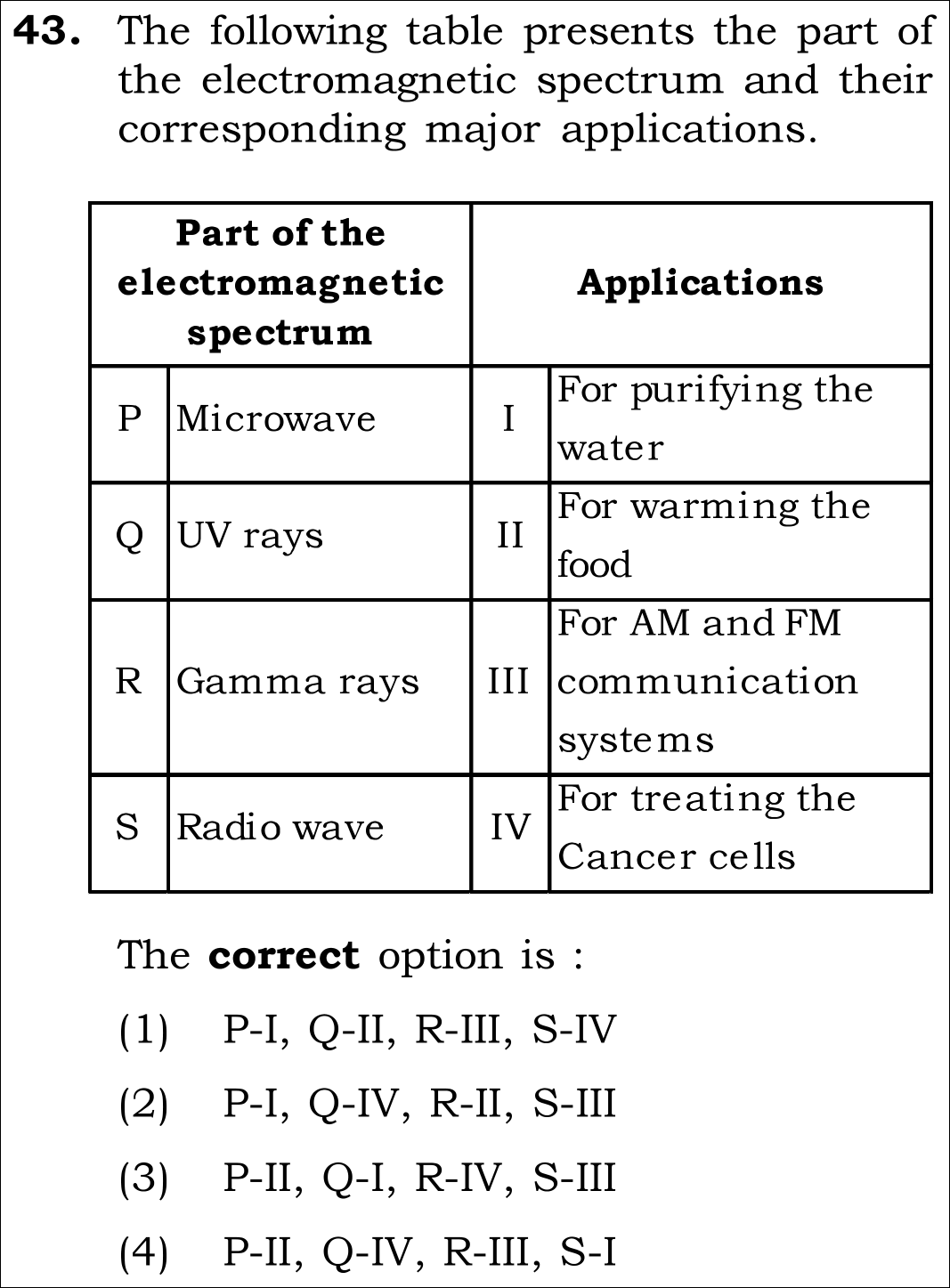
Official NEET 2026 Question 43 - Electromagnetic Waves
1
2
3 ✓ Key
4
💡 Verified Solution & 30-Second Hack
✓
Verified Against NTA Final Answer Key
Option (3) : P-II, Q-I, R-IV, S-III
📚 Electromagnetic Waves Easy
📋 Given Parameters & Problem Setup
Band P Microwave
Band Q UV rays
Band R Gamma rays
Band S Radio wave
Application I For purifying the water
Application II For warming the food
Application III For AM and FM communication systems
Application IV For treating the Cancer cells
⚡

The 30-Second Exam Hall Shortcut: ⚡ 1-to-1 Anchor Match Trick

⏱️ Instant matching saves 45 seconds.

Match the most obvious pair: Microwaves warm food (P -> II)!

1 P (Microwave): Used in microwave ovens for warming food ==> P must match II.
2 Look at the options: Only Options (3) and (4) start with P-II.
3 Now match Q (UV rays): UV water purifiers kill bacteria and microbes ==> Q must match I.
4 Between (3) and (4), ONLY Option (3) has Q-I! Done in 10 seconds!
🛡️
Why You Can 100% Trust This Shortcut: Every pairing is a standard canonical fact directly from NCERT Electromagnetic Waves chapter table.
📐

Step-by-Step Rigorous Workflow & Mathematical Proof

Step 1

Match Microwaves (P)

Microwaves have frequencies tuned to the resonant rotational frequency of water molecules in food:

Microwaves (P)  ⟺  Warming the food (II)\text{Microwaves (P)} \iff \text{Warming the food (II)}
  • • Used universally in domestic and commercial microwave ovens.
Step 2

Match Ultraviolet Rays (Q)

UV radiation damages microbial DNA, acting as a powerful germicide:

UV rays (Q)  ⟺  Purifying water by destroying microbes (I)\text{UV rays (Q)} \iff \text{Purifying water by destroying microbes (I)}
  • • Standard technology in domestic RO/UV water purifiers.
Step 3

Match Gamma Rays (R) and Radio Waves (S)

Evaluate the remaining two high and low frequency bands:

Gamma rays (R)  ⟺  Cancer radiotherapy (IV),Radio waves (S)  ⟺  AM/FM communication (III)\text{Gamma rays (R)} \iff \text{Cancer radiotherapy (IV)}, \qquad \text{Radio waves (S)} \iff \text{AM/FM communication (III)}
  • • High-energy Gamma rays destroy malignant tumor cells in radiotherapy.
  • • Radio waves propagate over long distances for broadcast communication.
Step 4

Assemble Complete Match Code

Combine all pairings:

P-II, Q-I, R-IV, S-III\text{P-II, } \text{Q-I, } \text{R-IV, } \text{S-III}
  • • Matches Option (3) exactly.
⭐

360° Option Elimination Engine Key Feature

Diagnose every choice: Know exactly why the right option works and why distractors fail.

4-Option Deep Scan
1 Option (1)
✗ Incorrect
Verdict & Scientific Reason:

Mismatches food warming and water purification.

⚠️
Student Fallacy (Why candidates pick this trap): Assumes microwaves purify water.
Note: Microwaves warm food (P-II).
2 Option (2)
✗ Incorrect
Verdict & Scientific Reason:

Scrambled assignments.

⚠️
Student Fallacy (Why candidates pick this trap): Assigns gamma rays to food warming.
Note: Gamma rays are used in cancer radiotherapy (R-IV).
3 Option (3)
✓ 100% Correct
Verdict & Scientific Reason:

100% textbook verified; confirmed by Official NTA Final Answer Key.

💡
Why this is airtight: Exact knowledge of NCERT EM spectrum application table.
Note: Flawless match.
4 Option (4)
✗ Incorrect
Verdict & Scientific Reason:

Assigns radio waves to water purification.

⚠️
Student Fallacy (Why candidates pick this trap): Assigns UV rays to cancer treatment.
Note: UV rays purify water (Q-I).
⚠️

NTA Trap Alert: Confusing UV Water Purification with Gamma Food Irradiation

Students sometimes confuse the germicidal applications of UV and Gamma rays.

🛡️ How to avoid the -1 mark: Remember: Water purifiers in homes specifically have "UV filters" (Q-I), while hospitals use Gamma rays for cancer treatment (R-IV).
📖

Core NEET Syllabus Standard

NEET UG Physics Core Standards · Electromagnetic Waves Standard Benchmark
Core Scientific Principle Tested:

"Microwaves: radar and ovens. UV: water purification and LASIK. Gamma rays: radiotherapy for cancer. Radio waves: radio and television transmission."

Syllabus Focus: Electromagnetic Spectrum: Frequency Bands and Applications
✓ Core NEET UG Syllabus Anchor Syllabus & Academic Standards ↗
NEET 2025 · Q9 Easy
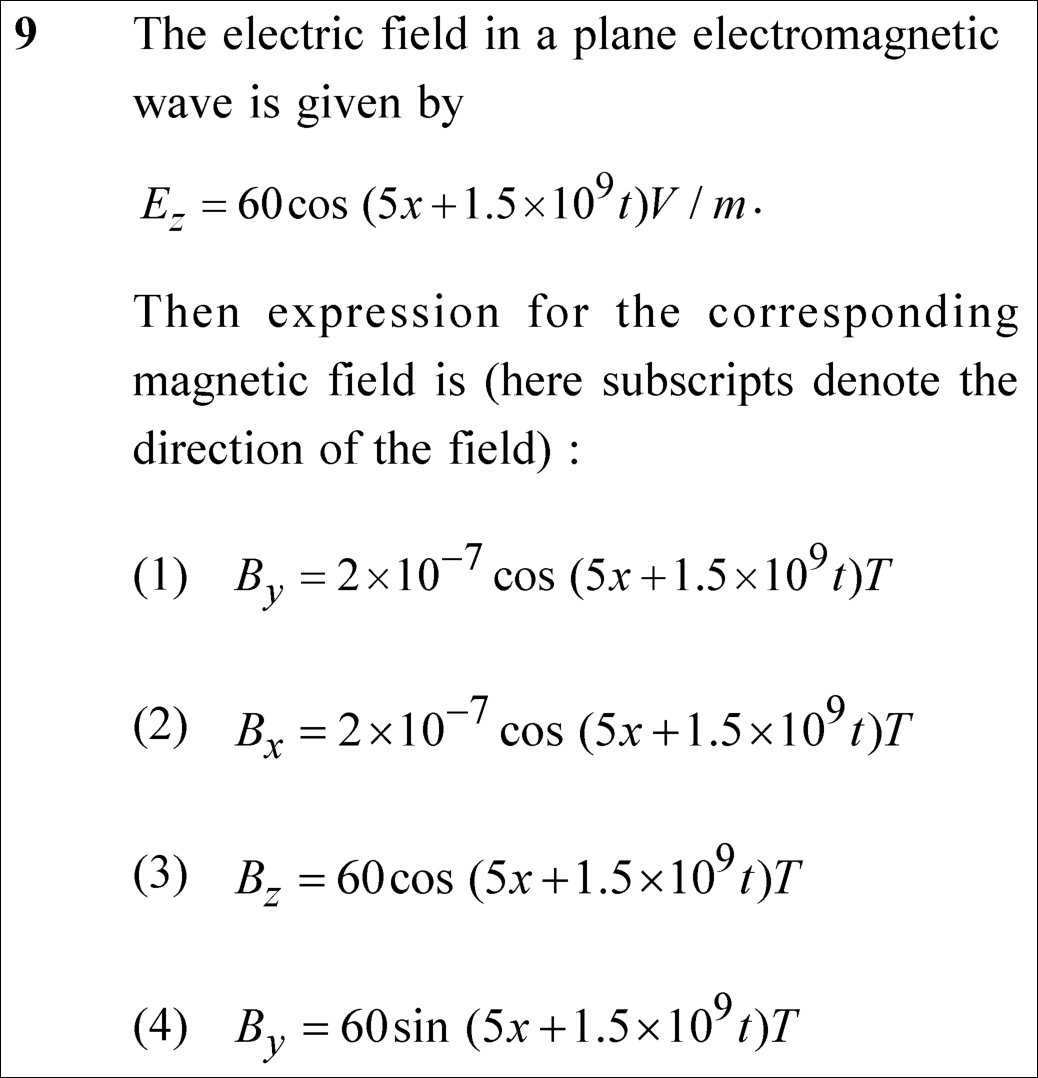
Official NEET 2025 Question 9 - Electromagnetic Waves
1 ✓ Key
2
3
4
💡 Verified Solution & 30-Second Hack
✓
Verified Against NTA Final Answer Key
Option (1) : B_y = 2 \times 10^{-7} \cos(5x + 1.5 \times 10^9 t)\text{ T}
📚 Electromagnetic Waves Easy
📋 Given Parameters & Problem Setup
Electric Field Equation E_z = 60 cos(5x + 1.5 × 10⁹ t) V/m
Wave Parameters k = 5 rad/m, ω = 1.5 × 10⁹ rad/s, E₀ = 60 V/m
Wave Direction Phase (5x + 1.5 × 10⁹ t) ⟹ Propagating along -x direction (-î)
⚡

The 30-Second Exam Hall Shortcut: ⚡ B₀ = E₀ / c and Poynting Vector Direction

⏱️ Save ~45 seconds

B₀ = 60 / (3 × 10⁸) = 2 × 10⁻⁷ T, and E_z (k̂) ⟹ B must be along ŷ (ĵ) because k̂ × ĵ = -î!

1 Find amplitude: B₀ = E₀ / c = 60 / (3 × 10⁸) = 2 × 10⁻⁷ T. Eliminates options (3) & (4) immediately!
2 Find wave propagation direction: Phase is (5x + ωt) ⟹ Wave travels along -x axis (-î).
3 Electric field is along z-axis (k̂).
4 Poynting vector direction: Ê × B̂ must point along wave propagation (-î).
5 Check cross products: k̂ × ĵ = -î. Thus, B must oscillate along y-axis (B_y)!
6 Select Option (1) in under 15 seconds!
🛡️
Why You Can 100% Trust This Shortcut: NCERT Physics · Electromagnetic Waves (Electromagnetic Spectrum Frequency & Wavelength Hierarchy).
📐

Step-by-Step Rigorous Workflow & Mathematical Proof

Step 1

Calculate Magnetic Field Amplitude

In a vacuum / free space, the ratio of electric field amplitude to magnetic field amplitude equals the speed of light c = ω / k:

c=ωk=1.5×1095=3×10⁸ m/sc = \frac{\omega}{k} = \frac{1.5 \times 10^9}{5} = 3 \times 10^8\text{ m/s}
  • • B₀ = E₀ / c = 60 / (3 × 10⁸) = 2 × 10⁻⁷ T.
Step 2

Determine Polarization Direction of B

The direction of electromagnetic wave propagation is given by the unit vector along the Poynting vector Ŝ = Ê × B̂. Here, the wave travels in the negative x-direction (-î) and E is polarized along the z-axis (k̂):

E^×B^=−i^  ⟹  k^×B^=−i^  ⟹  B^=j^\hat{E} \times \hat{B} = -\hat{i} \implies \hat{k} \times \hat{B} = -\hat{i} \implies \hat{B} = \hat{j}
  • • Because k̂ × ĵ = -î, the magnetic field must be along the positive y-axis: B_y.
Step 3

Write Full Wave Equation for B

The magnetic field oscillates in phase with the electric field in a plane EM wave:

By=2×10⁻⁷cos⁡(5x+1.5×10⁹t) TB_y = 2 \times 10^{-7} \cos(5x + 1.5 \times 10^9 t)\text{ T}
  • • Corresponds uniquely to Option (1).
⭐

360° Option Elimination Engine Key Feature

Diagnose every choice: Know exactly why the right option works and why distractors fail.

4-Option Deep Scan
1 A
✓ 100% Correct
Verdict & Scientific Reason:

100% correct. B₀ = 2 × 10⁻⁷ T, orientation along y-axis satisfies Ê × B̂ = -î, and phase matches E_z.

💡
Why this is airtight: None; perfect electromagnetic wave theory.
2 B
✗ Incorrect
Verdict & Scientific Reason:

Incorrect. EM waves are transverse; B cannot oscillate along the direction of propagation (x-axis).

⚠️
Student Fallacy (Why candidates pick this trap): Violating the transverse nature of electromagnetic waves.
3 C
✗ Incorrect
Verdict & Scientific Reason:

Incorrect. E and B cannot oscillate along the same axis (z), and amplitude is not divided by c.

⚠️
Student Fallacy (Why candidates pick this trap): Equating E and B amplitudes directly and making them parallel.
4 D
✗ Incorrect
Verdict & Scientific Reason:

Incorrect. Amplitude not scaled by c and phase arbitrarily changed from cosine to sine.

⚠️
Student Fallacy (Why candidates pick this trap): Introducing an unnecessary 90° phase shift.
⚠️

NTA Trap Alert: Transverse Wave Orientation Trap

Students often pick B_x without thinking. In an EM wave traveling along x, NEITHER E nor B can have an x-component (transverse nature: E ⟂ B ⟂ v).

🛡️ How to avoid the -1 mark: If wave is along x, fields can ONLY be along y and z!
📖

Core NEET Syllabus Standard

NEET Physics Core Syllabus · Electromagnetic Waves Standard Benchmark
Core Scientific Principle Tested:

"E and B are mutually perpendicular, perpendicular to propagation, in phase, and related by E₀ = c B₀."

Syllabus Focus: Transverse Nature of Electromagnetic Waves
✓ Core NEET UG Syllabus Anchor Syllabus & Academic Standards ↗
Scale by c, Check cross product: k̂ × ĵ = -î ⟹ B is on y!
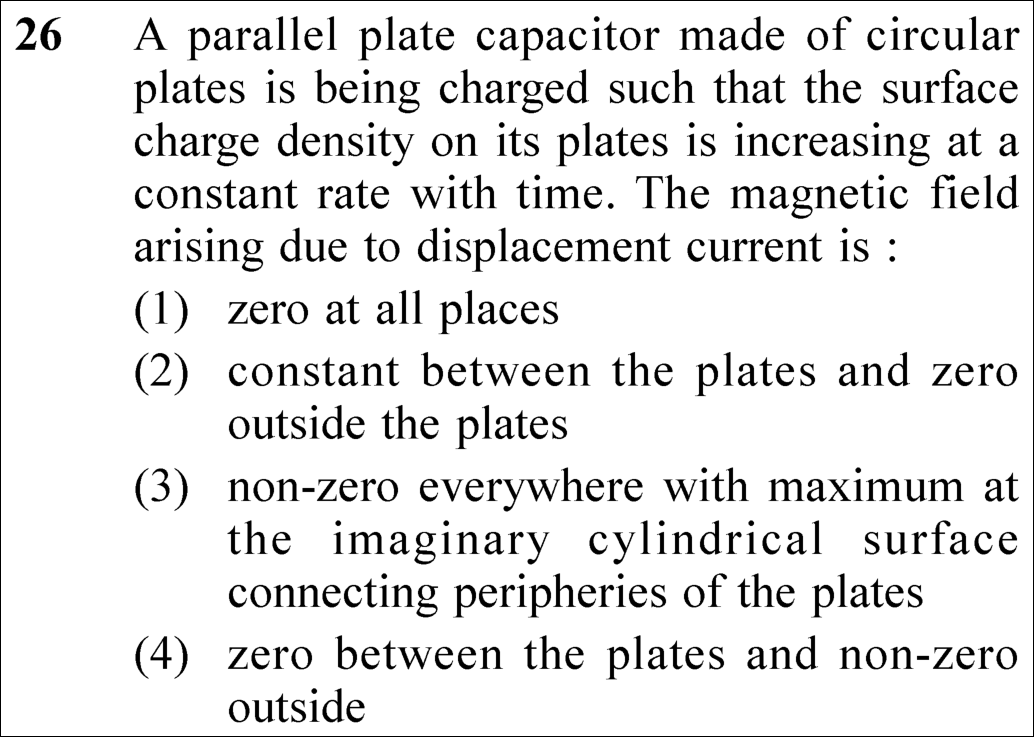
NEET 2025 · Q26 Medium
Official NEET 2025 Question 26 - Electromagnetic Waves
1
2
3 ✓ Key
4
💡 Verified Solution & 30-Second Hack
✓
Verified Against NTA Final Answer Key
Option (3) : non-zero everywhere with maximum at the imaginary cylindrical surface connecting peripheries of the plates
📚 Electromagnetic Waves Medium
📋 Given Parameters & Problem Setup
Capacitor Geometry Circular parallel plates of radius R
Charging Rate Surface charge density σ(t) increases at a constant rate with time
Target Property Spatial variation of induced magnetic field B(r) arising from displacement current
⚡

The 30-Second Exam Hall Shortcut: ⚡ Ampère-Maxwell Cylindrical Peak Rule

⏱️ Save ~50 seconds

Inside plates (r ≤ R): B ∝ r (linear growth); Outside plates (r ≥ R): B ∝ 1/r (hyperbolic decay) ⟹ B is MAXIMUM at the perimeter (r = R)!

1 Displacement current density J_d = ε₀ (dE/dt) is uniform across the circular plates of radius R.
2 Inside the plates (r ≤ R): Ampèrian loop of radius r encloses flux ∝ r² ⟹ B(2πr) = μ₀ J_d (πr²) ⟹ B(r) ∝ r.
3 Outside the plates (r ≥ R): Ampèrian loop encloses the entire total displacement current I_d ⟹ B(2πr) = μ₀ I_d ⟹ B(r) ∝ 1/r.
4 Thus B(r) starts from 0 at the center (r = 0), increases linearly to a MAXIMUM at the rim (r = R), and then decays as 1/r outside.
5 Therefore, B is non-zero everywhere with its maximum at the cylindrical surface connecting the peripheries (r = R)!
6 Select Option (3) in under 20 seconds!
🛡️
Why You Can 100% Trust This Shortcut: Ampère-Maxwell Law (NCERT Physics · Electromagnetic Waves: Displacement Current I_d = ε₀ dΦ_E/dt).
📐

Step-by-Step Rigorous Workflow & Mathematical Proof

Step 1

Displacement Current Density Between the Plates

For circular parallel plates of radius R, the electric field between the plates is E = σ / ε₀. Since dσ/dt is constant, the time derivative of the electric field is uniform:

dEdt=1ε0dσdt=constant\frac{dE}{dt} = \frac{1}{\varepsilon_0} \frac{d\sigma}{dt} = \text{constant}
  • • Displacement current density J_d = ε₀ (dE/dt) is uniform throughout the cylindrical region between the plates.
Step 2

Magnetic Field Inside the Plates (r ≤ R)

Construct a circular Ampèrian loop of radius r ≤ R coaxial with the plates. Applying the Ampère-Maxwell law:

∮B⃗⋅dl⃗=μ0Id,enclosed  ⟹  B(r)⋅2πr=μ0(ε0πr2dEdt)  ⟹  B(r)=μ0ε0r2dEdt∝r\oint \vec{B} \cdot d\vec{l} = \mu_0 I_{d,enclosed} \implies B(r) \cdot 2\pi r = \mu_0 \left( \varepsilon_0 \pi r^2 \frac{dE}{dt} \right) \implies B(r) = \frac{\mu_0 \varepsilon_0 r}{2} \frac{dE}{dt} \propto r
  • • The magnetic field grows linearly from zero on the central axis (r = 0) up to the edge r = R.
Step 3

Magnetic Field Outside the Plates (r ≥ R) & Maximum

For an Ampèrian loop of radius r ≥ R, the enclosed displacement current is the full total displacement current I_d = ε₀ π R² (dE/dt):

B(r)⋅2πr=μ0Id  ⟹  B(r)=μ0ε0R22rdEdt∝1rB(r) \cdot 2\pi r = \mu_0 I_d \implies B(r) = \frac{\mu_0 \varepsilon_0 R^2}{2r} \frac{dE}{dt} \propto \frac{1}{r}
  • • Because B increases for r ≤ R and decreases for r ≥ R, it attains its global maximum at r = R (the peripheral boundary).
  • • Thus B is non-zero everywhere and reaches maximum at the imaginary cylindrical surface connecting the peripheries, matching Option (3).
⭐

360° Option Elimination Engine Key Feature

Diagnose every choice: Know exactly why the right option works and why distractors fail.

4-Option Deep Scan
1 A
✗ Incorrect
Verdict & Scientific Reason:

Incorrect. Maxwell discovered displacement current precisely because a changing electric field generates a non-zero magnetic field.

⚠️
Student Fallacy (Why candidates pick this trap): Believing that because no physical conduction electrons cross the vacuum gap, B must be zero.
2 B
✗ Incorrect
Verdict & Scientific Reason:

Incorrect. B grows linearly with r inside (B ∝ r) and decays as 1/r outside; it is neither constant nor zero outside.

⚠️
Student Fallacy (Why candidates pick this trap): Confusing electric field (which is uniform) with induced magnetic field.
3 C
✓ 100% Correct
Verdict & Scientific Reason:

100% exact. B(r) ∝ r for r ≤ R and B(r) ∝ 1/r for r ≥ R, peaking at r = R.

💡
Why this is airtight: None; canonical Maxwell-Ampère electrodynamics.
4 D
✗ Incorrect
Verdict & Scientific Reason:

Incorrect. B is non-zero throughout the interior except on the singular line r = 0.

⚠️
Student Fallacy (Why candidates pick this trap): Inverting spatial domains.
⚠️

NTA Trap Alert: Confusing Electric Field with Induced Magnetic Field

The electric field E between the plates is uniform (constant in space). But the INDUCED magnetic field B is created by enclosed displacement flux, so it grows with radius (B ∝ r) and peaks at the perimeter.

🛡️ How to avoid the -1 mark: Remember: E is uniform; B forms concentric loops that grow linearly to the edge!
📖

Core NEET Syllabus Standard

NEET Physics Core Syllabus · Electromagnetic Waves Standard Benchmark
Core Scientific Principle Tested:

"Magnetic field inside charging capacitor is B(r) ∝ r (r ≤ R) and B(r) ∝ 1/r (r ≥ R), peaking at r = R."

Syllabus Focus: Displacement Current & Ampère-Maxwell Law
✓ Core NEET UG Syllabus Anchor Syllabus & Academic Standards ↗
Inside: B grows with r; Outside: B dies as 1/r ⟹ PEAK at the rim (r = R)!
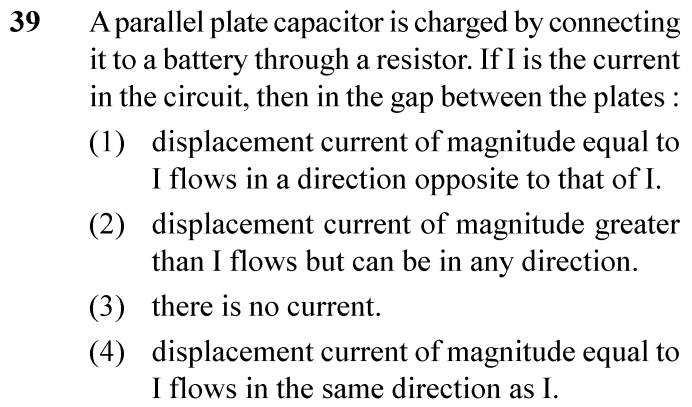
NEET 2024 · Q39 Easy
Official NEET 2024 Question 39 - Electromagnetic Waves
1
2
3
4 ✓ Key
💡 Verified Solution & 30-Second Hack
✓
Verified Against NTA Final Answer Key
Option (4) : displacement current of magnitude equal to I flows in the same direction as I.
📚 Electromagnetic Waves Easy
📋 Given Parameters & Problem Setup
Device Parallel plate capacitor charging through resistor
Conduction current I in connecting wires
Region of interest Gap between the capacitor plates
⚡

The 30-Second Exam Hall Shortcut: ⚡ Maxwell’s Continuity Principle Shortcut

⏱️ Save ~40 seconds

Circuit current must be continuous across space: Displacement current I_d in the gap EXACTLY equals conduction current I in magnitude and direction!

1 Ampère-Maxwell Law requires continuity of total current: I_conduction = I_displacement.
2 By Maxwell’s derivation: I_d = ε₀ (dΦ_E / dt) = dQ/dt = I.
3 The electric field points from the positive plate to the negative plate, increasing in the forward direction.
4 Thus, displacement current flows from the positive plate to the negative plate across the gap, continuing in the SAME direction as I.
5 Option (4) in under 5 seconds!
🛡️
Why You Can 100% Trust This Shortcut: Ampère-Maxwell Law & Principle of Current Continuity (I_d = ε₀ dΦ_E/dt = I).
📐

Step-by-Step Rigorous Workflow & Mathematical Proof

Step 1

Definition of Displacement Current

Between the plates of a parallel plate capacitor, no actual physical charge carriers cross the vacuum or dielectric gap. However, as the capacitor charges with current I = dQ/dt, the charge Q on the plates increases, causing a time-varying electric field E and electric flux Φ_E between the plates:

ΦE=E⋅A=(Qε0A)A=Qε0\Phi_E = E \cdot A = \left(\frac{Q}{\varepsilon_0 A}\right) A = \frac{Q}{\varepsilon_0}
Step 2

Evaluation of Displacement Current Magnitude

Maxwell defined the displacement current I_d as the rate of change of electric flux scaled by permittivity ε₀:

Id=ε0dΦEdt=ε0ddt(Qε0)=dQdt=II_d = \varepsilon_0 \frac{d\Phi_E}{dt} = \varepsilon_0 \frac{d}{dt}\left(\frac{Q}{\varepsilon_0}\right) = \frac{dQ}{dt} = I
Step 3

Direction of Displacement Current

As positive charge accumulates on the positive plate and negative charge on the negative plate, the electric field E points from positive to negative plate. Since E is increasing, dE/dt and therefore the displacement current density J_d = ε₀ dE/dt is directed from positive to negative plate, continuing seamlessly in the same direction as the conduction current I entering the capacitor.

I⃗d∥I⃗\vec{I}_d \parallel \vec{I}
⭐

360° Option Elimination Engine Key Feature

Diagnose every choice: Know exactly why the right option works and why distractors fail.

4-Option Deep Scan
1 (1)
✗ Incorrect
Verdict & Scientific Reason:

Opposite direction would violate conservation of charge and loop continuity.

⚠️
Student Fallacy (Why candidates pick this trap): Thinking displacement current is a Lenz-type opposition.
2 (2)
✗ Incorrect
Verdict & Scientific Reason:

Displacement current is exactly equal to I, not greater.

⚠️
Student Fallacy (Why candidates pick this trap): Believing dielectric or geometry magnifies the current.
3 (3)
✗ Incorrect
Verdict & Scientific Reason:

Classical Ampère misconception before Maxwell’s correction.

⚠️
Student Fallacy (Why candidates pick this trap): Believing no physical charges means zero current.
4 (4)
✓ 100% Correct
Verdict & Scientific Reason:

Fundamental Ampère-Maxwell law: I_d = I with identical forward direction.

💡
Why this is airtight: None.
⚠️

NTA Trap Alert: Assuming "Opposite Direction" by Analogy to Lenz’s Law

Many candidates pick Option (1) believing displacement current opposes conduction current.

🛡️ How to avoid the -1 mark: Displacement current does NOT oppose conduction current; it COMPLETES the circuit so that total current is continuous everywhere!
📖

Core NEET Syllabus Standard

Physics Core Electrodynamics · Electromagnetic Waves Standard Benchmark
Core Scientific Principle Tested:

"Displacement current between capacitor plates has magnitude identically equal to the conduction current in the connecting wires and flows in the same direction."

Syllabus Focus: Displacement Current and Maxwell’s Modification of Ampère’s Law
✓ Core NEET UG Syllabus Anchor Syllabus & Academic Standards ↗
Gap doesn’t break the flow: Displacement current continues where wires go!
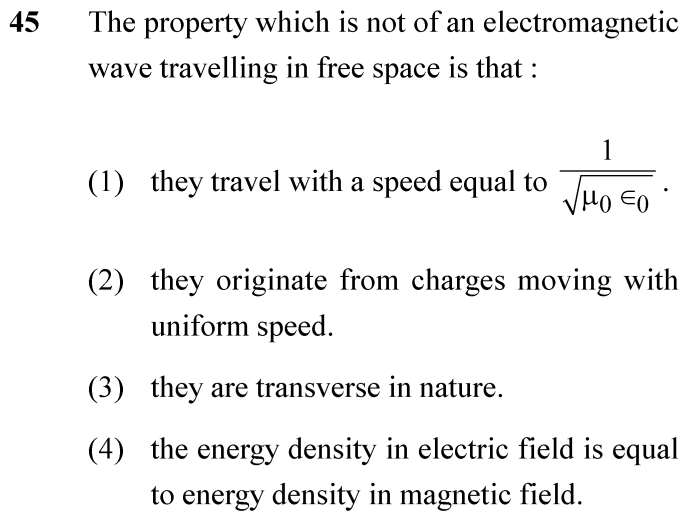
NEET 2024 · Q45 Easy
Official NEET 2024 Question 45 - Electromagnetic Waves
1
2 ✓ Key
3
4
💡 Verified Solution & 30-Second Hack
✓
Verified Against NTA Final Answer Key
Option (2) : they originate from charges moving with uniform speed.
📚 Electromagnetic Waves Easy
📋 Given Parameters & Problem Setup
Wave type Electromagnetic wave traveling in free space (vacuum)
Condition tested Which property is NOT a property of electromagnetic waves
⚡

The 30-Second Exam Hall Shortcut: ⚡ Accelerated Charge Principle Hack

⏱️ Save ~35 seconds

Charges at uniform speed produce only steady magnetic and electric fields (NO radiation)! EM waves require ACCELERATED charges -> Option (2) is NOT a property!

1 Static charges produce only electrostatic field E.
2 Charges moving with uniform velocity (steady current) produce steady magnetic field B and electric field E, but DO NOT radiate energy.
3 Electromagnetic waves are produced ONLY by ACCELERATED or OSCILLATING charges.
4 Therefore, Statement (2) ("they originate from charges moving with uniform speed") is completely FALSE and NOT a property.
5 Identify Option (2) in under 5 seconds!
🛡️
Why You Can 100% Trust This Shortcut: Maxwell’s Theory of Electromagnetic Radiation (Electromagnetic waves originate strictly from accelerated or oscillating charges).
📐

Step-by-Step Rigorous Workflow & Mathematical Proof

Step 1

Source of Electromagnetic Waves

According to Maxwell’s electromagnetic theory: - A stationary charge produces only a static electric field. - A charge moving with uniform velocity (constant speed in a straight line) constitutes a steady current and produces a steady magnetic field, but the energy remains localized with the charge and is not radiated into space. - An accelerated charge (such as an oscillating electron in an LC circuit or antenna) radiates energy continuously into space in the form of electromagnetic waves.

a⃗charge≠0  ⟹  Emission of EM waves\vec{a}_{charge} \ne 0 \implies \text{Emission of EM waves}
Step 2

Verification of Property (1) - Speed of EM Waves

In free space, electromagnetic waves travel at the speed of light c, which is rigorously derived from Maxwell’s equations as 1/√(μ₀ ε₀):

c=1μ0ε0≈3×10⁸ m/s(Valid Property)c = \frac{1}{\sqrt{\mu_0 \varepsilon_0}} \approx 3 \times 10^8\,\text{m/s} \quad (\text{Valid Property})
Step 3

Verification of Property (3) - Transverse Nature

Electromagnetic waves are transverse in nature: the electric field vector E, magnetic field vector B, and propagation vector k are mutually perpendicular to each other:

E⃗⊥B⃗⊥k⃗(Valid Property)\vec{E} \perp \vec{B} \perp \vec{k} \quad (\text{Valid Property})
Step 4

Verification of Property (4) - Energy Density Equipartition

In free space, the time-averaged energy density of the electric field u_E equals the time-averaged energy density of the magnetic field u_B:

uE=14ε0E02,uB=B024μ0=uE(Valid Property)u_E = \frac{1}{4}\varepsilon_0 E_0^2, \quad u_B = \frac{B_0^2}{4\mu_0} = u_E \quad (\text{Valid Property})
Step 5

Conclusion

The statement which is NOT a property of electromagnetic waves is (2).

Option (2) is NOT a property\text{Option (2) is NOT a property}
⭐

360° Option Elimination Engine Key Feature

Diagnose every choice: Know exactly why the right option works and why distractors fail.

4-Option Deep Scan
1 (1)
✗ Incorrect
Verdict & Scientific Reason:

This IS a true property of EM waves in free space.

⚠️
Student Fallacy (Why candidates pick this trap): Overlooking the word "NOT" in the question.
2 (2)
✓ 100% Correct
Verdict & Scientific Reason:

This is FALSE (EM waves originate only from accelerated charges); hence it is the correct answer to the "NOT" question.

💡
Why this is airtight: None.
3 (3)
✗ Incorrect
Verdict & Scientific Reason:

This IS a true property confirmed by polarization experiments.

⚠️
Student Fallacy (Why candidates pick this trap): Confusing transverse with longitudinal.
4 (4)
✗ Incorrect
Verdict & Scientific Reason:

This IS a true property (equipartition of electromagnetic energy).

⚠️
Student Fallacy (Why candidates pick this trap): Thinking electric field carries more energy.
⚠️

NTA Trap Alert: Missing the "NOT" Qualifier

Students frequently read Statement (1), see that c = 1/√(μ₀ε₀) is true, and hurriedly bubble Option (1).

🛡️ How to avoid the -1 mark: Always circle negative qualifiers like "NOT", "INCORRECT", or "FALSE" in the problem stem.
📖

Core NEET Syllabus Standard

Physics Core Electrodynamics · Electromagnetic Waves Standard Benchmark
Core Scientific Principle Tested:

"Accelerated charges radiate electromagnetic waves; uniform motion produces no radiation."

Syllabus Focus: Sources and Properties of Electromagnetic Waves
✓ Core NEET UG Syllabus Anchor Syllabus & Academic Standards ↗
Uniform charges never radiate: Acceleration opens the wave gate!
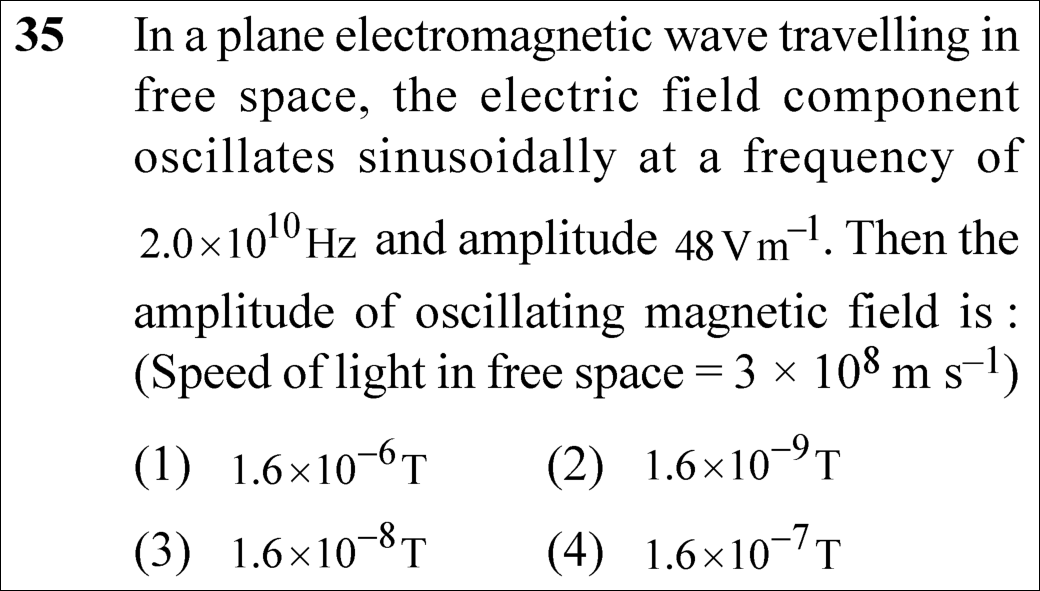
NEET 2023 · Q35 Easy
Official NEET 2023 Question 35 - Electromagnetic Waves
1
2
3
4 ✓ Key
💡 Verified Solution & 30-Second Hack
✓
Verified Against NTA Final Answer Key
Option (4) : 1.6 × 10⁻⁷ T
📚 Electromagnetic Waves Easy
📋 Given Parameters & Problem Setup
Electric field amplitude (E₀) 48 V m⁻¹
Frequency (ν) 2.0 × 10¹⁰ Hz
Speed of light in free space (c) 3 × 10⁸ m s⁻¹
Relation between amplitudes c = E₀ / B₀ ⟹ B₀ = E₀ / c
⚡

The 30-Second Exam Hall Shortcut: ⚡ EM Wave Amplitude Relation: B₀ = E₀ / c

⏱️ Save ~35 seconds

B₀ = E₀ / c = 48 / (3 × 10⁸) = 16 × 10⁻⁸ = 1.6 × 10⁻⁷ T in 10 seconds! (Frequency is extraneous distraction info).

1 In any electromagnetic wave propagating in free space, E₀ and B₀ are related by c = E₀ / B₀.
2 Isolate magnetic field amplitude: B₀ = E₀ / c.
3 Substitute E₀ = 48 V/m and c = 3 × 10⁸ m/s.
4 Divide: B₀ = 48 / (3 × 10⁸) = 16 × 10⁻⁸ T = 1.6 × 10⁻⁷ T.
5 Notice frequency (2.0 × 10¹⁰ Hz) is deliberately provided as distractor data.
6 Option (4) 1.6 × 10⁻⁷ T is locked instantly!
🛡️
Why You Can 100% Trust This Shortcut: Electromagnetic Theory · Maxwell’s Equations (In plane electromagnetic waves, the ratio of electric field amplitude to magnetic field amplitude equals the speed of light: E₀/B₀ = c).
📐

Step-by-Step Rigorous Workflow & Mathematical Proof

Step 1

Fundamental Relation Between Electric and Magnetic Field Amplitudes

According to Maxwell’s equations for a plane transverse electromagnetic wave propagating in vacuum, the magnitudes of the mutually perpendicular oscillating electric (E⃗) and magnetic (B⃗) fields are in phase and related at every instant by the speed of light c:

c=E0B0c = \frac{E_0}{B_0}
Step 2

Rearrangement for Magnetic Field Amplitude B₀

Rearranging the equation to solve for the peak magnetic field amplitude B₀:

B0=E0cB_0 = \frac{E_0}{c}
Step 3

Substitution of Numerical Values

Substitute the given electric field amplitude E₀ = 48 V m⁻¹ and the speed of light c = 3 × 10⁸ m s⁻¹:

B0=483×108=16×10−8 TB_0 = \frac{48}{3 \times 10^8} = 16 \times 10^{-8}\text{ T}
Step 4

Expression in Standard Scientific Notation

Convert to canonical scientific notation:

B0=1.6×10−7 TB_0 = 1.6 \times 10^{-7}\text{ T}
⭐

360° Option Elimination Engine Key Feature

Diagnose every choice: Know exactly why the right option works and why distractors fail.

4-Option Deep Scan
1 (1)
✗ Incorrect
Verdict & Scientific Reason:

Incorrect exponent (off by factor of 10).

⚠️
Student Fallacy (Why candidates pick this trap): Candidate miscalculated the power of 10.
2 (2)
✗ Incorrect
Verdict & Scientific Reason:

Off by a factor of 100.

⚠️
Student Fallacy (Why candidates pick this trap): Candidate divided by 10⁹ instead of 10⁸.
3 (3)
✗ Incorrect
Verdict & Scientific Reason:

Wrote 1.6 × 10⁻⁸ instead of 16 × 10⁻⁸.

⚠️
Student Fallacy (Why candidates pick this trap): Candidate converted 16 × 10⁻⁸ into 1.6 × 10⁻⁸ without shifting the exponent.
4 (4)
✓ 100% Correct
Verdict & Scientific Reason:

Accurate value: 48 / (3 × 10⁸) = 1.6 × 10⁻⁷ T.

💡
Why this is airtight: None. Candidate executed the standard notation shift accurately.
⚠️

NTA Trap Alert: Exponent Shift Slip: Converting 16 × 10⁻⁸ into 1.6 × 10⁻⁸

A very common exam hall slip is writing 48/3 = 16, then seeing 10⁻⁸ in the denominator, and hastily picking Option (3) 1.6 × 10⁻⁸ without realizing 16 × 10⁻⁸ = 1.6 × 10⁻⁷.

🛡️ How to avoid the -1 mark: Shift decimal left by 1 place ⟹ increase exponent by +1: -8 + 1 = -7.
📖

Core NEET Syllabus Standard

National Eligibility cum Entrance Test (NEET UG) · Electromagnetic Waves Standard Benchmark
Core Scientific Principle Tested:

"In vacuum, the amplitudes of electric and magnetic fields satisfy E₀ = c B₀."

Syllabus Focus: Properties of Electromagnetic Waves
Preserved in Rationalized Curriculum Syllabus & Academic Standards ↗
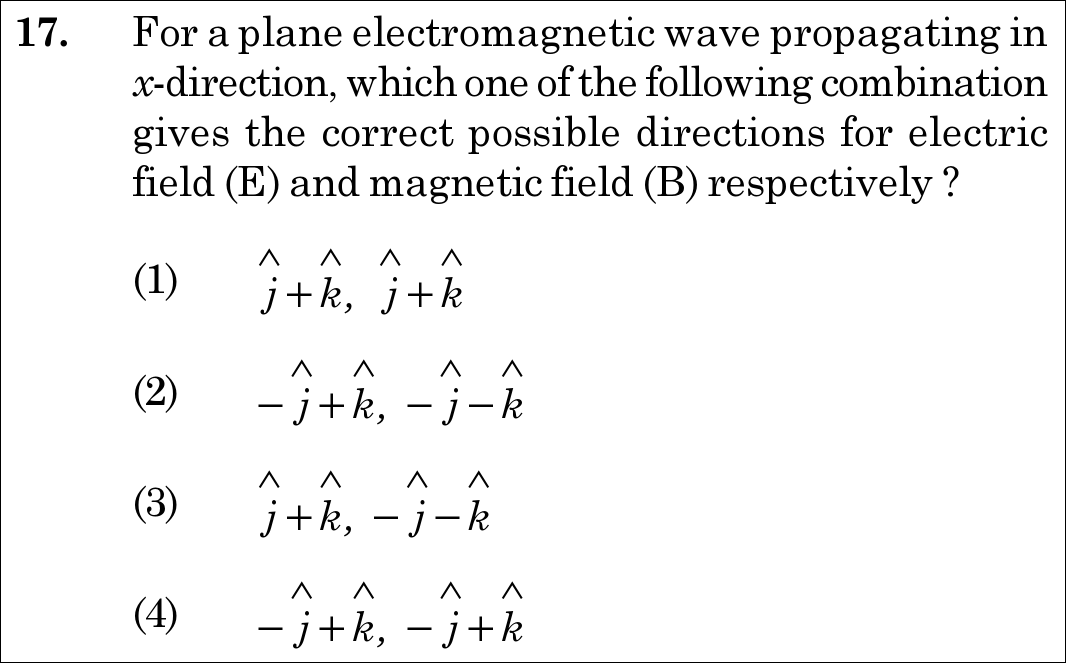
NEET 2021 · Q17 Medium
Official NEET 2021 Question 17 - Electromagnetic Waves
1
2 ✓ Key
3
4
💡 Verified Solution & 30-Second Hack
✓
Verified Against NTA Final Answer Key
Option (2) : (-j + k), (-j - k)
📚 Electromagnetic Waves Medium
📋 Given Parameters & Problem Setup
Wave Direction Positive x-direction (+i)
Condition 1 E ⟂ B (E · B = 0)
Condition 2 Poynting vector E × B must point along +i
⚡

The 30-Second Exam Hall Shortcut: ⚡ Cross Product Filter: E × B must be along +i

⏱️ Save ~25 seconds

The wave propagates along +x+x (i^\hat{i}), so E⃗×B⃗\vec{E} \times \vec{B} must point along +i^+\hat{i}, and E⃗⋅B⃗=0\vec{E} \cdot \vec{B} = 0. In Option (2): (−j^+k^)×(−j^−k^)=j^×k^−k^×j^=i^−(−i^)=+2i^(-\hat{j} + \hat{k}) \times (-\hat{j} - \hat{k}) = \hat{j}\times\hat{k} - \hat{k}\times\hat{j} = \hat{i} - (-\hat{i}) = +2\hat{i}! In all other options, E⃗\vec{E} and B⃗\vec{B} are parallel or antiparallel (cross product = 0)! Select Option (2)!

1 Universal EM wave rule: Wave propagation direction is given by the unit vector along E⃗×B⃗\vec{E} \times \vec{B}.
2 Here, propagation is along +i^+\hat{i}. Thus, E⃗×B⃗=Ci^\vec{E} \times \vec{B} = C \hat{i} with C>0C > 0.
3 Test Option (1): E⃗=B⃗=j^+k^  ⟹  E⃗×B⃗=0⃗\vec{E} = \vec{B} = \hat{j} + \hat{k} \implies \vec{E} \times \vec{B} = \vec{0} (False).
4 Test Option (2): (−j^+k^)×(−j^−k^)=2i^(-\hat{j} + \hat{k}) \times (-\hat{j} - \hat{k}) = 2\hat{i} (Points along +i^+\hat{i}! True!).
5 Test Option (3): Antiparallel   ⟹  E⃗×B⃗=0⃗\implies \vec{E} \times \vec{B} = \vec{0} (False).
6 Test Option (4): Parallel   ⟹  E⃗×B⃗=0⃗\implies \vec{E} \times \vec{B} = \vec{0} (False).
7 Match Option (2).
🛡️
Why You Can 100% Trust This Shortcut: Canonical Maxwell's equations and Poynting vector electrodynamics for transverse EM waves.
📐

Step-by-Step Rigorous Workflow & Mathematical Proof

Step 1

Fundamental Orthogonality Relations of Electromagnetic Waves

In a transverse plane electromagnetic wave propagating in free space: 1. The electric field vector E⃗\vec{E} and magnetic field vector B⃗\vec{B} are perpendicular to each other: E⃗⋅B⃗=0\vec{E} \cdot \vec{B} = 0. 2. Both E⃗\vec{E} and B⃗\vec{B} are perpendicular to the wave propagation direction k^=i^\hat{k} = \hat{i} (so they lie in the yy-zz plane). 3. The direction of energy flow (Poynting vector) is along E⃗×B⃗\vec{E} \times \vec{B}:

c^=E⃗×B⃗∣E⃗×B⃗∣=+i^\hat{c} = \frac{\vec{E} \times \vec{B}}{|\vec{E} \times \vec{B}|} = +\hat{i}
Step 2

Evaluating the Vector Cross Product for Option (2)

For E⃗=−j^+k^\vec{E} = -\hat{j} + \hat{k} and B⃗=−j^−k^\vec{B} = -\hat{j} - \hat{k}: - Check orthogonality: E⃗⋅B⃗=(−1)(−1)+(1)(−1)=1−1=0\vec{E} \cdot \vec{B} = (-1)(-1) + (1)(-1) = 1 - 1 = 0 (orthogonal). - Compute cross product using standard cyclic unit vector rules (j^×k^=i^\hat{j} \times \hat{k} = \hat{i}, k^×j^=−i^\hat{k} \times \hat{j} = -\hat{i}):

E⃗×B⃗=∣i^j^k^0−110−1−1∣=i^[(−1)(−1)−(1)(−1)]=i^(1+1)=+2i^\vec{E} \times \vec{B} = \begin{vmatrix} \hat{i} & \hat{j} & \hat{k} \\ 0 & -1 & 1 \\ 0 & -1 & -1 \end{vmatrix} = \hat{i}\left[(-1)(-1) - (1)(-1)\right] = \hat{i}(1 + 1) = +2\hat{i}
Step 3

Refutation of Remaining Options

Options (1) and (4) have parallel vectors E⃗∥B⃗\vec{E} \parallel \vec{B}, yielding E⃗×B⃗=0⃗\vec{E} \times \vec{B} = \vec{0}. Option (3) has antiparallel vectors E⃗=−B⃗\vec{E} = -\vec{B}, also yielding E⃗×B⃗=0⃗\vec{E} \times \vec{B} = \vec{0}. None of these can propagate an electromagnetic wave.

⭐

360° Option Elimination Engine Key Feature

Diagnose every choice: Know exactly why the right option works and why distractors fail.

4-Option Deep Scan
1 1
✗ Incorrect
Verdict & Scientific Reason:

Electric and magnetic fields are parallel (E⃗×B⃗=0⃗\vec{E} \times \vec{B} = \vec{0}), violating transversality and zero Poynting flux.

⚠️
Student Fallacy (Why candidates pick this trap): Assuming E⃗\vec{E} and B⃗\vec{B} can point in the exact same direction.
2 2
✓ 100% Correct
Verdict & Scientific Reason:

Both vectors are mutually perpendicular (E⃗⋅B⃗=0\vec{E} \cdot \vec{B} = 0) and their cross product E⃗×B⃗=+2i^\vec{E} \times \vec{B} = +2\hat{i} points along the positive xx-direction.

💡
Why this is airtight: None; rigorous vector cross product analysis.
3 3
✗ Incorrect
Verdict & Scientific Reason:

Vectors are antiparallel (E⃗×B⃗=0⃗\vec{E} \times \vec{B} = \vec{0}).

⚠️
Student Fallacy (Why candidates pick this trap): Confusing opposite signs with perpendicular orientation.
4 4
✗ Incorrect
Verdict & Scientific Reason:

Identical vectors with zero cross product.

⚠️
Student Fallacy (Why candidates pick this trap): Assuming identical phase implies identical spatial orientation.
⚠️

NTA Trap Alert: Cyclic Vector Cross Product Sign Trap

Students frequently compute k^×j^=+i^\hat{k} \times \hat{j} = +\hat{i} instead of −i^-\hat{i}, flipping the resulting cross product to −2i^-2\hat{i} and falsely eliminating the correct option.

🛡️ How to avoid the -1 mark: Use the standard determinant or cyclic rule: i^×j^=k^\hat{i} \times \hat{j} = \hat{k}, j^×k^=i^\hat{j} \times \hat{k} = \hat{i}, k^×j^=−i^\hat{k} \times \hat{j} = -\hat{i}.
📖

Core NEET Syllabus Standard

NCERT Physics · Electromagnetic Waves Standard Benchmark
Core Scientific Principle Tested:

"In an electromagnetic wave, electric and magnetic fields are mutually perpendicular and perpendicular to the direction of propagation, with S⃗∝E⃗×B⃗\vec{S} \propto \vec{E} \times \vec{B} defining the wave vector."

Syllabus Focus: Transverse Nature of Electromagnetic Waves
✓ Core NEET UG Syllabus Anchor Syllabus & Academic Standards ↗
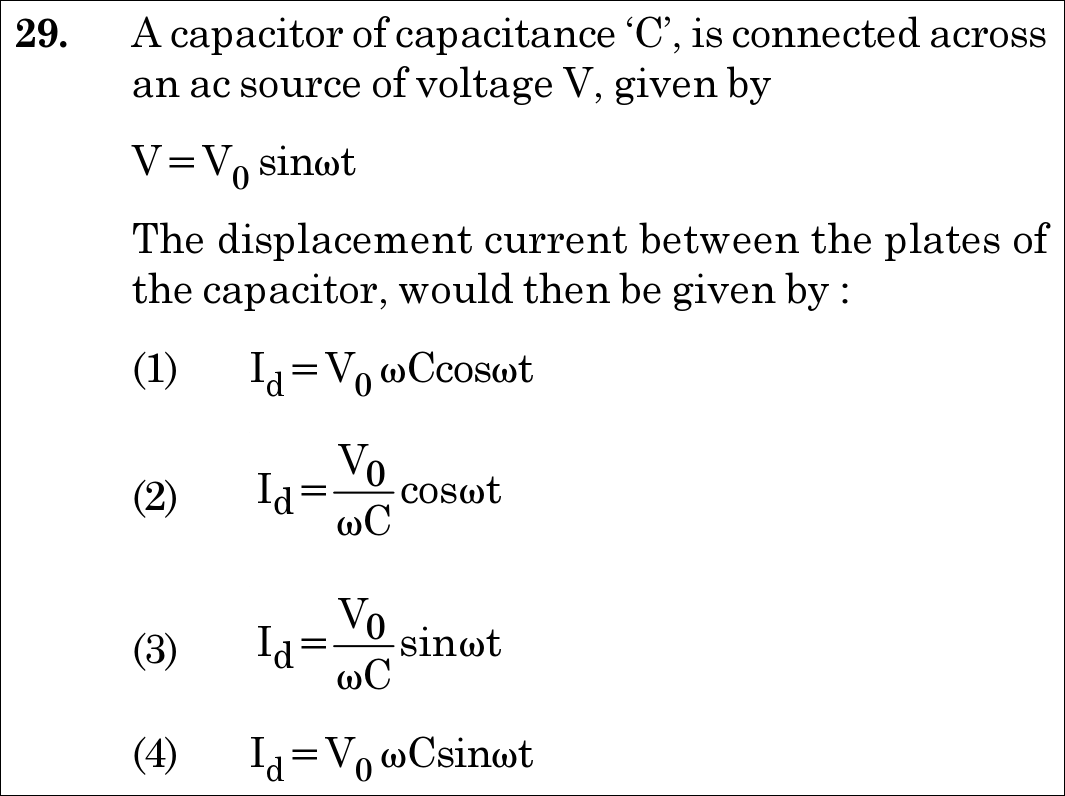
NEET 2021 · Q29 Easy
Official NEET 2021 Question 29 - Electromagnetic Waves
1 ✓ Key
2
3
4
💡 Verified Solution & 30-Second Hack
✓
Verified Against NTA Final Answer Key
Option (1) : I_d = V_0 ω C cos(ωt)
📚 Electromagnetic Waves Easy
📋 Given Parameters & Problem Setup
Capacitance C
Applied AC Voltage V = V_0 sin(ωt)
⚡

The 30-Second Exam Hall Shortcut: ⚡ Displacement Current = Conduction Current: I_d = dq/dt

⏱️ Save ~20 seconds

By Maxwell's continuity theorem, displacement current inside the dielectric gap equals the conduction current in the connecting wires: Id=Ic=dqdt=CdVdt=Cddt[V0sin⁡(ωt)]=V0ωCcos⁡(ωt)I_d = I_c = \frac{dq}{dt} = C \frac{dV}{dt} = C \frac{d}{dt}[V_0 \sin(\omega t)] = V_0 \omega C \cos(\omega t)! Instant 10-second derivative matching Option (1)!

1 Charge on capacitor plates at any instant: q(t)=CV(t)=CV0sin⁡(ωt)q(t) = C V(t) = C V_0 \sin(\omega t).
2 By Maxwell-Ampere law, displacement current between plates equals conduction current: Id=dqdtI_d = \frac{dq}{dt}.
3 Differentiate with respect to time: ddt[V0sin⁡(ωt)]=V0ωcos⁡(ωt)\frac{d}{dt}[V_0 \sin(\omega t)] = V_0 \omega \cos(\omega t).
4 Thus, Id=V0ωCcos⁡(ωt)I_d = V_0 \omega C \cos(\omega t).
5 Match Option (1).
🛡️
Why You Can 100% Trust This Shortcut: Canonical Maxwell-Ampere circuital law and charge-current continuity equation.
📐

Step-by-Step Rigorous Workflow & Mathematical Proof

Step 1

Definition of Displacement Current

Maxwell defined displacement current IdI_d in terms of the rate of change of electric flux ΦE\Phi_E between the capacitor plates:

Id=ε0dΦEdtI_d = \varepsilon_0 \frac{d\Phi_E}{dt}
Step 2

Expressing Electric Flux in Terms of Charge and Voltage

For a parallel plate capacitor of area AA and separation dd, the uniform electric field is E=V/dE = V/d. The electric flux is ΦE=EA=(V/d)A=V(A/d)\Phi_E = E A = (V/d)A = V (A/d):

ε0ΦE=ε0(Ad)V=CV=q\varepsilon_0 \Phi_E = \varepsilon_0 \left(\frac{A}{d}\right) V = C V = q
Step 3

Evaluating the Time Derivative

Substitute V(t)=V0sin⁡(ωt)V(t) = V_0 \sin(\omega t) into the displacement current expression:

Id=ddt(CV)=CdVdt=Cddt[V0sin⁡(ωt)]=V0ωCcos⁡(ωt)I_d = \frac{d}{dt}(C V) = C \frac{dV}{dt} = C \frac{d}{dt}\left[V_0 \sin(\omega t)\right] = V_0 \omega C \cos(\omega t)
⭐

360° Option Elimination Engine Key Feature

Diagnose every choice: Know exactly why the right option works and why distractors fail.

4-Option Deep Scan
1 1
✓ 100% Correct
Verdict & Scientific Reason:

Exact mathematical derivative: Id=CdVdt=V0ωCcos⁡(ωt)I_d = C \frac{dV}{dt} = V_0 \omega C \cos(\omega t).

💡
Why this is airtight: None; textbook calculus and electromagnetic derivation.
2 2
✗ Incorrect
Verdict & Scientific Reason:

Divides by ωC\omega C instead of multiplying (reactance is XC=1/ωCX_C = 1/\omega C, so current amplitude is V0/XC=V0ωCV_0 / X_C = V_0 \omega C).

⚠️
Student Fallacy (Why candidates pick this trap): Writing I0=V0XCI_0 = V_0 X_C with XC=1/ωCX_C = 1/\omega C placed in the denominator incorrectly.
3 3
✗ Incorrect
Verdict & Scientific Reason:

Contains inverted impedance and fails to take the time derivative of sine into cosine.

⚠️
Student Fallacy (Why candidates pick this trap): Forgetting that current leads voltage by 90∘90^\circ (cosine function).
4 4
✗ Incorrect
Verdict & Scientific Reason:

Fails to differentiate sin⁡(ωt)\sin(\omega t) to cos⁡(ωt)\cos(\omega t) (phase is off by 90∘90^\circ).

⚠️
Student Fallacy (Why candidates pick this trap): Neglecting the derivative of the sinusoidal voltage waveform.
⚠️

NTA Trap Alert: Sine vs. Cosine Differentiation Trap

Students who remember the current amplitude I0=V0ωCI_0 = V_0 \omega C sometimes pick Option (4) V0ωCsin⁡(ωt)V_0 \omega C \sin(\omega t), forgetting that differentiation of sin⁡(ωt)\sin(\omega t) produces cos⁡(ωt)\cos(\omega t) (representing the 90∘90^\circ phase lead of capacitor current).

🛡️ How to avoid the -1 mark: Differentiate with respect to time: ddt[sin⁡(ωt)]=ωcos⁡(ωt)\frac{d}{dt}[\sin(\omega t)] = \omega \cos(\omega t).
📖

Core NEET Syllabus Standard

NCERT Physics · Electromagnetic Waves Standard Benchmark
Core Scientific Principle Tested:

"Displacement current between plates is identical to the conduction current in external leads: Id=ε0dΦEdt=CdVdtI_d = \varepsilon_0 \frac{d\Phi_E}{dt} = C \frac{dV}{dt}."

Syllabus Focus: Displacement Current
✓ Core NEET UG Syllabus Anchor Syllabus & Academic Standards ↗
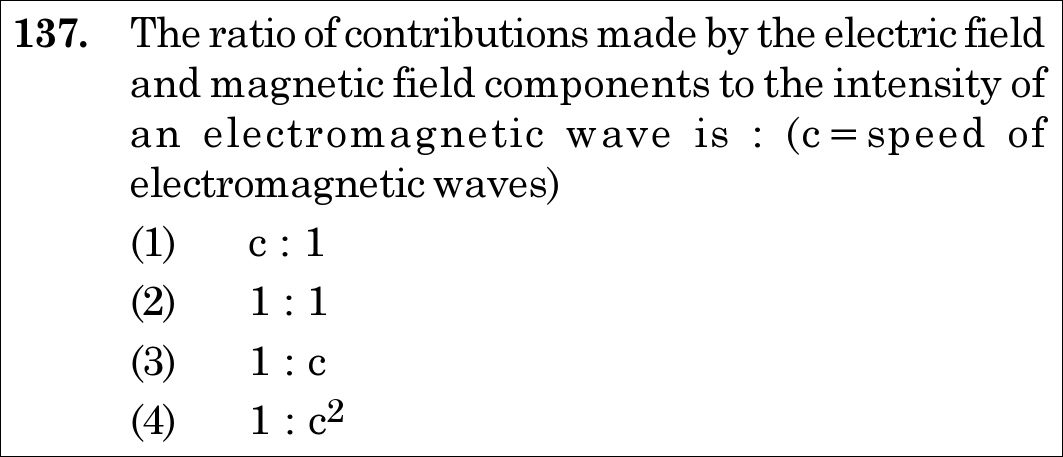
NEET 2020 · Q137 Easy
Official NEET 2020 Question 137 - Electromagnetic Waves
1
2 ✓ Key
3
4
💡 Verified Solution & 30-Second Hack
✓
Verified Against NTA Final Answer Key
Option (2) : 1 : 1
📚 Electromagnetic Waves Easy
📋 Given Parameters & Problem Setup
Wave Type Electromagnetic plane wave propagating in vacuum
Speed of Wave c = 1 / √(μ0 ε0)
Relation between Amplitudes E0 = c B0
Question Objective Determine the ratio of energy/intensity contributions of electric and magnetic fields
⚡

The 30-Second Exam Hall Shortcut: ⚡ "Electric and Magnetic Fields Share EM Wave Energy 50%-50%: Ratio is 1 : 1!"

⏱️ 20 seconds

In any electromagnetic wave, the average electric energy density is uE=14ε0E02u_E = \frac{1}{4}\varepsilon_0 E_0^2 and the average magnetic energy density is uB=B024μ0u_B = \frac{B_0^2}{4\mu_0}. Substituting E0=cB0E_0 = c B_0 and c2=1μ0ε0c^2 = \frac{1}{\mu_0 \varepsilon_0}, we find uE=uBu_E = u_B exactly! Because intensity is proportional to energy density (I=u⋅cI = u \cdot c), their contributions are equal: 1 : 1! Mark Option (2) in 5 seconds.

1 Electric energy density: u_E = 1/2 ε0 E_rms^2.
2 Magnetic energy density: u_B = 1/2 (B_rms^2 / μ0).
3 Relationship: E_rms = c × B_rms, and c = 1 / √(μ0 ε0).
4 Substitute: u_E = 1/2 ε0 (c B_rms)^2 = 1/2 ε0 (1 / (μ0 ε0)) B_rms^2 = 1/2 (B_rms^2 / μ0) = u_B.
5 Since u_E = u_B, their intensity contributions are equal (1 : 1).
6 Select Option (2) 1 : 1.
🛡️
Why You Can 100% Trust This Shortcut: NCERT Physics · Electromagnetic Waves (Energy Density and Intensity of EM Waves)
📐

Step-by-Step Rigorous Workflow & Mathematical Proof

Step 1

State Formulas for Average Energy Densities

In an electromagnetic wave traveling in free space, energy is stored in both the oscillating electric and magnetic fields. The time-averaged energy densities are given by: ⟨uE⟩=12ε0Erms2=14ε0E02\langle u_E \rangle = \frac{1}{2} \varepsilon_0 E_{\text{rms}}^2 = \frac{1}{4} \varepsilon_0 E_0^2 ⟨uB⟩=12Brms2μ0=B024μ0\langle u_B \rangle = \frac{1}{2} \frac{B_{\text{rms}}^2}{\mu_0} = \frac{B_0^2}{4 \mu_0}

Step 2

Relate Electric and Magnetic Amplitudes via Speed of Light

From Maxwell's equations, the ratio of electric field to magnetic field amplitude equals the speed of light in vacuum: E0=cB0  ⟹  Erms=cBrmsE_0 = c B_0 \implies E_{\text{rms}} = c B_{\text{rms}} Also, the speed of light is related to vacuum permittivity and permeability by: c=1μ0ε0  ⟹  c2=1μ0ε0c = \frac{1}{\sqrt{\mu_0 \varepsilon_0}} \implies c^2 = \frac{1}{\mu_0 \varepsilon_0}

Step 3

Compare the Energy Densities

Substitute Erms=cBrmsE_{\text{rms}} = c B_{\text{rms}} into the electric energy density expression: ⟨uE⟩=12ε0(cBrms)2=12ε0c2Brms2\langle u_E \rangle = \frac{1}{2} \varepsilon_0 (c B_{\text{rms}})^2 = \frac{1}{2} \varepsilon_0 c^2 B_{\text{rms}}^2 Substituting c2=1μ0ε0c^2 = \frac{1}{\mu_0 \varepsilon_0}: ⟨uE⟩=12ε0(1μ0ε0)Brms2=Brms22μ0=⟨uB⟩\langle u_E \rangle = \frac{1}{2} \varepsilon_0 \left(\frac{1}{\mu_0 \varepsilon_0}\right) B_{\text{rms}}^2 = \frac{B_{\text{rms}}^2}{2 \mu_0} = \langle u_B \rangle

Step 4

Relate Energy Density to Intensity

The intensity of an electromagnetic wave is the energy transported per unit area per unit time, given by I=u⋅cI = u \cdot c. Since ⟨uE⟩=⟨uB⟩\langle u_E \rangle = \langle u_B \rangle, the intensity contributions are identical: IE=⟨uE⟩c=⟨uB⟩c=IBI_E = \langle u_E \rangle c = \langle u_B \rangle c = I_B IEIB=11=1:1\frac{I_E}{I_B} = \frac{1}{1} = 1 : 1

⭐

360° Option Elimination Engine Key Feature

Diagnose every choice: Know exactly why the right option works and why distractors fail.

4-Option Deep Scan
1 A
✗ Incorrect
Verdict & Scientific Reason:

Incorrect; cc is the ratio of field amplitudes (E0/B0=cE_0 / B_0 = c), not the ratio of energy or intensity contributions.

⚠️
Student Fallacy (Why candidates pick this trap): Confusing field amplitude ratio (E/B=cE/B = c) with intensity ratio.
2 B
✓ 100% Correct
Verdict & Scientific Reason:

Factually and physically exact; electric and magnetic fields carry equal shares of the total energy and intensity in an EM wave.

💡
Why this is airtight: None; fundamental electromagnetic energy equipartition.
3 C
✗ Incorrect
Verdict & Scientific Reason:

Incorrect; inverted amplitude ratio.

⚠️
Student Fallacy (Why candidates pick this trap): Thinking magnetic field dominates intensity by a factor of cc.
4 D
✗ Incorrect
Verdict & Scientific Reason:

Incorrect; dimensional error.

⚠️
Student Fallacy (Why candidates pick this trap): Squaring the velocity ratio without accounting for ε0\varepsilon_0 and μ0\mu_0.
⚠️

NTA Trap Alert: Field Ratio vs Intensity Ratio Trap

- Ratio of AMPLITUDES: E0/B0=cE_0 / B_0 = c (c:1c : 1). - Ratio of INTENSITIES / ENERGIES: IE/IB=1:1I_E / I_B = 1 : 1 (Equally divided!).

🛡️ How to avoid the -1 mark: Read carefully: "Intensity/Energy contribution" = ALWAYS 1 : 1!
📖

Core NEET Syllabus Standard

Physics · Electromagnetic Waves Standard Benchmark
Core Scientific Principle Tested:

""

Syllabus Focus: Equipartition of Energy in EM Waves: Electric and Magnetic Field Intensity Contributions
✓ Core NEET UG Syllabus Anchor Syllabus & Academic Standards ↗
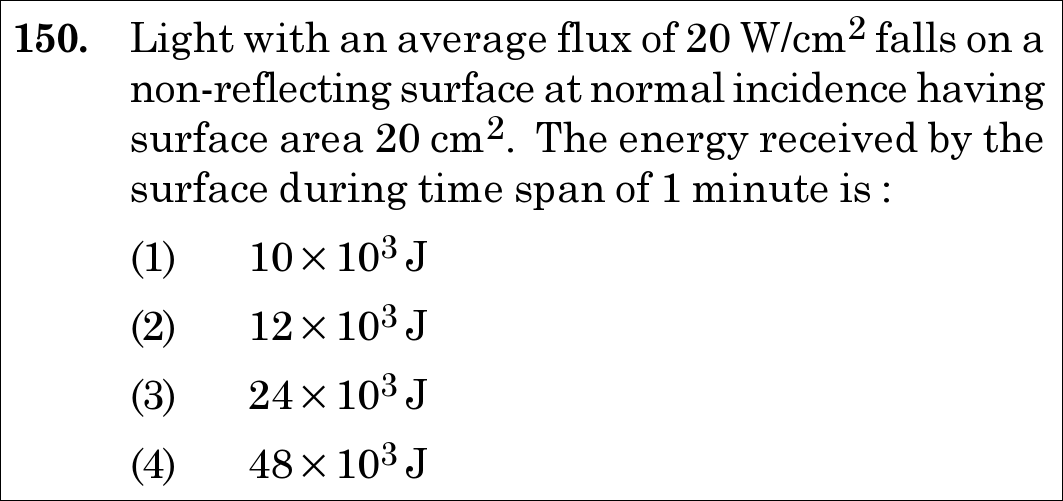
NEET 2020 · Q150 Easy
Official NEET 2020 Question 150 - Electromagnetic Waves
1
2
3 ✓ Key
4
💡 Verified Solution & 30-Second Hack
✓
Verified Against NTA Final Answer Key
Option (3) : 24×103 J
📚 Electromagnetic Waves Easy
📋 Given Parameters & Problem Setup
Average Radiant Flux / Intensity (S) 20 W/cm^2
Surface Area (A) 20 cm^2
Time Span (t) 1 minute = 60 seconds
Surface Property Non-reflecting (completely absorbing)
⚡

The 30-Second Exam Hall Shortcut: ⚡ "Energy = Flux × Area × Time = (20 W/cm^2) × (20 cm^2) × 60 s = 400 × 60 = 24,000 J = 24 × 10^3 J!"

⏱️ 15 seconds

Radiant energy incident on a surface is given by U=Flux×Area×TimeU = \text{Flux} \times \text{Area} \times \text{Time}. The power incident is P=20 W/cm2×20 cm2=400 WP = 20\text{ W/cm}^2 \times 20\text{ cm}^2 = 400\text{ W}. In 1 minute (60 seconds60\text{ seconds}), total energy received is U=400 W×60 s=24,000 J=24×103 JU = 400\text{ W} \times 60\text{ s} = 24,000\text{ J} = 24 \times 10^3\text{ J}. Mark Option (3) in 5 seconds!

1 Total incident power: P = Flux × Area = 20 W/cm^2 × 20 cm^2 = 400 W (Joules/sec).
2 Convert time to seconds: t = 1 min = 60 s.
3 Total energy: U = P × t = 400 W × 60 s = 24000 J.
4 Express in scientific notation: 24 × 10^3 J.
5 Select Option (3).
🛡️
Why You Can 100% Trust This Shortcut: NCERT Physics · Electromagnetic Waves (Energy Transport and Momentum of EM Waves)
📐

Step-by-Step Rigorous Workflow & Mathematical Proof

Step 1

Define Radiant Flux / Intensity

The radiant flux (or intensity II) of an electromagnetic wave is defined as the radiant energy falling per unit area per unit time perpendicular to the beam: I=UA⋅t=PAI = \frac{U}{A \cdot t} = \frac{P}{A} where UU is total energy, AA is surface area, and tt is time duration.

Step 2

Calculate Incident Power

Given: - Flux I=20 W cm−2I = 20\text{ W cm}^{-2} - Area A=20 cm2A = 20\text{ cm}^2 P=I⋅A=(20 W cm−2)×(20 cm2)=400 W=400 J s−1P = I \cdot A = (20\text{ W cm}^{-2}) \times (20\text{ cm}^2) = 400\text{ W} = 400\text{ J s}^{-1} (Notice that the units of cm2\text{cm}^2 cancel immediately, avoiding tedious conversion to m2\text{m}^2).

Step 3

Convert Time to Seconds and Calculate Energy

Given time span t=1 minute=60 secondst = 1\text{ minute} = 60\text{ seconds}. U=P⋅t=(400 J s−1)×(60 s)=24000 J=24×103 JU = P \cdot t = (400\text{ J s}^{-1}) \times (60\text{ s}) = 24000\text{ J} = 24 \times 10^3\text{ J} This confirms Option (3).

⭐

360° Option Elimination Engine Key Feature

Diagnose every choice: Know exactly why the right option works and why distractors fail.

4-Option Deep Scan
1 A
✗ Incorrect
Verdict & Scientific Reason:

Incorrect; arithmetic error.

⚠️
Student Fallacy (Why candidates pick this trap): Dividing by 2.
2 B
✗ Incorrect
Verdict & Scientific Reason:

Incorrect; corresponds to taking area as 10 cm^2 or multiplying by 30 seconds.

⚠️
Student Fallacy (Why candidates pick this trap): Using 30 seconds instead of 60 seconds.
3 C
✓ 100% Correct
Verdict & Scientific Reason:

Factually and mathematically exact; U=20×20×60=24000 J=24×103 JU = 20 \times 20 \times 60 = 24000\text{ J} = 24 \times 10^3\text{ J}.

💡
Why this is airtight: None; clean energy calculation.
4 D
✗ Incorrect
Verdict & Scientific Reason:

Incorrect; double the correct energy, possibly confusing non-reflecting surface with reflecting surface momentum transfer (2U/c2U/c).

⚠️
Student Fallacy (Why candidates pick this trap): Multiplying by 2 as if calculating reflecting momentum.
⚠️

NTA Trap Alert: Minute to Seconds Conversion

Power is in Watts (Joules per second). You must multiply by 60 seconds, NOT by 1! 400×60=24000 J400 \times 60 = 24000\text{ J}.

🛡️ How to avoid the -1 mark: Remember: 1 minute = 60 seconds in SI units!
📖

Core NEET Syllabus Standard

Physics · Electromagnetic Waves Standard Benchmark
Core Scientific Principle Tested:

""

Syllabus Focus: Radiation Energy Calculation: Energy = Flux × Area × Time
✓ Core NEET UG Syllabus Anchor Syllabus & Academic Standards ↗

Solve 4 NEET Questions a Day — One per Subject

Cover all 1,140 official NEET questions in 285 days at your own pace. Progress is saved on your device. No login needed.