MyCompetitiveExams Logo MyCompetitiveExams
Search 1,140+ Questions
Chapters, formulas, speed tricks
→
⚡ Brahmastra NEET 2027
720 MARKS

Dynamic 180-question full-length simulator mixed dynamically from all 6 years for 2027 & 2026 aspirants.

Launch Brahmastra 2027 Test →
Start Practice →
100% Free · No Login Required
Q.84 Chemistry ⭐ 360° Option Elimination Active
Vault ↗

NEET 2025 Chemistry Question 84 Solution

Topic: Haloalkanes and Haloarenes · Official NTA Booklet Code 45
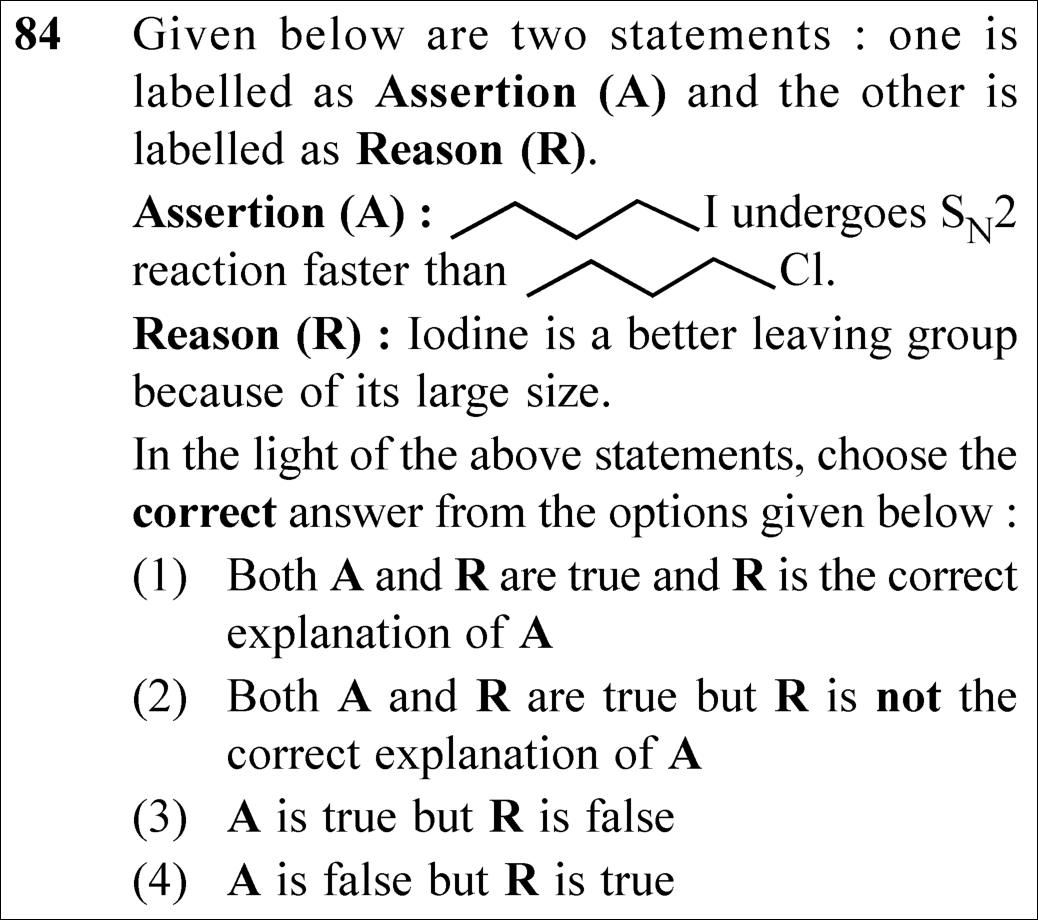
NEET 2025 Chemistry Question 84: Leaving Group Ability and S_N2 Reaction Rates of 1-Iodobutane vs. 1-Chlorobutane

Question

Given below are two statements: one is labelled as Assertion (A) and the other is labelled as Reason (R). Assertion (A): 1-iodobutane (CH₃CH₂CH₂CH₂I) undergoes Sₙ2 reaction faster than 1-chlorobutane (CH₃CH₂CH₂CH₂Cl). Reason (R): Iodine is a better leaving group because of its large size. In the light of the above statements, choose the correct answer from the options given below:

✓
Verified Against NTA Final Answer Key
Option (1) : Both A and R are true and R is the correct explanation of A
📚 Haloalkanes and Haloarenes Easy
📋 Given Parameters & Problem Setup
Assertion (A) 1-Iodobutane undergoes S_N2 reaction faster than 1-chlorobutane.
Reason (R) Iodine is a better leaving group because of its large size.
⚡

The 30-Second Exam Hall Shortcut: ⚡ Leaving Group Size & S_N2 Rate Rule

⏱️ Save ~25 seconds

Assertion is TRUE: Rate of S_N2 follows R-I > R-Br > R-Cl > R-F! Reason is TRUE: Iodide (I⁻) has a large ionic radius, making C-I bond weak and dispersing negative charge (stable weak base)! And R directly explains A ⟹ Option (1)!

1 Check Assertion (A): In S_N2 reactions, C-X bond cleavage occurs concurrently with nucleophile attack in the transition state. Since the C-I bond is weaker and I⁻ is a superior leaving group, 1-iodobutane reacts dramatically faster than 1-chlorobutane. Assertion (A) is TRUE.
2 Check Reason (R): Due to its large atomic radius, iodine forms a longer, weaker bond with carbon. Furthermore, the large size of the iodide ion (I⁻) accommodates and disperses negative charge over a larger volume, rendering it a very weak base (conjugate base of strong acid HI, pK_a ≈ -10). Weak bases are excellent leaving groups. Reason (R) is TRUE.
3 Check Explanation: The superior leaving ability of iodine directly accounts for the faster S_N2 reaction rate of 1-iodobutane. Thus, R is the correct explanation of A.
4 Select Option (1) in under 10 seconds!
🛡️
Why You Can 100% Trust This Shortcut: Steric Hindrance & Transition State Energetics in S_N2 Mechanism (NCERT Chemistry · Haloalkanes and Haloarenes).
📐

Step-by-Step Rigorous Workflow & Mathematical Proof

Step 1

Evaluate Assertion (A): S_N2 Kinetics and Leaving Group Influence

In a bimolecular nucleophilic substitution (S_N2), the rate equation is Rate = k [Substrate][Nu⁻]. The rate constant k depends directly on the leaving group ability of the departing halide ion:

Rate of SN2:R−I>R−Br>R−Cl>R−F\text{Rate of } S_N2: \quad R-\text{I} > R-\text{Br} > R-\text{Cl} > R-\text{F}
  • • Because 1-iodobutane and 1-chlorobutane are both primary (1°) alkyl halides with identical steric profiles, the difference in rate is determined purely by the leaving group.
  • • 1-Iodobutane reacts substantially faster than 1-chlorobutane.
  • • Assertion (A) is completely TRUE.
Step 2

Evaluate Reason (R): Physical Basis of Leaving Group Ability

A good leaving group is one that can stably accommodate the electron pair acquired upon cleavage:

Ionic Radius: I−(216 pm)≫Cl−(181 pm)  ⟹  C-I bond enthalpy (234 kJ/mol)≪C-Cl (338 kJ/mol)\text{Ionic Radius: } \text{I}^- (216\text{ pm}) \gg \text{Cl}^- (181\text{ pm}) \implies \text{C-I bond enthalpy } (234\text{ kJ/mol}) \ll \text{C-Cl } (338\text{ kJ/mol})
  • • The large diffuse electron cloud of iodide stabilizes the negative charge effectively, making I⁻ a very weak conjugate base and hence an exceptional leaving group.
  • • Reason (R) is completely TRUE.
Step 3

Determine if Reason (R) Explains Assertion (A)

Connect cause and effect:

Better leaving group due to large size (R)  ⟹  Accelerates SN2 rate (A)\text{Better leaving group due to large size (R)} \implies \text{Accelerates } S_N2 \text{ rate (A)}
  • • The large size and weak C-I bond are the precise mechanistic reason why 1-iodobutane reacts faster.
  • • Therefore, Both A and R are true and R is the correct explanation of A, matching Option (1).
⭐

360° Option Elimination Engine Key Feature

Diagnose every choice: Know exactly why the right option works and why distractors fail.

4-Option Deep Scan
1 A
✓ 100% Correct
Verdict & Scientific Reason:

100% correct. I⁻ is a better leaving group than Cl⁻ due to size/bond strength, directly explaining the faster S_N2 rate.

💡
Why this is airtight: None; flawless reaction kinetics understanding.
2 B
✗ Incorrect
Verdict & Scientific Reason:

Incorrect. R is the direct, primary physical explanation of A.

⚠️
Student Fallacy (Why candidates pick this trap): Failing to see the causal link between leaving group ability and S_N2 rate.
3 C
✗ Incorrect
Verdict & Scientific Reason:

Incorrect. R is true.

⚠️
Student Fallacy (Why candidates pick this trap): Doubting whether large size aids leaving group capacity.
4 D
✗ Incorrect
Verdict & Scientific Reason:

Incorrect. A is true.

⚠️
Student Fallacy (Why candidates pick this trap): Thinking chloride is faster due to higher electronegativity.
⚠️

NTA Trap Alert: Confusing Electronegativity with Leaving Group Ability

Students sometimes think chlorine should leave faster because it is more electronegative. In substitution reactions, leaving group ability is governed by WEAK BASICITY and BOND WEAKNESS, where Iodine wins overwhelmingly: I⁻ > Br⁻ > Cl⁻ > F⁻!

🛡️ How to avoid the -1 mark: Remember: In nucleophilic substitution, IODINE is always the fastest leaving group!
📖

Core NEET Syllabus Standard

NEET Chemistry Core Syllabus · Haloalkanes and Haloarenes Standard Benchmark
Core Scientific Principle Tested:

"S_N2 reaction rates follow R-I > R-Br > R-Cl > R-F due to leaving group ability and C-X bond strength."

Syllabus Focus: Nucleophilic Substitution Reactions: S_N2 Mechanism
✓ Core NEET UG Syllabus Anchor Syllabus & Academic Standards ↗
Bigger ion = Weaker base = Better leaving group = Faster S_N2 (Option 1)!

Ready to attempt under real exam pressure?

Test your speed and accuracy in the authentic 180-minute timed NTA simulator.

Launch NEET 2025 CBT Test →

Spotted a mistake in this solution? Report an error (support@mycompetitiveexams.com)

⚖️ Legal & Fair Dealing Notice: Sourced from publicly released NEET 2025 question papers and NEET answer keys for private study, research, and non-commercial educational practice under Fair Dealing (Section 52(1)(a) of the Indian Copyright Act, 1957). Not affiliated with or endorsed by NTA or NMC.

Solve 4 NEET Questions a Day — One per Subject

Cover all 1,140 official NEET questions in 285 days at your own pace. Progress is saved on your device. No login needed.