MyCompetitiveExams Logo MyCompetitiveExams
Search 1,140+ Questions
Chapters, formulas, speed tricks
→
⚡ Brahmastra NEET 2027
720 MARKS

Dynamic 180-question full-length simulator mixed dynamically from all 6 years for 2027 & 2026 aspirants.

Launch Brahmastra 2027 Test →
Start Practice →
100% Free · No Login Required
🧪 Chemistry 📌 Standard Frequency (~1–2 Qs/Year)

NEET States of Matter Previous Year Questions with Solutions

Complete repository of official NTA NEET questions for States of Matter from 2020 to 2026. Every question includes 30-second elimination tricks, step-by-step NCERT solutions, option-by-option traps, and official answer keys.

5 Questions 3 Exam Years (2023, 2021, 2020) 4 Easy · 1 Medium · 0 Challenging
NEET 2023 · Q67 Easy
Official NEET 2023 Question 67 - States of Matter
1
2
3
4 ✓ Key
💡 Verified Solution & 30-Second Hack
✓
Verified Against NTA Final Answer Key
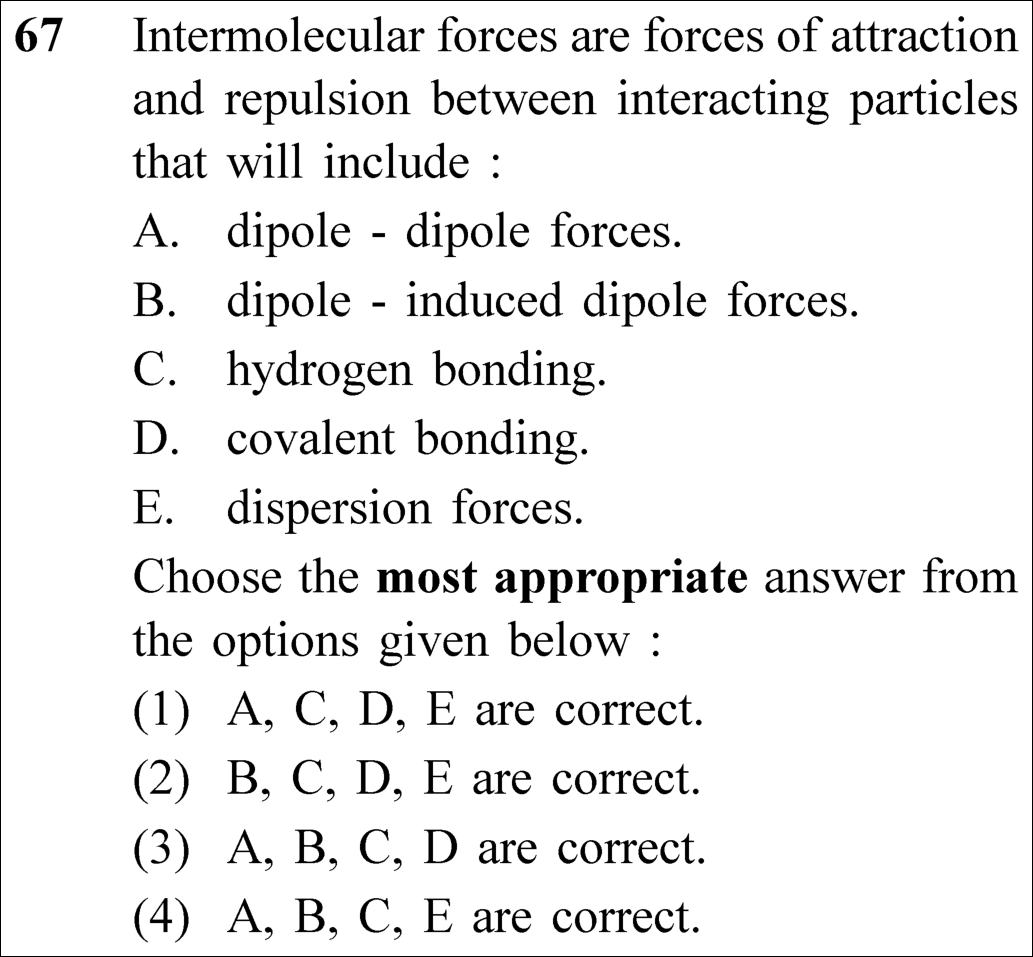
Option (4) : A, B, C, E are correct.
📚 States of Matter: Gases and Liquids Easy
📋 Given Parameters & Problem Setup
List of interactions A: Dipole-dipole, B: Dipole-induced dipole, C: Hydrogen bonding, D: Covalent bonding, E: Dispersion forces
Target criterion Forces that are classified as INTERMOLECULAR forces
⚡

The 30-Second Exam Hall Shortcut: ⚡ Intramolecular Exclusion Hack: Covalent Bonds are INTRAmolecular!

⏱️ Save ~30 seconds

Covalent bonds hold atoms together INSIDE a molecule (intramolecular, ~400 kJ/mol). Intermolecular forces act BETWEEN separate molecules (van der Waals + H-bonding, < 40 kJ/mol). Exclude D ⟹ A, B, C, E are correct in 5 seconds!

1 Recall NCERT’s strict definition of intermolecular forces:
2 - Intermolecular forces act BETWEEN interacting particles (molecules/atoms).
3 - It EXPLICITLY excludes covalent bonds and ionic bonds (which are intramolecular chemical bonds).
4 Evaluate each item:
5 - A. Dipole-dipole forces ⟶ Intermolecular (van der Waals).
6 - B. Dipole-induced dipole forces ⟶ Intermolecular (van der Waals).
7 - C. Hydrogen bonding ⟶ Intermolecular (special dipole-dipole).
8 - D. Covalent bonding ⟶ INTRAmolecular chemical bond (EXCLUDED!).
9 - E. Dispersion forces (London forces) ⟶ Intermolecular (van der Waals).
10 Thus, A, B, C, and E are intermolecular forces; D is NOT.
11 Select Option (4) A, B, C, E are correct!
🛡️
Why You Can 100% Trust This Shortcut: States of Matter · Intermolecular Forces Standards (NCERT verbatim: "This term does not include the electrostatic forces that exist between the two oppositely charged ions and the forces that hold atoms of a molecule together, i.e., covalent bonds").
📐

Step-by-Step Rigorous Workflow & Mathematical Proof

Step 1

Verbatim NCERT Definition of Intermolecular Forces

Intermolecular forces are the forces of attraction and repulsion between interacting particles (atoms and molecules). The term covers van der Waals forces and hydrogen bonding. As explicitly defined in standard textbooks, this term does not include electrostatic ionic bonds or the chemical forces that hold atoms together within a molecule, namely covalent bonds:

Intermolecular Forces=van der Waals Forces+Hydrogen Bonds(Excludes Covalent Bonds)\text{Intermolecular Forces} = \text{van der Waals Forces} + \text{Hydrogen Bonds} \quad (\text{Excludes Covalent Bonds})
Step 2

Item-by-Item Classification

Analyzing the physical nature of each given interaction:

A. Dipole-dipole forces:Between polar molecules with permanent dipoles (Intermolecular)B. Dipole-induced dipole:Between a polar and a non-polar molecule (Intermolecular)C. Hydrogen bonding:Strong directional dipole-dipole interaction (Intermolecular)D. Covalent bonding:Electron sharing holding atoms inside a molecule (Intramolecular)E. Dispersion forces:London attractive forces between all particles (Intermolecular)\begin{aligned} \text{A. Dipole-dipole forces} &: \text{Between polar molecules with permanent dipoles } (\text{Intermolecular}) \\[4pt] \text{B. Dipole-induced dipole} &: \text{Between a polar and a non-polar molecule } (\text{Intermolecular}) \\[4pt] \text{C. Hydrogen bonding} &: \text{Strong directional dipole-dipole interaction } (\text{Intermolecular}) \\[4pt] \text{D. Covalent bonding} &: \text{Electron sharing holding atoms inside a molecule } (\text{Intramolecular}) \\[4pt] \text{E. Dispersion forces} &: \text{London attractive forces between all particles } (\text{Intermolecular}) \end{aligned}
Step 3

Exclusion of Covalent Bonding

Because covalent bonding (D) is an intramolecular interaction, any valid option must include A, B, C, and E while omitting D.

Valid Set={A,B,C,E}\text{Valid Set} = \{A, B, C, E\}
⭐

360° Option Elimination Engine Key Feature

Diagnose every choice: Know exactly why the right option works and why distractors fail.

4-Option Deep Scan
1 (1)
✗ Incorrect
Verdict & Scientific Reason:

Erroneously includes covalent bonding (D) and omits dipole-induced dipole forces (B).

⚠️
Student Fallacy (Why candidates pick this trap): Candidate treated covalent bonds as intermolecular.
2 (2)
✗ Incorrect
Verdict & Scientific Reason:

Erroneously includes covalent bonding (D) and omits dipole-dipole forces (A).

⚠️
Student Fallacy (Why candidates pick this trap): Candidate confused inter- and intra-molecular bonding.
3 (3)
✗ Incorrect
Verdict & Scientific Reason:

Erroneously includes covalent bonding (D) and omits dispersion forces (E).

⚠️
Student Fallacy (Why candidates pick this trap): Candidate included chemical bonds in intermolecular category.
4 (4)
✓ 100% Correct
Verdict & Scientific Reason:

Accurate: A, B, C, and E are intermolecular interactions; covalent bonding (D) is strictly intramolecular.

💡
Why this is airtight: None. Candidate correctly excluded covalent bonding.
⚠️

NTA Trap Alert: Including Covalent Bonding as an Intermolecular Force

Covalent bonds are strong chemical bonds holding atoms within a molecule (H–O bond in water, ~460 kJ/mol). Intermolecular forces are weak attractions between separate molecules (between water molecules, ~20 kJ/mol). Confusing the prefixes INTER (between) and INTRA (within) is the primary trap.

🛡️ How to avoid the -1 mark: Rule: "Inter-" means between two different molecules (like international = between nations). Covalent bonds are within a single molecule.
📖

Core NEET Syllabus Standard

National Eligibility cum Entrance Test (NEET UG) · States of Matter: Gases and Liquids Standard Benchmark
Core Scientific Principle Tested:

"Intermolecular forces include dispersion forces, dipole-dipole forces, and dipole-induced dipole forces, as well as hydrogen bonding, but strictly exclude covalent and ionic bonds."
Syllabus Focus: Intermolecular Forces – Types and Characteristics
Preserved in Rationalized Curriculum Syllabus & Academic Standards ↗
NEET 2023 · Q79 Medium
Official NEET 2023 Question 79 - States of Matter
1
2
3 ✓ Key
4
💡 Verified Solution & 30-Second Hack
✓
Verified Against NTA Final Answer Key
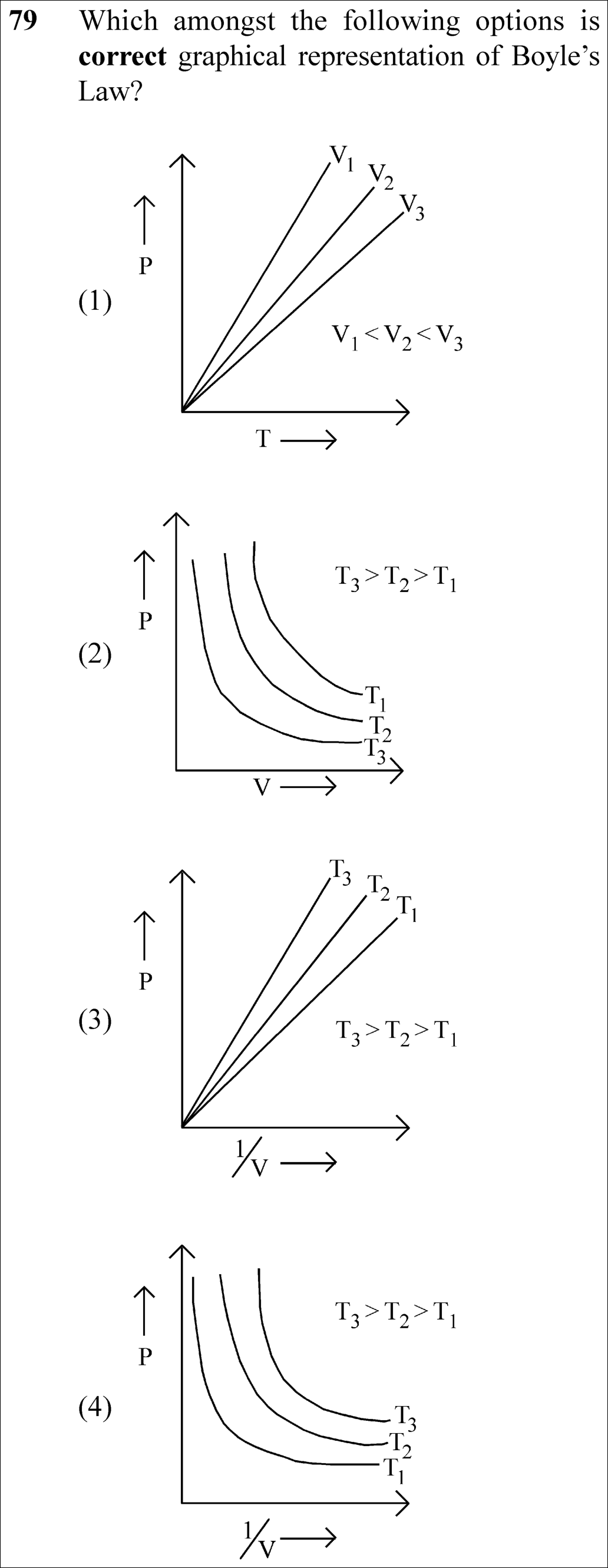
Option (3) : P vs 1/V straight lines with slopes T₃ > T₂ > T₁
📚 States of Matter Medium
📋 Given Parameters & Problem Setup
Gas Law Evaluated Boyle’s Law (constant n and T)
Temperature Ordering T₃ > T₂ > T₁
⚡

The 30-Second Exam Hall Shortcut: ⚡ Linear Isotherm Slope Scan: P = (nRT) · (1/V) with Slope ∝ T

⏱️ Save ~35 seconds

Ideal gas law PV = nRT converts to P = (nRT)(1/V). Comparing with y = mx: plot of P vs 1/V is a straight line through the origin with slope = nRT. Higher T gives steeper slope! Since T₃ > T₂ > T₁, the slope order is slope₃ > slope₂ > slope₁. Graph (3) is instantly recognized!

1 Express Boyle’s law in terms of plotted variables: P = (nRT)(1/V).
2 This conforms to y = mx with intercept c = 0 (straight line passing through the origin).
3 Slope m = nRT is directly proportional to absolute temperature T.
4 Since T₃ > T₂ > T₁, the lines must be linear through (0,0) with steepest slope for T₃.
5 Graph (3) correctly displays this straight-line fan with slope₃ > slope₂ > slope₁.
🛡️
Why You Can 100% Trust This Shortcut: Direct functional mapping of Ideal Gas Law PV = nRT into Cartesian coordinates.
📐

Step-by-Step Rigorous Workflow & Mathematical Proof

Step 1

State Boyle’s Law and the Ideal Gas Equation

Boyle’s Law states that at constant temperature (T) and constant mass of gas (n), the pressure of a given mass of gas is inversely proportional to its volume:

P∝1V  ⟹  PV=k=nRTP \propto \frac{1}{V} \implies PV = k = nRT
Step 2

Formulate Linear Equation for P vs 1/V

Rearranging the equation of state with y = P and x = 1/V yields a linear function:

P=(nRT)(1V)  ⟺  y=mx(where slope m=nRT)P = (nRT) \left(\frac{1}{V}\right) \iff y = mx \quad (\text{where slope } m = nRT)
Step 3

Analyze Slope Variation with Temperature

Because slope m = nRT, the slope is directly proportional to absolute temperature:

T3>T2>T1  ⟹  m3>m2>m1T_3 > T_2 > T_1 \implies m_3 > m_2 > m_1
Step 4

Eliminate Alternative Graphs

Option (1) plots P vs T (Gay-Lussac’s isochores). Option (2) plots P vs V hyperbolas but inverts the temperature ordering. Option (4) shows a hyperbola for P vs 1/V, violating linearity. Graph (3) is uniquely correct:

Correct graph: Straight lines through origin with slope(T3)>slope(T2)>slope(T1)\text{Correct graph: Straight lines through origin with } \text{slope}(T_3) > \text{slope}(T_2) > \text{slope}(T_1)
⭐

360° Option Elimination Engine Key Feature

Diagnose every choice: Know exactly why the right option works and why distractors fail.

4-Option Deep Scan
1 (1)
✗ Incorrect
Verdict & Scientific Reason:

Represents Gay-Lussac’s law (isochores), not Boyle’s law.

⚠️
Student Fallacy (Why candidates pick this trap): Candidate confused isochoric pressure-temperature variation with isothermal pressure-volume variation.
2 (2)
✗ Incorrect
Verdict & Scientific Reason:

The curves are hyperbolic, but the upper isotherm has a higher PV product, so the top curve should be T₃, not T₁.

⚠️
Student Fallacy (Why candidates pick this trap): Candidate overlooked the temperature label ordering on the P vs V curves.
3 (3)
✓ 100% Correct
Verdict & Scientific Reason:

Accurate: P = (nRT)(1/V) is a straight line through the origin whose slope increases with absolute temperature.

💡
Why this is airtight: None. Candidate correctly analyzed the linear functional form and temperature dependence of slope.
4 (4)
✗ Incorrect
Verdict & Scientific Reason:

P is directly proportional to 1/V, so the plot must be linear, not hyperbolic.

⚠️
Student Fallacy (Why candidates pick this trap): Candidate confused the hyperbolic shape of P vs V with the linear shape of P vs 1/V.
⚠️

NTA Trap Alert: Confusing P vs V with P vs 1/V

P vs V is a rectangular hyperbola (isotherm). P vs 1/V is a straight line passing through the origin. Furthermore, at higher temperature, any given volume sustains a higher pressure, meaning isotherms shift upward and outward.

🛡️ How to avoid the -1 mark: Identify the axis variables first: if the x-axis is 1/V, the relationship is strictly linear with slope = nRT.
📖

Core NEET Syllabus Standard

National Eligibility cum Entrance Test (NEET UG) · States of Matter Standard Benchmark
Core Scientific Principle Tested:

"At constant temperature, the pressure of a fixed mass of gas is inversely proportional to its volume: P = k/V."

Syllabus Focus: The Gaseous State – Boyle’s Law and Isotherms
Preserved in Rationalized Curriculum Syllabus & Academic Standards ↗
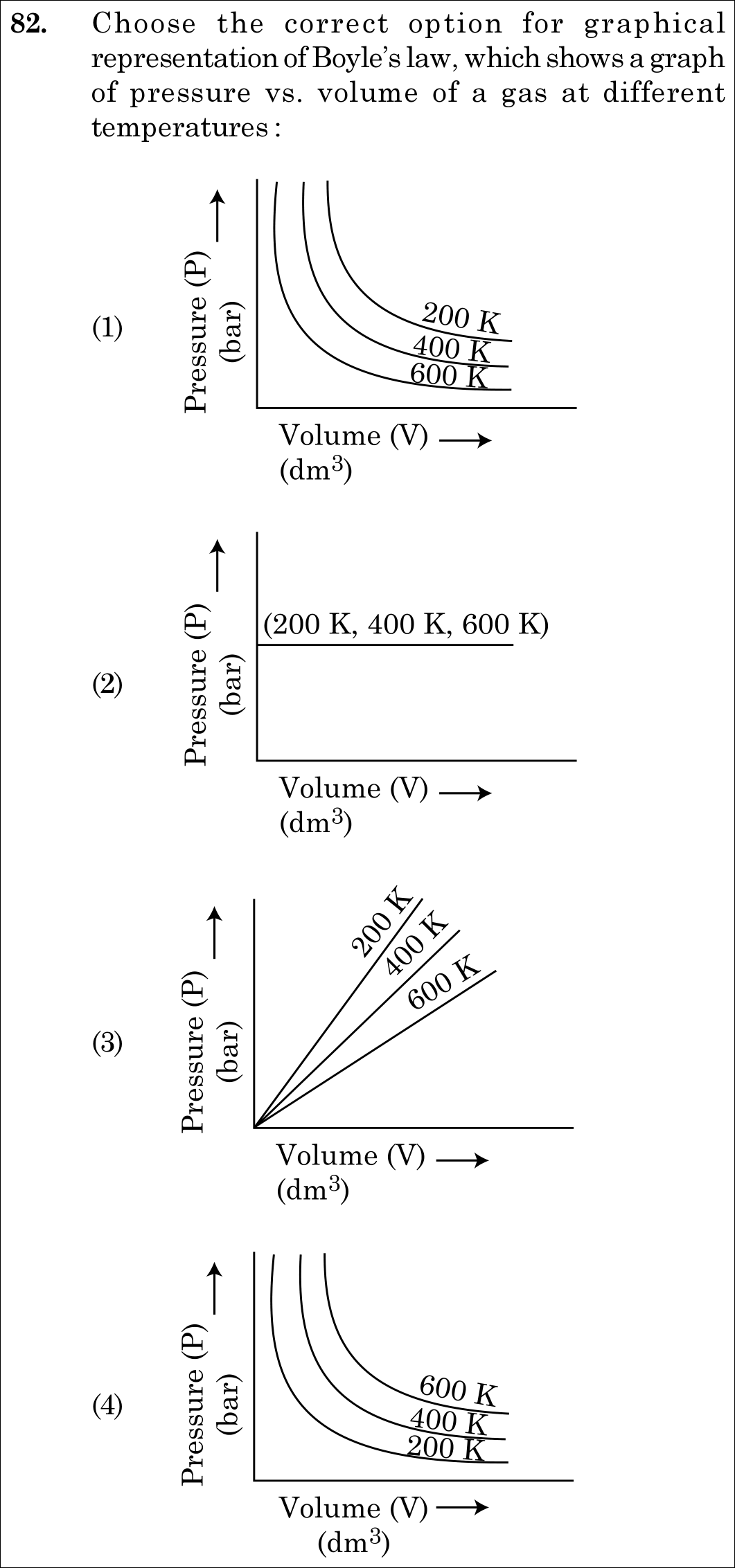
NEET 2021 · Q82 Easy
Official NEET 2021 Question 82 - States of Matter
1
2
3
4 ✓ Key
💡 Verified Solution & 30-Second Hack
✓
Verified Against NTA Final Answer Key
Option (4) : Graph (4) (Rectangular hyperbolas with 600 K highest, 200 K lowest)
📚 States of Matter Easy
📋 Given Parameters & Problem Setup
Governing Law Boyle's Law (P vs V at constant T)
Temperatures 200 K, 400 K, 600 K
⚡

The 30-Second Exam Hall Shortcut: ⚡ Higher T = Higher Curve (P ∝ T at constant V)

⏱️ Save ~15 seconds

From ideal gas equation PV=nRTPV = nRT, at any fixed volume VV, pressure is directly proportional to temperature: P∝TP \propto T. Thus, the highest temperature isotherm (600 K600\text{ K}) must lie at the highest pressure, followed by 400 K400\text{ K}, and the lowest is 200 K200\text{ K}. The curves are rectangular hyperbolas. This corresponds uniquely to Graph (4)! Match Option (4)!

1 Boyle's law states P∝1VP \propto \frac{1}{V} at constant TT, producing rectangular hyperbolic isotherms.
2 Draw a vertical line of constant volume V0V_0.
3 At constant volume: P=(nRV0)T  ⟹  P∝TP = \left(\frac{nR}{V_0}\right) T \implies P \propto T.
4 As TT increases (200 K→400 K→600 K200\text{ K} \to 400\text{ K} \to 600\text{ K}), the pressure must increase.
5 The uppermost curve is 600 K600\text{ K}, middle is 400 K400\text{ K}, and lowest is 200 K200\text{ K}.
6 Match Graph (4).
🛡️
Why You Can 100% Trust This Shortcut: Canonical NCERT States of Matter Fig. 5.1 (P vs V isotherms of Boyle's Law).
📐

Step-by-Step Rigorous Workflow & Mathematical Proof

Step 1

Mathematical Formulation of Boyle's Law Isotherms

Boyle's law states that at constant temperature TT, the pressure of a fixed mass of gas is inversely proportional to its volume: P=k1V  ⟹  PV=k1=nRTP = \frac{k_1}{V} \implies PV = k_1 = nRT A plot of PP versus VV at constant temperature gives a rectangular hyperbola called an isotherm.

Step 2

Temperature Dependence of the Constant k1 = nRT

The constant k1k_1 is directly proportional to the absolute temperature TT. A higher temperature corresponds to a larger value of k1=nRTk_1 = nRT. For any given volume VV on the horizontal axis:

P=nRTV  ⟹  P600 K>P400 K>P200 KP = \frac{nRT}{V} \implies P_{600\text{ K}} > P_{400\text{ K}} > P_{200\text{ K}}
Step 3

Identifying the Correct Graph

- Graph (1): Inverted temperature labels (200 K200\text{ K} is shown at top and 600 K600\text{ K} at bottom), which violates thermodynamics. - Graph (2): Shows pressure independent of volume (horizontal line), which is false. - Graph (3): Shows linear increase (P∝VP \propto V), which is isobaric/Charles law plot type, not PP vs VV. - Graph (4): Shows three hyperbolic isotherms with 600 K600\text{ K} on top, 400 K400\text{ K} in the middle, and 200 K200\text{ K} at the bottom. This is the exact NCERT textbook plot.

⭐

360° Option Elimination Engine Key Feature

Diagnose every choice: Know exactly why the right option works and why distractors fail.

4-Option Deep Scan
1 1
✗ Incorrect
Verdict & Scientific Reason:

Inverted temperature order (places 200 K200\text{ K} above 600 K600\text{ K}).

⚠️
Student Fallacy (Why candidates pick this trap): Assuming lower temperature has higher curve.
2 2
✗ Incorrect
Verdict & Scientific Reason:

Horizontal line implies pressure is independent of volume, completely violating Boyle's law.

⚠️
Student Fallacy (Why candidates pick this trap): Confusing PVPV vs PP plot with PP vs VV plot.
3 3
✗ Incorrect
Verdict & Scientific Reason:

Straight lines through origin represent direct proportionality (P∝VP \propto V), not inverse.

⚠️
Student Fallacy (Why candidates pick this trap): Confusing PP vs 1/V1/V plot with PP vs VV plot.
4 4
✓ 100% Correct
Verdict & Scientific Reason:

Flawless representation of Boyle's law isotherms with 600 K>400 K>200 K600\text{ K} > 400\text{ K} > 200\text{ K}.

💡
Why this is airtight: None; canonical NCERT isotherm diagram.
⚠️

NTA Trap Alert: Graph (1) Inverted Temperature Trap

Candidates who know the curves are hyperbolas often rush and pick Graph (1) without checking the temperature labels. Graph (1) places 200 K200\text{ K} at the top, which is physically impossible. At higher temperature, gas particles have higher kinetic energy and exert GREATER pressure, shifting the curve UPWARDS (Graph 4).

🛡️ How to avoid the -1 mark: Fix a vertical line at constant V: higher temperature MUST give higher pressure (600 K600\text{ K} on top).
📖

Core NEET Syllabus Standard

NCERT Chemistry · States of Matter Standard Benchmark
Core Scientific Principle Tested:

"Each curve on a P-V graph corresponds to a different constant temperature and is known as an isotherm. Higher curves correspond to higher temperatures."

Syllabus Focus: The Gas Laws (Boyle's Law - Pressure-Volume Relationship)
✓ Core NEET UG Syllabus Anchor Syllabus & Academic Standards ↗
NEET 2021 · Q100 Easy
Official NEET 2021 Question 100 - States of Matter
1
2
3 ✓ Key
4
💡 Verified Solution & 30-Second Hack
✓
Verified Against NTA Final Answer Key
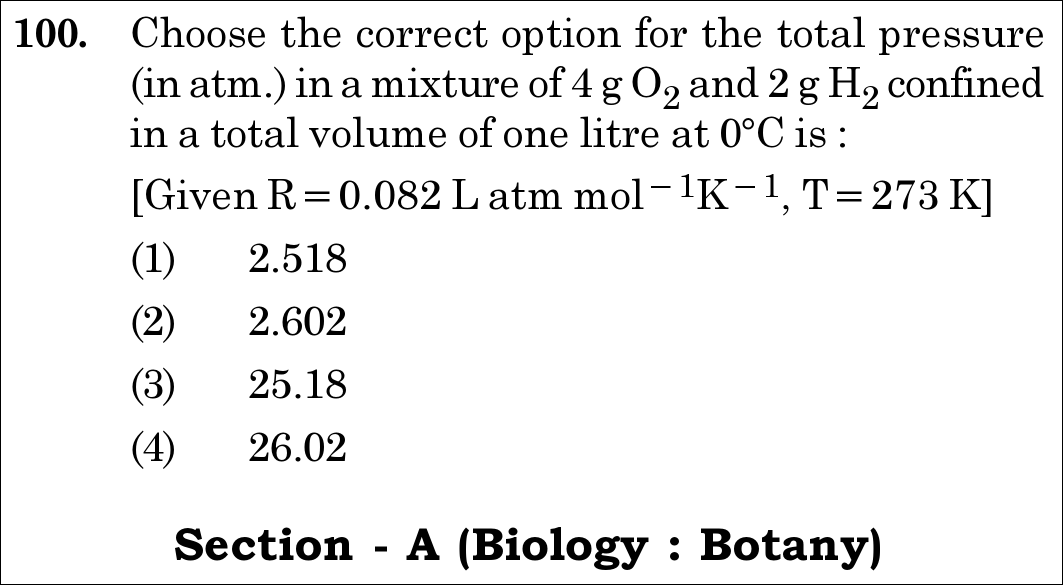
Option (3) : 25.18
📚 States of Matter Easy
📋 Given Parameters & Problem Setup
Mass of O2 4 g (M = 32 g/mol)
Mass of H2 2 g (M = 2 g/mol)
Volume (V) 1.0 L
Temperature (T) 0°C = 273 K
Gas Constant (R) 0.082 L atm mol^-1 K^-1
⚡

The 30-Second Exam Hall Shortcut: ⚡ Total Moles = 4/32 + 2/2 = 1.125 mol   ⟹  \implies P = n·R·T / V = 25.18 atm

⏱️ Save ~20 seconds

n(O2)=432=0.125 moln(O_2) = \frac{4}{32} = 0.125\text{ mol}. n(H2)=22=1.0 moln(H_2) = \frac{2}{2} = 1.0\text{ mol}. Total moles ntotal=1.125 moln_{\text{total}} = 1.125\text{ mol}. Total pressure P=ntotalRTV=1.125×0.082×2731=1.125×22.386=25.18 atmP = \frac{n_{\text{total}} R T}{V} = \frac{1.125 \times 0.082 \times 273}{1} = 1.125 \times 22.386 = 25.18\text{ atm}! Direct 15-second calculation matching Option (3)!

1 Calculate moles of each gas component: - n(O2)=4 g32 g/mol=0.125 moln(O_2) = \frac{4\text{ g}}{32\text{ g/mol}} = 0.125\text{ mol} - n(H2)=2 g2 g/mol=1.0 moln(H_2) = \frac{2\text{ g}}{2\text{ g/mol}} = 1.0\text{ mol}.
2 Sum total moles: ntotal=0.125+1.0=1.125 moln_{\text{total}} = 0.125 + 1.0 = 1.125\text{ mol}.
3 Calculate molar gas volume at given conditions: RT=0.082×273=22.386 L atm/molRT = 0.082 \times 273 = 22.386\text{ L atm/mol}.
4 Calculate total pressure: Ptotal=ntotalRTV=1.125×22.3861.0=25.184 atm≈25.18 atmP_{\text{total}} = \frac{n_{\text{total}} RT}{V} = \frac{1.125 \times 22.386}{1.0} = 25.184\text{ atm} \approx 25.18\text{ atm}.
5 Match Option (3).
🛡️
Why You Can 100% Trust This Shortcut: Canonical ideal gas equation of state and Dalton's law of partial pressures.
📐

Step-by-Step Rigorous Workflow & Mathematical Proof

Step 1

Calculating Moles of Oxygen and Hydrogen Gas

Using molar masses M(O2)=32 g mol−1M(O_2) = 32\text{ g mol}^{-1} and M(H2)=2 g mol−1M(H_2) = 2\text{ g mol}^{-1}: - Moles of oxygen: nO2=mO2MO2=4 g32 g mol−1=18=0.125 moln_{\text{O}_2} = \frac{m_{\text{O}_2}}{M_{\text{O}_2}} = \frac{4\text{ g}}{32\text{ g mol}^{-1}} = \frac{1}{8} = 0.125\text{ mol} - Moles of hydrogen: nH2=mH2MH2=2 g2 g mol−1=1.0 moln_{\text{H}_2} = \frac{m_{\text{H}_2}}{M_{\text{H}_2}} = \frac{2\text{ g}}{2\text{ g mol}^{-1}} = 1.0\text{ mol}

Step 2

Determining Total Moles of Gas in the Mixture

Assuming no chemical reaction occurs at 0∘C0^\circ\text{C} in the absence of a spark or catalyst, Dalton's law states that each gas behaves independently: ntotal=nO2+nH2=0.125+1.0=1.125 moln_{\text{total}} = n_{\text{O}_2} + n_{\text{H}_2} = 0.125 + 1.0 = 1.125\text{ mol}

Step 3

Applying the Ideal Gas Equation

Given V=1.0 LV = 1.0\text{ L}, T=273 KT = 273\text{ K}, and R=0.082 L atm mol−1K−1R = 0.082\text{ L atm mol}^{-1}\text{K}^{-1}: Ptotal=ntotalRTV=1.125 mol×0.082 L atm mol−1K−1×273 K1.0 LP_{\text{total}} = \frac{n_{\text{total}} R T}{V} = \frac{1.125\text{ mol} \times 0.082\text{ L atm mol}^{-1}\text{K}^{-1} \times 273\text{ K}}{1.0\text{ L}}

Ptotal=1.125×22.386=25.18425 atm≈25.18 atmP_{\text{total}} = 1.125 \times 22.386 = 25.18425\text{ atm} \approx \mathbf{25.18\text{ atm}}
⭐

360° Option Elimination Engine Key Feature

Diagnose every choice: Know exactly why the right option works and why distractors fail.

4-Option Deep Scan
1 1
✗ Incorrect
Verdict & Scientific Reason:

Off by a factor of 10 (2.5182.518 instead of 25.1825.18), corresponding to volume V=10 LV = 10\text{ L} instead of 1 L1\text{ L}.

⚠️
Student Fallacy (Why candidates pick this trap): Decimal position error.
2 2
✗ Incorrect
Verdict & Scientific Reason:

Result of rounding and decimal shift error.

⚠️
Student Fallacy (Why candidates pick this trap): Arithmetic miscalculation.
3 3
✓ 100% Correct
Verdict & Scientific Reason:

Exact total pressure: 1.125×0.082×273=25.184 atm≈25.18 atm1.125 \times 0.082 \times 273 = 25.184\text{ atm} \approx 25.18\text{ atm}.

💡
Why this is airtight: None; textbook gaseous state calculation.
4 4
✗ Incorrect
Verdict & Scientific Reason:

Approximation using 22.422.4 and rounding error.

⚠️
Student Fallacy (Why candidates pick this trap): Using imprecise molar volume.
⚠️

NTA Trap Alert: Molar Mass of Hydrogen (H vs H2) and Decimal Traps

Two traps exist here: 1. Using atomic weight of hydrogen (1 g/mol1\text{ g/mol}) instead of molecular weight of hydrogen gas (H2=2 g/molH_2 = 2\text{ g/mol}). 2. Decimal shift between Option (1) (2.5182.518) and Option (3) (25.1825.18). Since 1 mol1\text{ mol} of gas at STP occupies 22.4 L22.4\text{ L}, cramming 1.125 mol1.125\text{ mol} into only 1 L1\text{ L} MUST produce high pressure of over 20 atm20\text{ atm} (25.18 atm25.18\text{ atm}).

🛡️ How to avoid the -1 mark: Sanity check: 1.125 mol1.125\text{ mol} in 1 L1\text{ L}   ⟹  P≈1.125×22.4≈25 atm\implies P \approx 1.125 \times 22.4 \approx 25\text{ atm}, ruling out 2.518 atm2.518\text{ atm}.
📖

Core NEET Syllabus Standard

NCERT Chemistry · States of Matter Standard Benchmark
Core Scientific Principle Tested:

"The total pressure exerted by a mixture of non-reacting gases is equal to the sum of partial pressures: P_total = n_total R T / V."

Syllabus Focus: Ideal Gas Equation and Dalton's Law of Partial Pressures
✓ Core NEET UG Syllabus Anchor Syllabus & Academic Standards ↗
NEET 2020 · Q110 Easy
Official NEET 2020 Question 110 - States of Matter
1
2
3 ✓ Key
4
💡 Verified Solution & 30-Second Hack
✓
Verified Against NTA Final Answer Key
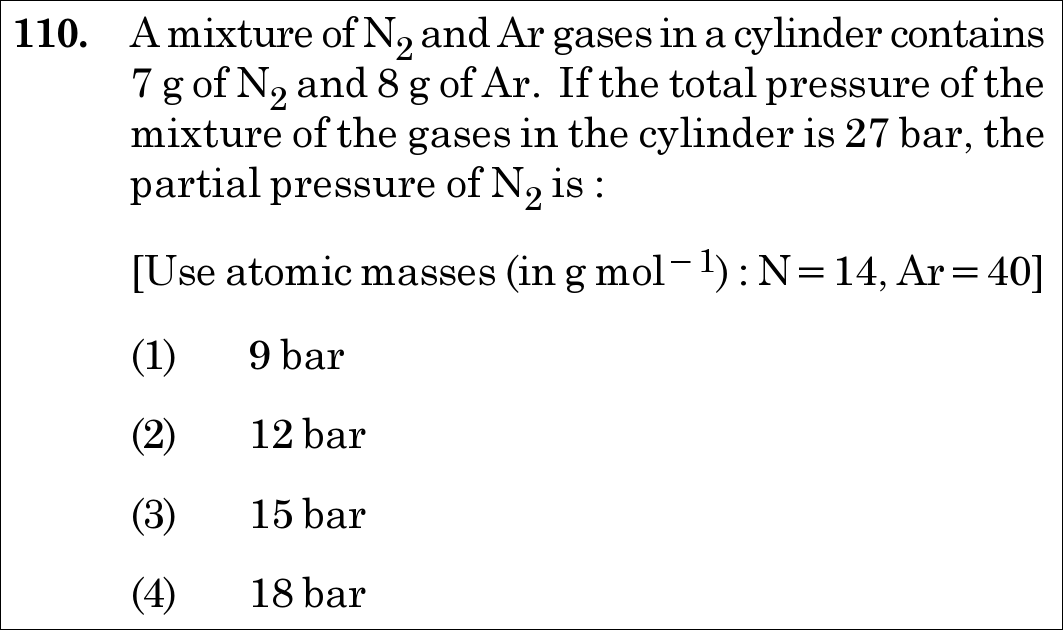
Option (3) : 15 bar
📚 States of Matter Easy
📋 Given Parameters & Problem Setup
Mass of N2 7 g (Molar mass of N2 = 28 g mol^-1)
Mass of Ar 8 g (Atomic mass of Ar = 40 g mol^-1)
Total Pressure (P_total) 27 bar
Question Objective Calculate the partial pressure of N2 (p_N2)
⚡

The 30-Second Exam Hall Shortcut: ⚡ "n(N2) = 7/28 = 0.25 mol; n(Ar) = 8/40 = 0.20 mol; p(N2) = (0.25/0.45) × 27 = 15 bar!"

⏱️ 25 seconds

Calculate moles: nN2=728=0.25 moln_{N_2} = \frac{7}{28} = 0.25\text{ mol}, and nAr=840=0.20 moln_{Ar} = \frac{8}{40} = 0.20\text{ mol}. Total moles = 0.25+0.20=0.45 mol0.25 + 0.20 = 0.45\text{ mol}. Mole fraction of N2N_2 = 0.250.45=59\frac{0.25}{0.45} = \frac{5}{9}. By Dalton's Law: pN2=xN2×Ptotal=59×27 bar=5×3=15 barp_{N_2} = x_{N_2} \times P_{\text{total}} = \frac{5}{9} \times 27\text{ bar} = 5 \times 3 = 15\text{ bar}! Mark Option (3) in 10 seconds.

1 Moles of N2 = 7 g / 28 g mol^-1 = 0.25 mol (or 1/4 mol).
2 Moles of Ar = 8 g / 40 g mol^-1 = 0.20 mol (or 1/5 mol).
3 Total moles = 0.25 + 0.20 = 0.45 mol.
4 Mole fraction of N2: x_N2 = 0.25 / 0.45 = 25/45 = 5/9.
5 Partial pressure: p_N2 = x_N2 × P_total = (5/9) × 27 bar = 15 bar.
6 Select Option (3).
🛡️
Why You Can 100% Trust This Shortcut: NCERT Chemistry · States of Matter (Dalton's Law of Partial Pressures)
📐

Step-by-Step Rigorous Workflow & Mathematical Proof

Step 1

Calculate Moles of Each Gas

Molar mass of diatomic nitrogen (N2\text{N}_2) = 2×14=28 g mol−12 \times 14 = 28\text{ g mol}^{-1}. Molar mass of noble gas argon (Ar\text{Ar}) = 40 g mol−140\text{ g mol}^{-1}. nN2=7 g28 g mol−1=0.25 moln_{\text{N}_2} = \frac{7\text{ g}}{28\text{ g mol}^{-1}} = 0.25\text{ mol} nAr=8 g40 g mol−1=0.20 moln_{\text{Ar}} = \frac{8\text{ g}}{40\text{ g mol}^{-1}} = 0.20\text{ mol}

Step 2

Calculate Total Number of Moles

ntotal=nN2+nAr=0.25+0.20=0.45 moln_{\text{total}} = n_{\text{N}_2} + n_{\text{Ar}} = 0.25 + 0.20 = 0.45\text{ mol}

Step 3

Calculate Mole Fraction of Nitrogen

xN2=nN2ntotal=0.250.45=2545=59x_{\text{N}_2} = \frac{n_{\text{N}_2}}{n_{\text{total}}} = \frac{0.25}{0.45} = \frac{25}{45} = \frac{5}{9}

Step 4

Apply Dalton's Law of Partial Pressures

According to Dalton's law, the partial pressure of a gas in a mixture equals its mole fraction multiplied by the total pressure: pN2=xN2⋅Ptotalp_{\text{N}_2} = x_{\text{N}_2} \cdot P_{\text{total}} pN2=(59)×27 bar=5×3=15 barp_{\text{N}_2} = \left(\frac{5}{9}\right) \times 27\text{ bar} = 5 \times 3 = 15\text{ bar} (Notice also that for argon, pAr=49×27=12 barp_{\text{Ar}} = \frac{4}{9} \times 27 = 12\text{ bar}, and 15+12=27 bar15 + 12 = 27\text{ bar}).

⭐

360° Option Elimination Engine Key Feature

Diagnose every choice: Know exactly why the right option works and why distractors fail.

4-Option Deep Scan
1 A
✗ Incorrect
Verdict & Scientific Reason:

Incorrect; arithmetic error in mole fraction.

⚠️
Student Fallacy (Why candidates pick this trap): Inverting fractions or dividing total pressure by 3.
2 B
✗ Incorrect
Verdict & Scientific Reason:

Incorrect; 12 bar is the partial pressure of ARGON (pAr=49×27=12 barp_{\text{Ar}} = \frac{4}{9} \times 27 = 12\text{ bar}), not nitrogen.

⚠️
Student Fallacy (Why candidates pick this trap): Accidentally calculating the partial pressure of the other gas (Argon).
3 C
✓ 100% Correct
Verdict & Scientific Reason:

Factually and mathematically exact; pN2=59×27=15 barp_{\text{N}_2} = \frac{5}{9} \times 27 = 15\text{ bar}.

💡
Why this is airtight: None; clean Dalton's law calculation.
4 D
✗ Incorrect
Verdict & Scientific Reason:

Incorrect; overestimation of nitrogen fraction.

⚠️
Student Fallacy (Why candidates pick this trap): Assuming nitrogen accounts for 2/3 of total pressure.
⚠️

NTA Trap Alert: Molar Mass of Nitrogen: N vs N2

Nitrogen gas is DIATOMIC (N2\text{N}_2), so its molar mass is 28 g/mol28\text{ g/mol}, NOT 14 g/mol14\text{ g/mol}! Using 14 gives n=0.5 moln = 0.5\text{ mol}, which leads to wrong options.

🛡️ How to avoid the -1 mark: Remember: Gas in cylinder is N2\text{N}_2 -> Molar mass = 28 g/mol!
📖

Core NEET Syllabus Standard

Chemistry · States of Matter Standard Benchmark
Core Scientific Principle Tested:

""

Syllabus Focus: Dalton's Law of Partial Pressures: Partial Pressure of N2 in N2-Ar Mixture
✓ Core NEET UG Syllabus Anchor Syllabus & Academic Standards ↗

Solve 4 NEET Questions a Day — One per Subject

Cover all 1,140 official NEET questions in 285 days at your own pace. Progress is saved on your device. No login needed.