The 30-Second Exam Hall Shortcut: ⚡ The 5:2 n-factor Redox Ratio
Permanganate transfers 5 electrons; Oxalate transfers 2 electrons!
Step-by-Step Rigorous Workflow & Mathematical Proof
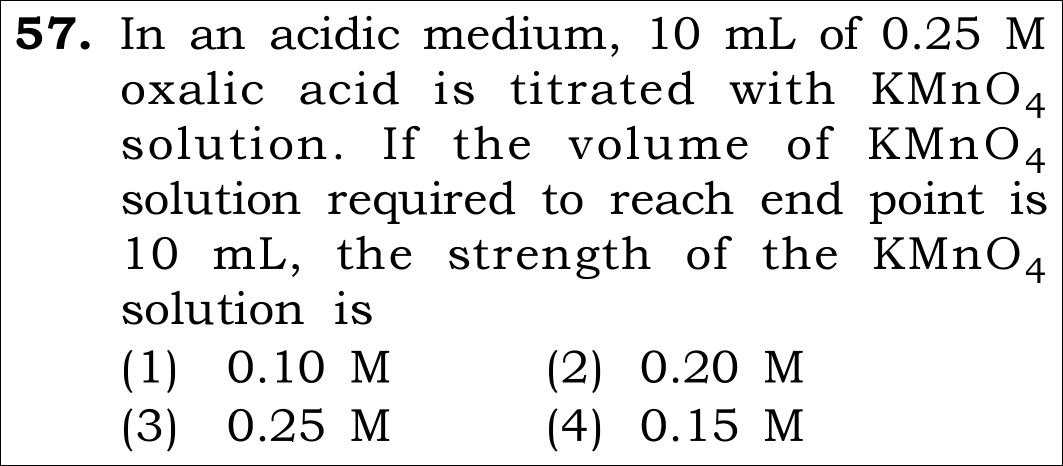
Determine the n-factors of the Reactants in Acidic Medium
1. Potassium permanganate (KMnO₄): Manganese is reduced from +7 in MnO₄⁻ to +2 in Mn²⁺. The change in oxidation state per mole is |+7 - (+2)| = 5. 2. Oxalic acid (H₂C₂O₄): Carbon is oxidized from +3 in C₂O₄²⁻ to +4 in CO₂. For two carbon atoms per molecule, total electron loss = 2 × 1 = 2.
- • n-factor of KMnO₄ in acidic medium = 5.
- • n-factor of oxalic acid = 2.
Apply the Law of Chemical Equivalence
At the equivalence (end) point of a titration, the number of gram equivalents of oxidizing agent equals the number of gram equivalents of reducing agent: Number of equivalents = Molarity × n-factor × Volume
- • V₁ = 10 mL.
- • V₂ = 10 mL.
- • M₂ = 0.25 M.
Calculate Molarity of KMnO₄
Substitute the given values into the equivalence equation.
- • Strength = 0.10 M.
- • Matches Option (1).
360° Option Elimination Engine Key Feature
Diagnose every choice: Know exactly why the right option works and why distractors fail.
Exact stoichiometric result derived from the law of equivalence and standard n-factors.
Incorrect. Arises from using n = 1 for oxalic acid.
Incorrect. Assuming a 1:1 molar ratio (M₁V₁ = M₂V₂), which is completely invalid for redox reactions.
Incorrect. Arithmetic miscalculation.
NTA Trap Alert: Using M₁V₁ = M₂V₂ Instead of N₁V₁ = N₂V₂
The most widespread error in quantitative titrations is using acid-base molarity equality for a redox reaction with unequal electron transfers (5 electrons vs 2 electrons).
Core NEET Syllabus Standard
"In acidic solution, MnO₄⁻ acts as a 5-electron acceptor while C₂O₄²⁻ acts as a 2-electron donor."