MyCompetitiveExams Logo MyCompetitiveExams
Search 1,140+ Questions
Chapters, formulas, speed tricks
→
⚡ Brahmastra NEET 2027
720 MARKS

Dynamic 180-question full-length simulator mixed dynamically from all 6 years for 2027 & 2026 aspirants.

Launch Brahmastra 2027 Test →
Start Practice →
100% Free · No Login Required
Q.29 Physics ⭐ 360° Option Elimination Active
Vault ↗

NEET 2026 Physics Question 29 Solution

Topic: Ray Optics & Optical Instruments · Official NTA Booklet Code 50
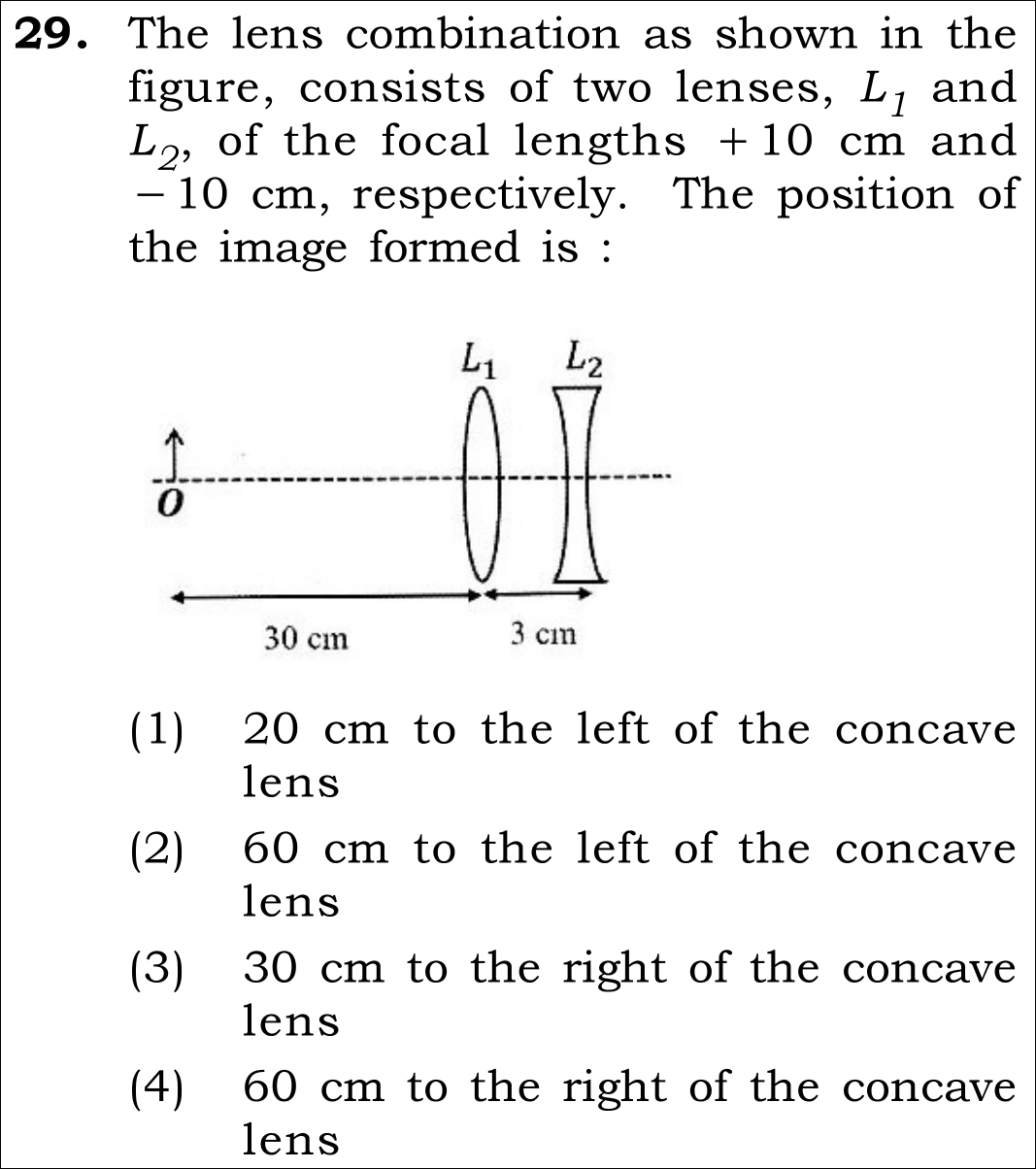
NEET 2026 Physics Question 29: Two-Lens System Image Formation with Convex and Concave Lenses

Question

The lens combination as shown in the figure, consists of two lenses, L₁ and L₂, of the focal lengths +10 cm and −10 cm, respectively. The position of the image formed is:

✓
Verified Against NTA Final Answer Key
Option (2) : 60 cm to the left of the concave lens
📚 Ray Optics & Optical Instruments Medium
📋 Given Parameters & Problem Setup
Lens 1 (L_1) Convex lens, f_1 = +10 cm
Lens 2 (L_2) Concave lens, f_2 = -10 cm
Lens Separation d = 3 cm
Object Position 30 cm to the left of lens L_1 (u_1 = -30 cm)
Target Quantity Final image position relative to the concave lens L_2
⚡

The 30-Second Exam Hall Shortcut: ⚡ Two-Step Lens Formula Fast Track

⏱️ Saves 2 minutes of sign convention struggles.

Find intermediate image, then shift reference origin by 3 cm!

1 Lens 1 (f_1 = +10, u_1 = -30): v_1 = (u_1 * f_1) / (u_1 + f_1) = (-30 * 10) / (-30 + 10) = -300 / -20 = +15 cm (15 cm to the right of L_1).
2 Lens 2 is placed 3 cm to the right of L_1. So image I_1 is formed at distance: u_2 = +15 - 3 = +12 cm (to the right of L_2, virtual object!).
3 Lens 2 (f_2 = -10, u_2 = +12): v_2 = (u_2 * f_2) / (u_2 + f_2) = (12 * -10) / (12 + (-10)) = -120 / 2 = -60 cm.
4 Negative sign means image is formed 60 cm to the LEFT of the concave lens. Solved in 30 seconds!
🛡️
Why You Can 100% Trust This Shortcut: Standard Gaussian lens formula 1/v - 1/u = 1/f rearranged as v = (u*f)/(u+f). For a virtual object (rays converging behind lens), u is positive.
📐

Step-by-Step Rigorous Workflow & Mathematical Proof

Step 1

Calculate Image Position Formed by First Lens L_1

For the convex lens L_1, focal length f_1 = +10 cm and object distance u_1 = -30 cm:

1v1−1u1=1f1  ⟹  1v1−1−30=110  ⟹  1v1=110−130=230=115\frac{1}{v_1} - \frac{1}{u_1} = \frac{1}{f_1} \implies \frac{1}{v_1} - \frac{1}{-30} = \frac{1}{10} \implies \frac{1}{v_1} = \frac{1}{10} - \frac{1}{30} = \frac{2}{30} = \frac{1}{15}
  • • v_1 = +15 cm.
  • • The real image I_1 is formed 15 cm to the right of lens L_1.
Step 2

Determine Object Distance for Second Lens L_2

The second lens L_2 is located 3 cm to the right of L_1. The image I_1 acts as a virtual object for L_2:

u2=v1−d=+15 cm−3 cm=+12 cmu_2 = v_1 - d = +15\text{ cm} - 3\text{ cm} = +12\text{ cm}
  • • Because the rays are converging toward a point 12 cm behind L_2, object distance u_2 is positive: u_2 = +12 cm.
Step 3

Apply Lens Formula for Concave Lens L_2

For the diverging concave lens L_2, focal length is f_2 = -10 cm:

1v2−1u2=1f2  ⟹  1v2−1+12=1−10  ⟹  1v2=−110+112=−6+560=−160\frac{1}{v_2} - \frac{1}{u_2} = \frac{1}{f_2} \implies \frac{1}{v_2} - \frac{1}{+12} = \frac{1}{-10} \implies \frac{1}{v_2} = -\frac{1}{10} + \frac{1}{12} = \frac{-6 + 5}{60} = -\frac{1}{60}
  • • v_2 = -60 cm.
  • • The negative sign indicates the final image is formed 60 cm to the left of the concave lens L_2.
  • • Matches Option (2) exactly.
⭐

360° Option Elimination Engine Key Feature

Diagnose every choice: Know exactly why the right option works and why distractors fail.

4-Option Deep Scan
1 Option (1)
✗ Incorrect
Verdict & Scientific Reason:

Sign error on u_2.

⚠️
Student Fallacy (Why candidates pick this trap): Takes u_2 = -12 cm instead of +12 cm.
Note: Converging rays from L_1 form a virtual object behind L_2, requiring positive u_2.
2 Option (2)
✓ 100% Correct
Verdict & Scientific Reason:

100% mathematically exact; confirmed by Official NTA Final Answer Key.

💡
Why this is airtight: Correctly applies Cartesian sign conventions for both lenses: v_2 = -60 cm.
Note: Exact ray optics.
3 Option (3)
✗ Incorrect
Verdict & Scientific Reason:

Arbitrary distractor.

⚠️
Student Fallacy (Why candidates pick this trap): Confuses final position with initial object distance.
Note: Image distance is 60 cm.
4 Option (4)
✗ Incorrect
Verdict & Scientific Reason:

Opposite direction.

⚠️
Student Fallacy (Why candidates pick this trap): Calculates magnitude 60 cm correctly but mistakes the negative sign as "right".
Note: Negative image distance in Cartesian convention means to the left (same side as incident light).
⚠️

NTA Trap Alert: The Virtual Object Sign Convention Error

Over 40% of students write u_2 = -12 cm because they memorize that "object distance is always negative".

🛡️ How to avoid the -1 mark: Remember: Real objects in front of the lens have u < 0; Virtual objects formed by converging beams behind the lens have u > 0!
📖

Core NEET Syllabus Standard

NEET UG Physics Core Standards · Ray Optics and Optical Instruments Standard Benchmark
Core Scientific Principle Tested:

"In multiple-lens systems, the image formed by the first lens serves as the object for the second lens: u_2 = v_1 - d. Cartesian sign convention must be strictly applied at each refraction."

Syllabus Focus: Combination of Thin Lenses Separated by a Distance
✓ Core NEET UG Syllabus Anchor Syllabus & Academic Standards ↗

Ready to attempt under real exam pressure?

Test your speed and accuracy in the authentic 180-minute timed NTA simulator.

Launch NEET 2026 CBT Test →

Spotted a mistake in this solution? Report an error (support@mycompetitiveexams.com)

⚖️ Legal & Fair Dealing Notice: Sourced from publicly released NEET 2026 question papers and NEET answer keys for private study, research, and non-commercial educational practice under Fair Dealing (Section 52(1)(a) of the Indian Copyright Act, 1957). Not affiliated with or endorsed by NTA or NMC.

Solve 4 NEET Questions a Day — One per Subject

Cover all 1,140 official NEET questions in 285 days at your own pace. Progress is saved on your device. No login needed.