MyCompetitiveExams Logo MyCompetitiveExams
Search 1,140+ Questions
Chapters, formulas, speed tricks
→
⚡ Brahmastra NEET 2027
720 MARKS

Dynamic 180-question full-length simulator mixed dynamically from all 6 years for 2027 & 2026 aspirants.

Launch Brahmastra 2027 Test →
Start Practice →
100% Free · No Login Required
🧪 Chemistry Moderate Frequency

NEET Practical Chemistry Previous Year Questions with Solutions

Complete repository of official NTA NEET questions for Practical Chemistry from 2020 to 2026. Every question includes 30-second elimination tricks, step-by-step NCERT solutions, option-by-option traps, and official answer keys.

2 Questions 1 Exam Years (2024) 2 Easy · 0 Medium · 0 Challenging
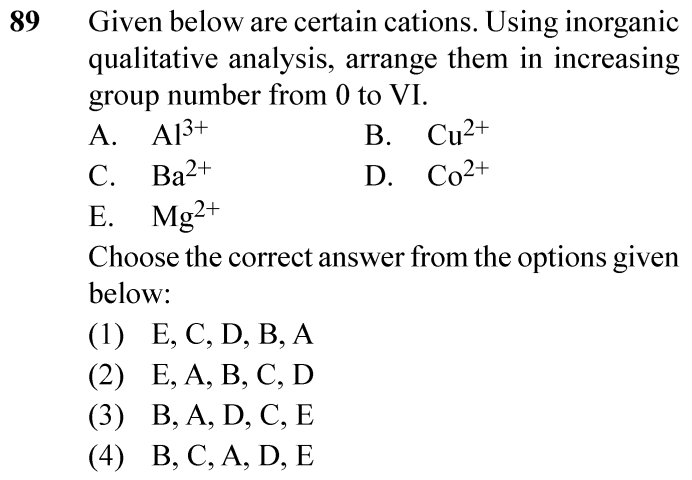
NEET 2024 · Q89 Easy
Official NEET 2024 Question 89 - Practical Chemistry
1
2
3 ✓ Key
4
💡 Verified Solution & 30-Second Hack
✓
Verified Against NTA Final Answer Key
Option (3) : B, A, D, C, E (Cu2+, Al3+, Co2+, Ba2+, Mg2+)
📚 Practical Chemistry Easy
📋 Given Parameters & Problem Setup
Cation A Al3+
Cation B Cu2+
Cation C Ba2+
Cation D Co2+
Cation E Mg2+
Objective Arrange cations in increasing group number from 0 to VI
⚡

The 30-Second Exam Hall Shortcut: ⚡ Qualitative Analysis Group Order Rule

⏱️ Save ~40 seconds

Cu²⁺ is Group II (B); Al³⁺ is Group III (A); Co²⁺ is Group IV (D); Ba²⁺ is Group V (C); Mg²⁺ is Group VI (E) -> Sequence: B, A, D, C, E!

1 Recall the canonical qualitative analysis cation groups and group reagents:
2 - Group 0: NH4⁺.
3 - Group I: Pb²⁺ (dil. HCl).
4 - Group II: Cu²⁺, Pb²⁺, As³⁺ (H2S in dil. HCl) -> Cu²⁺ = Group II (B).
5 - Group III: Fe³⁺, Al³⁺, Cr³⁺ (NH4OH in presence of NH4Cl) -> Al³⁺ = Group III (A).
6 - Group IV: Co²⁺, Ni²⁺, Mn²⁺, Zn²⁺ (H2S in presence of NH4OH) -> Co²⁺ = Group IV (D).
7 - Group V: Ba²⁺, Sr²⁺, Ca²⁺ ((NH4)2CO3 in presence of NH4OH) -> Ba²⁺ = Group V (C).
8 - Group VI: Mg²⁺ (disodium hydrogen phosphate) -> Mg²⁺ = Group VI (E).
9 Increasing group number: B (II) < A (III) < D (IV) < C (V) < E (VI).
10 Sequence: B, A, D, C, E -> Option (3) in 5 seconds!
🛡️
Why You Can 100% Trust This Shortcut: NCERT Chemistry · Practical Chemistry (Systematic analysis of basic radicals: cation group separation scheme).
📐

Step-by-Step Rigorous Workflow & Mathematical Proof

Step 1

Principles of Systematic Cation Separation

Qualitative inorganic analysis separates basic radicals (cations) into analytical groups based on the solubility products (Ksp) of their insoluble chlorides, sulphides, hydroxides, and carbonates:

Precipitation occurs when Ionic Product (IP) >Ksp\text{Precipitation occurs when Ionic Product (IP) } > K_{sp}
Step 2

Group Assignment for Each Given Cation

Mapping each given cation to its analytical group and identifying its group reagent: - B (Cu²⁺): Group II (precipitated as black CuS with H2S gas in acidic medium). Group Number = 2. - A (Al³⁺): Group III (precipitated as gelatinous white Al(OH)3 with NH4OH in the presence of NH4Cl). Group Number = 3. - D (Co²⁺): Group IV (precipitated as black CoS with H2S in ammoniacal medium). Group Number = 4. - C (Ba²⁺): Group V (precipitated as white BaCO3 with (NH4)2CO3 in ammoniacal medium). Group Number = 5. - E (Mg²⁺): Group VI (precipitated as white crystalline Mg(NH4)PO4). Group Number = 6.

Cu2+(II)<Al3+(III)<Co2+(IV)<Ba2+(V)<Mg2+(VI)\text{Cu}^{2+} (\text{II}) < \text{Al}^{3+} (\text{III}) < \text{Co}^{2+} (\text{IV}) < \text{Ba}^{2+} (\text{V}) < \text{Mg}^{2+} (\text{VI})
Step 3

Ordering by Analytical Group

Arranging in order of increasing group number from Group 0 to VI yields: B (Group II) ⟶ A (Group III) ⟶ D (Group IV) ⟶ C (Group V) ⟶ E (Group VI). Matching sequence: B, A, D, C, E.

Sequence: B,A,D,C,E  (Option 3)\text{Sequence: } \mathbf{B, A, D, C, E} \; (\text{Option 3})
⭐

360° Option Elimination Engine Key Feature

Diagnose every choice: Know exactly why the right option works and why distractors fail.

4-Option Deep Scan
1 (1)
✗ Incorrect
Verdict & Scientific Reason:

Reverses the order (decreasing group number).

⚠️
Student Fallacy (Why candidates pick this trap): Arranging in decreasing order instead of increasing.
2 (2)
✗ Incorrect
Verdict & Scientific Reason:

Places magnesium in the first position.

⚠️
Student Fallacy (Why candidates pick this trap): Confusing Group VI with Group 0.
3 (3)
✓ 100% Correct
Verdict & Scientific Reason:

Strictly matches analytical groups II, III, IV, V, and VI.

💡
Why this is airtight: None.
4 (4)
✗ Incorrect
Verdict & Scientific Reason:

Places barium (Group V) before aluminum (Group III).

⚠️
Student Fallacy (Why candidates pick this trap): Misremembering barium’s group number.
⚠️

NTA Trap Alert: Confusing Periodic Table Groups with Analytical Groups

Periodic table group for Mg is Group 2, but in qualitative salt analysis, Magnesium is in Group VI! Always use analytical salt analysis groups!

🛡️ How to avoid the -1 mark: Remember the mnemonic for analytical groups: Lead (I), Copper (II), Aluminium (III), Cobalt (IV), Barium (V), Magnesium (VI).
📖

Core NEET Syllabus Standard

Chemistry Core Practical Chemistry · Practical Chemistry Standard Benchmark
Core Scientific Principle Tested:

"Basic radicals are classified into six analytical groups based on selective precipitation with group reagents."
Syllabus Focus: Qualitative Analysis: Group Reagents and Systematic Classification of Cations
✓ Core NEET UG Syllabus Anchor Syllabus & Academic Standards ↗
Copper two, Al three, Cobalt four, Barium five, Magnesium six: B-A-D-C-E does the trick!
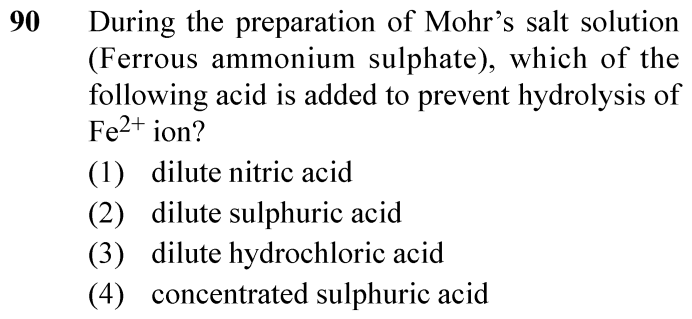
NEET 2024 · Q90 Easy
Official NEET 2024 Question 90 - Practical Chemistry
1
2 ✓ Key
3
4
💡 Verified Solution & 30-Second Hack
✓
Verified Against NTA Final Answer Key
Option (2) : dilute sulphuric acid
📚 Practical Chemistry Easy
📋 Given Parameters & Problem Setup
Target solution Mohr’s salt solution (Ferrous ammonium sulphate: FeSO4·(NH4)2SO4·6H2O)
Objective Acid added to prevent hydrolysis of Fe2+ ion
⚡

The 30-Second Exam Hall Shortcut: ⚡ Common Ion & Non-Interfering Acid Hack

⏱️ Save ~30 seconds

Mohr’s salt is a SULPHATE double salt! Dilute H2SO4 prevents hydrolysis of Fe²⁺ to Fe(OH)2 without introducing foreign anions or oxidizing Fe²⁺!

1 Mohr’s salt is ferrous ammonium sulphate, [FeSO4 · (NH4)2SO4 · 6H2O].
2 In neutral water, Fe²⁺ undergoes cationic hydrolysis with water to form pale yellow/brown turbid insoluble ferrous hydroxide Fe(OH)2.
3 Adding acid supplies H⁺ ions, shifting the hydrolysis equilibrium backward to preserve clear green Fe²⁺ ions.
4 Dilute HNO3 CANNOT be used because it is an oxidizing agent that oxidizes Fe²⁺ to Fe³⁺.
5 Dilute HCl CANNOT be used because Cl⁻ interferes with KMnO4 in redox titrations (KMnO4 oxidizes Cl⁻ to Cl2).
6 Dilute H2SO4 shares the common sulphate (SO4²⁻) ion, does not oxidize Fe²⁺, and does not interfere with permanganate.
7 Option (2) in 5 seconds!
🛡️
Why You Can 100% Trust This Shortcut: NCERT Chemistry · Practical Chemistry (Preparation of standard solution of Mohr’s salt and prevention of hydrolysis of Fe2+ using dilute H2SO4).
📐

Step-by-Step Rigorous Workflow & Mathematical Proof

Step 1

Hydrolysis Equilibrium of Ferrous Ion

When Mohr’s salt dissolves in neutral water, the Fe²⁺ cation acts as a weak conjugate acid and undergoes hydrolysis, producing basic salts / insoluble Fe(OH)2 which causes the solution to turn brownish and turbid:

Fe2++2H2O⇌Fe(OH)2↓+2H⊕\text{Fe}^{2+} + 2\text{H}_2\text{O} \rightleftharpoons \text{Fe(OH)}_2\downarrow + 2\text{H}^\oplus
Step 2

Le Chatelier Suppression by Added Acid

By adding dilute sulphuric acid, the high concentration of hydronium ions (H⁺) shifts the hydrolysis equilibrium to the left according to Le Chatelier’s principle, completely preventing the precipitation of Fe(OH)2 and maintaining a clear, transparent solution of Fe²⁺:

[H⊕]↑  ⟹  Equilibrium shifts left, suppressing Fe(OH)2 formation[\text{H}^\oplus] \uparrow \implies \text{Equilibrium shifts left, suppressing } \text{Fe(OH)}_2 \text{ formation}
Step 3

Why Other Acids are Unsuitable

Evaluating the alternative acids: - Dilute HNO3: Nitric acid is a strong oxidizing agent that oxidizes ferrous (Fe²⁺) to ferric (Fe³⁺), destroying the standard reducing solution: 3 Fe²⁺ + NO3⁻ + 4 H⁺ ⟶ 3 Fe³⁺ + NO + 2 H2O. - Dilute HCl: In redox titrations with KMnO4, hydrochloric acid is oxidized by permanganate to chlorine gas (2 Cl⁻ ⟶ Cl2 + 2e⁻), consuming titrant and producing false titer values. - Concentrated H2SO4: Charring agent; unnecessary and dangerous for aqueous volumetric solutions. Hence, dilute H2SO4 is the unique, ideal choice.

Only dilute H2SO4 prevents hydrolysis without redox interference\text{Only dilute H}_2\text{SO}_4 \text{ prevents hydrolysis without redox interference}
⭐

360° Option Elimination Engine Key Feature

Diagnose every choice: Know exactly why the right option works and why distractors fail.

4-Option Deep Scan
1 (1)
✗ Incorrect
Verdict & Scientific Reason:

Oxidizes Fe²⁺ to Fe³⁺, destroying the reducing capacity of Mohr’s salt.

⚠️
Student Fallacy (Why candidates pick this trap): Forgetting that HNO3 is an active oxidizing agent.
2 (2)
✓ 100% Correct
Verdict & Scientific Reason:

Supplies H⁺ to suppress hydrolysis, shares common sulphate ion, and does not interfere with KMnO4 titrations.

💡
Why this is airtight: None.
3 (3)
✗ Incorrect
Verdict & Scientific Reason:

Cl⁻ is oxidized to Cl2 by KMnO4 during redox titration.

⚠️
Student Fallacy (Why candidates pick this trap): Overlooking the permanganate-chloride side reaction.
4 (4)
✗ Incorrect
Verdict & Scientific Reason:

Excessively hazardous and unnecessary; only dilute acid is specified.

⚠️
Student Fallacy (Why candidates pick this trap): Choosing concentrated over dilute.
⚠️

NTA Trap Alert: Choosing Dilute HCl Instead of Dilute H2SO4

Students often think any strong mineral acid will work. In redox titrations, KMnO4 oxidizes HCl to Cl2! Only dilute H2SO4 provides the non-interfering acidic environment.

🛡️ How to avoid the -1 mark: Always remember: Mohr’s salt titration with KMnO4 MUST use dilute H2SO4.
📖

Core NEET Syllabus Standard

Chemistry Core Practical Chemistry · Practical Chemistry Standard Benchmark
Core Scientific Principle Tested:

"Dilute H2SO4 is added during the preparation of Mohr’s salt solution to prevent cationic hydrolysis of Fe2+ ions into Fe(OH)2."

Syllabus Focus: Volumetric Analysis: Redox Titration of Mohr’s Salt with KMnO4
✓ Core NEET UG Syllabus Anchor Syllabus & Academic Standards ↗
Mohr’s salt is a sulphate friend: Dilute H2SO4 keeps Fe2+ to the end!

Solve 4 NEET Questions a Day — One per Subject

Cover all 1,140 official NEET questions in 285 days at your own pace. Progress is saved on your device. No login needed.