The 30-Second Exam Hall Shortcut: ⚡ Electron Donor Rules: Empty Accepts from Filled!
Stabilization requires electron density to flow INTO the vacant p orbital from FILLED orbitals!
Step-by-Step Rigorous Workflow & Mathematical Proof
Analyze the Electronic Structure of the Carbocation
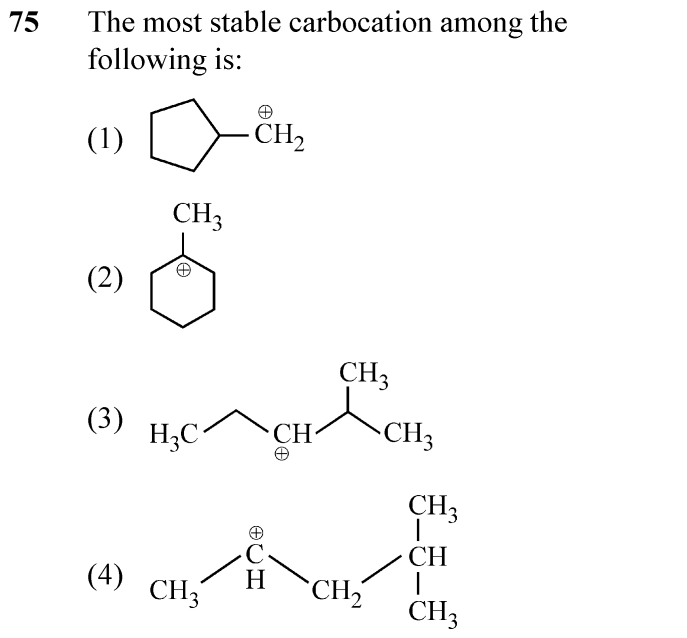
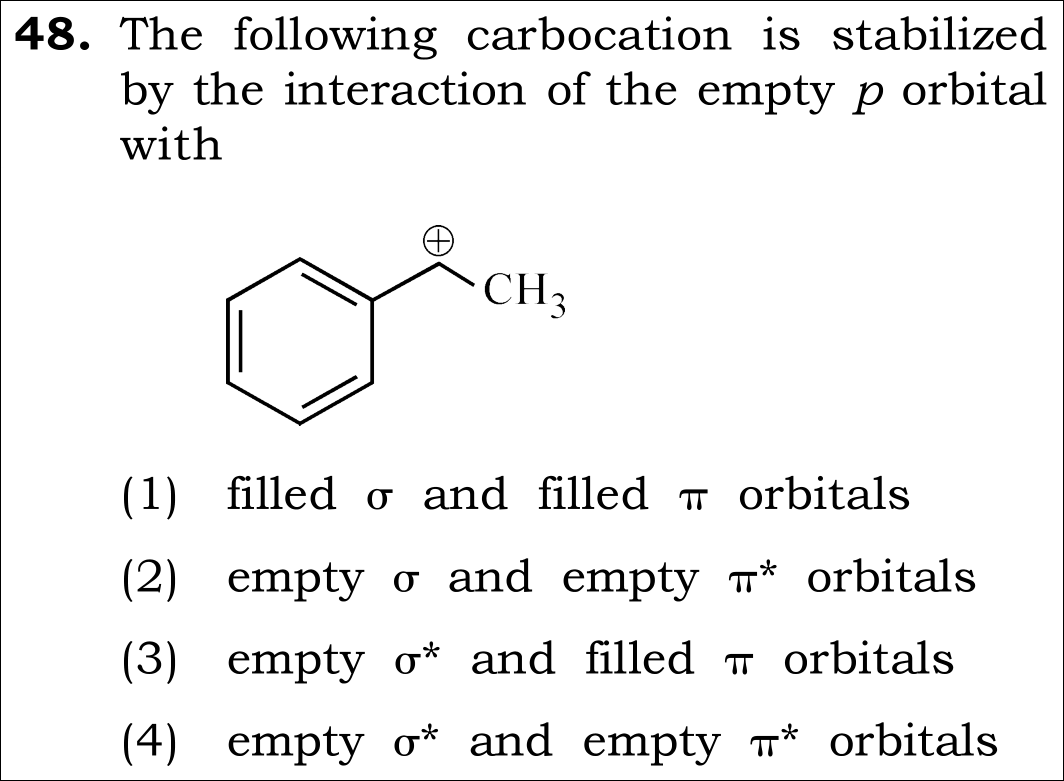
In the 1-phenylethyl carbocation, the positively charged carbon is sp² hybridized. It forms three σ bonds in a trigonal planar geometry, leaving one unhybridized 2p orbital that is completely empty (contains 0 electrons).
- • Hybridization of C⁺: sp².
- • Acceptor orbital: vacant unhybridized 2p orbital.
Resonance Stabilization with the Aromatic Benzene Ring
The empty 2p orbital on the benzylic carbon aligns parallel to the adjacent p-orbitals of the aromatic ring. This enables delocalization of the filled aromatic π-bonding electrons into the empty p-orbital, dispersing the positive charge across the ortho and para positions of the benzene ring.
- • Donor: Filled π-bonding molecular orbitals of the benzene ring.
- • Effect: Extensive benzylic resonance stabilization.
Hyperconjugative Stabilization with the Adjacent Methyl Group
The empty 2p orbital also interacts with the adjacent sp³-hybridized C-H σ-bonding orbitals of the methyl group. This no-bond resonance (hyperconjugation) involves the overlap of the filled C-H σ orbital with the empty p orbital.
- • Donor: Filled σ orbitals of the adjacent C-H bonds.
- • Overall Interaction: Empty p orbital interacts with filled σ and filled π orbitals.
360° Option Elimination Engine Key Feature
Diagnose every choice: Know exactly why the right option works and why distractors fail.
Exact physical description. Filled C-H σ-orbitals donate via hyperconjugation, and filled aromatic π-orbitals donate via resonance into the vacant p-orbital.
Incorrect. Overlap between two empty orbitals provides zero electron density and zero electronic stabilization.
Incorrect. The empty p-orbital does not get stabilized by empty σ* antibonding orbitals; it is stabilized by filled bonding σ orbitals.
Incorrect. Empty antibonding orbitals cannot donate electrons to a positively charged empty orbital.
NTA Trap Alert: Confusing Donor and Acceptor Roles in Hyperconjugation
Students frequently confuse whether hyperconjugation involves or . In carbocations, the acceptor is the vacant p-orbital, and the donors are the FILLED bonding σ and π orbitals.
Core NEET Syllabus Standard
"Carbocations are stabilized by overlap of the vacant p orbital with filled adjacent σ and π orbitals."