MyCompetitiveExams Logo MyCompetitiveExams
Search 1,140+ Questions
Chapters, formulas, speed tricks
→
⚡ Brahmastra NEET 2027
720 MARKS

Dynamic 180-question full-length simulator mixed dynamically from all 6 years for 2027 & 2026 aspirants.

Launch Brahmastra 2027 Test →
Start Practice →
100% Free · No Login Required
Q.48 Chemistry ⭐ 360° Option Elimination Active
Vault ↗

NEET 2026 Chemistry Question 48 Solution

Topic: Organic Chemistry: Some Basic Principles and Techniques · Official NTA Booklet Code 50
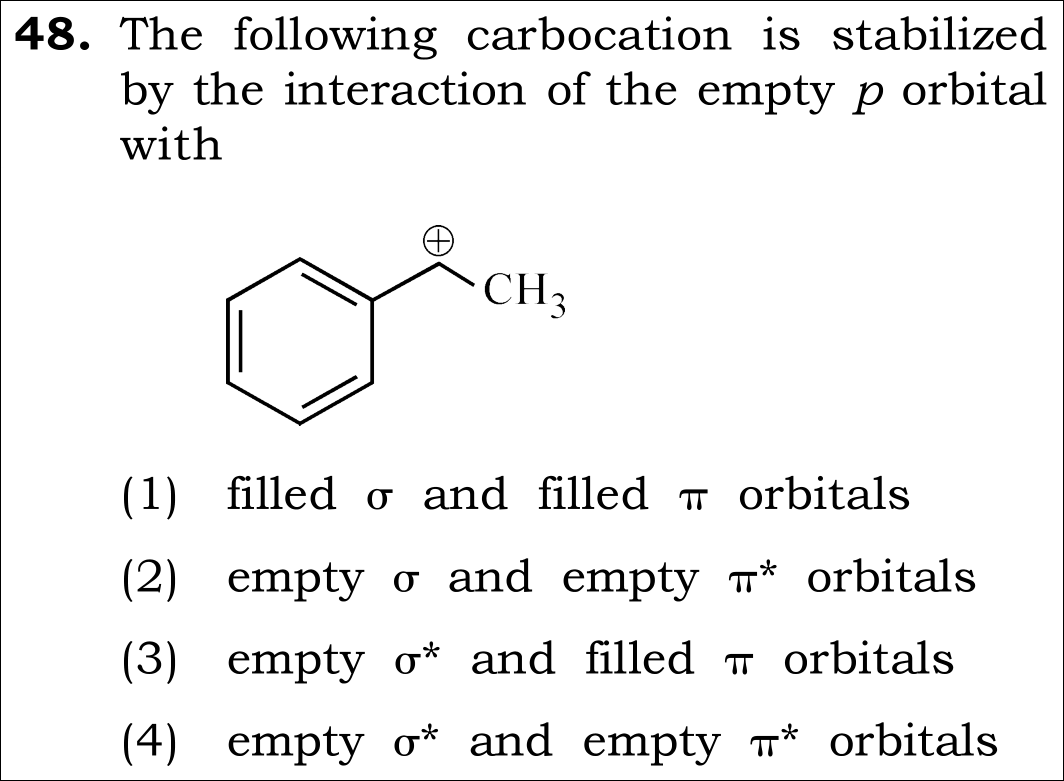
NEET 2026 Chemistry Question 48: Orbital Interactions in Carbocation Stabilization (Resonance & Hyperconjugation)

Question

The following carbocation is stabilized by the interaction of the empty p orbital with: C₆H₅−C⁺H−CH₃ (1-phenylethyl cation)

✓
Verified Against NTA Final Answer Key
Option (1) : filled σ and filled π orbitals
📚 Organic Chemistry: Some Basic Principles and Techniques Medium
📋 Given Parameters & Problem Setup
Species 1-phenylethyl cation [PhCH(⁺)CH₃]
Carbocation Carbon sp² hybridized with a vacant, unhybridized 2p orbital
Adjacent Groups Phenyl ring (π system) and methyl group (C-H σ bonds)
⚡

The 30-Second Exam Hall Shortcut: ⚡ Electron Donor Rules: Empty Accepts from Filled!

⏱️ Save ~60 seconds

Stabilization requires electron density to flow INTO the vacant p orbital from FILLED orbitals!

1 The carbocation carbon has an EMPTY p-orbital (electron-deficient).
2 To stabilize this deficiency, neighboring groups must DONATE electron density.
3 Donation comes from: (i) the FILLED π-orbitals of the aromatic ring (resonance), and (ii) the FILLED σ-orbitals of the adjacent C-H bonds (hyperconjugation).
4 Empty cannot donate to empty! Both donating orbitals must be FILLED (filled σ and filled π orbitals). Option (1) is instantly deduced in 10 seconds!
🛡️
Why You Can 100% Trust This Shortcut: Fundamental molecular orbital theory: Chemical stabilization via delocalization always involves overlap between a filled donor orbital (HOMO/bonding σ or π) and an empty acceptor orbital (LUMO/vacant p).
📐

Step-by-Step Rigorous Workflow & Mathematical Proof

Step 1

Analyze the Electronic Structure of the Carbocation

In the 1-phenylethyl carbocation, the positively charged carbon is sp² hybridized. It forms three σ bonds in a trigonal planar geometry, leaving one unhybridized 2p orbital that is completely empty (contains 0 electrons).

Carbocation C: [sp2]3(empty 2pz orbital, LUMO)\text{Carbocation C: } [\text{sp}^2]^3 \quad (\text{empty } 2p_z \text{ orbital, LUMO})
  • • Hybridization of C⁺: sp².
  • • Acceptor orbital: vacant unhybridized 2p orbital.
Step 2

Resonance Stabilization with the Aromatic Benzene Ring

The empty 2p orbital on the benzylic carbon aligns parallel to the adjacent p-orbitals of the aromatic ring. This enables delocalization of the filled aromatic π-bonding electrons into the empty p-orbital, dispersing the positive charge across the ortho and para positions of the benzene ring.

πfilled(ring)⟶pempty(C+)(Resonance / Mesomeric effect)\pi_{\text{filled}}(\text{ring}) \longrightarrow p_{\text{empty}}(\text{C}^+) \quad (\text{Resonance / Mesomeric effect})
  • • Donor: Filled π-bonding molecular orbitals of the benzene ring.
  • • Effect: Extensive benzylic resonance stabilization.
Step 3

Hyperconjugative Stabilization with the Adjacent Methyl Group

The empty 2p orbital also interacts with the adjacent sp³-hybridized C-H σ-bonding orbitals of the methyl group. This no-bond resonance (hyperconjugation) involves the overlap of the filled C-H σ orbital with the empty p orbital.

σC-H, filled⟶pempty(C+)(Hyperconjugation)\sigma_{\text{C-H, filled}} \longrightarrow p_{\text{empty}}(\text{C}^+) \quad (\text{Hyperconjugation})
  • • Donor: Filled σ orbitals of the adjacent C-H bonds.
  • • Overall Interaction: Empty p orbital interacts with filled σ and filled π orbitals.
⭐

360° Option Elimination Engine Key Feature

Diagnose every choice: Know exactly why the right option works and why distractors fail.

4-Option Deep Scan
1 A
✓ 100% Correct
Verdict & Scientific Reason:

Exact physical description. Filled C-H σ-orbitals donate via hyperconjugation, and filled aromatic π-orbitals donate via resonance into the vacant p-orbital.

💡
Why this is airtight: None; rigorous application of frontier molecular orbital theory.
2 B
✗ Incorrect
Verdict & Scientific Reason:

Incorrect. Overlap between two empty orbitals provides zero electron density and zero electronic stabilization.

⚠️
Student Fallacy (Why candidates pick this trap): Assuming orbitals of the same occupancy interact to stabilize.
3 C
✗ Incorrect
Verdict & Scientific Reason:

Incorrect. The empty p-orbital does not get stabilized by empty σ* antibonding orbitals; it is stabilized by filled bonding σ orbitals.

⚠️
Student Fallacy (Why candidates pick this trap): Confusing hyperconjugation with back-bonding into antibonding orbitals.
4 D
✗ Incorrect
Verdict & Scientific Reason:

Incorrect. Empty antibonding orbitals cannot donate electrons to a positively charged empty orbital.

⚠️
Student Fallacy (Why candidates pick this trap): Selecting antibonding orbitals without considering electron occupancy.
⚠️

NTA Trap Alert: Confusing Donor and Acceptor Roles in Hyperconjugation

Students frequently confuse whether hyperconjugation involves σ→p\sigma \to p or σ→π∗\sigma \to \pi^*. In carbocations, the acceptor is the vacant p-orbital, and the donors are the FILLED bonding σ and π orbitals.

🛡️ How to avoid the -1 mark: Remember: Stabilization of a cation requires electron donation. Donors must be FILLED; acceptors are EMPTY.
📖

Core NEET Syllabus Standard

NEET Chemistry Core Syllabus · General Organic Chemistry Standard Benchmark
Core Scientific Principle Tested:

"Carbocations are stabilized by overlap of the vacant p orbital with filled adjacent σ and π orbitals."

Syllabus Focus: Carbocation stability, Resonance, and Hyperconjugation
✓ Core NEET UG Syllabus Anchor Syllabus & Academic Standards ↗
Empty p needs electron feast: Filled σ and Filled π feed the beast!

Ready to attempt under real exam pressure?

Test your speed and accuracy in the authentic 180-minute timed NTA simulator.

Launch NEET 2026 CBT Test →

Spotted a mistake in this solution? Report an error (support@mycompetitiveexams.com)

⚖️ Legal & Fair Dealing Notice: Sourced from publicly released NEET 2026 question papers and NEET answer keys for private study, research, and non-commercial educational practice under Fair Dealing (Section 52(1)(a) of the Indian Copyright Act, 1957). Not affiliated with or endorsed by NTA or NMC.

Solve 4 NEET Questions a Day — One per Subject

Cover all 1,140 official NEET questions in 285 days at your own pace. Progress is saved on your device. No login needed.