The 30-Second Exam Hall Shortcut: ⚡ Endpoint Velocity Symmetry Rule
Check the momentum at the start and end points!
Step-by-Step Rigorous Workflow & Mathematical Proof
Formulate Velocity Vectors for Both Counter-Rotating Particles
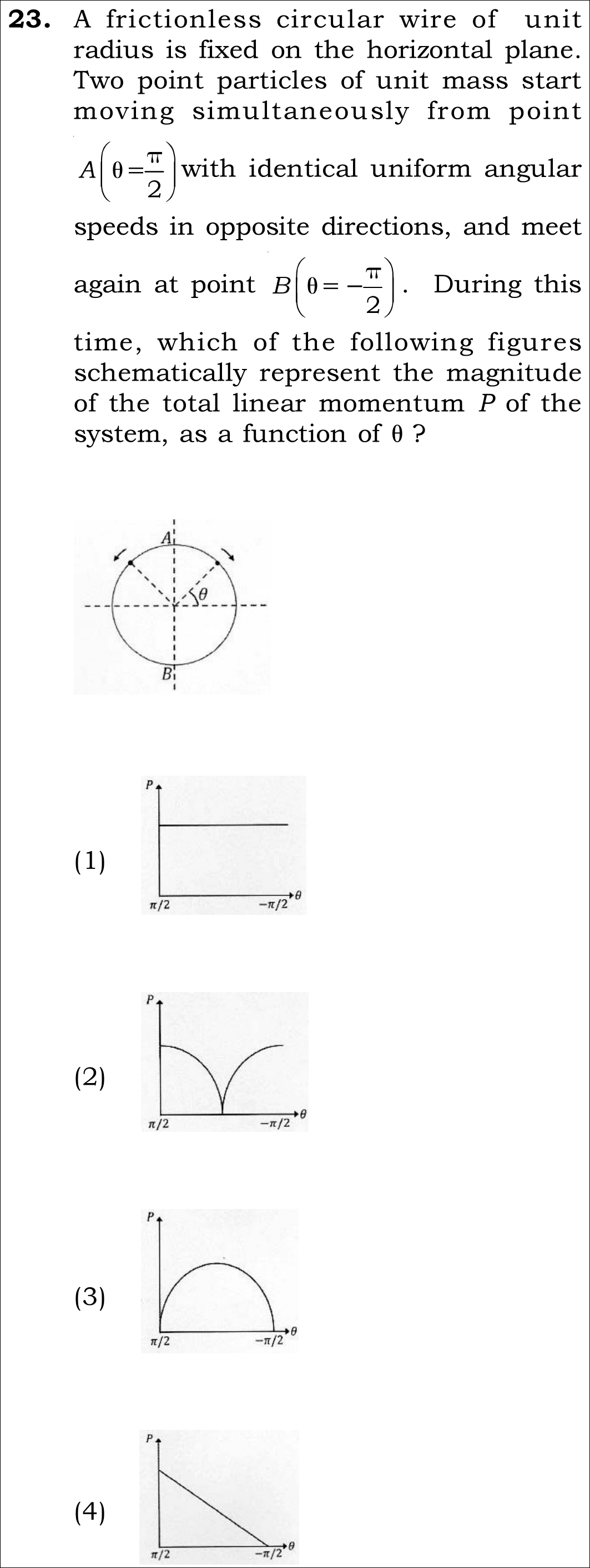
Both particles move along the unit circle with speed v = omega * R = omega (since R = 1). Let angle theta be measured from the positive x-axis:
- • Particle 1 moves counter-clockwise along the left semicircle.
- • Particle 2 moves clockwise along the right semicircle.
Compute Total Vector Linear Momentum
Sum the individual momenta (with unit mass m = 1):
- • Horizontal momentum components cancel out completely at every angle due to bilateral symmetry.
- • Magnitude of total momentum is P(\theta) = 2v |\cos\theta|.
Evaluate Boundary Values Over the Interval [pi/2, -pi/2]
Evaluate P(theta) as theta progresses from pi/2 down to -pi/2:
- • The graph is a smooth positive cosine arch starting at zero, peaking at 2v, and terminating at zero.
- • Matches Figure (3) perfectly.
360° Option Elimination Engine Key Feature
Diagnose every choice: Know exactly why the right option works and why distractors fail.
Ignores vector cancellation.
Inverted graph.
100% mathematically exact; confirmed by Official NTA Final Answer Key.
Linear decay error.
NTA Trap Alert: The Scalar Speed Sum Trap (Graph 1)
Students who treat momentum as scalar speed calculate P = m*v + m*v = 2 and pick the constant flat line in Figure (1).
Core NEET Syllabus Standard
"Total linear momentum is the vector sum P_total = sum(m_i * v_i). When symmetry creates opposite directional components, net momentum along that axis is zero."