MyCompetitiveExams Logo MyCompetitiveExams
Search 1,140+ Questions
Chapters, formulas, speed tricks
→
⚡ Brahmastra NEET 2027
720 MARKS

Dynamic 180-question full-length simulator mixed dynamically from all 6 years for 2027 & 2026 aspirants.

Launch Brahmastra 2027 Test →
Start Practice →
100% Free · No Login Required
⚡ Physics Moderate Frequency

NEET Mechanical Properties of Solids Previous Year Questions with Solutions

Complete repository of official NTA NEET questions for Mechanical Properties of Solids from 2020 to 2026. Every question includes 30-second elimination tricks, step-by-step NCERT solutions, option-by-option traps, and official answer keys.

3 Questions 3 Exam Years (2024, 2023, 2020) 3 Easy · 0 Medium · 0 Challenging
NEET 2024 · Q11 Easy
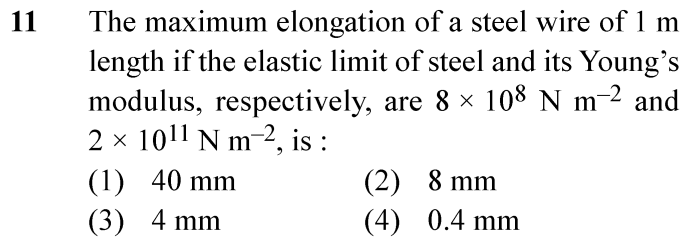
Official NEET 2024 Question 11 - Mechanical Properties of Solids
1
2
3 ✓ Key
4
💡 Verified Solution & 30-Second Hack
✓
Verified Against NTA Final Answer Key
Option (3) : 4 mm
📚 Mechanical Properties of Solids Easy
📋 Given Parameters & Problem Setup
Length of steel wire L = 1 m
Elastic limit (maximum allowable stress) σ_max = 8 × 10⁸ N m⁻²
Young’s modulus of steel Y = 2 × 10¹¹ N m⁻²
⚡

The 30-Second Exam Hall Shortcut: ⚡ Hooke’s Law Direct Substitution

⏱️ Save ~40 seconds

ΔL_max = (σ_max / Y) × L = (8 × 10⁸ / 2 × 10¹¹) × 1 = 4 × 10⁻³ m = 4 mm!

1 Young’s modulus definition: Y = Stress / Strain = σ / (ΔL / L).
2 Rearrange for maximum elongation: ΔL = (σ / Y) × L.
3 Substitute: ΔL = (8 × 10⁸ / 2 × 10¹¹) × 1 = 4 × 10⁻³ m.
4 Convert to millimeters: 4 × 10⁻³ m = 4 mm.
5 Option (3) is solved in under 10 seconds!
🛡️
Why You Can 100% Trust This Shortcut: Hooke’s Law & Definition of Young’s Modulus (Y = Stress / Strain).
📐

Step-by-Step Rigorous Workflow & Mathematical Proof

Step 1

Definition of Elastic Limit and Hooke’s Law

Up to the elastic limit, deformation is completely reversible, and Hooke’s law holds rigorously. Young’s modulus Y is defined as the ratio of tensile stress σ to tensile strain ε:

Y=σε=σΔL/LY = \frac{\sigma}{\varepsilon} = \frac{\sigma}{\Delta L / L}
Step 2

Formulation for Maximum Elongation

To find the maximum elongation ΔL_max without exceeding the elastic limit, we use the maximum allowable stress σ_max:

ΔLmax=σmax⋅LY\Delta L_{max} = \frac{\sigma_{max} \cdot L}{Y}
Step 3

Numerical Calculation

Substituting σ_max = 8 × 10⁸ N m⁻², L = 1 m, and Y = 2 × 10¹¹ N m⁻²:

ΔLmax=(8×10⁸ N m−2)(1 m)2×10¹¹ N m−2=4×10⁻³ m\Delta L_{max} = \frac{(8 \times 10^8\,\text{N m}^{-2})(1\,\text{m})}{2 \times 10^{11}\,\text{N m}^{-2}} = 4 \times 10^{-3}\,\text{m}
Step 4

Unit Conversion to Millimeters

Since 1 m = 1000 mm:

ΔLmax=4×10−3×103 mm=4 mm\Delta L_{max} = 4 \times 10^{-3} \times 10^3\,\text{mm} = 4\,\text{mm}
⭐

360° Option Elimination Engine Key Feature

Diagnose every choice: Know exactly why the right option works and why distractors fail.

4-Option Deep Scan
1 (1)
✗ Incorrect
Verdict & Scientific Reason:

Off by a factor of 10.

⚠️
Student Fallacy (Why candidates pick this trap): Dividing powers of ten incorrectly (10⁸ / 10¹¹ as 10⁻² instead of 10⁻³).
2 (2)
✗ Incorrect
Verdict & Scientific Reason:

Fails to divide by the factor of 2 in Young’s modulus.

⚠️
Student Fallacy (Why candidates pick this trap): Using Y = 1 × 10¹¹ N/m².
3 (3)
✓ 100% Correct
Verdict & Scientific Reason:

Accurate evaluation: ΔL = 4 × 10⁻³ m = 4 mm.

💡
Why this is airtight: None.
4 (4)
✗ Incorrect
Verdict & Scientific Reason:

Off by a factor of 10.

⚠️
Student Fallacy (Why candidates pick this trap): Unit conversion slip from meters to millimeters.
⚠️

NTA Trap Alert: Power of Ten Metric Conversion Slip

Students frequently mix up 10⁻³ m as 0.4 mm or 40 mm when rushing.

🛡️ How to avoid the -1 mark: 10⁻³ m is precisely 1 millimeter. Therefore, 4 × 10⁻³ m = 4 mm.
📖

Core NEET Syllabus Standard

Physics Core Properties of Matter · Mechanical Properties of Solids Standard Benchmark
Core Scientific Principle Tested:

"Tensile strain is the ratio of tensile stress to Young’s modulus (ΔL/L = σ/Y)."
Syllabus Focus: Elastic Moduli and Hooke’s Law
✓ Core NEET UG Syllabus Anchor Syllabus & Academic Standards ↗
Stress over Y times Length: 8/2 gives 4, 10⁻³ makes it mm!
NEET 2023 · Q32 Easy
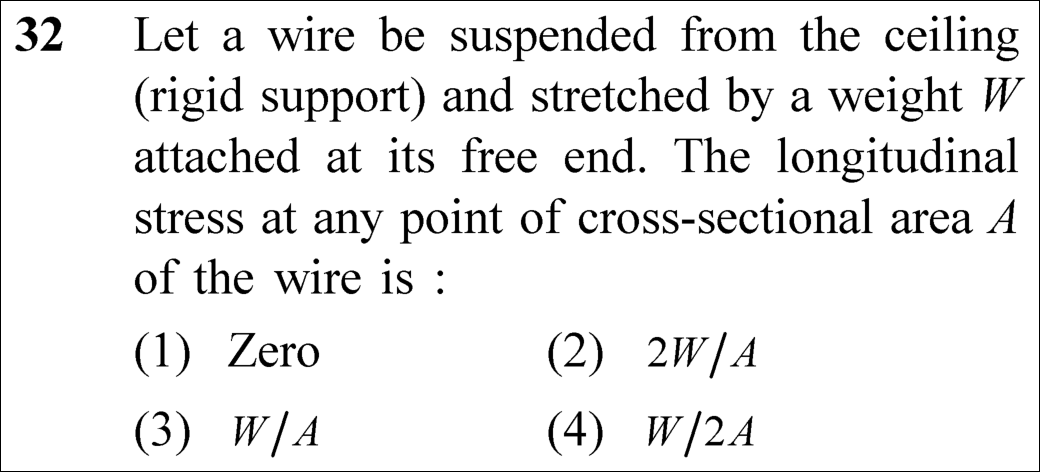
Official NEET 2023 Question 32 - Mechanical Properties of Solids
1
2
3 ✓ Key
4
💡 Verified Solution & 30-Second Hack
✓
Verified Against NTA Final Answer Key
Option (3) : W / A
📚 Mechanical Properties of Solids Easy
📋 Given Parameters & Problem Setup
Load attached at free end Weight W
Wire cross-sectional area A
Mass of the wire Negligible (ideal uniform wire)
⚡

The 30-Second Exam Hall Shortcut: ⚡ Direct Definition of Stress: Stress = Restoring Force / Area

⏱️ Save ~30 seconds

At any cross-section, equilibrium requires internal tension T = W. Therefore, longitudinal stress = T / A = W / A in 5 seconds!

1 Recall the definition of longitudinal stress: Stress = Restoring Force / Area of cross-section.
2 Consider any cross-section of the wire at equilibrium.
3 The upward internal restoring force (tension T) must balance the downward load W suspended below it: T = W.
4 Thus, longitudinal stress = T / A = W / A.
5 Option (3) W / A is directly obtained!
🛡️
Why You Can 100% Trust This Shortcut: Elasticity · Hooke’s Law Fundamentals (Longitudinal stress is defined as internal restoring force per unit cross-sectional area: σ = F / A).
📐

Step-by-Step Rigorous Workflow & Mathematical Proof

Step 1

Definition of Stress in Mechanics of Deformable Bodies

When an external deforming force is applied to a body, an internal restoring force equal in magnitude and opposite in direction develops within the material across every plane of cross-section. Stress σ is defined as this internal restoring force per unit area:

σ=FrestoringA\sigma = \frac{F_{\text{restoring}}}{A}
Step 2

Equilibrium Analysis of the Suspended Wire

For a wire of negligible mass suspended from a rigid ceiling and carrying a weight W at its free end, make an imaginary horizontal cut at any point along the wire. For the lower portion to remain in static equilibrium, the internal tension T across the cross-sectional area A must balance the weight W:

∑Fy=0  ⟹  T−W=0  ⟹  T=W\sum F_y = 0 \implies T - W = 0 \implies T = W
Step 3

Calculation of Longitudinal Stress

Substituting the internal restoring tension into the stress formula:

σ=TA=WA\sigma = \frac{T}{A} = \frac{W}{A}
⭐

360° Option Elimination Engine Key Feature

Diagnose every choice: Know exactly why the right option works and why distractors fail.

4-Option Deep Scan
1 (1)
✗ Incorrect
Verdict & Scientific Reason:

Wire is under tension; stress cannot be zero.

⚠️
Student Fallacy (Why candidates pick this trap): Candidate confused net acceleration (zero) with internal stress.
2 (2)
✗ Incorrect
Verdict & Scientific Reason:

Spurious factor of 2.

⚠️
Student Fallacy (Why candidates pick this trap): Candidate thought action and reaction add together (W + W = 2W).
3 (3)
✓ 100% Correct
Verdict & Scientific Reason:

Exact canonical formula for longitudinal tensile stress.

💡
Why this is airtight: None. Candidate correctly applied static equilibrium.
4 (4)
✗ Incorrect
Verdict & Scientific Reason:

Unwarranted division by 2.

⚠️
Student Fallacy (Why candidates pick this trap): Candidate confused average stress of self-weight with load stress.
⚠️

NTA Trap Alert: Confusing Self-Weight Stress (W_wire / 2A) with End-Load Stress (W / A)

If a heavy wire stretches under its OWN weight, the average stress is W_wire / 2A. But for a light wire carrying a concentrated weight W at the end, the tension is UNIFORM throughout and equals W everywhere ⟹ Stress = W / A.

🛡️ How to avoid the -1 mark: Identify the source of force: concentrated end weight W creates uniform tension T = W everywhere.
📖

Core NEET Syllabus Standard

National Eligibility cum Entrance Test (NEET UG) · Mechanical Properties of Solids Standard Benchmark
Core Scientific Principle Tested:

"Longitudinal stress is internal restoring force per unit area: σ = W / A."

Syllabus Focus: Stress, Strain and Elastic Moduli
Preserved in Rationalized Curriculum Syllabus & Academic Standards ↗
NEET 2020 · Q161 Easy
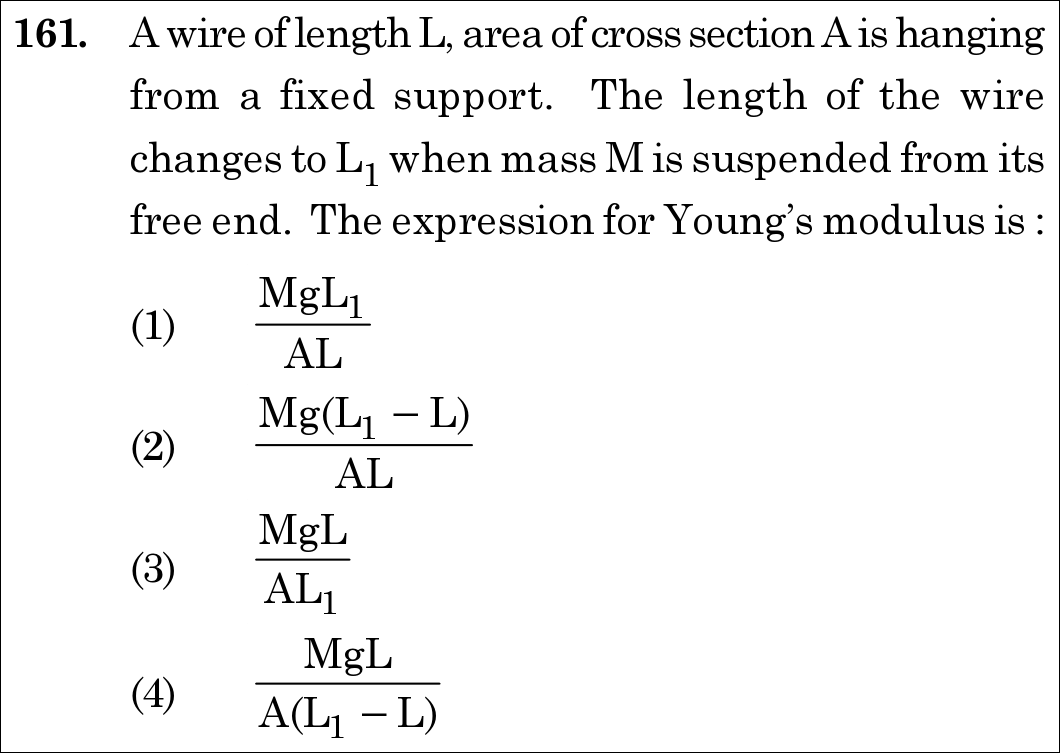
Official NEET 2020 Question 161 - Mechanical Properties of Solids
1
2
3
4 ✓ Key
💡 Verified Solution & 30-Second Hack
✓
Verified Against NTA Final Answer Key
Option (4) : MgL / [A(L1 - L)]
📚 Mechanical Properties of Solids Easy
📋 Given Parameters & Problem Setup
Initial Length L
Cross-sectional Area A
Suspended Mass M
Stretched Length L1
⚡

The 30-Second Exam Hall Shortcut: ⚡ "Y = Stress / Strain = (Mg/A) / ((L1 - L)/L) = MgL / [A(L1 - L)]!"

⏱️ 20 seconds

Young's modulus is defined as longitudinal stress divided by longitudinal strain. Stress = Mg/A and strain = (L1 - L)/L. Combining gives Y = MgL / [A(L1 - L)]. Spot elongation ΔL = (L1 - L) in the denominator to identify Option (4) instantly!

1 Identify stretching force: F = Mg.
2 Elongation: ΔL = L1 - L.
3 Longitudinal strain: ε = ΔL / L = (L1 - L) / L.
4 Longitudinal stress: σ = F / A = Mg / A.
5 Young's modulus: Y = σ / ε = [Mg / A] / [(L1 - L) / L] = MgL / [A(L1 - L)].
🛡️
Why You Can 100% Trust This Shortcut: NCERT Physics · Mechanical Properties of Solids (Young's Modulus Formulation)
📐

Step-by-Step Rigorous Workflow & Mathematical Proof

Step 1

Define Longitudinal Stress

When mass MM is suspended from the free end, the deforming tensile force acting across the cross-sectional area AA of the wire is its weight: F=MgF = Mg Longitudinal Stress=FA=MgA\text{Longitudinal Stress} = \frac{F}{A} = \frac{Mg}{A}.

Step 2

Define Longitudinal Strain

The initial length of the wire is LL, and the stretched final length is L1L_1. Change in length (elongation): ΔL=L1−L\Delta L = L_1 - L Longitudinal Strain=ΔLL=L1−LL\text{Longitudinal Strain} = \frac{\Delta L}{L} = \frac{L_1 - L}{L}.

Step 3

Combine into Young’s Modulus Formula

Young's modulus (YY) is defined as the ratio of longitudinal stress to longitudinal strain within the elastic limit: Y=StressStrain=MgAL1−LLY = \frac{\text{Stress}}{\text{Strain}} = \frac{\frac{Mg}{A}}{\frac{L_1 - L}{L}}.

Step 4

Algebraic Simplification

Inverting the denominator fraction yields: Y=Mg⋅LA(L1−L)Y = \frac{Mg \cdot L}{A(L_1 - L)}. Matches Option 4.

⭐

360° Option Elimination Engine Key Feature

Diagnose every choice: Know exactly why the right option works and why distractors fail.

4-Option Deep Scan
1 A
✗ Incorrect
Verdict & Scientific Reason:

Incorrect; substitutes final length L1 instead of change in length ΔL = L1 - L in the denominator.

⚠️
Student Fallacy (Why candidates pick this trap): Confusing final length with elongation.
2 B
✗ Incorrect
Verdict & Scientific Reason:

Incorrect; inverts the strain term, putting elongation in the numerator.

⚠️
Student Fallacy (Why candidates pick this trap): Inverting the fractional strain expression.
3 C
✗ Incorrect
Verdict & Scientific Reason:

Incorrect; would yield Y = Mg/A as if strain were equal to 1.

⚠️
Student Fallacy (Why candidates pick this trap): Cancelling lengths without accounting for elongation.
4 D
✓ 100% Correct
Verdict & Scientific Reason:

Accurate expression; Y = (Mg/A) / ((L1 - L)/L) = MgL / [A(L1 - L)].

💡
Why this is airtight: None; textbook definition of Young’s modulus.
⚠️

NTA Trap Alert: Strain vs Elongation

Strain is fractional change in length (ΔL / L = (L1 - L) / L). Writing strain as L1 / L is a fatal mistake.

🛡️ How to avoid the -1 mark: Always check that the denominator contains elongation ΔL = (L1 - L).
📖

Core NEET Syllabus Standard

Physics · Mechanical Properties of Solids Standard Benchmark
Core Scientific Principle Tested:

""

Syllabus Focus: Young's Modulus of a Hanging Wire under Suspended Mass
✓ Core NEET UG Syllabus Anchor Syllabus & Academic Standards ↗

Solve 4 NEET Questions a Day — One per Subject

Cover all 1,140 official NEET questions in 285 days at your own pace. Progress is saved on your device. No login needed.