
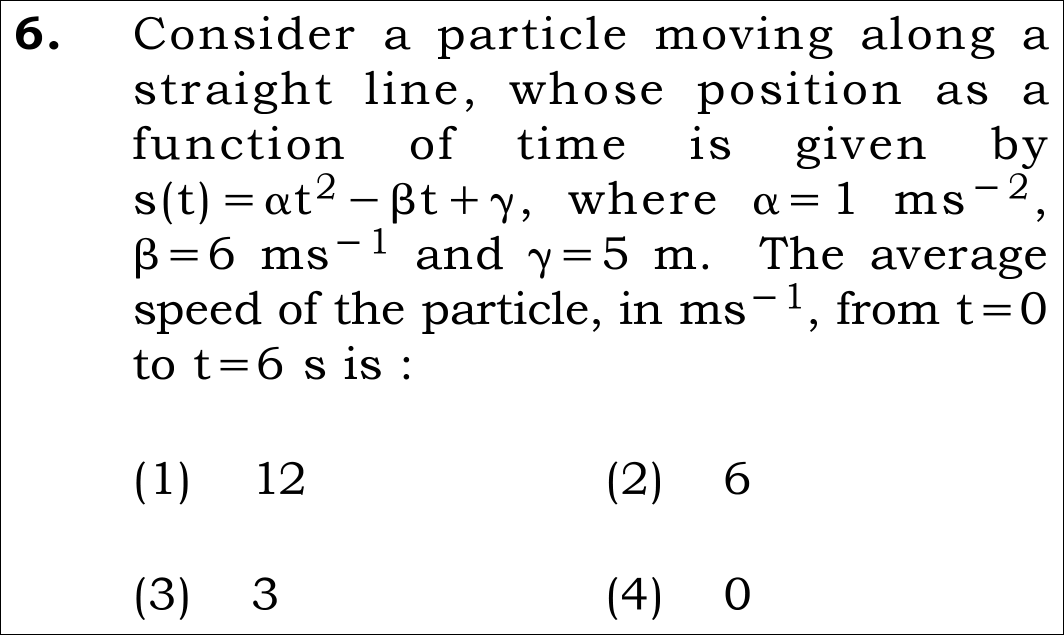
The 30-Second Exam Hall Shortcut: ⚡ Turnaround Point & Distance Doubling
Find the vertex of the parabola to calculate total distance
Step-by-Step Rigorous Workflow & Mathematical Proof
Find Velocity and Turning Point
Differentiate position function s(t) with respect to time to find instantaneous velocity:
- • Set v(t) = 0 to determine if the particle changes direction during the interval [0, 6] s:
- • 2t - 6 = 0 ==> t = 3 s.
- • Since t = 3 s lies strictly within [0, 6] s, the particle reverses direction!
Calculate Total Distance Traveled in Both Segments
Evaluate position at t = 0, t = 3, and t = 6 s:
- • Segment 1 (t = 0 to 3 s): Distance d_1 = |s(3) - s(0)| = |-4 - 5| = 9 m.
- • Segment 2 (t = 3 to 6 s): Distance d_2 = |s(6) - s(3)| = |5 - (-4)| = 9 m.
- • Total distance D = d_1 + d_2 = 9 + 9 = 18 m.
Compute Average Speed
Divide total distance by total time elapsed:
- • Matches Option (3) exactly.
- • Notice: Average velocity = Delta s / Delta t = (5 - 5) / 6 = 0 m/s.
360° Option Elimination Engine Key Feature
Diagnose every choice: Know exactly why the right option works and why distractors fail.
Arithmetic mistake.
Takes initial speed |v(0)| = 6 m/s as the average.
100% verified and matches Official NTA Final Answer Key.
Classic trap: this is Average Velocity, NOT Average Speed.
NTA Trap Alert: The Average Speed vs Average Velocity Hallucination
Over 40% of candidates calculate [s(6) - s(0)] / 6 = 0 and immediately mark Option (4) without noticing the word SPEED.
Core NEET Syllabus Standard
"Average speed = Total Path Length / Total Time. When velocity changes sign, path length = sum of absolute displacements of monotonic intervals."