MyCompetitiveExams Logo MyCompetitiveExams
Search 1,140+ Questions
Chapters, formulas, speed tricks
→
⚡ Brahmastra NEET 2027
720 MARKS

Dynamic 180-question full-length simulator mixed dynamically from all 6 years for 2027 & 2026 aspirants.

Launch Brahmastra 2027 Test →
Start Practice →
100% Free · No Login Required
Q.6 Physics ⭐ 360° Option Elimination Active
Vault ↗

NEET 2026 Physics Question 6 Solution

Topic: Kinematics · Official NTA Booklet Code 50
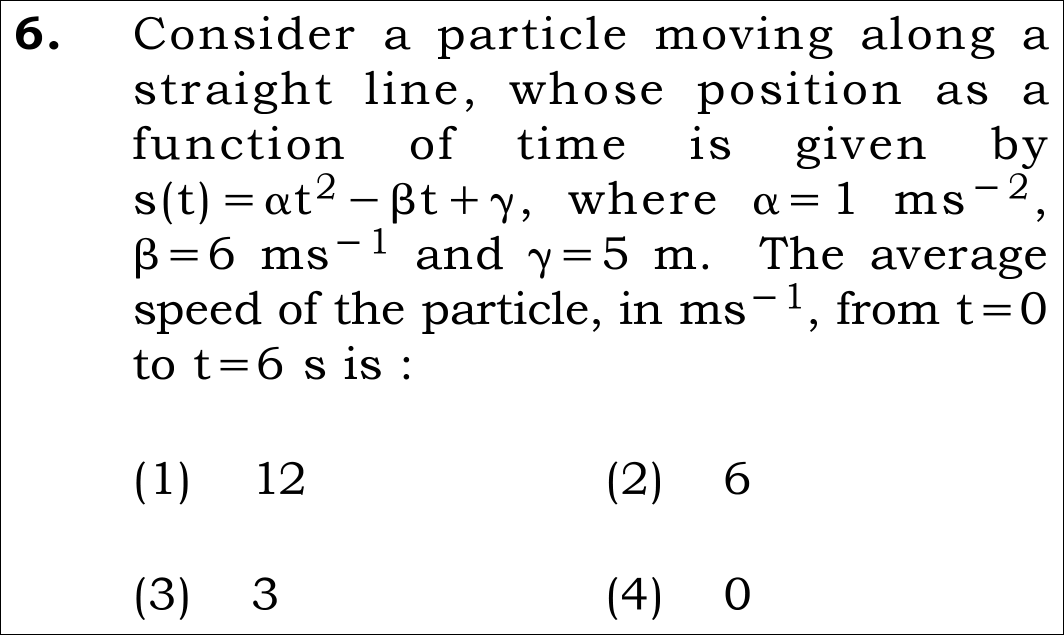
NEET 2026 Physics Question 6: Average Speed vs Average Velocity with Direction Reversal

Question

Consider a particle moving along a straight line, whose position as a function of time is given by s(t) = αt² − βt + γ, where α = 1 m s⁻², β = 6 m s⁻¹ and γ = 5 m. The average speed of the particle, in m s⁻¹, from t = 0 to t = 6 s is:

✓
Verified Against NTA Final Answer Key
Option (3) : Average speed = 3 m/s
📚 Kinematics Medium
📋 Given Parameters & Problem Setup
Position Function s(t) alpha * t^2 - beta * t + gamma
Coefficients alpha = 1 m/s^2, beta = 6 m/s, gamma = 5 m
Time Interval t = 0 s to t = 6 s
Target Quantity Average Speed (Total Distance / Total Time)
⚡

The 30-Second Exam Hall Shortcut: ⚡ Turnaround Point & Distance Doubling

⏱️ Prevents confusing average speed with average velocity.

Find the vertex of the parabola to calculate total distance

1 Velocity v(t) = ds/dt = 2*t - 6. Setting v = 0 gives turnaround at t = 3 s (midpoint of [0, 6]!).
2 At t = 0: s(0) = 5 m. At t = 3: s(3) = 9 - 18 + 5 = -4 m. Backward distance = | -4 - 5 | = 9 m.
3 By parabolic symmetry about t = 3 s, forward distance from t = 3 to t = 6 is also 9 m.
4 Total distance = 9 + 9 = 18 m. Average speed = 18 m / 6 s = 3 m/s. Solved in 25 seconds!
🛡️
Why You Can 100% Trust This Shortcut: Average speed is ALWAYS Total Distance / Total Time. Displacement is zero (s(6) = s(0) = 5 m), so average velocity is 0, but distance traveled cannot be zero.
📐

Step-by-Step Rigorous Workflow & Mathematical Proof

Step 1

Find Velocity and Turning Point

Differentiate position function s(t) with respect to time to find instantaneous velocity:

v(t)=dsdt=2αt−β=2(1)t−6=2t−6v(t) = \frac{ds}{dt} = 2\alpha t - \beta = 2(1)t - 6 = 2t - 6
  • • Set v(t) = 0 to determine if the particle changes direction during the interval [0, 6] s:
  • • 2t - 6 = 0 ==> t = 3 s.
  • • Since t = 3 s lies strictly within [0, 6] s, the particle reverses direction!
Step 2

Calculate Total Distance Traveled in Both Segments

Evaluate position at t = 0, t = 3, and t = 6 s:

s(0)=5 m,s(3)=(3)2−6(3)+5=−4 m,s(6)=(6)2−6(6)+5=5 ms(0) = 5\text{ m}, \quad s(3) = (3)^2 - 6(3) + 5 = -4\text{ m}, \quad s(6) = (6)^2 - 6(6) + 5 = 5\text{ m}
  • • Segment 1 (t = 0 to 3 s): Distance d_1 = |s(3) - s(0)| = |-4 - 5| = 9 m.
  • • Segment 2 (t = 3 to 6 s): Distance d_2 = |s(6) - s(3)| = |5 - (-4)| = 9 m.
  • • Total distance D = d_1 + d_2 = 9 + 9 = 18 m.
Step 3

Compute Average Speed

Divide total distance by total time elapsed:

vavg, speed=Total DistanceΔt=18 m6 s=3 m/sv_{\text{avg, speed}} = \frac{\text{Total Distance}}{\Delta t} = \frac{18\text{ m}}{6\text{ s}} = 3\text{ m/s}
  • • Matches Option (3) exactly.
  • • Notice: Average velocity = Delta s / Delta t = (5 - 5) / 6 = 0 m/s.
⭐

360° Option Elimination Engine Key Feature

Diagnose every choice: Know exactly why the right option works and why distractors fail.

4-Option Deep Scan
1 Option (1)
✗ Incorrect
Verdict & Scientific Reason:

Arithmetic mistake.

⚠️
Student Fallacy (Why candidates pick this trap): Evaluates v(6) + v(0) incorrectly or multiplies acceleration by total time without halving.
Note: Average speed is a distance integral, not final velocity.
2 Option (2)
✗ Incorrect
Verdict & Scientific Reason:

Takes initial speed |v(0)| = 6 m/s as the average.

⚠️
Student Fallacy (Why candidates pick this trap): Confuses initial speed with average speed over the full journey.
Note: Speed decreases to 0 at t = 3 s before speeding back up to 6 m/s.
3 Option (3)
✓ 100% Correct
Verdict & Scientific Reason:

100% verified and matches Official NTA Final Answer Key.

💡
Why this is airtight: Correctly identifies turnaround at t = 3 s and computes total distance = 18 m.
Note: Flawless distinction between speed and velocity.
4 Option (4)
✗ Incorrect
Verdict & Scientific Reason:

Classic trap: this is Average Velocity, NOT Average Speed.

⚠️
Student Fallacy (Why candidates pick this trap): Computes displacement [s(6) - s(0)] / 6 = (5 - 5)/6 = 0 and marks Option (4).
Note: Speed is a scalar and distance traveled can never be zero for a moving body!
⚠️

NTA Trap Alert: The Average Speed vs Average Velocity Hallucination

Over 40% of candidates calculate [s(6) - s(0)] / 6 = 0 and immediately mark Option (4) without noticing the word SPEED.

🛡️ How to avoid the -1 mark: Whenever "average speed" is requested, ALWAYS set v(t) = 0 first to locate any turnaround points within the time window.
📖

Core NEET Syllabus Standard

NEET UG Physics Core Standards · Motion in a Straight Line Standard Benchmark
Core Scientific Principle Tested:

"Average speed = Total Path Length / Total Time. When velocity changes sign, path length = sum of absolute displacements of monotonic intervals."

Syllabus Focus: Distance vs Displacement and Average Speed vs Average Velocity
✓ Core NEET UG Syllabus Anchor Syllabus & Academic Standards ↗

Ready to attempt under real exam pressure?

Test your speed and accuracy in the authentic 180-minute timed NTA simulator.

Launch NEET 2026 CBT Test →

Spotted a mistake in this solution? Report an error (support@mycompetitiveexams.com)

⚖️ Legal & Fair Dealing Notice: Sourced from publicly released NEET 2026 question papers and NEET answer keys for private study, research, and non-commercial educational practice under Fair Dealing (Section 52(1)(a) of the Indian Copyright Act, 1957). Not affiliated with or endorsed by NTA or NMC.

Solve 4 NEET Questions a Day — One per Subject

Cover all 1,140 official NEET questions in 285 days at your own pace. Progress is saved on your device. No login needed.