
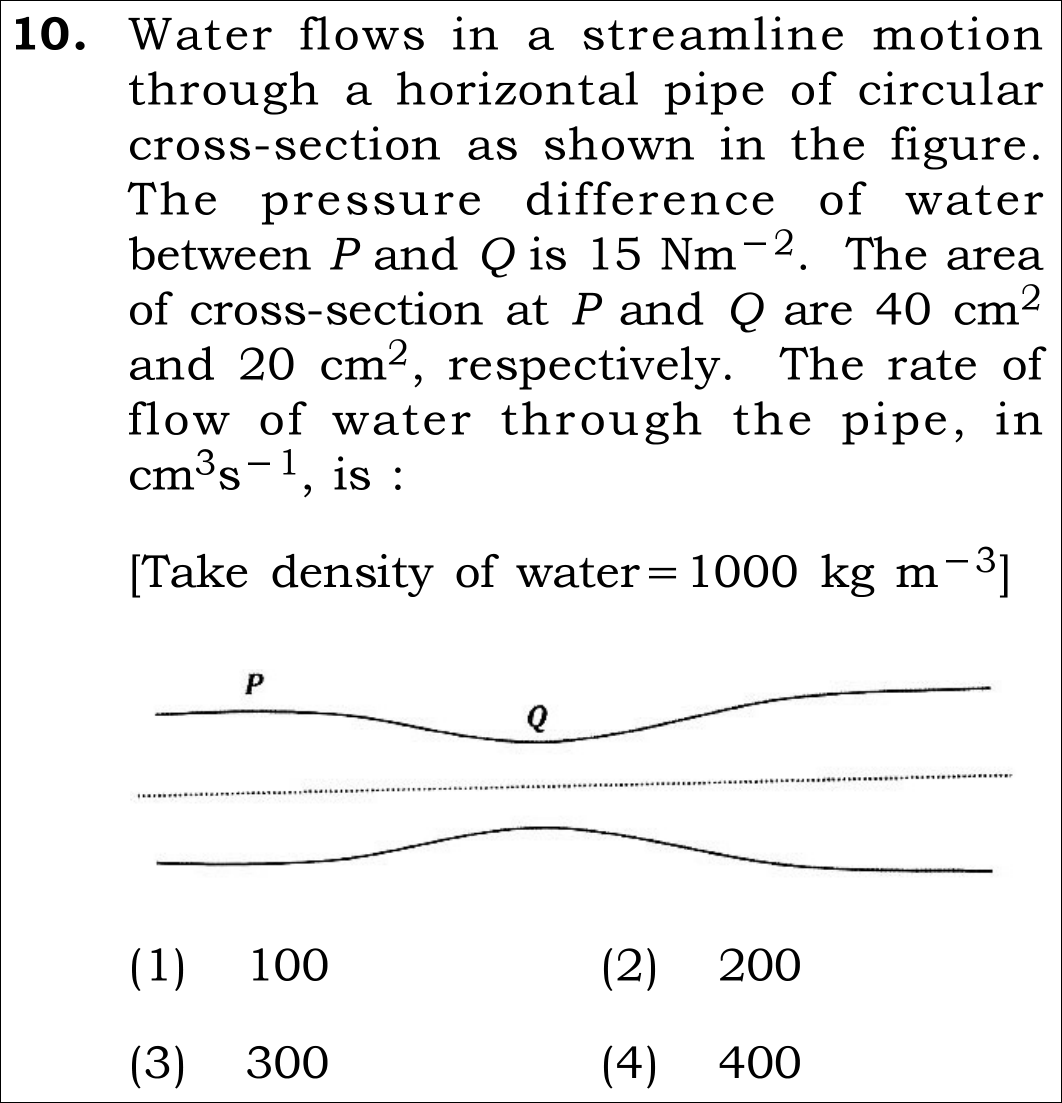
The 30-Second Exam Hall Shortcut: ⚡ Ratio Bernoulli Shortcut
Express throat speed directly in terms of area ratio
Step-by-Step Rigorous Workflow & Mathematical Proof
Apply the Equation of Continuity
For an incompressible fluid in steady streamline flow, volume flow rate Q is constant:
- • Because the cross-section at Q is halved, water flows twice as fast through the throat.
Apply Bernoulli's Equation along the Horizontal Streamline
Since the pipe is horizontal, potential energy terms cancel (h_P = h_Q):
- • Substitute v_Q = 2*v_P: v_Q^2 - v_P^2 = (2*v_P)^2 - v_P^2 = 4*v_P^2 - v_P^2 = 3*v_P^2.
- • P_P - P_Q = \frac{1}{2} (1000) (3 v_P^2) = 1500 v_P^2.
Solve for Velocity and Volume Flow Rate
Substitute the given pressure difference Delta P = 15 N/m^2:
- • Calculate rate of flow: Q = A_P * v_P = (40 cm^2) * (10 cm/s) = 400 cm^3/s.
- • Cross-check at throat Q: Q = A_Q * v_Q = (20 cm^2) * (20 cm/s) = 400 cm^3/s.
- • Matches Option (4) exactly.
360° Option Elimination Engine Key Feature
Diagnose every choice: Know exactly why the right option works and why distractors fail.
Arithmetic factor of 4 error.
Uses throat area with wide section velocity.
Misses square root of velocity.
100% mathematically exact and matches Official NTA Final Answer Key.
NTA Trap Alert: Mismatched Area-Velocity Pairing
A very common student mistake is multiplying the throat area A_Q (20 cm^2) by the inlet velocity v_P (10 cm/s), getting 200 cm^3/s (Option 2).
Core NEET Syllabus Standard
"In a horizontal streamline flow, P + (1/2)*rho*v^2 is constant. Fluid speed increases at constrictions, causing a drop in static pressure."