MyCompetitiveExams Logo MyCompetitiveExams
Search 1,140+ Questions
Chapters, formulas, speed tricks
→
⚡ Brahmastra NEET 2027
720 MARKS

Dynamic 180-question full-length simulator mixed dynamically from all 6 years for 2027 & 2026 aspirants.

Launch Brahmastra 2027 Test →
Start Practice →
100% Free · No Login Required
Q.10 Physics ⭐ 360° Option Elimination Active
Vault ↗

NEET 2026 Physics Question 10 Solution

Topic: Fluid Mechanics · Official NTA Booklet Code 50
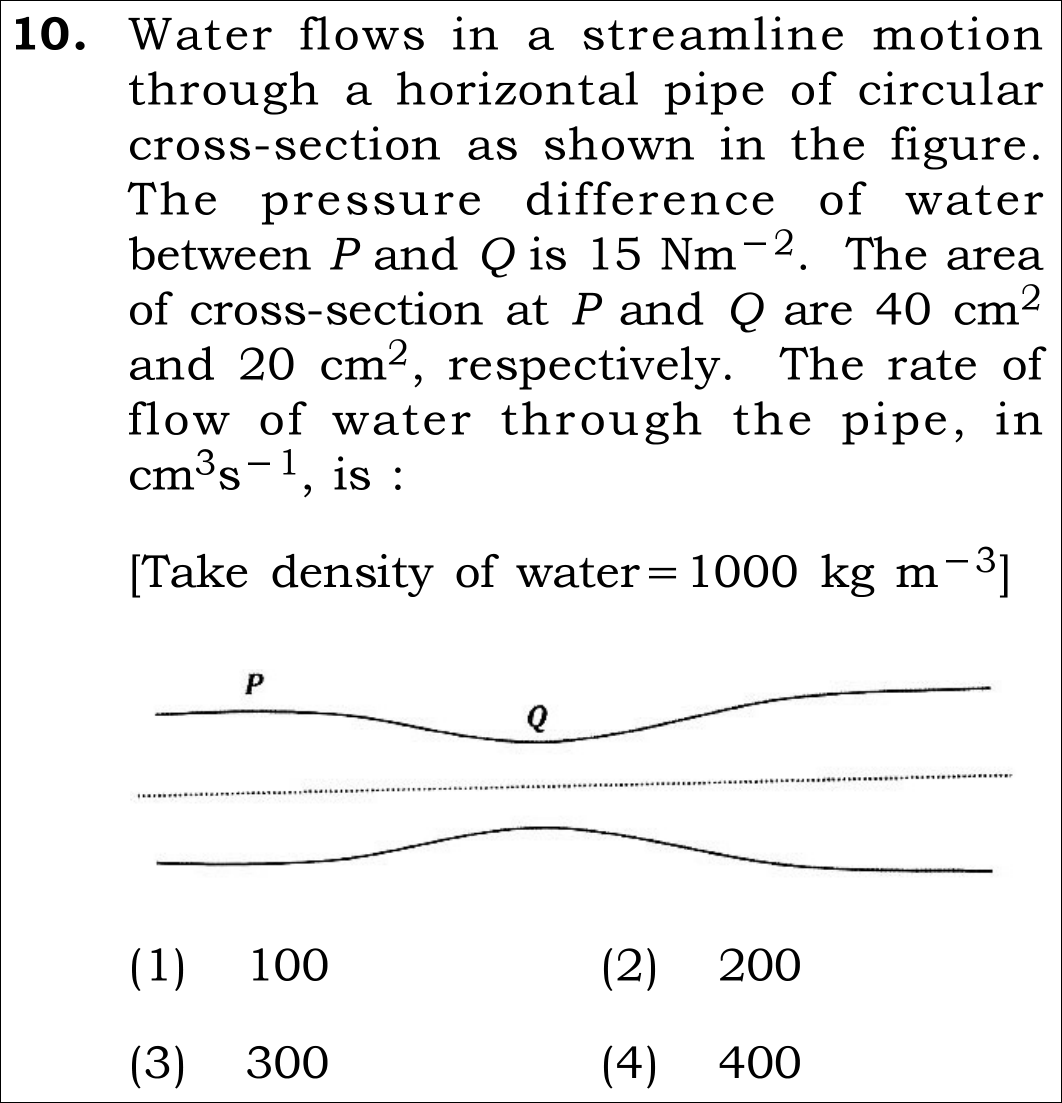
NEET 2026 Physics Question 10: Venturimeter Flow Rate Calculation using Bernoulli and Continuity Equations

Question

Water flows in a streamline motion through a horizontal pipe of circular cross-section as shown in the figure. The pressure difference of water between P and Q is 15 N m⁻². The area of cross-section at P and Q are 40 cm² and 20 cm², respectively. The rate of flow of water through the pipe, in cm³ s⁻¹, is: [Take density of water = 1000 kg m⁻³]

✓
Verified Against NTA Final Answer Key
Option (4) : Rate of flow = 400 cm^3/s
📚 Fluid Mechanics Medium
📋 Given Parameters & Problem Setup
Area at Section P (A_P) 40 cm^2 = 40 * 10^-4 m^2
Area at Section Q (A_Q) 20 cm^2 = 20 * 10^-4 m^2
Pressure Difference (Delta P) P_P - P_Q = 15 N/m^2 (Pa)
Density of Water (rho) 1000 kg/m^3
Target Quantity Volume rate of flow in cm^3/s
⚡

The 30-Second Exam Hall Shortcut: ⚡ Ratio Bernoulli Shortcut

⏱️ Working in cm units at the final step avoids 10^-6 m^3/s conversion errors.

Express throat speed directly in terms of area ratio

1 Area ratio: A_P / A_Q = 40 / 20 = 2. By continuity, v_Q = 2 * v_P.
2 Bernoulli pressure difference: Delta P = (1/2) * rho * (v_Q^2 - v_P^2) = (1/2) * 1000 * (4*v_P^2 - v_P^2) = 500 * (3*v_P^2) = 1500 * v_P^2.
3 Given Delta P = 15 N/m^2: 1500 * v_P^2 = 15 ==> v_P^2 = 1/100 ==> v_P = 0.1 m/s = 10 cm/s.
4 Rate of flow: Q = A_P * v_P = (40 cm^2) * (10 cm/s) = 400 cm^3/s. Done in 30 seconds!
🛡️
Why You Can 100% Trust This Shortcut: Combines the equation of continuity A_1*v_1 = A_2*v_2 with Bernoulli's theorem for horizontal streamline flow: P_1 - P_2 = (1/2)*rho*(v_2^2 - v_1^2).
📐

Step-by-Step Rigorous Workflow & Mathematical Proof

Step 1

Apply the Equation of Continuity

For an incompressible fluid in steady streamline flow, volume flow rate Q is constant:

APvP=AQvQ  ⟹  vQ=(APAQ)vP=(4020)vP=2vPA_P v_P = A_Q v_Q \implies v_Q = \left(\frac{A_P}{A_Q}\right) v_P = \left(\frac{40}{20}\right) v_P = 2 v_P
  • • Because the cross-section at Q is halved, water flows twice as fast through the throat.
Step 2

Apply Bernoulli's Equation along the Horizontal Streamline

Since the pipe is horizontal, potential energy terms cancel (h_P = h_Q):

PP+12ρvP2=PQ+12ρvQ2  ⟹  PP−PQ=12ρ(vQ2−vP2)P_P + \frac{1}{2} \rho v_P^2 = P_Q + \frac{1}{2} \rho v_Q^2 \implies P_P - P_Q = \frac{1}{2} \rho (v_Q^2 - v_P^2)
  • • Substitute v_Q = 2*v_P: v_Q^2 - v_P^2 = (2*v_P)^2 - v_P^2 = 4*v_P^2 - v_P^2 = 3*v_P^2.
  • • P_P - P_Q = \frac{1}{2} (1000) (3 v_P^2) = 1500 v_P^2.
Step 3

Solve for Velocity and Volume Flow Rate

Substitute the given pressure difference Delta P = 15 N/m^2:

15=1500vP2  ⟹  vP2=151500=1100  ⟹  vP=0.1 m/s=10 cm/s15 = 1500 v_P^2 \implies v_P^2 = \frac{15}{1500} = \frac{1}{100} \implies v_P = 0.1\text{ m/s} = 10\text{ cm/s}
  • • Calculate rate of flow: Q = A_P * v_P = (40 cm^2) * (10 cm/s) = 400 cm^3/s.
  • • Cross-check at throat Q: Q = A_Q * v_Q = (20 cm^2) * (20 cm/s) = 400 cm^3/s.
  • • Matches Option (4) exactly.
⭐

360° Option Elimination Engine Key Feature

Diagnose every choice: Know exactly why the right option works and why distractors fail.

4-Option Deep Scan
1 Option (1)
✗ Incorrect
Verdict & Scientific Reason:

Arithmetic factor of 4 error.

⚠️
Student Fallacy (Why candidates pick this trap): Divides by 4 during area conversion or uses wrong velocity.
Note: Flow rate is 400 cm^3/s.
2 Option (2)
✗ Incorrect
Verdict & Scientific Reason:

Uses throat area with wide section velocity.

⚠️
Student Fallacy (Why candidates pick this trap): Multiplies throat area (20 cm^2) by wide section velocity (10 cm/s): 20 * 10 = 200 cm^3/s.
Note: You must multiply matching area and velocity at the SAME point: A_P*v_P or A_Q*v_Q.
3 Option (3)
✗ Incorrect
Verdict & Scientific Reason:

Misses square root of velocity.

⚠️
Student Fallacy (Why candidates pick this trap): Forgets to take the square root of v_P^2 = 1/100 or miscalculates 3 * v_P.
Note: Bernoulli energy balance involves v^2, not linear v.
4 Option (4)
✓ 100% Correct
Verdict & Scientific Reason:

100% mathematically exact and matches Official NTA Final Answer Key.

💡
Why this is airtight: Correctly applies Bernoulli and Continuity equations with consistent units.
Note: Flawless execution.
⚠️

NTA Trap Alert: Mismatched Area-Velocity Pairing

A very common student mistake is multiplying the throat area A_Q (20 cm^2) by the inlet velocity v_P (10 cm/s), getting 200 cm^3/s (Option 2).

🛡️ How to avoid the -1 mark: Always label your variables clearly: Q = A_P * v_P OR Q = A_Q * v_Q. Never mix indices!
📖

Core NEET Syllabus Standard

NEET UG Physics Core Standards · Mechanical Properties of Fluids Standard Benchmark
Core Scientific Principle Tested:

"In a horizontal streamline flow, P + (1/2)*rho*v^2 is constant. Fluid speed increases at constrictions, causing a drop in static pressure."

Syllabus Focus: Bernoulli's Principle and Venturimeter Applications
✓ Core NEET UG Syllabus Anchor Syllabus & Academic Standards ↗

Ready to attempt under real exam pressure?

Test your speed and accuracy in the authentic 180-minute timed NTA simulator.

Launch NEET 2026 CBT Test →

Spotted a mistake in this solution? Report an error (support@mycompetitiveexams.com)

⚖️ Legal & Fair Dealing Notice: Sourced from publicly released NEET 2026 question papers and NEET answer keys for private study, research, and non-commercial educational practice under Fair Dealing (Section 52(1)(a) of the Indian Copyright Act, 1957). Not affiliated with or endorsed by NTA or NMC.

Solve 4 NEET Questions a Day — One per Subject

Cover all 1,140 official NEET questions in 285 days at your own pace. Progress is saved on your device. No login needed.