The 30-Second Exam Hall Shortcut: ⚡ Successive Conduction Fraction Shortcut
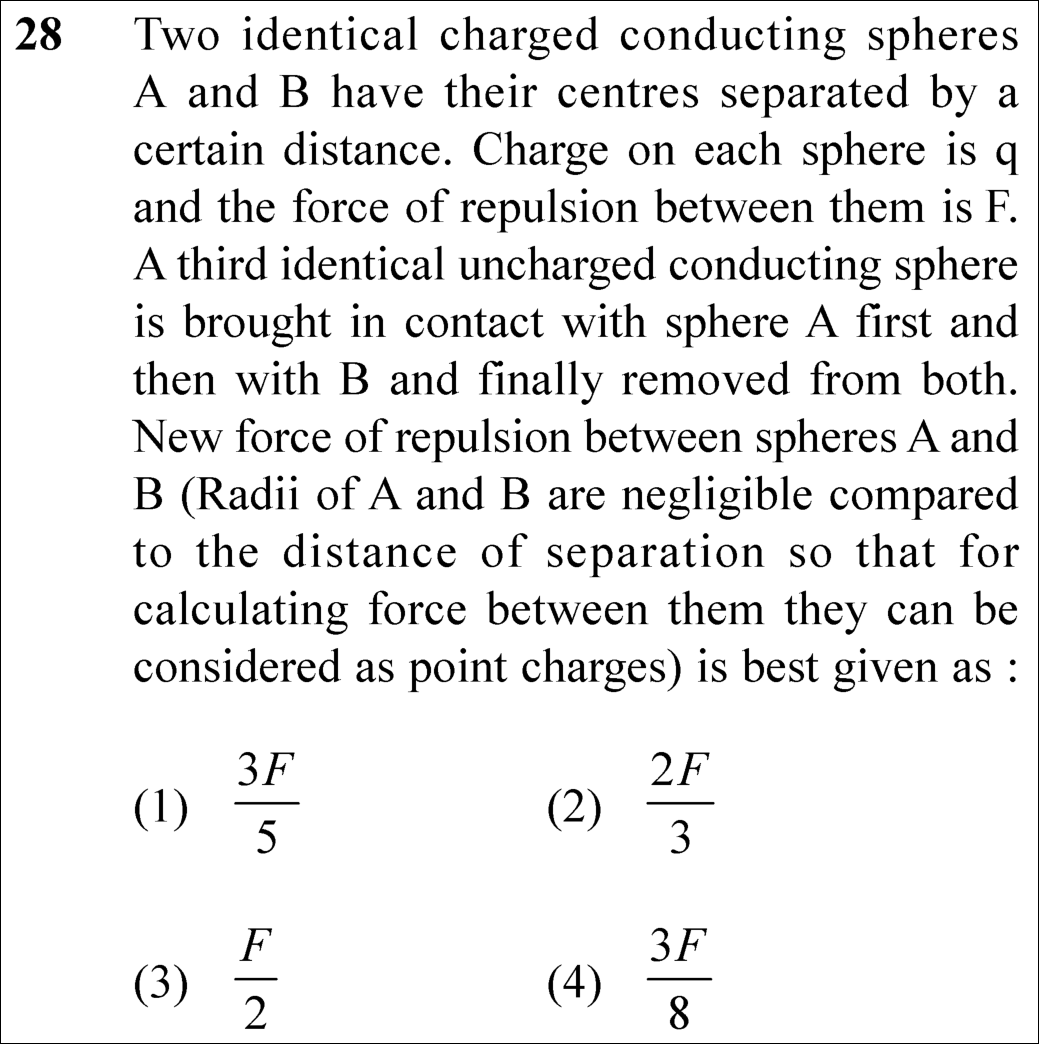
Sphere C takes half of A (q/2). Then C (q/2) shares with B (q): (q + q/2)/2 = 3q/4 on B! New Force F' = (1/2) × (3/4) F = 3/8 F!
Step-by-Step Rigorous Workflow & Mathematical Proof
Initial Electrostatic Force
By Coulomb’s law, the initial repulsive force between the two identical spheres A and B carrying charge q separated by distance r is:
- • Spheres are treated as point charges because radii are negligible compared to distance r.
Step 1: Contact Between Sphere C and Sphere A
An identical uncharged conducting sphere C (initial charge = 0) is brought into physical contact with sphere A (charge q). Due to identical capacitance and symmetry, charge redistributes equally:
- • Sphere A now retains charge q/2, and sphere C carries charge q/2.
Step 2: Contact Between Sphere C and Sphere B & Final Force
Sphere C (charge q/2) is now brought into contact with sphere B (charge q). The total charge divides equally between the two identical spheres:
- • Sphere C is now removed.
- • The new force between A (charge q/2) and B (charge 3q/4) is:
- • F' = k (q/2)(3q/4) / r² = (3/8) [k q² / r²] = (3/8) F.
- • Corresponds uniquely to Option (4).
360° Option Elimination Engine Key Feature
Diagnose every choice: Know exactly why the right option works and why distractors fail.
Incorrect. Denominator 5 is physically impossible in binary equal sharing.
Incorrect. Arithmetic slip.
Incorrect. Considers only the halving of charge on A while ignoring the charge reduction on B.
100% correct. q_A = q/2, q_B = 3q/4 ⟹ F' = (1/2) × (3/4) F = 3F / 8.
NTA Trap Alert: Ignoring Charge Carried Over by Sphere C
Students frequently assume sphere C is still uncharged when it touches sphere B! But sphere C brings charge q/2 from its contact with A, so B shares (q + q/2), leaving 3q/4 on B.
Core NEET Syllabus Standard
"Identical conducting spheres in contact share charge equally: q_shared = (q₁ + q₂) / 2."