The 30-Second Exam Hall Shortcut: ⚡ Rutherford Sin^4 Scattering Law
Number of particles scattered drops as 1 / sin^4(theta / 2)!
Step-by-Step Rigorous Workflow & Mathematical Proof
State Rutherford's Alpha-Particle Scattering Formula
In the Geiger-Marsden experiment, alpha particles scattered by a thin gold foil follow Rutherford's Coulombic scattering cross-section:
- • theta is the scattering angle relative to the forward incident beam direction.
- • N(theta) is the number of scattered alpha particles detected per unit area at angle theta.
Analyze Angle Regimes (Small vs Large Angles)
Evaluate the theoretical scattering count across the angular domain [0, 180] degrees:
- • At small angles (< 20 degrees), the vast majority of particles suffer negligible deflection.
- • At large angles (> 90 degrees), head-on collisions with the massive nucleus are extraordinarily rare (~1 in 8000).
Identify the Correct Graph in the Question Options
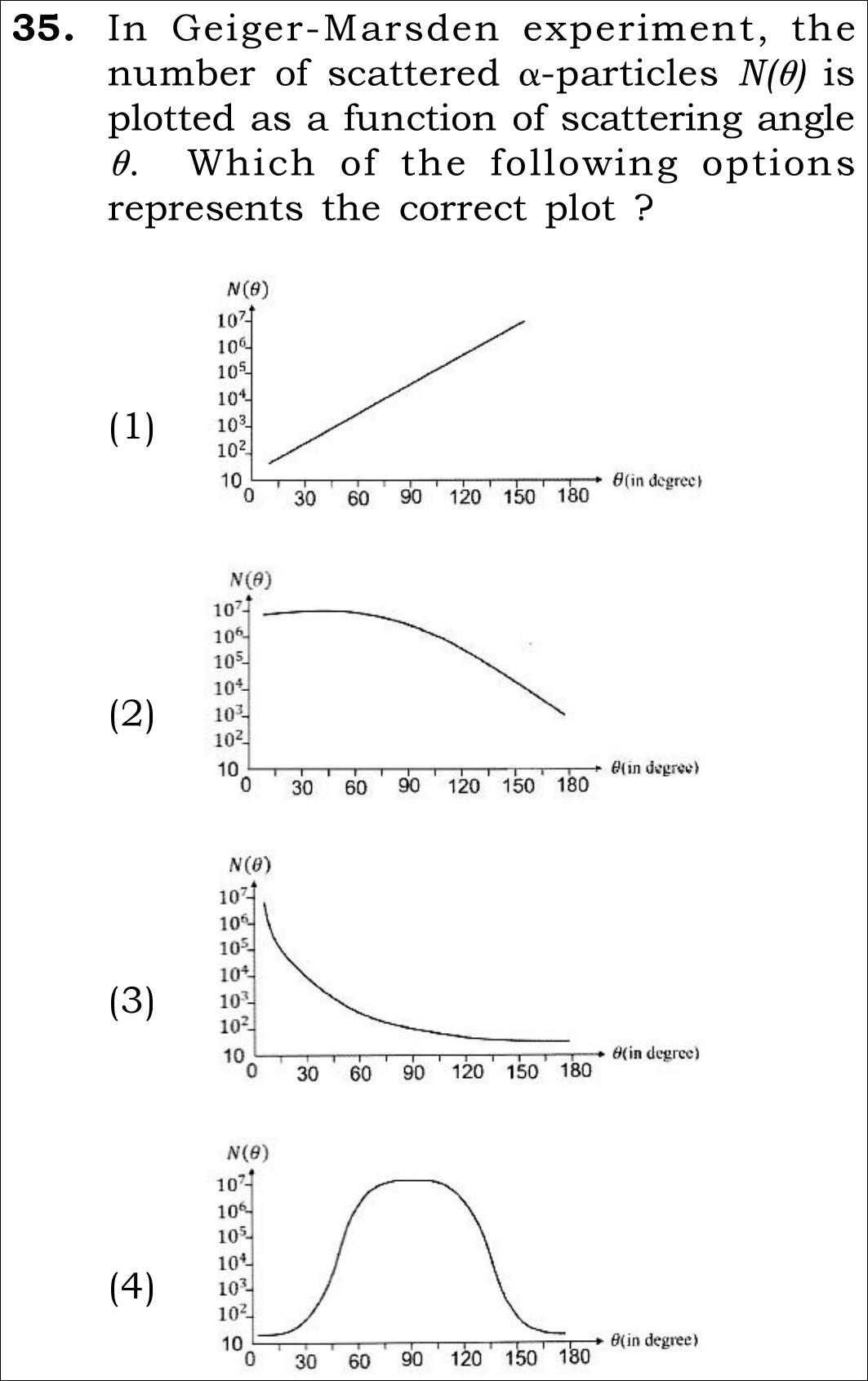
Match the qualitative behavior to the provided plots:
- • Plot (1) shows a straight upward line (completely unphysical).
- • Plot (2) shows an inverted curve that stays high until 90 degrees (false).
- • Plot (4) shows a bell-shaped Gaussian peak at 90 degrees (false).
- • Matches Plot (3) perfectly.
360° Option Elimination Engine Key Feature
Diagnose every choice: Know exactly why the right option works and why distractors fail.
Completely unphysical.
Fails to capture sharp forward peak.
Canonical textbook graph from Geiger-Marsden experiment; confirmed by Official NTA Key.
Confuses scattering with blackbody radiation or diffraction envelope.
NTA Trap Alert: Confusing Atomic Scattering with Diffraction Central Maximum
Students who confuse Rutherford scattering with wave optics or blackbody radiation pick the bell curve in Plot (4).
Core NEET Syllabus Standard
"Rutherford scattering: N(theta) is proportional to 1 / sin^4(theta/2). The steep decline confirms that the atom is mostly empty space with a tiny, dense, positively charged nucleus."