NEET 2026 Physics Question 35 Solution
Question
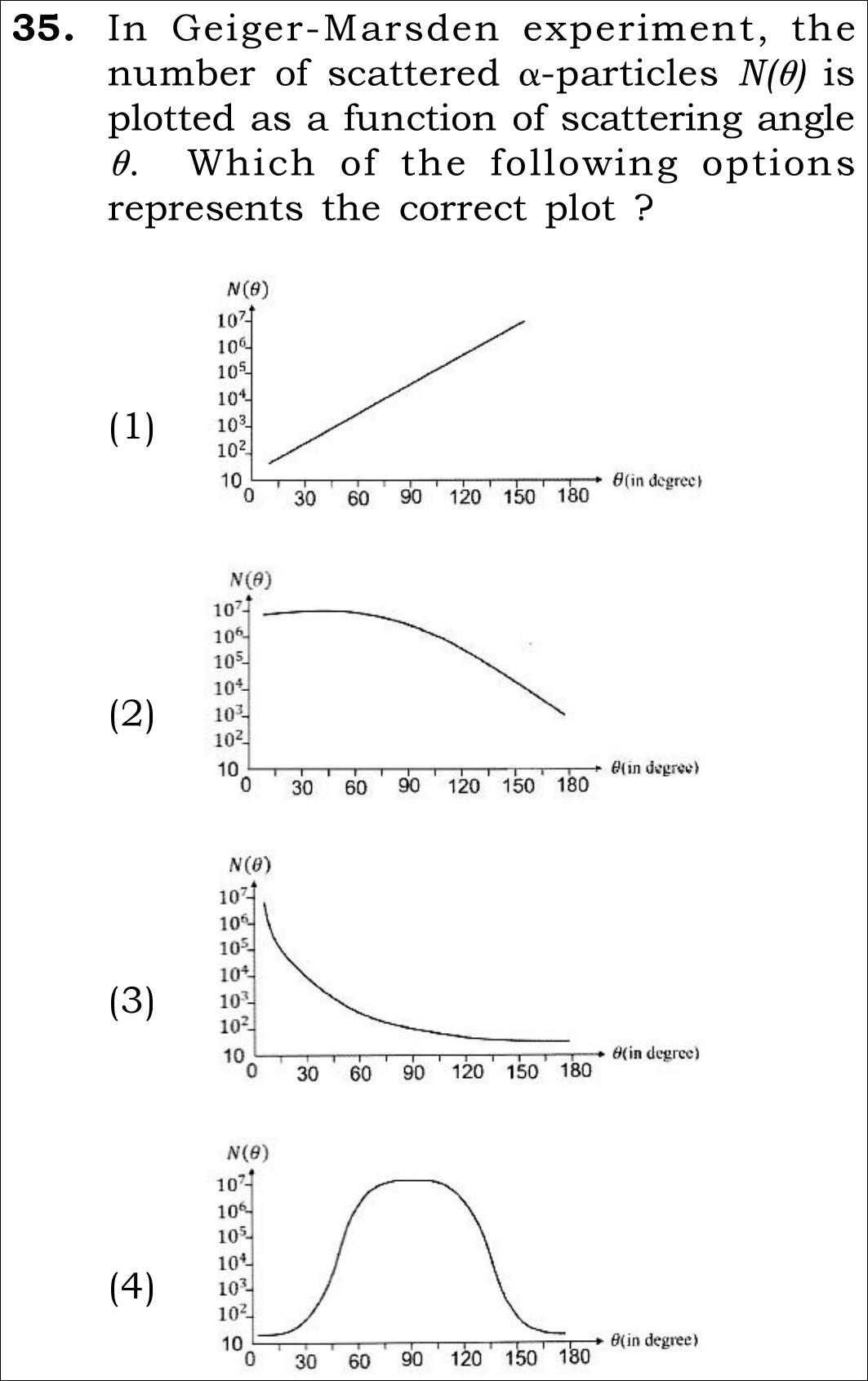
In Geiger-Marsden experiment, the number of scattered α-particles N(θ) is plotted as a function of scattering angle θ. Which of the following options represents the correct plot?
Dynamic 180-question full-length simulator mixed dynamically from all 6 years for 2027 & 2026 aspirants.
In Geiger-Marsden experiment, the number of scattered α-particles N(θ) is plotted as a function of scattering angle θ. Which of the following options represents the correct plot?
Number of particles scattered drops as 1 / sin^4(theta / 2)!
In the Geiger-Marsden experiment, alpha particles scattered by a thin gold foil follow Rutherford's Coulombic scattering cross-section:
Evaluate the theoretical scattering count across the angular domain [0, 180] degrees:
Match the qualitative behavior to the provided plots:
Diagnose every choice: Know exactly why the right option works and why distractors fail.
Completely unphysical.
Fails to capture sharp forward peak.
Canonical textbook graph from Geiger-Marsden experiment; confirmed by Official NTA Key.
Confuses scattering with blackbody radiation or diffraction envelope.
Students who confuse Rutherford scattering with wave optics or blackbody radiation pick the bell curve in Plot (4).
"Rutherford scattering: N(theta) is proportional to 1 / sin^4(theta/2). The steep decline confirms that the atom is mostly empty space with a tiny, dense, positively charged nucleus."
Test your speed and accuracy in the authentic 180-minute timed NTA simulator.
Spotted a mistake in this solution? Report an error (support@mycompetitiveexams.com)
Cover all 1,140 official NEET questions in 285 days at your own pace. Progress is saved on your device. No login needed.