📋 Given Parameters & Problem Setup
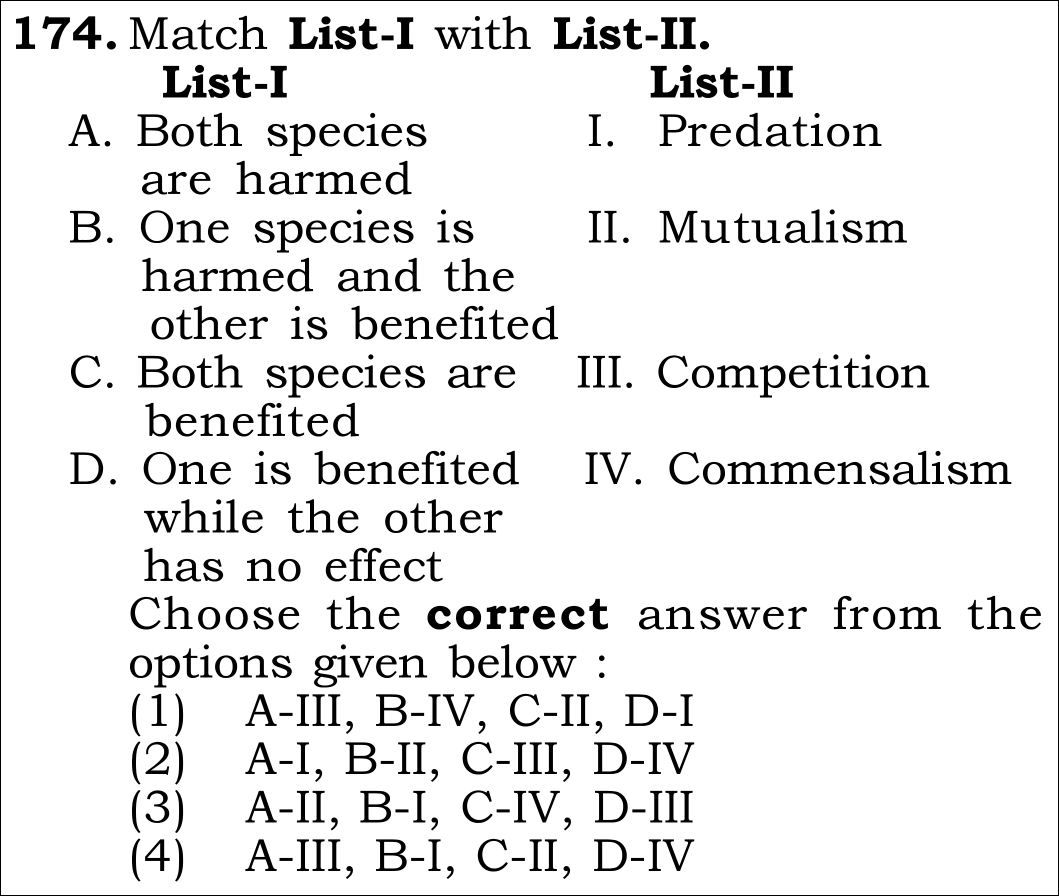
List I (Interactions) A. Competition, B. Predation, C. Mutualism, D. Commensalism
List II (Effects) I. (+, -), II. (+, +), III. (-, -), IV. (+, 0)
Competition = (-/-), Predation = (+/-), Mutualism = (+/+), Commensalism = (+/0)!
1 Mutualism: Both species benefit -> (+, +) -> C matches II.
2 Competition: Both species suffer -> (-, -) -> A matches III.
3 Predation: One benefits, one is harmed -> (+, -) -> B matches I.
4 Commensalism: One benefits, other unaffected -> (+, 0) -> D matches IV.
5 Compiled match: A-III, B-I, C-II, D-IV.
6 Scan options: Matches Option (4) uniquely. Solved in 5 seconds!
🛡️ Why You Can 100% Trust This Shortcut: NCERT Biology · Organisms and Populations (Interspecific Interactions: Commensalism (+, 0), Amensalism (-, 0), Parasitism (+, -)).
⚠️
Students sometimes think the "winner" of competition gets a (+) sign. Both species suffer from reduced growth, survival, or reproduction compared to living alone; thus competition is ALWAYS (-,-).
🛡️ How to avoid the -1 mark: Remember: In competition, both sides pay a cost -> (-,-).
📖
NEET Biology Core Syllabus · Organisms and Populations Standard Benchmark
Core Scientific Principle Tested:
"In mutualism both species benefit (+,+); in competition both lose (-,-); in predation one benefits and one is harmed (+,-); in commensalism one benefits and the other is unaffected (+,0)."
Syllabus Focus: Population Interactions
Mutual = Win-Win (+,+); Compete = Lose-Lose (-,-); Predator = Win-Lose (+,-); Commensal = Win-Shrug (+,0)!