MyCompetitiveExams Logo MyCompetitiveExams
Search 1,140+ Questions
Chapters, formulas, speed tricks
→
⚡ Brahmastra NEET 2027
720 MARKS

Dynamic 180-question full-length simulator mixed dynamically from all 6 years for 2027 & 2026 aspirants.

Launch Brahmastra 2027 Test →
Start Practice →
100% Free · No Login Required
Q.53 Chemistry ⭐ 360° Option Elimination Active
Vault ↗

NEET 2026 Chemistry Question 53 Solution

Topic: Classification of Elements and Periodicity in Properties · Official NTA Booklet Code 50
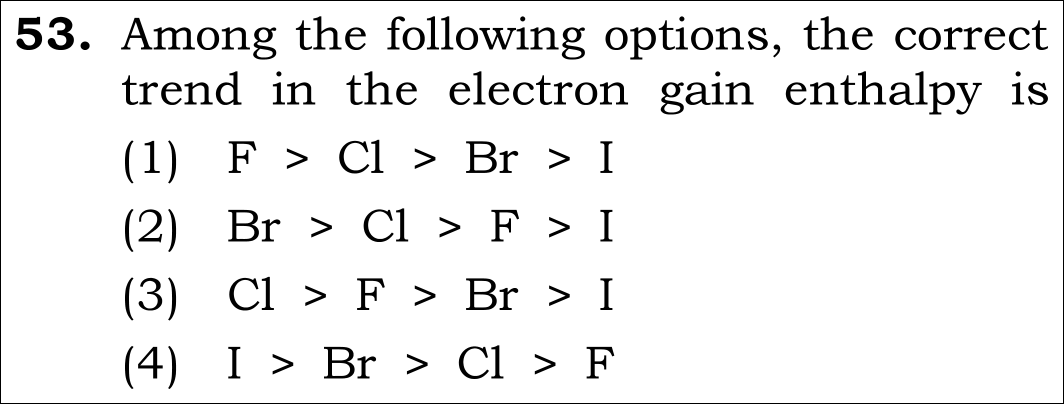
NEET 2026 Chemistry Question 53: Periodic Trends in Electron Gain Enthalpy of Halogens

Question

Among the following options, the correct trend in the electron gain enthalpy is

✓
Verified Against NTA Final Answer Key
Option (3) : Cl > F > Br > I
📚 Classification of Elements and Periodicity in Properties Easy
📋 Given Parameters & Problem Setup
Elements Halogens: F, Cl, Br, I (Group 17)
Property Electron gain enthalpy magnitude (tendency to accept an electron)
⚡

The 30-Second Exam Hall Shortcut: ⚡ The 2p Interelectronic Repulsion Anomaly

⏱️ Save ~45 seconds

Chlorine beats Fluorine in electron gain enthalpy due to compact 2p crowding in F!

1 Down the group, atomic size increases, so electron gain enthalpy generally becomes less negative.
2 Crucial Exception: Fluorine is extremely small; adding an electron into the compact 2p orbital creates significant interelectronic repulsion.
3 Chlorine has a larger 3p orbital that accommodates the added electron with minimal repulsion.
4 Therefore: Magnitude of negative electron gain enthalpy is Cl > F > Br > I.
5 Pick Option (3) immediately in 10 seconds!
🛡️
Why You Can 100% Trust This Shortcut: Standard NCERT values: Cl (-349 kJ/mol) > F (-328 kJ/mol) > Br (-325 kJ/mol) > I (-295 kJ/mol).
📐

Step-by-Step Rigorous Workflow & Mathematical Proof

Step 1

Definition of Electron Gain Enthalpy

Electron gain enthalpy (Δ_eg H) is the enthalpy change when an isolated gaseous atom in its ground state gains an electron to form a gaseous uninegative ion. For halogens, this process is highly exothermic.

X(g)+e−⟶X−(g)+ΔegH\text{X}(g) + e^- \longrightarrow \text{X}^-(g) + \Delta_{\text{eg}}H
  • • Negative Δ_eg H indicates energy release.
  • • Trend question compares magnitude (exothermicity).
Step 2

Explain the Fluorine-Chlorine Anomaly

Although electronegativity decreases uniformly from F to I, the electron gain enthalpy of fluorine is unexpectedly less negative than that of chlorine. In fluorine (n=2), the incoming electron enters the compact 2p subshell where it experiences strong repulsive forces from the other seven valence electrons. In chlorine (n=3), the incoming electron enters the larger 3p subshell where interelectronic repulsions are substantially weaker.

Size: 2pF≪3pCl  ⟹  Interelectronic repulsion in 2pF>3pCl\text{Size: } 2p_{\text{F}} \ll 3p_{\text{Cl}} \implies \text{Interelectronic repulsion in } 2p_{\text{F}} > 3p_{\text{Cl}}
  • • Δ_eg H of Cl = -349 kJ mol⁻¹.
  • • Δ_eg H of F = -328 kJ mol⁻¹.
Step 3

Establish the Complete Halogen Series

Beyond chlorine, as we descend to bromine and iodine, the increase in atomic size and nuclear shielding causes electron affinity to steadily decrease.

∣ΔegH∣:Cl (349)>F (328)>Br (325)>I (295)[in kJ mol−1]|\Delta_{\text{eg}}H|: \text{Cl } (349) > \text{F } (328) > \text{Br } (325) > \text{I } (295) \quad [\text{in kJ mol}^{-1}]
  • • Trend: Cl > F > Br > I.
  • • Matches Option (3).
⭐

360° Option Elimination Engine Key Feature

Diagnose every choice: Know exactly why the right option works and why distractors fail.

4-Option Deep Scan
1 A
✗ Incorrect
Verdict & Scientific Reason:

Incorrect. This is the trend for electronegativity, but fails for electron gain enthalpy due to the 2p repulsion anomaly.

⚠️
Student Fallacy (Why candidates pick this trap): Confusing electronegativity with electron gain enthalpy.
2 B
✗ Incorrect
Verdict & Scientific Reason:

Incorrect. Bromine does not have a higher electron affinity than chlorine.

⚠️
Student Fallacy (Why candidates pick this trap): Arbitrary ranking of halogens.
3 C
✓ 100% Correct
Verdict & Scientific Reason:

Scientifically accurate, reflecting the standard NCERT anomalous halogen order.

💡
Why this is airtight: None; textbook precision.
4 D
✗ Incorrect
Verdict & Scientific Reason:

Incorrect. Completely inverted order.

⚠️
Student Fallacy (Why candidates pick this trap): Thinking electron affinity increases down the group.
⚠️

NTA Trap Alert: Confusing Electronegativity with Electron Gain Enthalpy

Electronegativity measures bonded atom attraction (F > Cl > Br > I). Electron gain enthalpy measures isolated gaseous ion formation, where chlorine wins because fluorine is too tightly packed.

🛡️ How to avoid the -1 mark: Remember: Fluorine is the most electronegative, but Chlorine is the electron gain champion!
📖

Core NEET Syllabus Standard

NEET Chemistry Core Syllabus · Classification of Elements and Periodicity in Properties Standard Benchmark
Core Scientific Principle Tested:

"Interelectronic repulsions in the small 2p subshell make Δ_eg H of fluorine less negative than that of chlorine."

Syllabus Focus: Periodic trends in chemical properties - Electron Gain Enthalpy
✓ Core NEET UG Syllabus Anchor Syllabus & Academic Standards ↗
Chlorine grabs electrons cleanest: Cl > F > Br > I is the keenest!

Ready to attempt under real exam pressure?

Test your speed and accuracy in the authentic 180-minute timed NTA simulator.

Launch NEET 2026 CBT Test →

Spotted a mistake in this solution? Report an error (support@mycompetitiveexams.com)

⚖️ Legal & Fair Dealing Notice: Sourced from publicly released NEET 2026 question papers and NEET answer keys for private study, research, and non-commercial educational practice under Fair Dealing (Section 52(1)(a) of the Indian Copyright Act, 1957). Not affiliated with or endorsed by NTA or NMC.

Solve 4 NEET Questions a Day — One per Subject

Cover all 1,140 official NEET questions in 285 days at your own pace. Progress is saved on your device. No login needed.