
Q.47 Chemistry ⭐ 360° Option Elimination Active
NEET 2025 Chemistry Question 47 Solution
Topic: Classification of Elements and Periodicity in Properties · Official NTA Booklet Code 45
Question
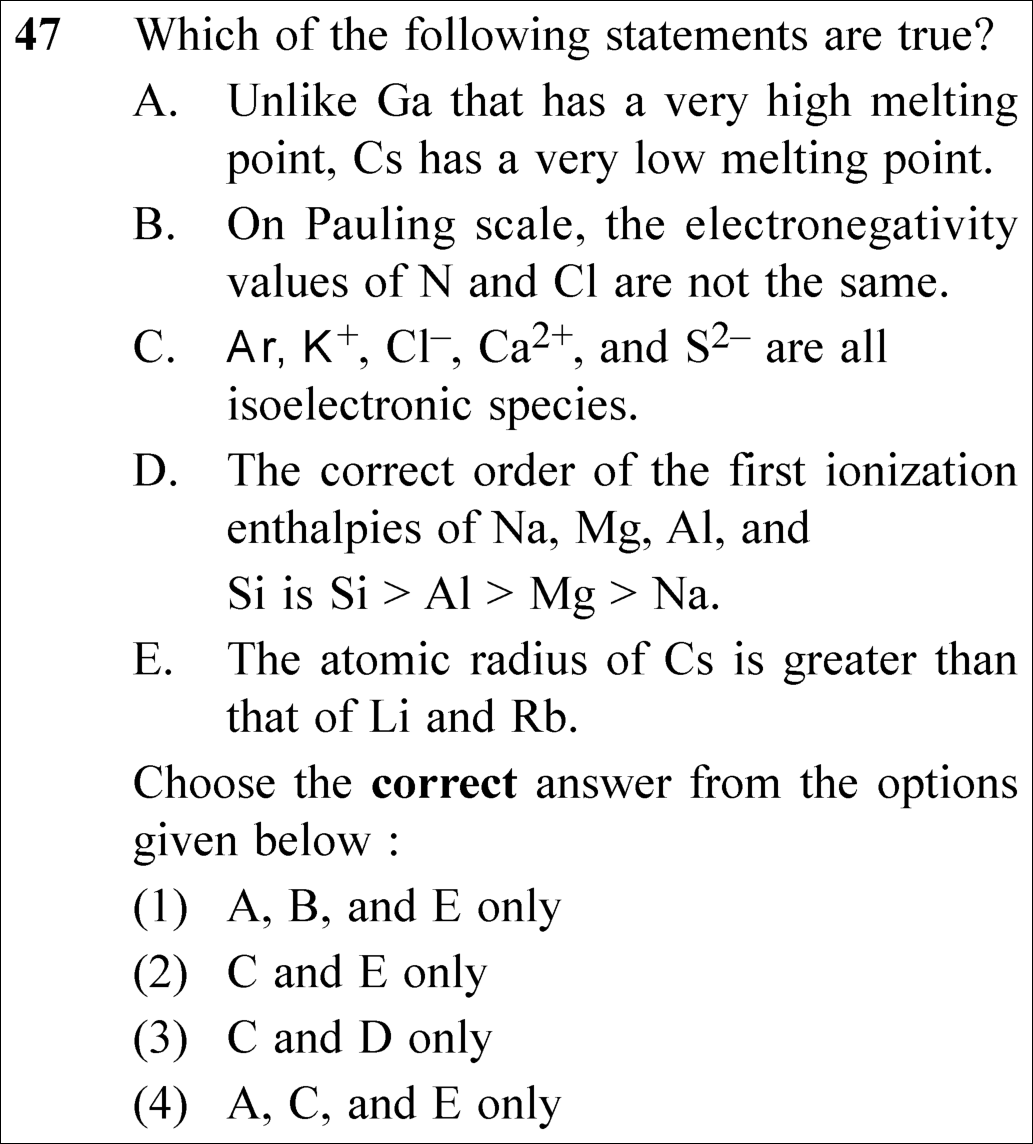
Which of the following statements are true? A. Unlike Ga that has a very high melting point, Cs has a very low melting point. B. On Pauling scale, the electronegativity values of N and Cl are not the same. C. Ar, K⁺, Cl⁻, Ca²⁺, and S²⁻ are all isoelectronic species. D. The correct order of the first ionization enthalpies of Na, Mg, Al, and Si is Si > Al > Mg > Na. E. The atomic radius of Cs is greater than that of Li and Rb. Choose the correct answer from the options given below: