NEET 2025 Chemistry Question 83 Solution
Question
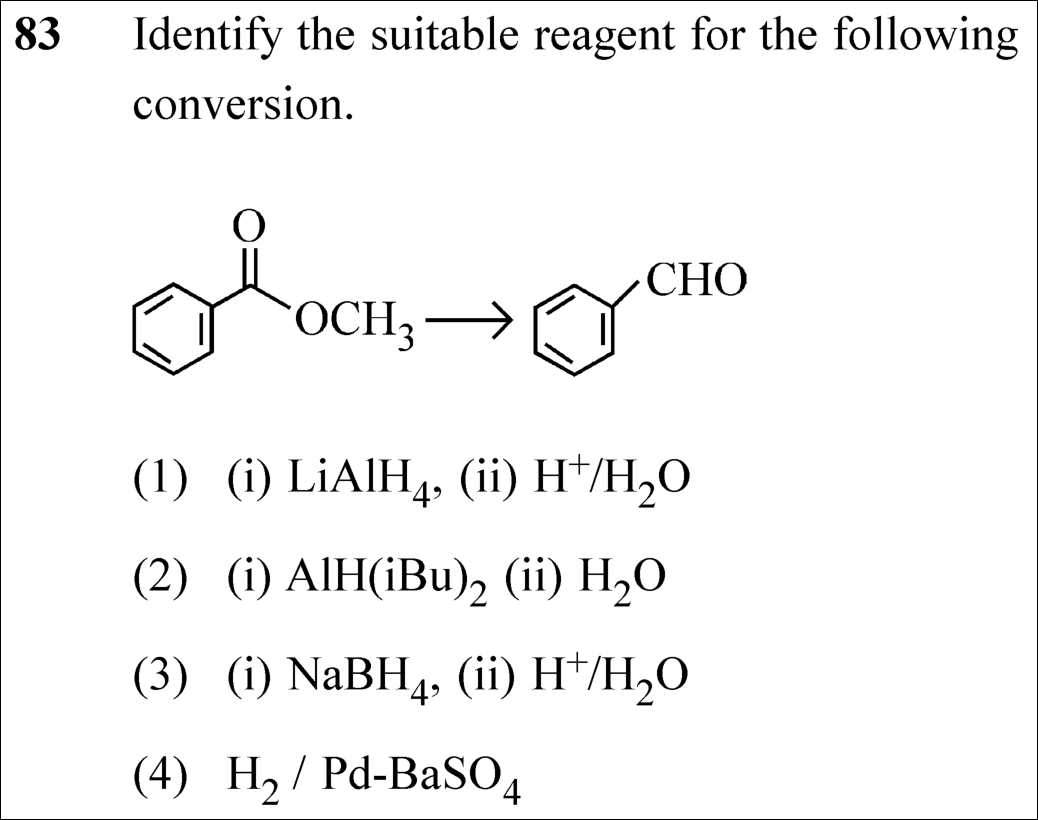
Identify the suitable reagent for the following conversion. Methyl benzoate (C₆H₅COOCH₃) → Benzaldehyde (C₆H₅CHO)
Dynamic 180-question full-length simulator mixed dynamically from all 6 years for 2027 & 2026 aspirants.
Identify the suitable reagent for the following conversion. Methyl benzoate (C₆H₅COOCH₃) → Benzaldehyde (C₆H₅CHO)
Ester ⟶ Aldehyde requires DIBAL-H [AlH(iBu)₂]! LiAlH₄ over-reduces esters all the way to primary alcohols (Ph-CH₂OH). NaBH₄ does not reduce esters. H₂/Pd-BaSO₄ reduces acid chlorides, not esters! ⟹ (i) AlH(iBu)₂ (ii) H₂O!
Diisobutylaluminium hydride, [(CH₃)₂CH-CH₂]₂AlH or AlH(iBu)₂, delivers exactly one hydride ion to the carbonyl carbon of the ester at low temperature (-78 °C):
Upon addition of water (H₂O workup), the tetrahedral aluminium intermediate collapses, releasing the aldehyde and methanol:
Verify why the other reagents fail for this specific transformation:
Diagnose every choice: Know exactly why the right option works and why distractors fail.
Incorrect. LiAlH₄ reduces esters completely to primary alcohols (benzyl alcohol Ph-CH₂OH).
100% correct. DIBAL-H specifically reduces esters to aldehydes.
Incorrect. NaBH₄ cannot reduce esters.
Incorrect. Rosenmund catalyst reduces acyl chlorides, not esters.
LiAlH₄ is too reactive to prepare aldehydes from carboxylic acids or esters—it inevitably reduces the carbonyl all the way down to a primary alcohol. DIBAL-H is specifically designed to stop at the aldehyde!
"DIBAL-H selectively reduces esters to aldehydes upon hydrolysis."
Test your speed and accuracy in the authentic 180-minute timed NTA simulator.
Spotted a mistake in this solution? Report an error (support@mycompetitiveexams.com)
Cover all 1,140 official NEET questions in 285 days at your own pace. Progress is saved on your device. No login needed.