MyCompetitiveExams Logo MyCompetitiveExams
Search 1,140+ Questions
Chapters, formulas, speed tricks
→
⚡ Brahmastra NEET 2027
720 MARKS

Dynamic 180-question full-length simulator mixed dynamically from all 6 years for 2027 & 2026 aspirants.

Launch Brahmastra 2027 Test →
Start Practice →
100% Free · No Login Required
Q.48 Chemistry ⭐ 360° Option Elimination Active
Vault ↗

NEET 2025 Chemistry Question 48 Solution

Topic: Practical Chemistry & Coordination Compounds · Official NTA Booklet Code 45
NEET 2025 Chemistry Question 48: Systematic Group Classification in Qualitative Salt Analysis

Question

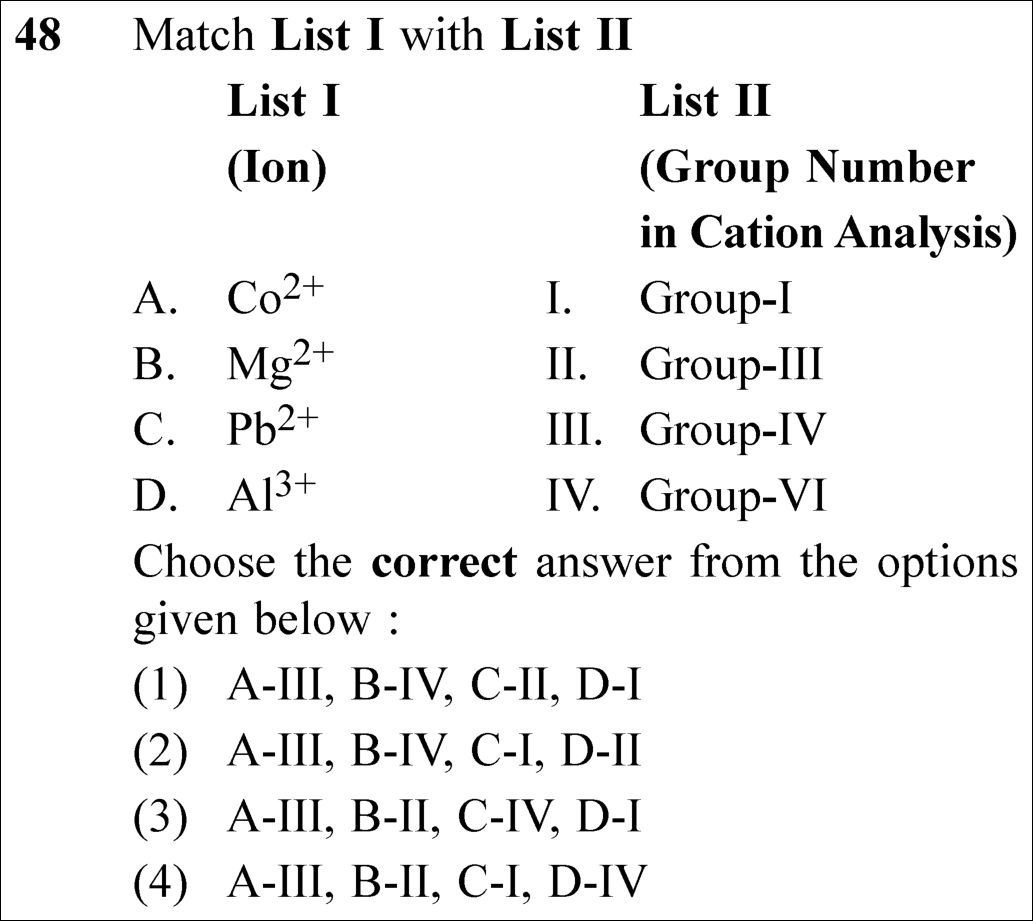
Match List I (Ion) with List II (Group Number in Cation Analysis). List I: A. Co²⁺; B. Mg²⁺; C. Pb²⁺; D. Al³⁺. List II: I. Group-I; II. Group-III; III. Group-IV; IV. Group-VI. Choose the correct answer from the options given below:

✓
Verified Against NTA Final Answer Key
Option (2) : A-III, B-IV, C-I, D-II
📚 Practical Chemistry & Coordination Compounds Easy
📋 Given Parameters & Problem Setup
List I (Ions) A. Co²⁺, B. Mg²⁺, C. Pb²⁺, D. Al³⁺
List II (Analytical Groups) I. Group-I, II. Group-III, III. Group-IV, IV. Group-VI
⚡

The 30-Second Exam Hall Shortcut: ⚡ Cation Group Reagent Fingerprint

⏱️ Save ~45 seconds

Pb²⁺ precipitated by dil HCl = Group-I (C-I). Al³⁺ precipitated by NH₄OH = Group-III (D-II). Co²⁺ precipitated by H₂S in NH₄OH = Group-IV (A-III). Mg²⁺ = Group-VI (B-IV)!

1 Identify Group-I cation: Pb²⁺ precipitates as white PbCl₂ with dilute HCl ⟹ C matches I.
2 Look at options: Only Option (2) has C-I and D-II!
3 Verify Al³⁺: Group-III cation, precipitated as gelatinous white Al(OH)₃ with NH₄OH in presence of NH₄Cl ⟹ D matches II.
4 Verify Co²⁺: Group-IV cation, precipitated as black CoS with H₂S in alkaline medium ⟹ A matches III.
5 Verify Mg²⁺: Group-VI cation, precipitated as Mg(NH₄)PO₄ with (NH₄)₂HPO₄ ⟹ B matches IV.
6 Matches Option (2) uniquely in under 10 seconds!
🛡️
Why You Can 100% Trust This Shortcut: Systematic Qualitative Cation Analysis (NCERT Chemistry Laboratory Manual).
📐

Step-by-Step Rigorous Workflow & Mathematical Proof

Step 1

Classification of Lead (Pb²⁺) in Group-I

Cations of analytical Group-I form insoluble chlorides upon the addition of dilute hydrochloric acid (dil. HCl). Lead (Pb²⁺), along with Ag⁺ and Hg₂²⁺, belongs to Group-I:

Pb2++2Cl−⟶PbCl2↓ (White precipitate)\text{Pb}^{2+} + 2\text{Cl}^- \longrightarrow \text{PbCl}_2 \downarrow \text{ (White precipitate)}
  • • Thus C matches I (C-I).
Step 2

Classification of Aluminium (Al³⁺) in Group-III

Cations of Group-III are precipitated as their hydroxides by ammonium hydroxide (NH₄OH) in the presence of ammonium chloride (NH₄Cl). Aluminium (Al³⁺), Fe³⁺, and Cr³⁺ belong to Group-III:

Al3++3OH−⟶Al(OH)3↓ (Gelatinous white)\text{Al}^{3+} + 3\text{OH}^- \longrightarrow \text{Al(OH)}_3 \downarrow \text{ (Gelatinous white)}
  • • Thus D matches II (D-II).
Step 3

Classification of Cobalt (Co²⁺) and Magnesium (Mg²⁺)

Group-IV cations (Co²⁺, Ni²⁺, Mn²⁺, Zn²⁺) precipitate as sulphides in basic medium (H₂S + NH₄OH + NH₄Cl). Magnesium (Mg²⁺) does not precipitate in Groups I–V and belongs to Group-VI:

Co2++S2−⟶CoS↓,Mg2++NH4++PO43−⟶Mg(NH4)PO4↓\text{Co}^{2+} + \text{S}^{2-} \longrightarrow \text{CoS} \downarrow, \quad \text{Mg}^{2+} + \text{NH}_4^+ + \text{PO}_4^{3-} \longrightarrow \text{Mg(NH}_4\text{)PO}_4 \downarrow
  • • Co²⁺ is in Group-IV ⟹ A matches III (A-III).
  • • Mg²⁺ is in Group-VI ⟹ B matches IV (B-IV).
  • • Complete match: A-III, B-IV, C-I, D-II, corresponding to Option (2).
⭐

360° Option Elimination Engine Key Feature

Diagnose every choice: Know exactly why the right option works and why distractors fail.

4-Option Deep Scan
1 A
✗ Incorrect
Verdict & Scientific Reason:

Incorrect. Swaps Pb²⁺ into Group-III and Al³⁺ into Group-I.

⚠️
Student Fallacy (Why candidates pick this trap): Confusing Al³⁺ chloride insolubility with PbCl₂.
2 B
✓ 100% Correct
Verdict & Scientific Reason:

100% correct. Co²⁺ (Group-IV), Mg²⁺ (Group-VI), Pb²⁺ (Group-I), Al³⁺ (Group-III).

💡
Why this is airtight: None; standard qualitative analysis sequence.
3 C
✗ Incorrect
Verdict & Scientific Reason:

Incorrect. Places Mg²⁺ in Group-III and Pb²⁺ in Group-VI.

⚠️
Student Fallacy (Why candidates pick this trap): Completely scrambling group reagents.
4 D
✗ Incorrect
Verdict & Scientific Reason:

Incorrect. Places Al³⁺ in Group-VI.

⚠️
Student Fallacy (Why candidates pick this trap): Confusing Al³⁺ with zero group or group VI.
⚠️

NTA Trap Alert: Lead (Pb²⁺) Dual Appearance Trap

Pb²⁺ is slightly soluble in cold water, so it precipitates in Group-I as PbCl₂ and the remaining traces also precipitate in Group-II as PbS. However, in canonical classification, Pb²⁺ is primarily listed in Group-I!

🛡️ How to avoid the -1 mark: Pb is Group-I (chloride); Al is Group-III (hydroxide); Co is Group-IV (sulphide in base); Mg is Group-VI.
📖

Core NEET Syllabus Standard

NEET Chemistry Core Syllabus · Practical Chemistry Standard Benchmark
Core Scientific Principle Tested:

"Systematic cation precipitation: Gr-I (Cl⁻), Gr-III (OH⁻), Gr-IV (S²⁻ in base), Gr-VI (HPO₄²⁻)."

Syllabus Focus: Qualitative Analysis of Cations
✓ Core NEET UG Syllabus Anchor Syllabus & Academic Standards ↗
Pb is 1st (Cl⁻), Al is 3rd (OH⁻), Co is 4th (S²⁻), Mg is 6th (last)!

Ready to attempt under real exam pressure?

Test your speed and accuracy in the authentic 180-minute timed NTA simulator.

Launch NEET 2025 CBT Test →

Spotted a mistake in this solution? Report an error (support@mycompetitiveexams.com)

⚖️ Legal & Fair Dealing Notice: Sourced from publicly released NEET 2025 question papers and NEET answer keys for private study, research, and non-commercial educational practice under Fair Dealing (Section 52(1)(a) of the Indian Copyright Act, 1957). Not affiliated with or endorsed by NTA or NMC.

Solve 4 NEET Questions a Day — One per Subject

Cover all 1,140 official NEET questions in 285 days at your own pace. Progress is saved on your device. No login needed.