MyCompetitiveExams Logo MyCompetitiveExams
Search 1,140+ Questions
Chapters, formulas, speed tricks
→
⚡ Brahmastra NEET 2027
720 MARKS

Dynamic 180-question full-length simulator mixed dynamically from all 6 years for 2027 & 2026 aspirants.

Launch Brahmastra 2027 Test →
Start Practice →
100% Free · No Login Required
Q.61 Chemistry ⭐ 360° Option Elimination Active
Vault ↗

NEET 2025 Chemistry Question 61 Solution

Topic: Electrochemistry · Official NTA Booklet Code 45
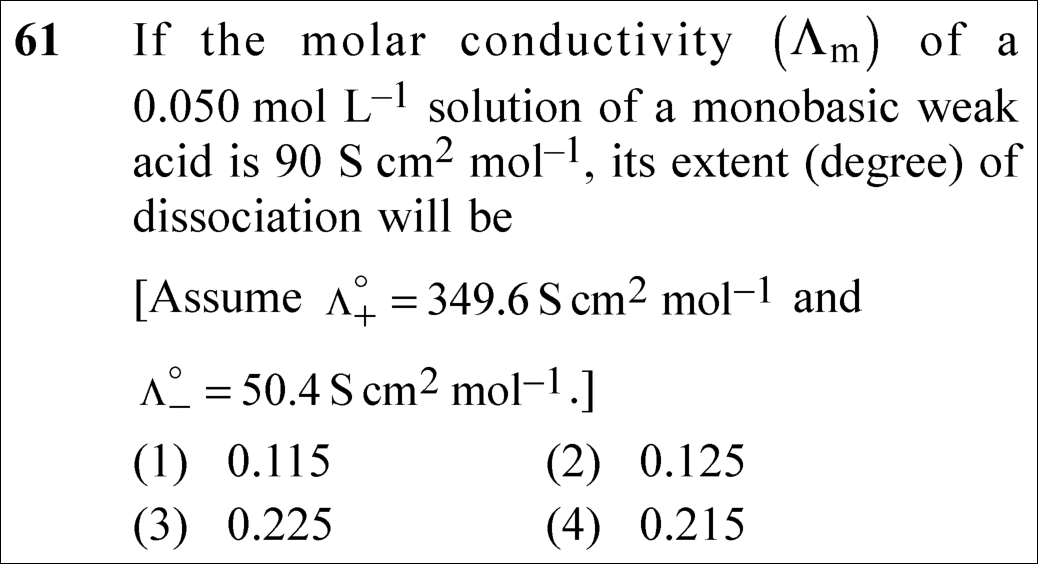
NEET 2025 Chemistry Question 61: Calculation of Degree of Dissociation of Monobasic Weak Acid

Question

If the molar conductivity (Λm) of a 0.050 mol L⁻¹ solution of a monobasic weak acid is 90 S cm² mol⁻¹, its extent (degree) of dissociation will be [Assume Λ°₊ = 349.6 S cm² mol⁻¹ and Λ°₋ = 50.4 S cm² mol⁻¹.]

✓
Verified Against NTA Final Answer Key
Option (3) : 0.225
📚 Electrochemistry Easy
📋 Given Parameters & Problem Setup
Concentration (C) 0.050 mol L⁻¹
Molar Conductivity at Concentration C (Λ_m) 90 S cm² mol⁻¹
Limiting Molar Conductivity of Cation (λ₊°) 349.6 S cm² mol⁻¹
Limiting Molar Conductivity of Anion (λ₋°) 50.4 S cm² mol⁻¹
⚡

The 30-Second Exam Hall Shortcut: ⚡ Kohlrausch Ratio Shortcut

⏱️ Save ~30 seconds

Λ_m° = 349.6 + 50.4 = 400 S cm² mol⁻¹. Degree of dissociation α = Λ_m / Λ_m° = 90 / 400 = 9 / 40 = 0.225!

1 Apply Kohlrausch’s law: Limiting molar conductivity of weak acid HA is the sum of ionic conductivities: Λ_m° = λ₊° + λ₋°.
2 Add the numbers: 349.6 + 50.4 = 400.0 S cm² mol⁻¹.
3 Degree of dissociation formula: α = Λ_m / Λ_m°.
4 Divide: α = 90 / 400 = 9 / 40 = 0.225.
5 Select Option (3) in under 15 seconds!
🛡️
Why You Can 100% Trust This Shortcut: Kohlrausch’s Law of Independent Migration of Ions (NCERT Chemistry · Electrochemistry: Λ°_m = ν₊ λ°₊ + ν₋ λ°₋).
📐

Step-by-Step Rigorous Workflow & Mathematical Proof

Step 1

Apply Kohlrausch’s Law of Independent Migration of Ions

For a monobasic weak acid HA dissociating into H⁺ and A⁻, the limiting molar conductivity at infinite dilution is the sum of the limiting molar conductivities of its constituent ions:

Λm∘=λ+∘+λ−∘=349.6 S⋅cm2⋅mol−1+50.4 S⋅cm2⋅mol−1=400.0 S⋅cm2⋅mol−1\Lambda_m^\circ = \lambda_+^\circ + \lambda_-^\circ = 349.6\text{ S}\cdot\text{cm}^2\cdot\text{mol}^{-1} + 50.4\text{ S}\cdot\text{cm}^2\cdot\text{mol}^{-1} = 400.0\text{ S}\cdot\text{cm}^2\cdot\text{mol}^{-1}
  • • Λ_m° represents the theoretical conductivity at 100% complete dissociation.
Step 2

Calculate Degree of Dissociation (α)

The degree of dissociation α of a weak electrolyte at concentration C is the ratio of its molar conductivity Λ_m to its limiting molar conductivity Λ_m°:

α=ΛmΛm∘=90 S⋅cm2⋅mol−1400.0 S⋅cm2⋅mol−1=940=0.225\alpha = \frac{\Lambda_m}{\Lambda_m^\circ} = \frac{90\text{ S}\cdot\text{cm}^2\cdot\text{mol}^{-1}}{400.0\text{ S}\cdot\text{cm}^2\cdot\text{mol}^{-1}} = \frac{9}{40} = 0.225
  • • Expressed as a percentage, α = 22.5%.
Step 3

Match with Multiple Choice Options

The calculated degree of dissociation is 0.225:

α=0.225  ⟹  Option (3)\alpha = 0.225 \implies \text{Option (3)}
  • • Matches Option (3) exactly.
⭐

360° Option Elimination Engine Key Feature

Diagnose every choice: Know exactly why the right option works and why distractors fail.

4-Option Deep Scan
1 A
✗ Incorrect
Verdict & Scientific Reason:

Incorrect. Dividing by 800 or arithmetic error.

⚠️
Student Fallacy (Why candidates pick this trap): Arithmetic miscalculation.
2 B
✗ Incorrect
Verdict & Scientific Reason:

Incorrect. Corresponds to 50/400 = 0.125.

⚠️
Student Fallacy (Why candidates pick this trap): Using anion conductivity 50 instead of given Λ_m = 90.
3 C
✓ 100% Correct
Verdict & Scientific Reason:

100% correct. α = 90 / (349.6 + 50.4) = 90 / 400 = 0.225.

💡
Why this is airtight: None; textbook electrochemistry calculation.
4 D
✗ Incorrect
Verdict & Scientific Reason:

Incorrect. Subtraction error in long division.

⚠️
Student Fallacy (Why candidates pick this trap): Inaccurate decimal division.
⚠️

NTA Trap Alert: Attempting to Use Ostwald Dilution Law with Concentration C

The problem gives concentration C = 0.050 mol L⁻¹, which tempts students to set up K_a = Cα² / (1-α). But K_a is not requested—the question asks ONLY for the degree of dissociation α, which is simply Λ_m / Λ_m°!

🛡️ How to avoid the -1 mark: Concentration C = 0.050 is extraneous data here; α is directly Λ_m / Λ_m°.
📖

Core NEET Syllabus Standard

NEET Chemistry Core Syllabus · Electrochemistry Standard Benchmark
Core Scientific Principle Tested:

"α = Λ_m / Λ_m° where Λ_m° = Σ ν_i λ_i°."

Syllabus Focus: Kohlrausch’s Law and Applications to Weak Electrolytes
✓ Core NEET UG Syllabus Anchor Syllabus & Academic Standards ↗
Sum ions = 400 ⟹ α = 90 / 400 = 9/40 = 0.225!

Ready to attempt under real exam pressure?

Test your speed and accuracy in the authentic 180-minute timed NTA simulator.

Launch NEET 2025 CBT Test →

Spotted a mistake in this solution? Report an error (support@mycompetitiveexams.com)

⚖️ Legal & Fair Dealing Notice: Sourced from publicly released NEET 2025 question papers and NEET answer keys for private study, research, and non-commercial educational practice under Fair Dealing (Section 52(1)(a) of the Indian Copyright Act, 1957). Not affiliated with or endorsed by NTA or NMC.

Solve 4 NEET Questions a Day — One per Subject

Cover all 1,140 official NEET questions in 285 days at your own pace. Progress is saved on your device. No login needed.