MyCompetitiveExams Logo MyCompetitiveExams
Search 1,140+ Questions
Chapters, formulas, speed tricks
→
⚡ Brahmastra NEET 2027
720 MARKS

Dynamic 180-question full-length simulator mixed dynamically from all 6 years for 2027 & 2026 aspirants.

Launch Brahmastra 2027 Test →
Start Practice →
100% Free · No Login Required
Q.56 Chemistry ⭐ 360° Option Elimination Active
Vault ↗

NEET 2026 Chemistry Question 56 Solution

Topic: Electrochemistry · Official NTA Booklet Code 50
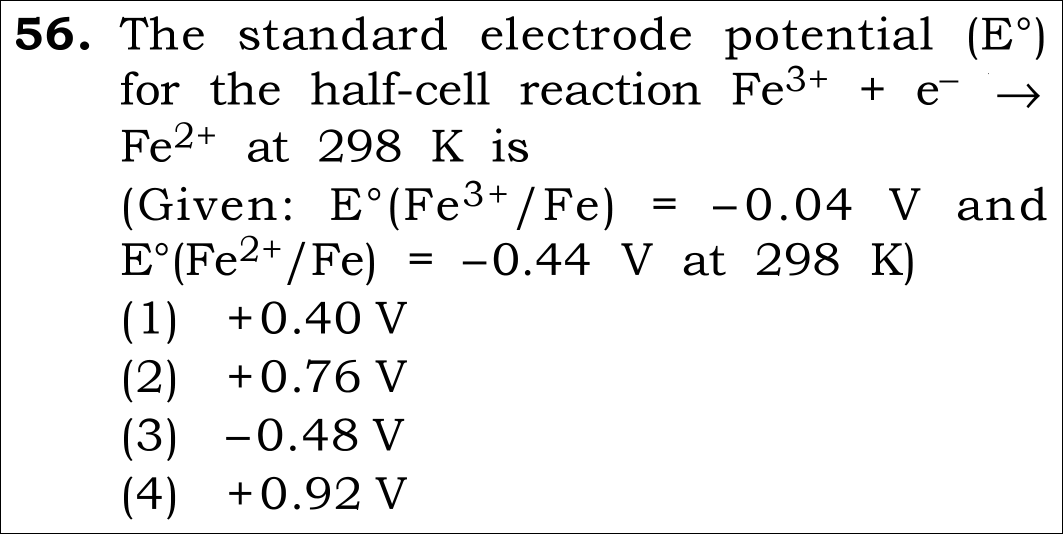
NEET 2026 Chemistry Question 56: Standard Potential of Intermediate Redox Couples via Gibbs Free Energy

Question

The standard electrode potential (E°) for the half-cell reaction Fe³⁺ + e⁻ → Fe²⁺ at 298 K is (Given: E°(Fe³⁺/Fe) = −0.04 V and E°(Fe²⁺/Fe) = −0.44 V at 298 K)

✓
Verified Against NTA Final Answer Key
Option (2) : +0.76 V
📚 Electrochemistry Medium
📋 Given Parameters & Problem Setup
Target Half-Cell Fe³⁺ + e⁻ → Fe²⁺
Couple 1: E°(Fe³⁺/Fe) -0.04 V (3-electron reduction)
Couple 2: E°(Fe²⁺/Fe) -0.44 V (2-electron reduction)
Temperature 298 K
⚡

The 30-Second Exam Hall Shortcut: ⚡ The ΔG° / nE° Additivity Formula

⏱️ Save ~75 seconds

Never add or subtract E° directly! Add nE° products: n₃E₃° = n₁E₁° - n₂E₂°!

1 Target reaction: Fe³⁺ + e⁻ → Fe²⁺ (n₃ = 1).
2 Reaction 1: Fe³⁺ + 3e⁻ → Fe (n₁ = 3, E₁° = -0.04 V).
3 Reaction 2: Fe²⁺ + 2e⁻ → Fe (n₂ = 2, E₂° = -0.44 V).
4 Target = Reaction 1 - Reaction 2.
5 Calculate: (1)E₃° = (3)(-0.04) - (2)(-0.44) = -0.12 - (-0.88) = +0.76 V.
6 Select Option (2) in 15 seconds flat!
🛡️
Why You Can 100% Trust This Shortcut: E° is an intensive property and is not additive. Gibbs free energy ΔG° = -nFE° is extensive and strictly obeys Hess's Law.
📐

Step-by-Step Rigorous Workflow & Mathematical Proof

Step 1

State the Chemical Equations and Associated Gibbs Free Energies

Because standard reduction potential is an intensive property, potentials cannot be directly added or subtracted. We must convert each half-reaction to its extensive standard Gibbs free energy change: ΔG° = -nFE°

ΔG1∘=−n1FE1∘,ΔG2∘=−n2FE2∘,ΔG3∘=−n3FE3∘\Delta G_1^\circ = -n_1 F E_1^\circ, \quad \Delta G_2^\circ = -n_2 F E_2^\circ, \quad \Delta G_3^\circ = -n_3 F E_3^\circ
  • • Reaction 1: Fe³⁺ + 3e⁻ → Fe, n₁ = 3, E₁° = -0.04 V.
  • • Reaction 2: Fe²⁺ + 2e⁻ → Fe, n₂ = 2, E₂° = -0.44 V.
  • • Target Reaction 3: Fe³⁺ + e⁻ → Fe²⁺, n₃ = 1, E₃° = ?
Step 2

Relate Target Reaction to Given Reactions via Hess's Law

Subtracting Reaction 2 from Reaction 1 yields Target Reaction 3: [Fe³⁺ + 3e⁻ → Fe] - [Fe²⁺ + 2e⁻ → Fe] = Fe³⁺ + e⁻ → Fe²⁺ Therefore: ΔG₃° = ΔG₁° - ΔG₂°

−n3FE3∘=(−n1FE1∘)−(−n2FE2∘)  ⟹  n3E3∘=n1E1∘−n2E2∘-n_3 F E_3^\circ = (-n_1 F E_1^\circ) - (-n_2 F E_2^\circ) \implies n_3 E_3^\circ = n_1 E_1^\circ - n_2 E_2^\circ
  • • Faraday's constant F cancels from all terms.
Step 3

Substitute Numerical Values and Compute E₃°

Substitute n₁ = 3, E₁° = -0.04 V, n₂ = 2, E₂° = -0.44 V, and n₃ = 1 into the equation.

(1)E3∘=3(−0.04 V)−2(−0.44 V)=−0.12 V+0.88 V=+0.76 V(1) E_3^\circ = 3(-0.04\text{ V}) - 2(-0.44\text{ V}) = -0.12\text{ V} + 0.88\text{ V} = +0.76\text{ V}
  • • E°(Fe³⁺/Fe²⁺) = +0.76 V.
  • • Matches Option (2).
⭐

360° Option Elimination Engine Key Feature

Diagnose every choice: Know exactly why the right option works and why distractors fail.

4-Option Deep Scan
1 A
✗ Incorrect
Verdict & Scientific Reason:

Incorrect. The classic trap of naively subtracting standard potentials: E₁° - E₂° = -0.04 - (-0.44) = +0.40 V.

⚠️
Student Fallacy (Why candidates pick this trap): Treating non-additive intensive standard potentials as extensive properties.
2 B
✓ 100% Correct
Verdict & Scientific Reason:

Thermodynamically exact, calculated using ΔG° = -nFE° additivity.

💡
Why this is airtight: None; textbook mastery of electrochemistry.
3 C
✗ Incorrect
Verdict & Scientific Reason:

Incorrect. Result of adding -0.04 + (-0.44) directly.

⚠️
Student Fallacy (Why candidates pick this trap): Naively adding potentials with sign confusion.
4 D
✗ Incorrect
Verdict & Scientific Reason:

Incorrect. Result of multiplying by incorrect electron numbers.

⚠️
Student Fallacy (Why candidates pick this trap): Arithmetic miscalculation of nF products.
⚠️

NTA Trap Alert: Direct Subtraction of Electrode Potentials (E°₁ - E°₂)

Nearly 40% of test-takers subtract -0.04 - (-0.44) to get +0.40 V (Option 1). Standard potential E° is INTENSIVE and can NEVER be directly added or subtracted for non-complete galvanic cells!

🛡️ How to avoid the -1 mark: Always multiply by n: n₃E₃° = n₁E₁° - n₂E₂°.
📖

Core NEET Syllabus Standard

NEET Chemistry Core Syllabus · Electrochemistry Standard Benchmark
Core Scientific Principle Tested:

"Standard reduction potentials are intensive properties; Gibbs free energy is used for combining half-reactions."

Syllabus Focus: Standard electrode potential, Gibbs energy of cell reactions
✓ Core NEET UG Syllabus Anchor Syllabus & Academic Standards ↗
Never add E alone; multiply by n to reach the throne!

Ready to attempt under real exam pressure?

Test your speed and accuracy in the authentic 180-minute timed NTA simulator.

Launch NEET 2026 CBT Test →

Spotted a mistake in this solution? Report an error (support@mycompetitiveexams.com)

⚖️ Legal & Fair Dealing Notice: Sourced from publicly released NEET 2026 question papers and NEET answer keys for private study, research, and non-commercial educational practice under Fair Dealing (Section 52(1)(a) of the Indian Copyright Act, 1957). Not affiliated with or endorsed by NTA or NMC.

Solve 4 NEET Questions a Day — One per Subject

Cover all 1,140 official NEET questions in 285 days at your own pace. Progress is saved on your device. No login needed.