MyCompetitiveExams Logo MyCompetitiveExams
Search 1,140+ Questions
Chapters, formulas, speed tricks
→
⚡ Brahmastra NEET 2027
720 MARKS

Dynamic 180-question full-length simulator mixed dynamically from all 6 years for 2027 & 2026 aspirants.

Launch Brahmastra 2027 Test →
Start Practice →
100% Free · No Login Required
Q.82 Chemistry ⭐ 360° Option Elimination Active
Vault ↗

NEET 2026 Chemistry Question 82 Solution

Topic: Aldehydes, Ketones and Carboxylic Acids · Official NTA Booklet Code 50
NEET 2026 Chemistry Question 82: Regiochemical Selectivity in Aldol Dehydration Products

Question

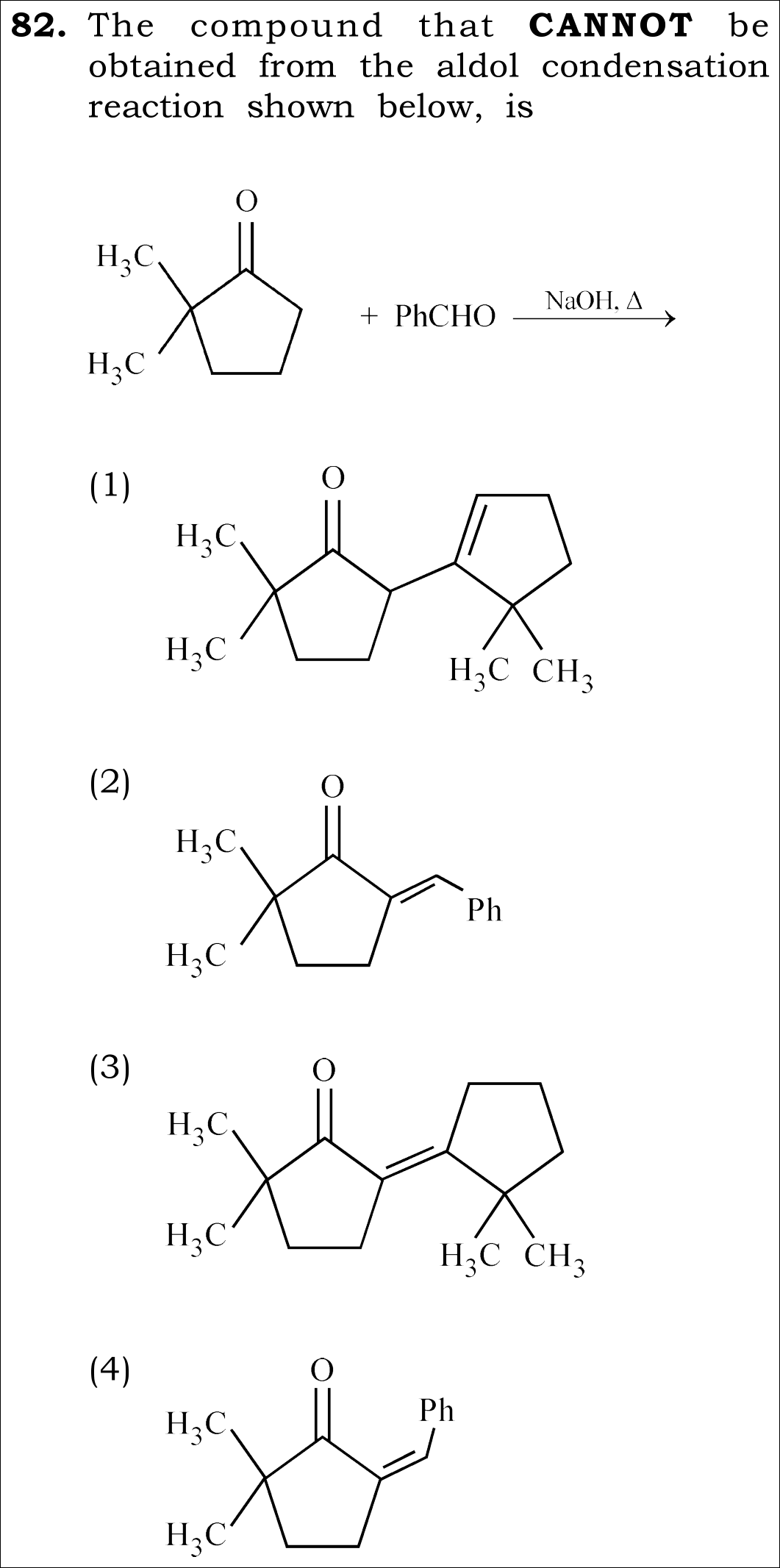
The compound that CANNOT be obtained from the aldol condensation reaction shown below, is: 2,2-dimethylcyclopentanone + PhCHO → (NaOH, Δ)

✓
Verified Against NTA Final Answer Key
Option (1) : Structure (1)
📚 Aldehydes, Ketones and Carboxylic Acids Challenging
📋 Given Parameters & Problem Setup
Ketone 2,2-dimethylcyclopentan-1-one (only one α-carbon with hydrogens: C5)
Aldehyde Benzaldehyde (PhCHO, non-enolizable aldehyde)
Reagent NaOH, Δ (Base-catalyzed aldol condensation with dehydration)
Target The compound that CANNOT be obtained
⚡

The 30-Second Exam Hall Shortcut: ⚡ Conjugation Requirement in Aldol Dehydration

⏱️ Save ~80 seconds

Aldol dehydration ALWAYS produces an α,β-unsaturated carbonyl! Structure (1) is NOT conjugated with the carbonyl!

1 Enolate can only form at C5 (C2 is blocked by two methyl groups, no α-H).
2 Cross-aldol with PhCHO gives E and Z α,β-unsaturated ketones (Structures 2 and 4) -> Formed!
3 Self-aldol of two molecules of 2,2-dimethylcyclopentanone dehydrates across C5=C1' to yield the conjugated α,β-unsaturated enone (Structure 3) -> Formed!
4 Examine Structure (1): The double bond is inside the second ring (between C2' and C3') and isolated by a single bond from the carbonyl! Aldol dehydration can NEVER form an isolated, non-conjugated β,γ-alkene under heating!
5 Structure (1) CANNOT be formed -> Option (1) in 25 seconds!
🛡️
Why You Can 100% Trust This Shortcut: Thermodynamic driving force of aldol condensation: Dehydration under base and heat selectively eliminates water to form the resonance-stabilized conjugated α,β-unsaturated carbonyl system.
📐

Step-by-Step Rigorous Workflow & Mathematical Proof

Step 1

Analyze Enolate Formation on 2,2-Dimethylcyclopentan-1-one

2,2-dimethylcyclopentan-1-one has two α-carbons: - C2: fully substituted with two methyl groups (quaternary carbon, 0 α-hydrogens). - C5: secondary carbon with two acidic α-hydrogens. Therefore, deprotonation by hydroxide base occurs exclusively at C5 to form a single regioselective enolate.

Enolate: Deprotonation strictly at C5\text{Enolate: } \text{Deprotonation strictly at C5}
  • • Benzaldehyde (PhCHO) has zero α-hydrogens and cannot form an enolate.
Step 2

Identify Possible Reaction Pathways

1. Cross-Aldol Condensation with PhCHO: C5 enolate attacks the carbonyl of PhCHO. Subsequent dehydration eliminates the remaining C5 α-hydrogen and the β-hydroxyl group to give an exocyclic conjugated C=CH-Ph double bond. This yields the E-isomer (Structure 2) and Z-isomer (Structure 4). 2. Self-Aldol Condensation: C5 enolate attacks the carbonyl of another 2,2-dimethylcyclopentanone molecule. Dehydration of the resulting β-hydroxyketone occurs between C5 and C1' of the newly attached ring to yield the fully conjugated enone (Structure 3).

Products formed: Structure 2 (Cross E), Structure 4 (Cross Z), Structure 3 (Self enone)\text{Products formed: Structure 2 (Cross E), Structure 4 (Cross Z), Structure 3 (Self enone)}
  • • Structures 2, 3, and 4 are standard feasible products.
Step 3

Analyze Structure (1) and Identify Why It Cannot Form

In Structure (1), the double bond is endocyclic in the second ring (between C1' and C2' or C2' and C3'), leaving the inter-ring bond as a C-C single bond. This fails to eliminate the C5 α-hydrogen, producing a non-conjugated, thermodynamically unstable β,γ-unsaturated framework. Elimination in aldol condensation always proceeds toward the carbonyl to achieve resonance stabilization of the α,β-unsaturated system.

Structure (1) lacks α,β-conjugation with C=O  ⟹  Cannot be obtained\text{Structure (1) lacks } \alpha,\beta\text{-conjugation with C=O} \implies \text{Cannot be obtained}
  • • Matches Option (1).
⭐

360° Option Elimination Engine Key Feature

Diagnose every choice: Know exactly why the right option works and why distractors fail.

4-Option Deep Scan
1 A
✓ 100% Correct
Verdict & Scientific Reason:

Accurate: Structure (1) has an endocyclic double bond lacking conjugation with the carbonyl, which violates the aldol E1cB elimination mechanism.

💡
Why this is airtight: None; deep mechanistic insight.
2 B
✗ Incorrect
Verdict & Scientific Reason:

Incorrect. Structure (2) is the major E-isomer of the cross-aldol condensation with benzaldehyde.

⚠️
Student Fallacy (Why candidates pick this trap): Failing to recognize standard cross-aldol condensation.
3 C
✗ Incorrect
Verdict & Scientific Reason:

Incorrect. Structure (3) is the conjugated self-aldol condensation product formed between two cyclopentanone units.

⚠️
Student Fallacy (Why candidates pick this trap): Forgetting that self-aldol condensation competes in cross-aldol mixtures.
4 D
✗ Incorrect
Verdict & Scientific Reason:

Incorrect. Structure (4) is the geometric Z-isomer of the cross-aldol condensation.

⚠️
Student Fallacy (Why candidates pick this trap): Thinking geometrical isomers cannot both be formed.
⚠️

NTA Trap Alert: Forgetting that Self-Aldol Can Always Occur

Students frequently look only for reactions between cyclopentanone and benzaldehyde and mistakenly think Structure (3) cannot form because it lacks phenyl. However, self-condensation of the ketone readily occurs!

🛡️ How to avoid the -1 mark: Cross aldol reactions always allow self-condensation of the enolizable ketone (Structure 3). The impossible product is the unconjugated isomer (Structure 1).
📖

Core NEET Syllabus Standard

NEET Chemistry Core Syllabus · Aldehydes, Ketones and Carboxylic Acids Standard Benchmark
Core Scientific Principle Tested:

"Base-catalyzed aldol dehydration proceeds via E1cB to form thermodynamically favored α,β-unsaturated carbonyls."

Syllabus Focus: Aldol condensation, cross-aldol condensation, and dehydration selectivity
✓ Core NEET UG Syllabus Anchor Syllabus & Academic Standards ↗
Aldol loves conjugation so strong: Unconjugated Structure 1 is chemically wrong!

Ready to attempt under real exam pressure?

Test your speed and accuracy in the authentic 180-minute timed NTA simulator.

Launch NEET 2026 CBT Test →

Spotted a mistake in this solution? Report an error (support@mycompetitiveexams.com)

⚖️ Legal & Fair Dealing Notice: Sourced from publicly released NEET 2026 question papers and NEET answer keys for private study, research, and non-commercial educational practice under Fair Dealing (Section 52(1)(a) of the Indian Copyright Act, 1957). Not affiliated with or endorsed by NTA or NMC.

Solve 4 NEET Questions a Day — One per Subject

Cover all 1,140 official NEET questions in 285 days at your own pace. Progress is saved on your device. No login needed.