MyCompetitiveExams Logo MyCompetitiveExams
Search 1,140+ Questions
Chapters, formulas, speed tricks
→
⚡ Brahmastra NEET 2027
720 MARKS

Dynamic 180-question full-length simulator mixed dynamically from all 6 years for 2027 & 2026 aspirants.

Launch Brahmastra 2027 Test →
Start Practice →
100% Free · No Login Required
Q.70 Chemistry ⭐ 360° Option Elimination Active
Vault ↗

NEET 2025 Chemistry Question 70 Solution

Topic: Aldehydes, Ketones and Carboxylic Acids · Official NTA Booklet Code 45
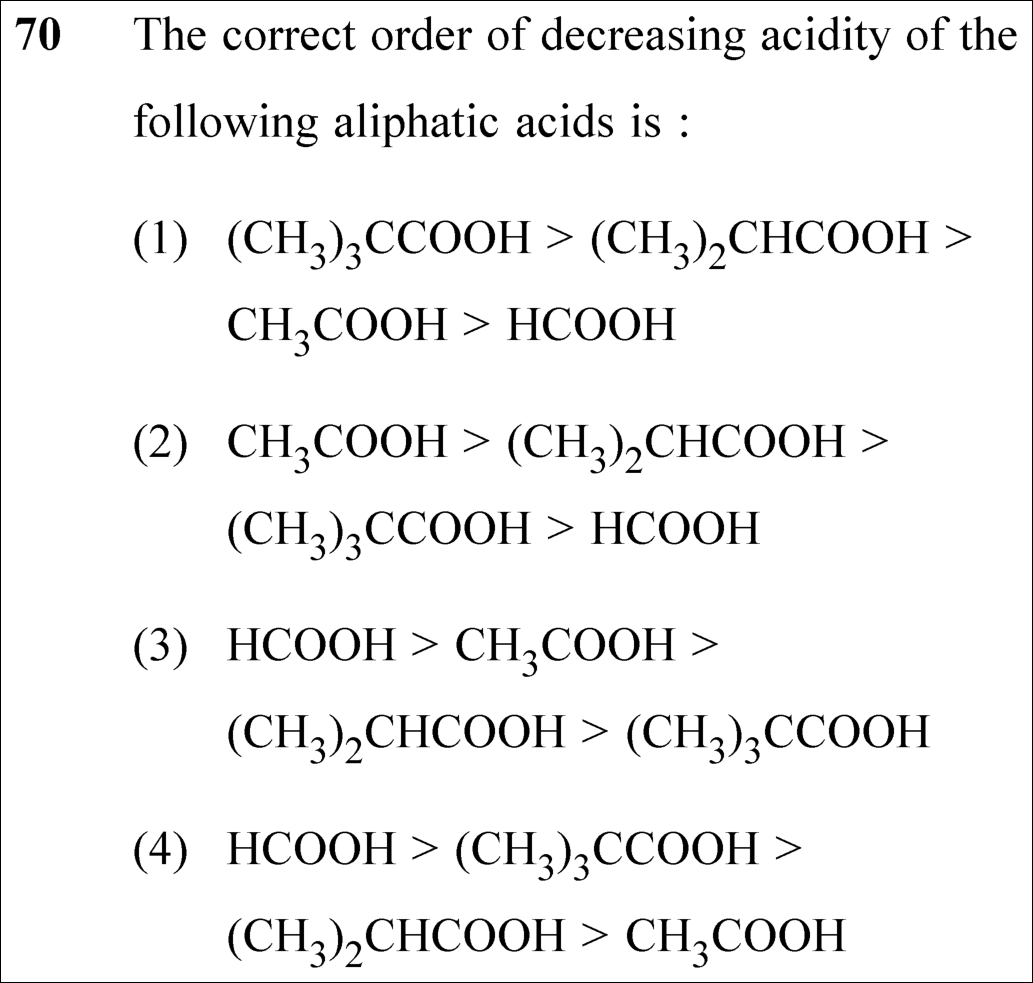
NEET 2025 Chemistry Question 70: Decreasing Order of Acidity of Aliphatic Carboxylic Acids (+I Inductive Effect)

Question

The correct order of decreasing acidity of the following aliphatic acids is:

✓
Verified Against NTA Final Answer Key
Option (3) : HCOOH > CH₃COOH > (CH₃)₂CHCOOH > (CH₃)₃CCOOH
📚 Aldehydes, Ketones and Carboxylic Acids Easy
📋 Given Parameters & Problem Setup
Acid 1 HCOOH (Formic acid / Methanoic acid)
Acid 2 CH₃COOH (Acetic acid / Ethanoic acid)
Acid 3 (CH₃)₂CHCOOH (Isobutyric acid / 2-Methylpropanoic acid)
Acid 4 (CH₃)₃CCOOH (Pivalic acid / 2,2-Dimethylpropanoic acid)
⚡

The 30-Second Exam Hall Shortcut: ⚡ +I Inductive Charge Destabilization Rule

⏱️ Save ~30 seconds

Acidity ∝ 1 / (+I effect)! Alkyl groups push electron density into -COO⁻, destabilizing the conjugate base and reducing acidity! HCOOH has zero alkyl groups (STRONGEST). CH₃ has 1 methyl. (CH₃)₂CH has 2 methyls. (CH₃)₃C has 3 methyls (WEAKEST)! ⟹ HCOOH > CH₃COOH > (CH₃)₂CHCOOH > (CH₃)₃CCOOH!

1 Recall acidity determinant: Stronger acid produces a more stable conjugate base (carboxylate anion R-COO⁻).
2 Electron-donating groups (+I effect) intensify negative charge on the carboxylate oxygen, destabilizing the anion and decreasing acid strength.
3 Order of +I inductive effect: -C(CH₃)₃ (tertiary butyl) > -CH(CH₃)₂ (isopropyl) > -CH₃ (methyl) > -H.
4 Invert for acid strength: HCOOH > CH₃COOH > (CH₃)₂CHCOOH > (CH₃)₃CCOOH.
5 Select Option (3) in under 10 seconds!
🛡️
Why You Can 100% Trust This Shortcut: Electron-Withdrawing Substituent Effects on Carboxylic Acid Acidity (NCERT Chemistry · Aldehydes, Ketones and Carboxylic Acids).
📐

Step-by-Step Rigorous Workflow & Mathematical Proof

Step 1

Role of Inductive Effect in Carboxylate Anion Stability

Carboxylic acids dissociate in water to generate carboxylate anions and hydronium ions:

R-COOH+H2O⇌R-COO−+H3O+\text{R-COOH} + \text{H}_2\text{O} \rightleftharpoons \text{R-COO}^- + \text{H}_3\text{O}^+
  • • Any factor that disperses the negative charge stabilizes the carboxylate anion and increases acidity.
  • • Any factor that concentrates or intensifies the negative charge destabilizes the anion and decreases acidity.
Step 2

Compare +I Power of Alkyl Substituents

Alkyl groups are electron-releasing (+I) groups. As the size and branching of the alkyl group increases, its +I electron-donating power increases dramatically:

+I effect: −C(CH3)3>−CH(CH3)2>−CH3>−H+I \text{ effect: } -\text{C(CH}_3)_3 > -\text{CH(CH}_3)_2 > -\text{CH}_3 > -\text{H}
  • • In (CH₃)₃CCOOH, three electron-releasing methyl groups pump electron density into the carboxylate group, creating maximum destabilization of the anion (weakest acid).
  • • In HCOOH, there is no alkyl group attached to the carboxyl carbon, so there is no +I destabilization (strongest acid).
Step 3

Synthesize the Complete Acidity Order

Invert the +I hierarchy to obtain the decreasing acidity series:

Decreasing Acidity: HCOOH>CH3COOH>(CH3)2CHCOOH>(CH3)3CCOOH\text{Decreasing Acidity: } \text{HCOOH} > \text{CH}_3\text{COOH} > (\text{CH}_3)_2\text{CHCOOH} > (\text{CH}_3)_3\text{CCOOH}
  • • pK_a values: HCOOH (3.75) < CH₃COOH (4.76) < (CH₃)₂CHCOOH (4.86) < (CH₃)₃CCOOH (5.05).
  • • Matches Option (3) perfectly.
⭐

360° Option Elimination Engine Key Feature

Diagnose every choice: Know exactly why the right option works and why distractors fail.

4-Option Deep Scan
1 A
✗ Incorrect
Verdict & Scientific Reason:

Incorrect. Completely inverts the acidity order, treating +I groups as acid-strengthening.

⚠️
Student Fallacy (Why candidates pick this trap): Confusing electron-donating groups with electron-withdrawing groups.
2 B
✗ Incorrect
Verdict & Scientific Reason:

Incorrect. Falsely places formic acid (HCOOH) as the weakest acid.

⚠️
Student Fallacy (Why candidates pick this trap): Thinking formic acid is weaker than acetic acid.
3 C
✓ 100% Correct
Verdict & Scientific Reason:

100% correct. HCOOH is strongest, followed by acetic, isobutyric, and pivalic acid.

💡
Why this is airtight: None; flawless mastery of inductive effects.
4 D
✗ Incorrect
Verdict & Scientific Reason:

Incorrect. Scrambled middle order.

⚠️
Student Fallacy (Why candidates pick this trap): Inverting the branched alkyl sequence.
⚠️

NTA Trap Alert: Placing Acetic Acid Ahead of Formic Acid

Some students memorize that substituted acids can be stronger and mistakenly think CH₃COOH is stronger than HCOOH. In reality, HCOOH is significantly stronger than acetic acid (pK_a 3.75 vs 4.76) because H does not donate electrons by +I effect!

🛡️ How to avoid the -1 mark: Formic acid is ALWAYS the strongest among unsubstituted simple aliphatic acids!
📖

Core NEET Syllabus Standard

NEET Chemistry Core Syllabus · Aldehydes, Ketones and Carboxylic Acids Standard Benchmark
Core Scientific Principle Tested:

"+I electron donating groups decrease acidity: HCOOH > CH₃COOH > R₂CHCOOH > R₃CCOOH."

Syllabus Focus: Acidity of Carboxylic Acids & Effect of Substituents
✓ Core NEET UG Syllabus Anchor Syllabus & Academic Standards ↗
Less Alkyl = Stronger Acid: Formic > Acetic > Isobutyric > Pivalic (Option 3)!

Ready to attempt under real exam pressure?

Test your speed and accuracy in the authentic 180-minute timed NTA simulator.

Launch NEET 2025 CBT Test →

Spotted a mistake in this solution? Report an error (support@mycompetitiveexams.com)

⚖️ Legal & Fair Dealing Notice: Sourced from publicly released NEET 2025 question papers and NEET answer keys for private study, research, and non-commercial educational practice under Fair Dealing (Section 52(1)(a) of the Indian Copyright Act, 1957). Not affiliated with or endorsed by NTA or NMC.

Solve 4 NEET Questions a Day — One per Subject

Cover all 1,140 official NEET questions in 285 days at your own pace. Progress is saved on your device. No login needed.