MyCompetitiveExams Logo MyCompetitiveExams
Search 1,140+ Questions
Chapters, formulas, speed tricks
→
⚡ Brahmastra NEET 2027
720 MARKS

Dynamic 180-question full-length simulator mixed dynamically from all 6 years for 2027 & 2026 aspirants.

Launch Brahmastra 2027 Test →
Start Practice →
100% Free · No Login Required
Q.46 Chemistry ⭐ 360° Option Elimination Active
Vault ↗

NEET 2026 Chemistry Question 46 Solution

Topic: Aldehydes, Ketones and Carboxylic Acids & Haloalkanes · Official NTA Booklet Code 50
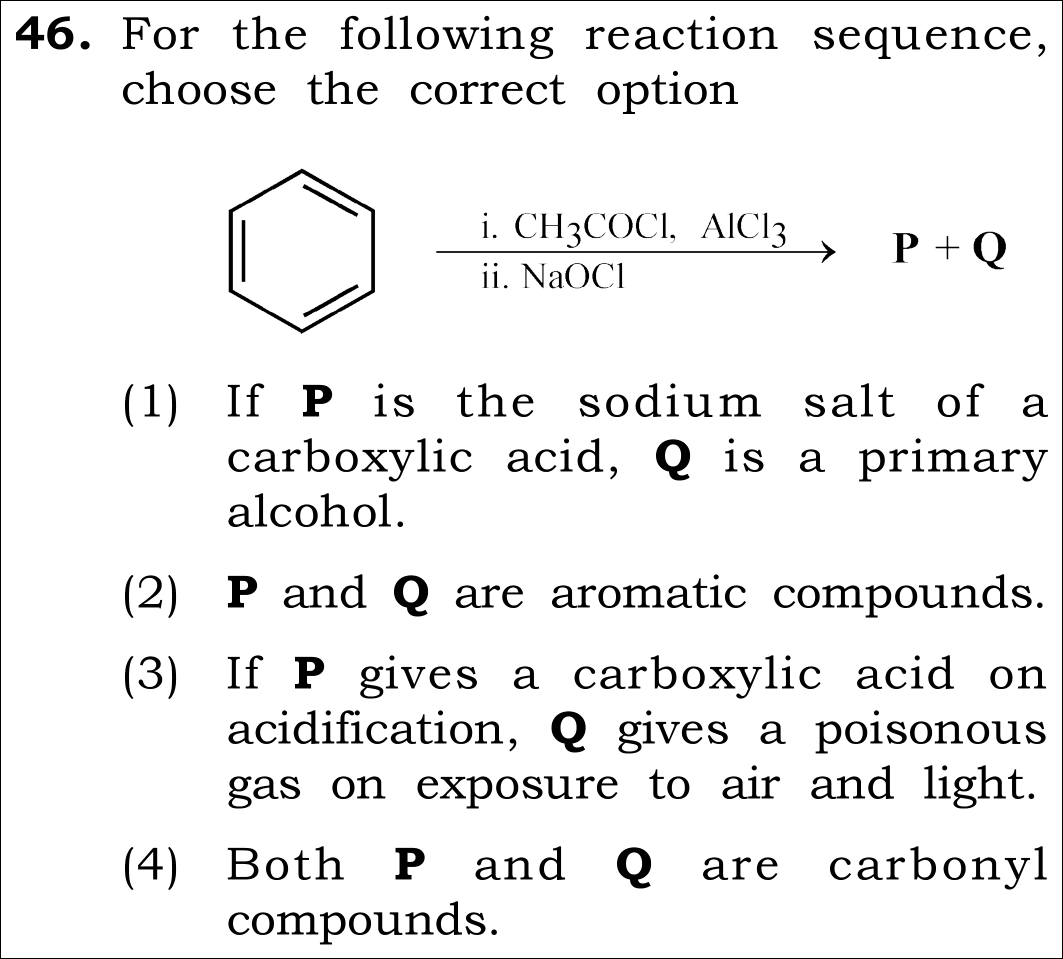
NEET 2026 Chemistry Question 46: Friedel-Crafts Acylation Followed by Haloform Cleavage

Question

For the following reaction sequence, choose the correct option: Benzene → i. CH₃COCl, AlCl₃ ii. NaOCl → P + Q

✓
Verified Against NTA Final Answer Key
Option (3) : If P gives a carboxylic acid on acidification, Q gives a poisonous gas on exposure to air and light.
📚 Aldehydes, Ketones and Carboxylic Acids & Haloalkanes Medium
📋 Given Parameters & Problem Setup
Starting Material Benzene (C₆H₆)
Reagent (i) CH₃COCl + Anhydrous AlCl₃ (Friedel-Crafts Acylation)
Reagent (ii) NaOCl (Sodium Hypochlorite / Haloform reagent)
Products P (carboxylate salt) + Q (haloform)
⚡

The 30-Second Exam Hall Shortcut: ⚡ The Methyl Ketone + Hypochlorite Fingerprint

⏱️ Save ~95 seconds

Spot the tandem: Benzene + Acetyl Chloride = Acetophenone (a methyl ketone). NaOCl is the textbook Haloform reagent!

1 Identify Intermediate: Benzene + CH₃COCl/AlCl₃ → Acetophenone (Ph-CO-CH₃).
2 Recognize Haloform Reagent: NaOCl = Cl₂ + NaOH. It cleaves the methyl ketone group into Sodium Benzoate (P) and Chloroform (Q = CHCl₃).
3 Direct Link to Statement 3: Chloroform (CHCl₃) when exposed to air and sunlight oxidizes into deadly Phosgene gas (COCl₂)! P upon acidification gives Benzoic Acid.
4 Zero doubt: Pick Option (3) immediately in 15 seconds!
🛡️
Why You Can 100% Trust This Shortcut: In standard organic chemistry, NaOCl is the definitive chlorinating oxidizer for haloform cleavage. The conversion of chloroform into poisonous phosgene (COCl₂) under sunlight is an established canonical reaction.
📐

Step-by-Step Rigorous Workflow & Mathematical Proof

Step 1

Electrophilic Aromatic Substitution: Friedel-Crafts Acylation

Benzene reacts with acetyl chloride in the presence of anhydrous aluminium chloride (Lewis acid catalyst). An acylium ion (CH₃-C⁺=O) is generated, which attacks the benzene ring to yield acetophenone.

C6H6+CH3COCl→anh. AlCl3C6H5COCH3+HCl\text{C}_6\text{H}_6 + \text{CH}_3\text{COCl} \xrightarrow{\text{anh. AlCl}_3} \text{C}_6\text{H}_5\text{COCH}_3 + \text{HCl}
  • • Electrophile: CH₃-C⁺=O (resonance-stabilized acylium cation).
  • • Product: Acetophenone (methyl phenyl ketone).
Step 2

Haloform Reaction with Sodium Hypochlorite (NaOCl)

Acetophenone contains the characteristic -COCH₃ group attached to carbon. Sodium hypochlorite (NaOCl), an aqueous mixture of chlorine and sodium hydroxide, oxidizes and halogenates the methyl ketone. Tri-alpha chlorination occurs followed by hydroxide attack and cleavage of the C-C bond to yield Sodium Benzoate (P) and Chloroform (Q).

C6H5COCH3+3NaOCl→C6H5COONa(P)+CHCl3(Q)+2NaOH\text{C}_6\text{H}_5\text{COCH}_3 + 3\text{NaOCl} \to \text{C}_6\text{H}_5\text{COONa} (P) + \text{CHCl}_3 (Q) + 2\text{NaOH}
  • • Product P: Sodium benzoate (C₆H₅COONa).
  • • Product Q: Chloroform / trichloromethane (CHCl₃).
Step 3

Chemical Properties of P and Q (Acidification & Atmospheric Oxidation)

Acidification of sodium benzoate (P) yields Benzoic Acid (C₆H₅COOH). When chloroform (Q) is exposed to atmospheric oxygen in the presence of sunlight, it undergoes slow photochemical oxidation to form carbonyl chloride (Phosgene, COCl₂), an extremely poisonous gas.

2CHCl3+O2→light2COCl2 (Phosgene, poisonous)+2HCl2\text{CHCl}_3 + \text{O}_2 \xrightarrow{\text{light}} 2\text{COCl}_2\text{ (Phosgene, poisonous)} + 2\text{HCl}
  • • Acidification: C₆H₅COONa + H⁺ → C₆H₅COOH (Benzoic acid).
  • • Safety protocol in labs: Chloroform is stored in dark amber bottles filled to the brim with 1% ethanol added as a stabilizer.
⭐

360° Option Elimination Engine Key Feature

Diagnose every choice: Know exactly why the right option works and why distractors fail.

4-Option Deep Scan
1 A
✗ Incorrect
Verdict & Scientific Reason:

Completely false. P is sodium benzoate (C₇H₅O₂Na) and Q is chloroform (CHCl₃); their molecular weights and atom compositions are entirely different.

⚠️
Student Fallacy (Why candidates pick this trap): Confusing functional group cleavage with a rearrangement reaction.
2 B
✗ Incorrect
Verdict & Scientific Reason:

Incorrect. Neither an alcohol nor an ether is generated in haloform cleavage of a methyl ketone.

⚠️
Student Fallacy (Why candidates pick this trap): Assuming reduction or substitution rather than haloform cleavage.
3 C
✓ 100% Correct
Verdict & Scientific Reason:

Scientifically rigorous. P = Sodium benzoate (acidifies to Benzoic Acid) and Q = Chloroform (oxidizes to poisonous Phosgene gas COCl₂).

💡
Why this is airtight: None; matches the textbook oxidation mechanism of chloroform.
4 D
✗ Incorrect
Verdict & Scientific Reason:

Incorrect. Chloroform (CHCl₃) with base undergoes alpha-elimination to generate dichlorocarbene (:CCl₂), or hydrolyzes to sodium formate (HCOONa), not an alkene.

⚠️
Student Fallacy (Why candidates pick this trap): Thinking of dehydrohalogenation of an alkyl halide to form an alkene (which requires at least 2 carbon atoms).
⚠️

NTA Trap Alert: Forgetting the Storage Danger of Chloroform

Students frequently remember the haloform mechanism but forget the industrial toxicology of chloroform (photochemical oxidation to phosgene COCl₂).

🛡️ How to avoid the -1 mark: Always remember: Chloroform (CHCl₃) + sunlight + air = deadly Phosgene (COCl₂). That is why 1% ethanol is added to commercial chloroform.
📖

Core NEET Syllabus Standard

NEET Chemistry Core Syllabus · Aldehydes, Ketones & Haloalkanes Standard Benchmark
Core Scientific Principle Tested:

"Methyl ketones undergo hypohalite cleavage to yield carboxylate salts and trihalomethanes. Chloroform photochemically oxidizes to phosgene."

Syllabus Focus: Haloform reaction and oxidation of polyhalogen compounds
✓ Core NEET UG Syllabus Anchor Syllabus & Academic Standards ↗
Methyl ketone + Hypochlorite = Benzoate (P) + Chloroform (Q). Chloroform + Sun = Phosgene poison!

Ready to attempt under real exam pressure?

Test your speed and accuracy in the authentic 180-minute timed NTA simulator.

Launch NEET 2026 CBT Test →

Spotted a mistake in this solution? Report an error (support@mycompetitiveexams.com)

⚖️ Legal & Fair Dealing Notice: Sourced from publicly released NEET 2026 question papers and NEET answer keys for private study, research, and non-commercial educational practice under Fair Dealing (Section 52(1)(a) of the Indian Copyright Act, 1957). Not affiliated with or endorsed by NTA or NMC.

Solve 4 NEET Questions a Day — One per Subject

Cover all 1,140 official NEET questions in 285 days at your own pace. Progress is saved on your device. No login needed.