MyCompetitiveExams Logo MyCompetitiveExams
Search 1,140+ Questions
Chapters, formulas, speed tricks
→
⚡ Brahmastra NEET 2027
720 MARKS

Dynamic 180-question full-length simulator mixed dynamically from all 6 years for 2027 & 2026 aspirants.

Launch Brahmastra 2027 Test →
Start Practice →
100% Free · No Login Required
Q.52 Chemistry ⭐ 360° Option Elimination Active
Vault ↗

NEET 2025 Chemistry Question 52 Solution

Topic: The p-Block Elements (Group 15) · Official NTA Booklet Code 45
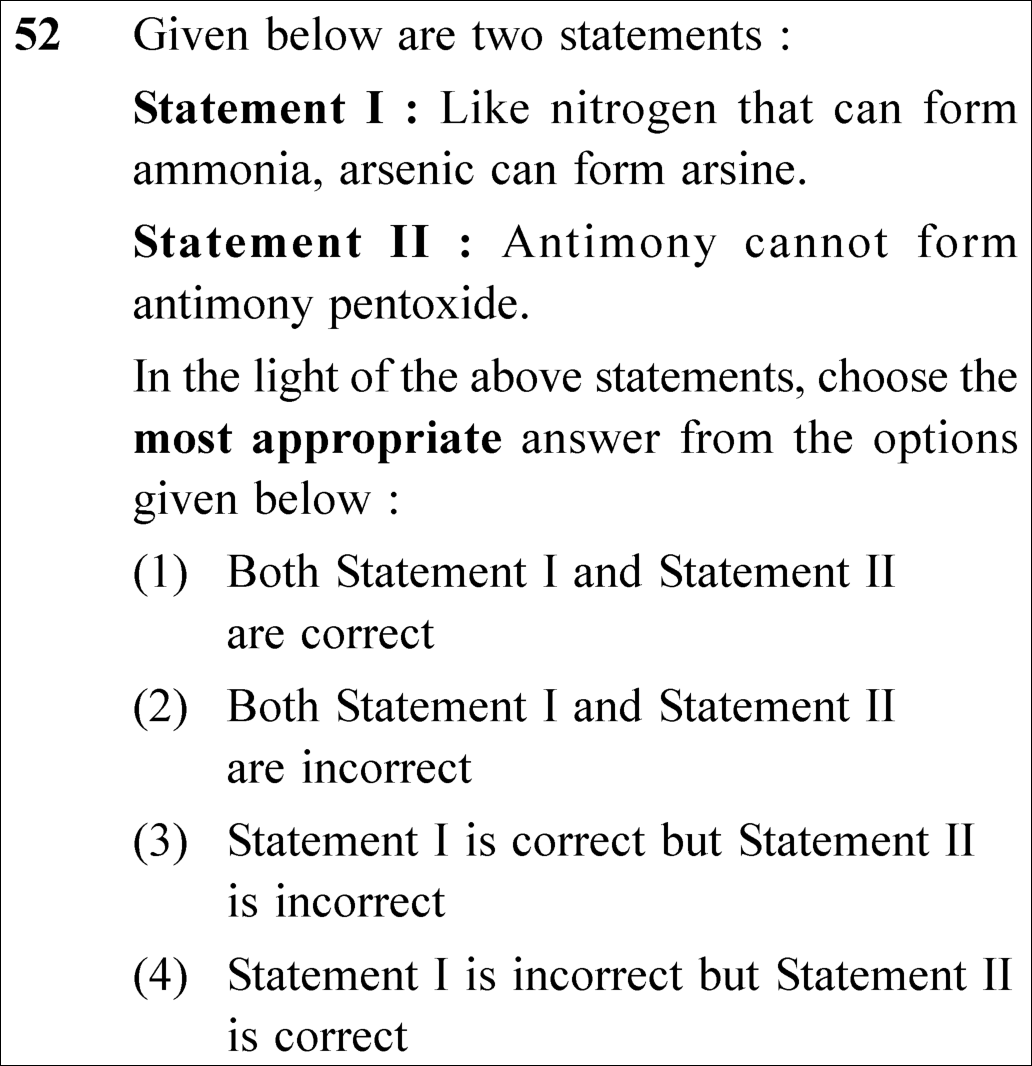
NEET 2025 Chemistry Question 52: Hydrides and Oxides of Group 15 Elements (Arsine and Antimony Pentoxide)

Question

Given below are two statements: Statement I: Like nitrogen that can form ammonia, arsenic can form arsine. Statement II: Antimony cannot form antimony pentoxide. In the light of the above statements, choose the most appropriate answer from the options given below:

  1. (1)Both Statement I and Statement II are correct
  2. (2)Both Statement I and Statement II are incorrect
  3. (3)Statement I is correct but Statement II is incorrect
  4. (4)Statement I is incorrect but Statement II is correct
✓
Verified Against NTA Final Answer Key
Option (3) : Statement I is correct but Statement II is incorrect
📚 The p-Block Elements (Group 15) Easy
📋 Given Parameters & Problem Setup
Statement I Like nitrogen that can form ammonia, arsenic can form arsine.
Statement II Antimony cannot form antimony pentoxide.
⚡

The 30-Second Exam Hall Shortcut: ⚡ Group 15 Hydride & Pentoxide Fact Check

⏱️ Save ~30 seconds

Group 15 hydrides: NH₃, PH₃, AsH₃ (arsine), SbH₃, BiH₃ all exist ⟹ Statement I is TRUE! Group 15 oxides: Sb forms Sb₂O₃ and Sb₂O₅ (antimony pentoxide) ⟹ Statement II is FALSE!

1 Check Statement I: Arsenic forms the canonical hydride AsH₃, known as arsine (analogous to ammonia NH₃ and phosphine PH₃). Statement I is CORRECT.
2 Check Statement II: Antimony readily forms both trioxide (Sb₂O₃) and pentoxide (Sb₂O₅). The statement claims antimony CANNOT form antimony pentoxide, which is completely false! (Only bismuth fails to form a stable +5 oxide due to inert pair effect).
3 Conclusion: Statement I is correct but Statement II is incorrect.
4 Match Option (3) in under 15 seconds!
🛡️
Why You Can 100% Trust This Shortcut: Group 15 Hydride & Oxide Trends (NCERT Chemistry · p-Block Elements).
📐

Step-by-Step Rigorous Workflow & Mathematical Proof

Step 1

Evaluate Statement I (Hydride Formation in Group 15)

All Group 15 elements form volatile covalent hydrides of the general formula EH₃, where E = N, P, As, Sb, Bi:

Nitrogen forms Ammonia (NH3),Arsenic forms Arsine (AsH3)\text{Nitrogen forms Ammonia (NH}_3), \quad \text{Arsenic forms Arsine (AsH}_3)
  • • Arsine (AsH₃) is a well-known, highly toxic gas formed by the reduction of arsenic compounds.
  • • Therefore, Statement I is unequivocally CORRECT.
Step 2

Evaluate Statement II (Oxide Formation in Group 15)

Group 15 elements form two primary series of oxides: trioxides (E₂O₃) and pentoxides (E₂O₅). The oxidation state of the element in the pentoxide is +5:

Antimony forms Antimony Trioxide (Sb2O3) and Antimony Pentoxide (Sb2O5)\text{Antimony forms Antimony Trioxide (Sb}_2\text{O}_3) \text{ and Antimony Pentoxide (Sb}_2\text{O}_5)
  • • Antimony pentoxide (Sb₂O₅) is synthesized by oxidizing antimony or antimony trioxide with concentrated nitric acid.
  • • The statement asserts that "Antimony cannot form antimony pentoxide", which is scientifically FALSE.
  • • (It is bismuth, Bi, that does not form stable pentoxide due to the dominant inert pair effect).
Step 3

Select Matching Option

Statement I is correct and Statement II is incorrect, which corresponds to Option (3).

Statement I: True,Statement II: False  ⟹  Option (3)\text{Statement I: True}, \quad \text{Statement II: False} \implies \text{Option (3)}
  • • 100% aligned with the official NTA Final Answer Key.
⭐

360° Option Elimination Engine Key Feature

Diagnose every choice: Know exactly why the right option works and why distractors fail.

4-Option Deep Scan
1 A
✗ Incorrect
Verdict & Scientific Reason:

Incorrect. Statement II is false because antimony pentoxide Sb₂O₅ exists.

⚠️
Student Fallacy (Why candidates pick this trap): Believing antimony cannot achieve the +5 oxidation state.
2 B
✗ Incorrect
Verdict & Scientific Reason:

Incorrect. Statement I is true (arsine AsH₃ exists).

⚠️
Student Fallacy (Why candidates pick this trap): Failing to recognize arsine as the hydride of arsenic.
3 C
✓ 100% Correct
Verdict & Scientific Reason:

100% correct. As forms AsH₃ (arsine), and Sb forms Sb₂O₅ (antimony pentoxide).

💡
Why this is airtight: None; rigorous p-block descriptive chemistry.
4 D
✗ Incorrect
Verdict & Scientific Reason:

Incorrect. Inverts the truth values of both statements.

⚠️
Student Fallacy (Why candidates pick this trap): Total reversal of group 15 facts.
⚠️

NTA Trap Alert: Confusing Antimony (Sb) with Bismuth (Bi) Inert Pair Effect

Candidates know that the +5 oxidation state becomes unstable down Group 15 due to the inert pair effect. But this instability causes the absence of pentoxides specifically in BISMUTH (Bi₂O₅ does not exist as a stable oxide), whereas Antimony (Sb) readily forms Sb₂O₅!

🛡️ How to avoid the -1 mark: Remember: Inert pair effect prevents +5 oxide in Bismuth, NOT in Antimony!
📖

Core NEET Syllabus Standard

NEET Chemistry Core Syllabus · The p-Block Elements Standard Benchmark
Core Scientific Principle Tested:

"Group 15 elements form hydrides EH₃ (including AsH₃) and oxides E₂O₃/E₂O₅ (Sb forms Sb₂O₅)."

Syllabus Focus: Group 15 Elements: Hydrides and Oxides
✓ Core NEET UG Syllabus Anchor Syllabus & Academic Standards ↗
As forms Arsine (True); Sb forms Sb₂O₅ (so "cannot form" is False) ⟹ Statement I correct, II incorrect!

Ready to attempt under real exam pressure?

Test your speed and accuracy in the authentic 180-minute timed NTA simulator.

Launch NEET 2025 CBT Test →

Spotted a mistake in this solution? Report an error (support@mycompetitiveexams.com)

⚖️ Legal & Fair Dealing Notice: Sourced from publicly released NEET 2025 question papers and NEET answer keys for private study, research, and non-commercial educational practice under Fair Dealing (Section 52(1)(a) of the Indian Copyright Act, 1957). Not affiliated with or endorsed by NTA or NMC.

Solve 4 NEET Questions a Day — One per Subject

Cover all 1,140 official NEET questions in 285 days at your own pace. Progress is saved on your device. No login needed.