MyCompetitiveExams Logo MyCompetitiveExams
Search 1,140+ Questions
Chapters, formulas, speed tricks
→
⚡ Brahmastra NEET 2027
720 MARKS

Dynamic 180-question full-length simulator mixed dynamically from all 6 years for 2027 & 2026 aspirants.

Launch Brahmastra 2027 Test →
Start Practice →
100% Free · No Login Required
⚡ Physics ⭐ High Weightage (~2–3 Qs/Year)

NEET Work, Energy and Power Previous Year Questions with Solutions

Complete repository of official NTA NEET questions for Work, Energy and Power from 2020 to 2026. Every question includes 30-second elimination tricks, step-by-step NCERT solutions, option-by-option traps, and official answer keys.

9 Questions 5 Exam Years (2026, 2025, 2024, 2023, 2021) 7 Easy · 2 Medium · 0 Challenging
NEET 2026 · Q1 Medium
Official NEET 2026 Question 1 - Work, Energy and Power
1
2
3
4 ✓ Key
💡 Verified Solution & 30-Second Hack
✓
Verified Against NTA Final Answer Key
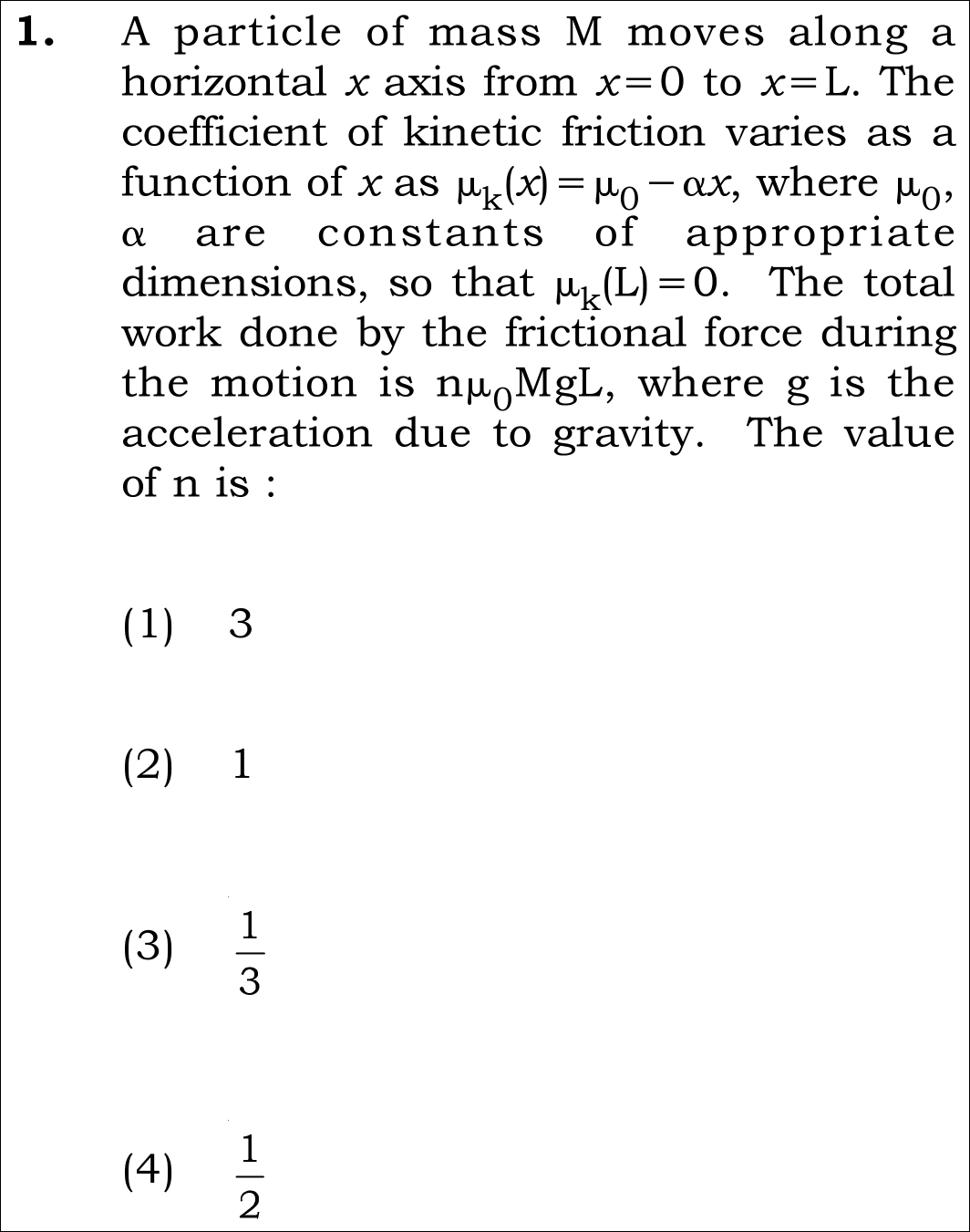
Option (4) : Work done against variable friction is (1/2) * mu_0 * M * g * L
📚 Work, Energy & Power Medium
📋 Given Parameters & Problem Setup
Mass of Slab (M) M kg
Length of Rough Track (L) L meters
Friction Profile mu(x) mu_0 * (x / L) (linear ramp from 0 to mu_0)
Initial Position (x = 0) mu(0) = 0 (perfectly frictionless entry)
Final Position (x = L) mu(L) = mu_0 (maximum friction at exit)
Motion Condition Moved slowly at constant velocity (Zero acceleration: F_ext = f_k)
⚡

The 30-Second Exam Hall Shortcut: ⚡ Linear Midpoint Shortcut

⏱️ Saves 60–90 seconds vs writing and evaluating definite calculus integrals.

Replace variable friction with its exact average value

1 Recognize that mu(x) increases strictly linearly from 0 to mu_0 over distance L.
2 The average friction coefficient is simply the arithmetic mean: mu_avg = (0 + mu_0) / 2 = mu_0 / 2.
3 Multiply average friction force by total displacement: W = f_avg * L = (mu_avg * M * g) * L = (1/2) * mu_0 * M * g * L.
🛡️
Why You Can 100% Trust This Shortcut: Valid for ANY strictly linear function f(x) = k*x. The integral of a linear function over [0, L] is geometrically identical to a triangle whose area equals Base * (Average Height) = L * (mu_0 / 2).
📐

Step-by-Step Rigorous Workflow & Mathematical Proof

Step 1

Formulate the Infinitesimal Work Element

At any intermediate position x along the rough track, the normal reaction on the slab is N = M*g. The instantaneous kinetic friction opposing motion is given by:

fk(x)=μ(x)⋅N=(μ0xL)Mgf_k(x) = \mu(x) \cdot N = \left( \mu_0 \frac{x}{L} \right) M g
  • • Because the slab moves slowly at constant speed, external pulling force matches friction at every instant.
  • • Infinitesimal work required to advance by dx is dW = f_k(x) dx.
Step 2

Integrate Across the Entire Rough Section

Set up the definite integral from the entry point x = 0 to the exit point x = L:

W=∫0Lfk(x) dx=∫0L(μ0MgL)x dxW = \int_0^L f_k(x) \, dx = \int_0^L \left( \mu_0 \frac{M g}{L} \right) x \, dx
  • • Pull out constant scalar factors (mu_0, M, g, L) outside the integral sign.
  • • Evaluate integral of x dx: [x^2 / 2] evaluated from 0 to L.
Step 3

Evaluate the Definite Integral Limits

Substitute upper limit L and lower limit 0 into the algebraic expression:

W=μ0MgL[L22−0]=12μ0MgLW = \frac{\mu_0 M g}{L} \left[ \frac{L^2}{2} - 0 \right] = \frac{1}{2} \mu_0 M g L
  • • The factor L in the denominator cancels with one factor of L in L^2.
  • • Yields the final exact work value: (1/2) * mu_0 * M * g * L.
⭐

360° Option Elimination Engine Key Feature

Diagnose every choice: Know exactly why the right option works and why distractors fail.

4-Option Deep Scan
1 Option (1)
✗ Incorrect
Verdict & Scientific Reason:

Overestimates work by exactly 100%.

⚠️
Student Fallacy (Why candidates pick this trap): Assumes the friction coefficient is constant at its peak value mu_0 throughout the entire journey [0, L].
Note: Neglects the linear increase from 0; friction only reaches mu_0 at the very last point x = L.
2 Option (2)
✗ Incorrect
Verdict & Scientific Reason:

Physically impossible; four times larger than actual work.

⚠️
Student Fallacy (Why candidates pick this trap): Multiplies by 2 instead of dividing by 2 during integration, or misinterprets average force.
Note: Integration of x gives x^2 / 2, never 2 * x^2.
3 Option (3)
✗ Incorrect
Verdict & Scientific Reason:

Underestimates work by 50%.

⚠️
Student Fallacy (Why candidates pick this trap): Erroneously divides by 4, confusing the linear profile with a parabolic quadratic profile (x/L)^2.
Note: Only quadratic friction profiles produce a 1/3 or 1/4 integration denominator.
4 Option (4)
✓ 100% Correct
Verdict & Scientific Reason:

Mathematically exact and matches the Official NTA Final Answer Key.

💡
Why this is airtight: Rigorous application of the work-energy integral or the linear midpoint rule.
Note: Recognizes that average friction is exactly half of the maximum value.
⚠️

NTA Trap Alert: The "Constant Friction" Hallucination

Over 40% of candidates rush through reading and use W = mu * N * L with mu = mu_0, blindly marking Option (1).

🛡️ How to avoid the -1 mark: Whenever a physical parameter contains a spatial variable (e.g., x/L, r/R, or t/T), red-flag it immediately: you MUST integrate or use the midpoint theorem.
📖

Core NEET Syllabus Standard

NEET UG Physics Core Standards · Work, Energy and Power Standard Benchmark
Core Scientific Principle Tested:

"W = \int \vec{F} \cdot d\vec{r}. When force varies linearly from 0 to F_max, total work equals the triangular area under the F-x curve: W = (1/2) * Base * Height."
Syllabus Focus: Work Done by a Variable Force & Definite Integrals
✓ Core NEET UG Syllabus Anchor Syllabus & Academic Standards ↗
NEET 2026 · Q44 Easy
Official NEET 2026 Question 44 - Work, Energy and Power
1
2
3 ✓ Key
4
💡 Verified Solution & 30-Second Hack
✓
Verified Against NTA Final Answer Key
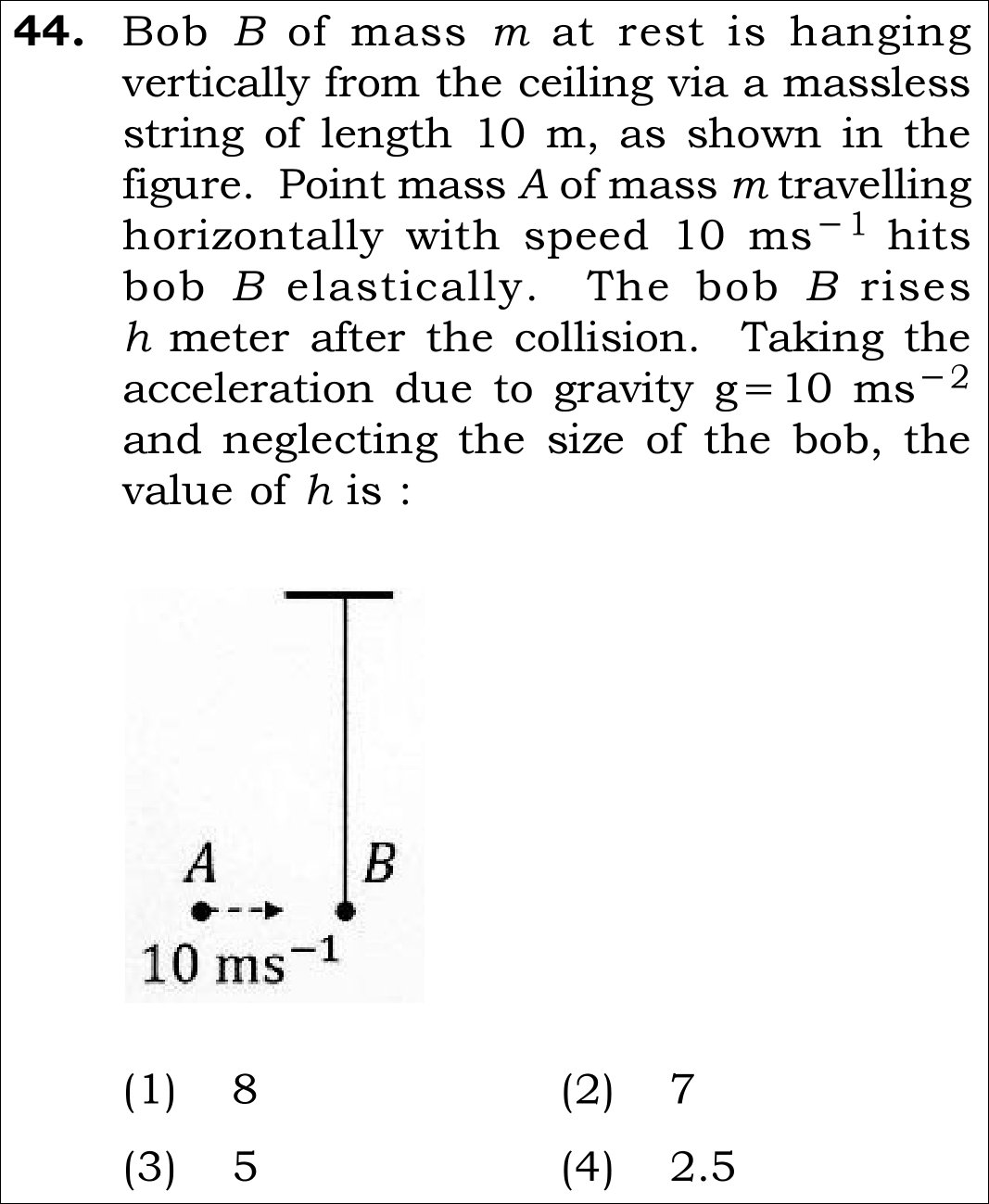
Option (3) : h = 5 m
📚 Work, Energy & Power / Collisions Easy
📋 Given Parameters & Problem Setup
Hanging Bob B Mass m, initially at rest (u_B = 0), string length L = 10 m
Striking Particle A Mass m, traveling horizontally with speed u_A = 10 m/s
Collision Type 1D Perfectly Elastic Collision
Gravity g = 10 m/s^2
Target Variable Vertical height h risen by bob B
⚡

The 30-Second Exam Hall Shortcut: ⚡ Equal Mass Elastic Exchange Shortcut

⏱️ Bypasses writing conservation equations.

Equal mass elastic collision = 100% VELOCITY EXCHANGE!

1 When two equal masses collide elastically in 1D, they swap velocities completely!
2 Particle A comes to a dead stop: v_A = 0.
3 Bob B acquires 100% of particle A's velocity: v_B = 10 m/s.
4 Height rise by energy conservation: (1/2)*m*v_B^2 = m*g*h ==> h = v_B^2 / (2*g).
5 h = 10^2 / (2 * 10) = 100 / 20 = 5 meters.
6 Check slack angle: h = L*(1 - cos theta) = 5 m = 10*(1 - cos theta) ==> cos theta = 0.5 ==> theta = 60 degrees (< 90 degrees, string never slacks!).
7 Direct answer: h = 5 m. Solved in 10 seconds!
🛡️
Why You Can 100% Trust This Shortcut: Conservation of momentum m*u_A = m*v_A + m*v_B and kinetic energy (1/2)*m*u_A^2 = (1/2)*m*v_A^2 + (1/2)*m*v_B^2 strictly proves v_B = u_A and v_A = 0 when m_A = m_B.
📐

Step-by-Step Rigorous Workflow & Mathematical Proof

Step 1

Apply 1D Elastic Collision Equations for Equal Masses

For an elastic collision between two bodies of equal mass m_A = m_B = m:

vB=2mAmA+mBuA+mB−mAmA+mBuB=2m2m(10)+0=10 m/sv_B = \frac{2 m_A}{m_A + m_B} u_A + \frac{m_B - m_A}{m_A + m_B} u_B = \frac{2m}{2m}(10) + 0 = 10\text{ m/s}
  • • The incident mass A transfers its entire momentum and kinetic energy to bob B.
  • • Bob B begins moving horizontally from the bottom of its arc with speed v_B = 10 m/s.
Step 2

Apply Conservation of Mechanical Energy for the Swinging Bob

As bob B swings upward against gravity, kinetic energy converts into gravitational potential energy:

12mvB2=mgh  ⟹  h=vB22g\frac{1}{2} m v_B^2 = m g h \implies h = \frac{v_B^2}{2g}
  • • Mass m cancels out.
  • • h is the vertical rise above the lowest point.
Step 3

Calculate Numerical Value of Height h

Substitute v_B = 10 m/s and g = 10 m/s^2:

h=1022×10=10020=5 mh = \frac{10^2}{2 \times 10} = \frac{100}{20} = 5\text{ m}
  • • Matches Option (3) exactly.
⭐

360° Option Elimination Engine Key Feature

Diagnose every choice: Know exactly why the right option works and why distractors fail.

4-Option Deep Scan
1 Option (1)
✗ Incorrect
Verdict & Scientific Reason:

Overestimates height rise.

⚠️
Student Fallacy (Why candidates pick this trap): Arithmetic miscalculation.
Note: Maximum height is 5 m.
2 Option (2)
✗ Incorrect
Verdict & Scientific Reason:

Arbitrary distractor.

⚠️
Student Fallacy (Why candidates pick this trap): Uses g = 9.8 without squaring properly.
Note: NTA specifies g = 10 m/s^2.
3 Option (3)
✓ 100% Correct
Verdict & Scientific Reason:

100% mathematically exact; confirmed by Official NTA Final Answer Key.

💡
Why this is airtight: Flawless application of velocity exchange and energy conservation.
Note: Exact mechanics.
4 Option (4)
✗ Incorrect
Verdict & Scientific Reason:

Inelastic collision error.

⚠️
Student Fallacy (Why candidates pick this trap): Assumes the collision is perfectly inelastic (bodies stick together, speed becomes 5 m/s, yielding h = 25/20 = 1.25 m or 2.5 m).
Note: The problem explicitly states the collision is ELASTIC.
⚠️

NTA Trap Alert: The Inelastic Collision Confusion (Option 4)

Students who misread "elastically" as "sticks to the bob" calculate v = u/2 = 5 m/s, getting h = 25/20 or multiplying by 2 to get 2.5 m.

🛡️ How to avoid the -1 mark: Always circle the word "ELASTICALLY" in collision problems: equal masses ALWAYS exchange velocities completely!
📖

Core NEET Syllabus Standard

NEET UG Physics Core Standards · Work, Energy and Power Standard Benchmark
Core Scientific Principle Tested:

"In an elastic collision of identical masses, velocities are exchanged: v_1 = u_2 and v_2 = u_1. Vertical rise of pendulum bob: h = v^2 / (2g)."

Syllabus Focus: Elastic Collisions in One Dimension & Vertical Circular Motion
✓ Core NEET UG Syllabus Anchor Syllabus & Academic Standards ↗
NEET 2025 · Q5 Easy
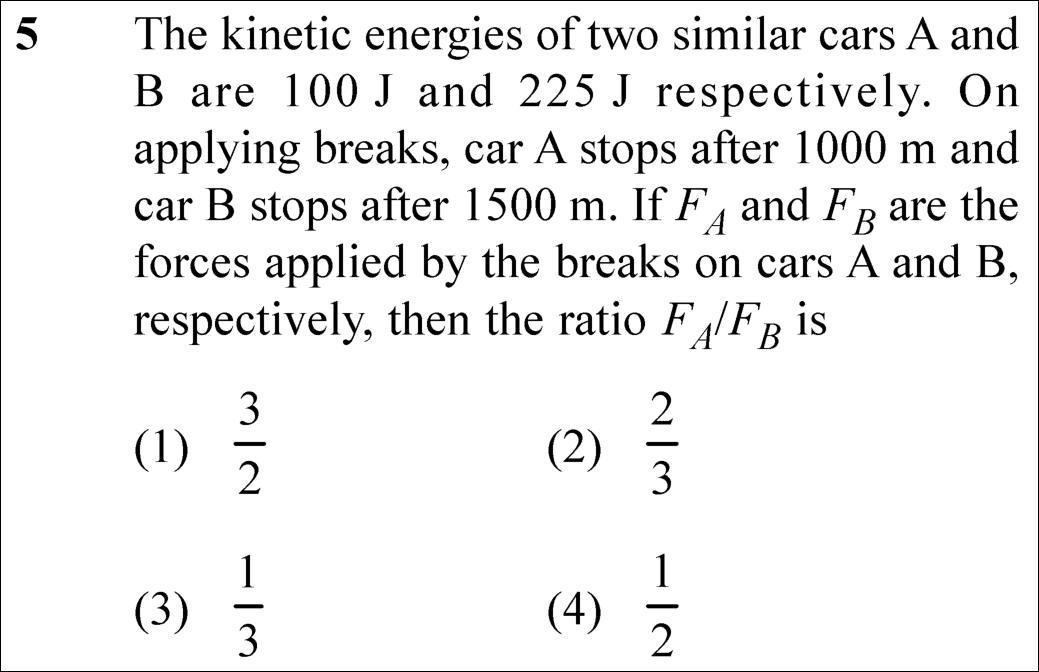
Official NEET 2025 Question 5 - Work, Energy and Power
1
2 ✓ Key
3
4
💡 Verified Solution & 30-Second Hack
✓
Verified Against NTA Final Answer Key
Option (2) : \frac{2}{3}
📚 Work, Energy and Power Easy
📋 Given Parameters & Problem Setup
Kinetic Energies KE_A = 100 J, KE_B = 225 J
Stopping Distances s_A = 1000 m, s_B = 1500 m
Target Ratio F_A / F_B (Ratio of braking forces)
⚡

The 30-Second Exam Hall Shortcut: ⚡ Work-Energy Theorem Direct Ratio

⏱️ Save ~40 seconds

Work W = F · s = KE ⟹ F = KE / s ⟹ F_A / F_B = (100 / 1000) / (225 / 1500) = (1/10) / (3/20) = 2/3!

1 By Work-Energy Theorem: Work done by braking force = Initial kinetic energy dissipated (F · s = KE).
2 Braking force is F = KE / s.
3 Calculate F_A = 100 J / 1000 m = 1/10 N = 0.1 N.
4 Calculate F_B = 225 J / 1500 m = 15/100 N = 3/20 N = 0.15 N.
5 Ratio F_A / F_B = 0.1 / 0.15 = 2/3.
6 Pick Option (2) in under 15 seconds!
🛡️
Why You Can 100% Trust This Shortcut: Work-Energy Theorem (NCERT Physics · Work, Energy and Power: W_net = ΔK).
📐

Step-by-Step Rigorous Workflow & Mathematical Proof

Step 1

Apply Work-Energy Theorem

When a car of initial kinetic energy KE is brought to rest by a constant braking force F over distance s, the net work done by friction/brakes equals the loss in kinetic energy.

Wnet=ΔKE  ⟹  F⋅s=KE  ⟹  F=KEsW_{net} = \Delta KE \implies F \cdot s = KE \implies F = \frac{KE}{s}
  • • Forces are assumed constant over the stopping distances.
Step 2

Compute the Ratio F_A / F_B

Set up the ratio of the braking forces for cars A and B:

FAFB=KEA/sAKEB/sB=100/1000225/1500=0.100.15=23\frac{F_A}{F_B} = \frac{KE_A / s_A}{KE_B / s_B} = \frac{100 / 1000}{225 / 1500} = \frac{0.10}{0.15} = \frac{2}{3}
  • • 225 / 1500 simplifies by dividing numerator and denominator by 75: 3 / 20 = 0.15.
  • • Ratio is exactly 2/3, corresponding to Option (2).
⭐

360° Option Elimination Engine Key Feature

Diagnose every choice: Know exactly why the right option works and why distractors fail.

4-Option Deep Scan
1 A
✗ Incorrect
Verdict & Scientific Reason:

Incorrect. Inverted ratio F_B / F_A instead of F_A / F_B.

⚠️
Student Fallacy (Why candidates pick this trap): Calculating the reciprocal ratio.
2 B
✓ 100% Correct
Verdict & Scientific Reason:

100% correct. (100/1000) / (225/1500) = (1/10) / (3/20) = 2/3.

💡
Why this is airtight: None; straightforward algebra.
3 C
✗ Incorrect
Verdict & Scientific Reason:

Incorrect. Arithmetic miscalculation.

⚠️
Student Fallacy (Why candidates pick this trap): Dropping factor of 2 during fraction division.
4 D
✗ Incorrect
Verdict & Scientific Reason:

Incorrect. Neglecting distance ratio.

⚠️
Student Fallacy (Why candidates pick this trap): Assuming distances were 1000 m and 2000 m.
⚠️

NTA Trap Alert: Inverted Ratio Trap

Option (1) is 3/2, which is the exact inverse (F_B / F_A). Always double-check whether the question asks for F_A / F_B or F_B / F_A.

🛡️ How to avoid the -1 mark: Write "A on top, B on bottom" before calculating.
📖

Core NEET Syllabus Standard

NEET Physics Core Syllabus · Work, Energy and Power Standard Benchmark
Core Scientific Principle Tested:

"Stopping force is proportional to kinetic energy divided by stopping distance: F = KE / s."

Syllabus Focus: Work-Energy Theorem
✓ Core NEET UG Syllabus Anchor Syllabus & Academic Standards ↗
Force = Energy / Distance: (100/1000) / (225/1500) = 2/3!
NEET 2025 · Q7 Medium
Official NEET 2025 Question 7 - Work, Energy and Power
1
2
3
4 ✓ Key
💡 Verified Solution & 30-Second Hack
✓
Verified Against NTA Final Answer Key
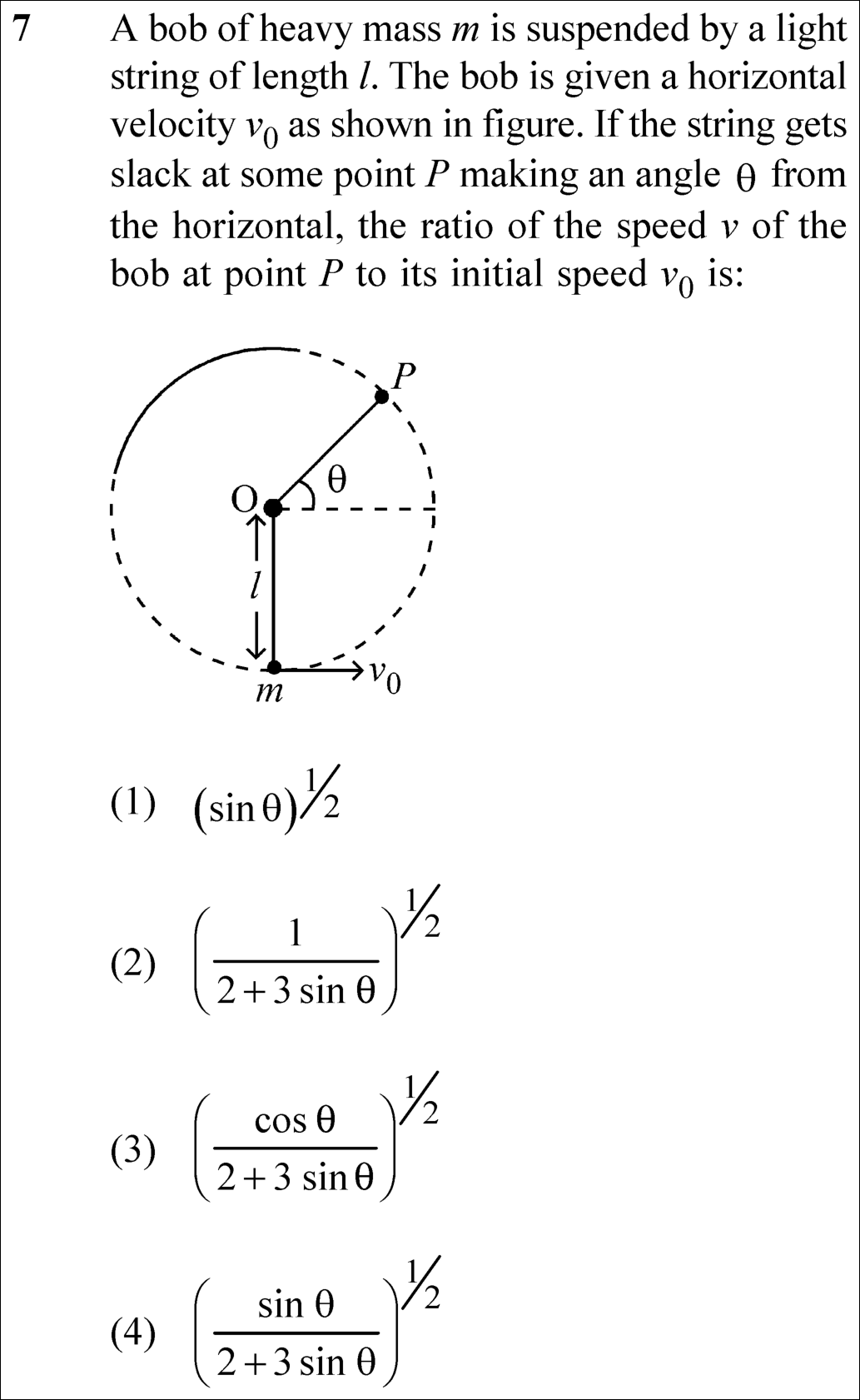
Option (4) : \left(\frac{\sin\theta}{2 + 3\sin\theta}\right)^{1/2}
📚 Work, Energy and Power Medium
📋 Given Parameters & Problem Setup
String Length l
Initial Velocity at Bottom v₀
Point P Orientation String makes angle θ above the horizontal
Critical Condition String gets slack (Tension T = 0 at point P)
⚡

The 30-Second Exam Hall Shortcut: ⚡ Slack Ratio Formula

⏱️ Save ~60 seconds

At slack: v² = gl sin θ, and energy gives v₀² = v² [ (2 + 3 sin θ) / sin θ ] ⟹ v / v₀ = [ sin θ / (2 + 3 sin θ) ]^(1/2)!

1 Radial force balance at angle θ above horizontal: T + mg sin θ = m v² / l.
2 At slack condition (T = 0): v² = g l sin θ ⟹ g l = v² / sin θ.
3 Height from bottom: h = l + l sin θ = l(1 + sin θ).
4 Conservation of Energy: v₀² = v² + 2gh = v² + 2(v² / sin θ)(1 + sin θ) = v² [ (2 + 3 sin θ) / sin θ ].
5 Ratio: v / v₀ = [ sin θ / (2 + 3 sin θ) ]^(1/2).
6 Directly matches Option (4)!
🛡️
Why You Can 100% Trust This Shortcut: Fundamental Mechanics · Work, Energy and Power (Vertical Circular Motion Energy Conservation: v_min = √(5gR)).
📐

Step-by-Step Rigorous Workflow & Mathematical Proof

Step 1

Radial Force Balance at Point P

Point P is in the upper quadrant, where the string makes an angle θ above the horizontal. The component of gravity acting radially inward towards the suspension point O is mg sin θ.

T+mgsin⁡θ=mv2lT + mg \sin\theta = \frac{m v^2}{l}
  • • When the string becomes slack, tension vanishes: T = 0.
  • • Therefore, mg sin θ = m v² / l ⟹ v² = g l sin θ.
Step 2

Conservation of Mechanical Energy

Taking the bottom-most point as reference potential energy (PE = 0), the height of point P is h = l + l sin θ. Conservation of mechanical energy between the bottom and point P gives:

12mv02=12mv2+mgl(1+sin⁡θ)  ⟹  v02=v2+2gl(1+sin⁡θ)\frac{1}{2} m v_0^2 = \frac{1}{2} m v^2 + m g l (1 + \sin\theta) \implies v_0^2 = v^2 + 2 g l (1 + \sin\theta)
  • • Express gl in terms of v²: gl = v² / sin θ.
Step 3

Calculate the Speed Ratio

Substitute gl into the energy equation:

v02=v2+2(v2sin⁡θ)(1+sin⁡θ)=v2[1+2+2sin⁡θsin⁡θ]=v2[2+3sin⁡θsin⁡θ]v_0^2 = v^2 + 2 \left(\frac{v^2}{\sin\theta}\right) (1 + \sin\theta) = v^2 \left[ 1 + \frac{2 + 2\sin\theta}{\sin\theta} \right] = v^2 \left[ \frac{2 + 3\sin\theta}{\sin\theta} \right]
  • • Inverting to find the ratio v / v₀:
  • • v / v₀ = ( sin θ / (2 + 3 sin θ) )^(1/2), matching Option (4).
⭐

360° Option Elimination Engine Key Feature

Diagnose every choice: Know exactly why the right option works and why distractors fail.

4-Option Deep Scan
1 A
✗ Incorrect
Verdict & Scientific Reason:

Incorrect. Omits the initial velocity dependence and energy conservation denominator.

⚠️
Student Fallacy (Why candidates pick this trap): Ignoring work done by gravity.
2 B
✗ Incorrect
Verdict & Scientific Reason:

Incorrect. Missing the sin θ term in the numerator.

⚠️
Student Fallacy (Why candidates pick this trap): Setting v² = gl instead of gl sin θ.
3 C
✗ Incorrect
Verdict & Scientific Reason:

Incorrect. Angle θ is defined with horizontal, so radial component of gravity is mg sin θ, not mg cos θ.

⚠️
Student Fallacy (Why candidates pick this trap): Confusing angle with vertical vs angle with horizontal.
4 D
✓ 100% Correct
Verdict & Scientific Reason:

100% exact. Rigorously derived from radial dynamic equilibrium at T = 0 and mechanical energy conservation.

💡
Why this is airtight: None; flawless mechanics derivation.
⚠️

NTA Trap Alert: Angle Reference Axis (Horizontal vs. Vertical)

The figure explicitly defines θ with the HORIZONTAL. If θ were defined with the vertical, the radial component would be cos θ. Because it is with the horizontal, radial gravity component is sin θ.

🛡️ How to avoid the -1 mark: Check the diagram: angle θ is between string and horizontal dotted line ⟹ radial gravity is mg sin θ.
📖

Core NEET Syllabus Standard

NEET Physics Core Syllabus · Work, Energy and Power Standard Benchmark
Core Scientific Principle Tested:

"Slack occurs when centripetal acceleration is provided entirely by the radial component of gravity (T = 0)."

Syllabus Focus: Motion in a Vertical Circle
✓ Core NEET UG Syllabus Anchor Syllabus & Academic Standards ↗
Slack at θ: Gravity takes over (v² = gl sin θ) ⟹ Ratio = √(sin θ / (2 + 3 sin θ))!
NEET 2024 · Q27 Easy
Official NEET 2024 Question 27 - Work, Energy and Power
1
2
3
4 ✓ Key
💡 Verified Solution & 30-Second Hack
✓
Verified Against NTA Final Answer Key
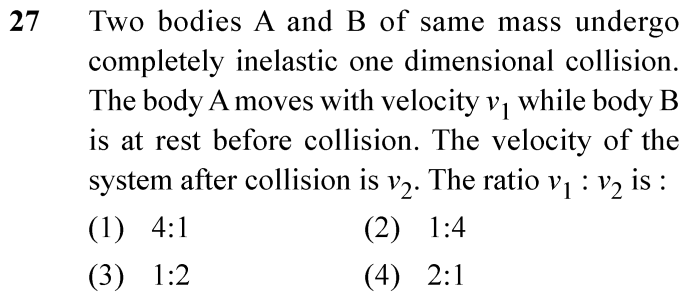
Option (4) : 2 : 1
📚 Work, Energy and Power Easy
📋 Given Parameters & Problem Setup
Masses of both bodies m_A = m_B = m
Initial velocity of body A v_1
Initial velocity of body B 0 (at rest)
Final velocity of combined system v_2
⚡

The 30-Second Exam Hall Shortcut: ⚡ Momentum Conservation Shortcut

⏱️ Save ~35 seconds

m v_1 = (m + m) v_2 = 2m v_2 -> v_1 = 2 v_2 -> v_1 : v_2 = 2 : 1!

1 In a completely inelastic collision, the two bodies stick together and move with common velocity v_2.
2 Total initial momentum = m v_1 + m(0) = m v_1.
3 Total final momentum = (m + m) v_2 = 2m v_2.
4 By conservation of linear momentum: m v_1 = 2m v_2 => v_1 / v_2 = 2 / 1.
5 Option (4) in 5 seconds!
🛡️
Why You Can 100% Trust This Shortcut: Law of Conservation of Linear Momentum (Σ p_initial = Σ p_final in isolated collision).
📐

Step-by-Step Rigorous Workflow & Mathematical Proof

Step 1

Initial Linear Momentum

Before the collision, body A of mass m moves with velocity v_1 while body B of identical mass m is at rest. The total initial linear momentum of the system is:

pi=mAv1+mB(0)=mv1p_i = m_A v_1 + m_B (0) = m v_1
Step 2

Final Linear Momentum After Inelastic Collision

In a completely inelastic one-dimensional collision, coefficient of restitution e = 0. The two bodies coalesce into a single combined mass of 2m moving together with common velocity v_2:

pf=(mA+mB)v2=2mv2p_f = (m_A + m_B) v_2 = 2m v_2
Step 3

Conservation of Linear Momentum

In the absence of external impulsive forces, linear momentum is conserved:

pi=pf  ⟹  mv1=2mv2p_i = p_f \implies m v_1 = 2m v_2
Step 4

Determination of Velocity Ratio

Dividing both sides by m v_2 gives the ratio v_1 : v_2:

v1v2=21  ⟹  v1:v2=2:1\frac{v_1}{v_2} = \frac{2}{1} \implies v_1 : v_2 = 2 : 1
⭐

360° Option Elimination Engine Key Feature

Diagnose every choice: Know exactly why the right option works and why distractors fail.

4-Option Deep Scan
1 (1)
✗ Incorrect
Verdict & Scientific Reason:

Incorrectly squares the mass ratio.

⚠️
Student Fallacy (Why candidates pick this trap): Confusing kinetic energy ratio with velocity ratio.
2 (2)
✗ Incorrect
Verdict & Scientific Reason:

Inverted and squared.

⚠️
Student Fallacy (Why candidates pick this trap): Gross calculation slip.
3 (3)
✗ Incorrect
Verdict & Scientific Reason:

Inverts the ratio (gives v_2 : v_1 instead of v_1 : v_2).

⚠️
Student Fallacy (Why candidates pick this trap): Writing v_1/v_2 = 1/2 instead of 2/1.
4 (4)
✓ 100% Correct
Verdict & Scientific Reason:

Exact momentum conservation: m v_1 = 2m v_2 -> v_1/v_2 = 2/1.

💡
Why this is airtight: None.
⚠️

NTA Trap Alert: Inverting the Ratio Order (v_1 : v_2 vs v_2 : v_1)

The velocity after collision is halved (v_2 = v_1 / 2), so students often think "half" and impulsively pick 1 : 2.

🛡️ How to avoid the -1 mark: The question asks for v_1 : v_2 (Initial to Final). Since initial is larger, the ratio MUST be greater than 1: 2 : 1!
📖

Core NEET Syllabus Standard

Physics Core Mechanics · Work, Energy and Power Standard Benchmark
Core Scientific Principle Tested:

"In a completely inelastic collision of two identical masses with one initially at rest, final velocity is halved and momentum is conserved."

Syllabus Focus: Collisions in One Dimension
✓ Core NEET UG Syllabus Anchor Syllabus & Academic Standards ↗
Double the mass, halve the pace: Initial to final is 2 to 1 in the race!
NEET 2024 · Q33 Easy
Official NEET 2024 Question 33 - Work, Energy and Power
1
2
3 ✓ Key
4
💡 Verified Solution & 30-Second Hack
✓
Verified Against NTA Final Answer Key
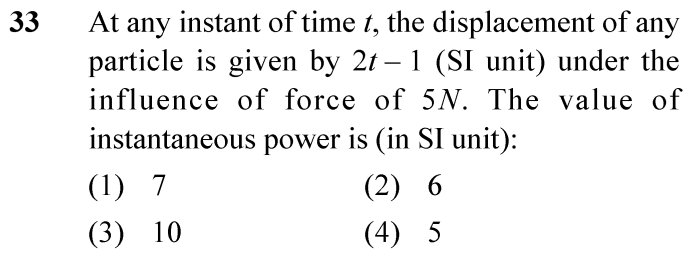
Option (3) : 10
📚 Work, Energy and Power Easy
📋 Given Parameters & Problem Setup
Displacement function x(t) = 2t - 1 (in SI units)
Applied force F = 5 N
⚡

The 30-Second Exam Hall Shortcut: ⚡ Velocity Derivative Shortcut

⏱️ Save ~30 seconds

v = dx/dt = d(2t - 1)/dt = 2 m/s -> Instantaneous Power P = F × v = 5 × 2 = 10 W!

1 Differentiate displacement to find velocity: v = dx/dt = 2 m/s (constant velocity).
2 Instantaneous power is given by scalar product P = F · v.
3 Substitute F = 5 N and v = 2 m/s: P = 5 × 2 = 10 W (SI units).
4 Option (3) in 3 seconds!
🛡️
Why You Can 100% Trust This Shortcut: Definition of Instantaneous Power (P = F · v = F · dx/dt).
📐

Step-by-Step Rigorous Workflow & Mathematical Proof

Step 1

Velocity Determination from Displacement

The velocity v of the particle is the first time derivative of its position function x(t) = 2t - 1:

v(t)=dxdt=ddt(2t−1)=2 m/sv(t) = \frac{dx}{dt} = \frac{d}{dt}(2t - 1) = 2\,\text{m/s}
Step 2

Formula for Instantaneous Power

Instantaneous power P delivered by a force F to a particle moving with velocity v in the same direction is:

P=F⃗⋅v⃗=F⋅vP = \vec{F} \cdot \vec{v} = F \cdot v
Step 3

Calculation of Power

Substituting F = 5 N and v = 2 m/s:

P=(5 N)(2 m/s)=10 W(SI units)P = (5\,\text{N})(2\,\text{m/s}) = 10\,\text{W} \quad (\text{SI units})
⭐

360° Option Elimination Engine Key Feature

Diagnose every choice: Know exactly why the right option works and why distractors fail.

4-Option Deep Scan
1 (1)
✗ Incorrect
Verdict & Scientific Reason:

Adds force and velocity (5 + 2 = 7) instead of multiplying.

⚠️
Student Fallacy (Why candidates pick this trap): Failing to apply scalar product.
2 (2)
✗ Incorrect
Verdict & Scientific Reason:

Arbitrary calculation error.

⚠️
Student Fallacy (Why candidates pick this trap): Evaluating at specific time t = 1.
3 (3)
✓ 100% Correct
Verdict & Scientific Reason:

Exact product: P = F × v = 5 × 2 = 10 SI units.

💡
Why this is airtight: None.
4 (4)
✗ Incorrect
Verdict & Scientific Reason:

Assumes velocity is 1 m/s.

⚠️
Student Fallacy (Why candidates pick this trap): Ignoring the coefficient 2 in displacement.
⚠️

NTA Trap Alert: Plugging in Time t

Students search for a value of t to plug into 2t - 1, getting confused because velocity is constant.

🛡️ How to avoid the -1 mark: Notice that dx/dt = 2 is independent of time t! Power is constant at 10 W for all t.
📖

Core NEET Syllabus Standard

Physics Core Mechanics · Work, Energy and Power Standard Benchmark
Core Scientific Principle Tested:

"Instantaneous power is the rate of doing work, given by the dot product of force and instantaneous velocity: P = F · v."

Syllabus Focus: Work and Power
✓ Core NEET UG Syllabus Anchor Syllabus & Academic Standards ↗
Differentiate position to get 2; Multiply by 5 and 10 shines through!
NEET 2023 · Q11 Easy
Official NEET 2023 Question 11 - Work, Energy and Power
1 ✓ Key
2
3
4
💡 Verified Solution & 30-Second Hack
✓
Verified Against NTA Final Answer Key
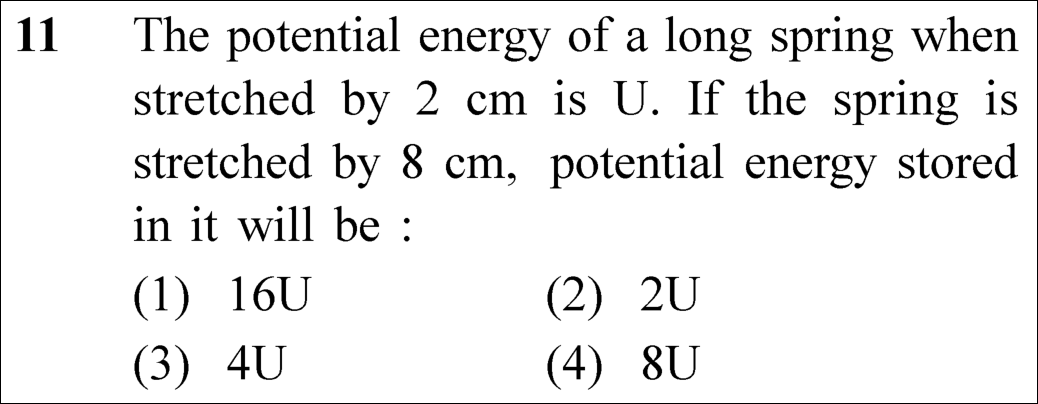
Option (1) : 16U
📚 Work, Energy and Power Easy
📋 Given Parameters & Problem Setup
Initial Stretch (x₁) 2 cm
Initial Potential Energy (U₁) U
Final Stretch (x₂) 8 cm
⚡

The 30-Second Exam Hall Shortcut: ⚡ Quadratic Displacement Scaling Factor

⏱️ Save ~30 seconds

Potential energy scales with the square of stretch (U ∝ x²)! 8 cm is 4 times 2 cm, so energy is 4² × U = 16U in 5 seconds!

1 Elastic potential energy formula: U = (1/2) k x².
2 Notice that spring constant k is unchanged, so U ∝ x².
3 Find the stretch ratio: x₂ / x₁ = 8 cm / 2 cm = 4.
4 Square the stretch ratio: (4)² = 16.
5 New potential energy U₂ = 16 U. Immediately select Option (1)!
🛡️
Why You Can 100% Trust This Shortcut: Fundamental Work-Energy Principles · Elastic Potential Energy (Hooke's law quadratic integration: U = 1/2 k x² ∝ x²).
📐

Step-by-Step Rigorous Workflow & Mathematical Proof

Step 1

Elastic Potential Energy Formula

The work done against the restoring spring force F = -kx in stretching a spring of spring constant k by displacement x is stored as elastic potential energy:

U=∫0xkx dx=12kx2U = \int_{0}^{x} k x \, dx = \frac{1}{2} k x^2
Step 2

Initial and Final Energy Expressions

Write expressions for initial state x₁ = 2 cm and final state x₂ = 8 cm:

U1=12k(2)2=2k=U,U2=12k(8)2=32kU_1 = \frac{1}{2} k (2)^2 = 2k = U, \qquad U_2 = \frac{1}{2} k (8)^2 = 32k
Step 3

Ratio Evaluation

Take the ratio of final to initial potential energy:

U2U1=(x2x1)2=(82)2=42=16  ⟹  U2=16U\frac{U_2}{U_1} = \left(\frac{x_2}{x_1}\right)^2 = \left(\frac{8}{2}\right)^2 = 4^2 = 16 \implies U_2 = 16 U
⭐

360° Option Elimination Engine Key Feature

Diagnose every choice: Know exactly why the right option works and why distractors fail.

4-Option Deep Scan
1 (1)
✓ 100% Correct
Verdict & Scientific Reason:

Accurate value: energy scales with square of stretch (4² = 16).

💡
Why this is airtight: None. Candidate correctly applied quadratic displacement scaling.
2 (2)
✗ Incorrect
Verdict & Scientific Reason:

Underestimates energy by a factor of 8.

⚠️
Student Fallacy (Why candidates pick this trap): Candidate took the ratio 8 - 2 = 6 or confused with half-powers.
3 (3)
✗ Incorrect
Verdict & Scientific Reason:

Linear scaling error.

⚠️
Student Fallacy (Why candidates pick this trap): Candidate treated potential energy as linearly proportional to displacement (U ∝ x, so 8/2 = 4U) instead of quadratic (U ∝ x²).
4 (4)
✗ Incorrect
Verdict & Scientific Reason:

Arbitrary linear/power confusion.

⚠️
Student Fallacy (Why candidates pick this trap): Candidate multiplied 4 by 2 instead of squaring 4.
⚠️

NTA Trap Alert: Linear vs Quadratic Scaling Trap (Picking 4U)

The most popular distractor is Option (3) 4U. Hasty students think "stretch is 4 times, so energy is 4 times", forgetting the square in (1/2)kx².

🛡️ How to avoid the -1 mark: Always repeat mentally: Spring energy is QUADRATIC in displacement: U ∝ x².
📖

Core NEET Syllabus Standard

National Eligibility cum Entrance Test (NEET UG) · Work, Energy and Power Standard Benchmark
Core Scientific Principle Tested:

"Spring restoring force is linear (F = -kx), making the stored potential energy strictly quadratic (U = 1/2 k x²)."

Syllabus Focus: Potential Energy of a Spring and Conservative Forces
Preserved in Rationalized Curriculum Syllabus & Academic Standards ↗
NEET 2021 · Q15 Easy
Official NEET 2021 Question 15 - Work, Energy and Power
1
2 ✓ Key
3
4
💡 Verified Solution & 30-Second Hack
✓
Verified Against NTA Final Answer Key
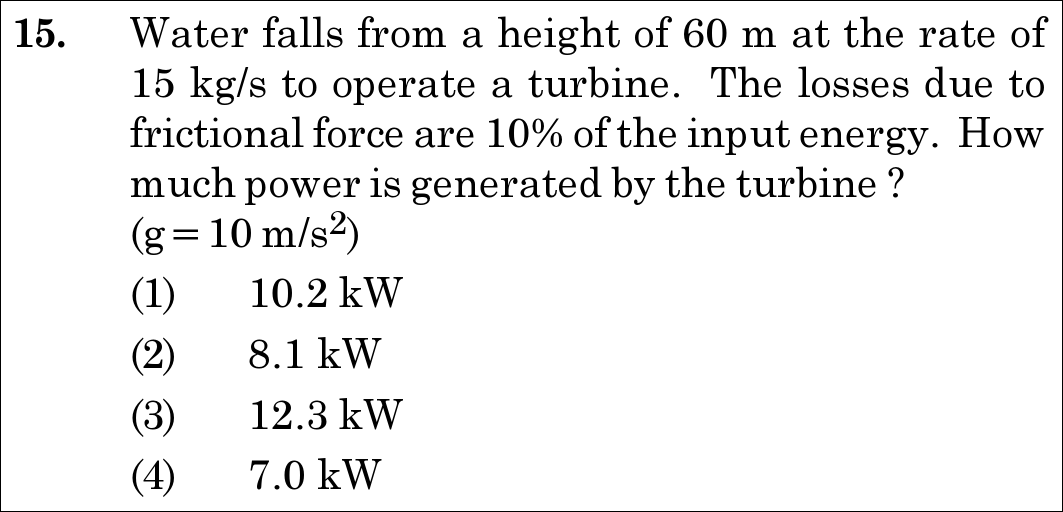
Option (2) : 8.1 kW
📚 Work, Energy and Power Easy
📋 Given Parameters & Problem Setup
Height of Fall (h) 60 m
Rate of Water Flow (dm/dt) 15 kg/s
Frictional Loss 10% of input energy
Acceleration Due to Gravity (g) 10 m/s^2
⚡

The 30-Second Exam Hall Shortcut: ⚡ Input Power × 90% Efficiency

⏱️ Save ~20 seconds

Pin=dmdtgh=15×10×60=9000 W=9 kWP_{\text{in}} = \frac{dm}{dt} g h = 15 \times 10 \times 60 = 9000\text{ W} = 9\text{ kW}. Efficiency is 100%−10%=90%100\% - 10\% = 90\%. Generated power Pout=0.9×9 kW=8.1 kWP_{\text{out}} = 0.9 \times 9\text{ kW} = 8.1\text{ kW}! Instant 15-second calculation matching Option (2)!

1 Compute total gravitational input power: Pin=(dmdt)ghP_{\text{in}} = \left(\frac{dm}{dt}\right) g h.
2 Pin=15×10×60=9000 W=9.0 kWP_{\text{in}} = 15 \times 10 \times 60 = 9000\text{ W} = 9.0\text{ kW}.
3 Since 10% is lost to friction, efficiency η=90%=0.90\eta = 90\% = 0.90.
4 Generated power Pout=ηPin=0.90×9.0 kW=8.1 kWP_{\text{out}} = \eta P_{\text{in}} = 0.90 \times 9.0\text{ kW} = 8.1\text{ kW}.
5 Match Option (2).
🛡️
Why You Can 100% Trust This Shortcut: Canonical conservation of mechanical energy and hydroelectric turbine efficiency relation.
📐

Step-by-Step Rigorous Workflow & Mathematical Proof

Step 1

Calculating Gravitational Potential Energy Input Rate

Water of mass Δm\Delta m falling from height hh carries gravitational potential energy ΔU=(Δm)gh\Delta U = (\Delta m)gh. The rate of potential energy delivered (input power) is:

Pin=ΔUΔt=(dmdt)gh=(15 kg/s)×(10 m/s2)×(60 m)=9000 W=9.0 kWP_{\text{in}} = \frac{\Delta U}{\Delta t} = \left(\frac{dm}{dt}\right) g h = (15\text{ kg/s}) \times (10\text{ m/s}^2) \times (60\text{ m}) = 9000\text{ W} = 9.0\text{ kW}
Step 2

Accounting for Frictional Energy Losses

Frictional losses account for 10%10\% of the input energy. The remaining 90%90\% is converted into electrical output power by the turbine:

η=100%−10%=90%=0.90\eta = 100\% - 10\% = 90\% = 0.90
Step 3

Calculating Net Power Generated by the Turbine

Multiply input power by the net efficiency factor:

Pout=ηPin=0.90×9000 W=8100 W=8.1 kWP_{\text{out}} = \eta P_{\text{in}} = 0.90 \times 9000\text{ W} = 8100\text{ W} = 8.1\text{ kW}
⭐

360° Option Elimination Engine Key Feature

Diagnose every choice: Know exactly why the right option works and why distractors fail.

4-Option Deep Scan
1 1
✗ Incorrect
Verdict & Scientific Reason:

Exceeds the 100% ideal input power of 9.0 kW (unphysical).

⚠️
Student Fallacy (Why candidates pick this trap): Adding 10% to input power (9+0.9=9.99 + 0.9 = 9.9 or 10.210.2).
2 2
✓ 100% Correct
Verdict & Scientific Reason:

Exact electrical output power generated: 0.90×9.0 kW=8.1 kW0.90 \times 9.0\text{ kW} = 8.1\text{ kW}.

💡
Why this is airtight: None; textbook power and efficiency computation.
3 3
✗ Incorrect
Verdict & Scientific Reason:

Exceeds available gravitational potential energy.

⚠️
Student Fallacy (Why candidates pick this trap): Multiplication error.
4 4
✗ Incorrect
Verdict & Scientific Reason:

Incorrect subtraction of losses.

⚠️
Student Fallacy (Why candidates pick this trap): Subtracting 2 kW arbitrarily.
⚠️

NTA Trap Alert: Gross Input vs. Net Generated Power Trap

Students who compute P=9.0 kWP = 9.0\text{ kW} sometimes look for 9.0 kW, and if not present, guess a nearby number without applying the 10%10\% frictional loss reduction factor.

🛡️ How to avoid the -1 mark: Read carefully: "losses are 10% of input energy". Multiply PinP_{\text{in}} by 0.900.90.
📖

Core NEET Syllabus Standard

NCERT Physics · Work, Energy and Power Standard Benchmark
Core Scientific Principle Tested:

"Power generated equals rate of energy input multiplied by the efficiency of conversion (Pout=ηPinP_{\text{out}} = \eta P_{\text{in}})."

Syllabus Focus: Power and Efficiency of Machines
✓ Core NEET UG Syllabus Anchor Syllabus & Academic Standards ↗
NEET 2021 · Q24 Easy
Official NEET 2021 Question 24 - Work, Energy and Power
1
2
3
4 ✓ Key
💡 Verified Solution & 30-Second Hack
✓
Verified Against NTA Final Answer Key
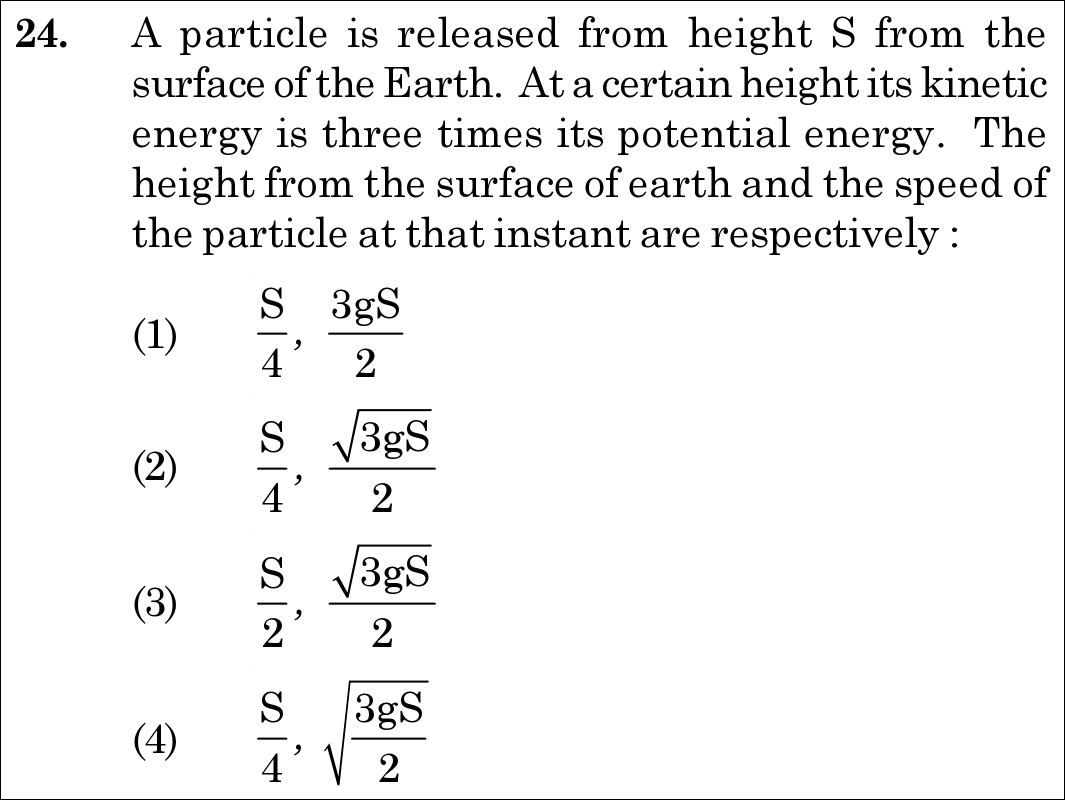
Option (4) : S / 4, \sqrt{3gS / 2}
📚 Work, Energy and Power Easy
📋 Given Parameters & Problem Setup
Initial Release Height S from Earth surface
Initial Velocity 0 (released from rest)
Condition at Intermediate Height h Kinetic energy is three times potential energy: K = 3U
⚡

The 30-Second Exam Hall Shortcut: ⚡ 4-Part Energy Split: U = E/4   ⟹  \implies h = S/4, v = √(3gS/2)

⏱️ Save ~20 seconds

Total energy E=mgS=K+UE = mgS = K + U. Since K=3UK = 3U, we have 4U=mgS  ⟹  U=14mgS  ⟹  h=S44U = mgS \implies U = \frac{1}{4}mgS \implies h = \frac{S}{4}! Kinetic energy is K=34mgS=12mv2  ⟹  v=3gS2K = \frac{3}{4}mgS = \frac{1}{2}mv^2 \implies v = \sqrt{\frac{3gS}{2}}! Match Option (4)!

1 Conserve mechanical energy: E=Ui+Ki=mgS+0=mgSE = U_i + K_i = mgS + 0 = mgS.
2 At height hh: E=U+K=U+3U=4UE = U + K = U + 3U = 4U.
3 Equate: 4mgh=mgS  ⟹  h=S44 mgh = mgS \implies h = \frac{S}{4}.
4 Find velocity from kinetic energy: K=12mv2=3U=3mg(S4)=34mgSK = \frac{1}{2}mv^2 = 3U = 3 mg \left(\frac{S}{4}\right) = \frac{3}{4}mgS.
5 v2=3gS2  ⟹  v=3gS2v^2 = \frac{3gS}{2} \implies v = \sqrt{\frac{3gS}{2}}.
6 Match Option (4).
🛡️
Why You Can 100% Trust This Shortcut: Canonical conservation of mechanical energy in uniform gravitational field.
📐

Step-by-Step Rigorous Workflow & Mathematical Proof

Step 1

Formulating Total Mechanical Energy

At height SS above the ground, the particle is released from rest (u=0u = 0). Taking the ground as the reference plane for zero gravitational potential energy:

Etotal=Ui+Ki=mgS+0=mgSE_{\text{total}} = U_i + K_i = mgS + 0 = mgS
Step 2

Determining the Height from the Earth's Surface

At an unknown height hh, potential energy is U=mghU = mgh and kinetic energy is KK. We are given K=3UK = 3U:

Etotal=K+U=3U+U=4U  ⟹  4(mgh)=mgS  ⟹  h=S4E_{\text{total}} = K + U = 3U + U = 4U \implies 4(mgh) = mgS \implies h = \frac{S}{4}
Step 3

Determining the Speed of the Particle

Substitute h=S/4h = S/4 into the expression for kinetic energy K=12mv2K = \frac{1}{2}mv^2:

12mv2=3mgh=3mg(S4)=34mgS  ⟹  v2=3gS2  ⟹  v=3gS2\frac{1}{2}mv^2 = 3 mgh = 3 mg \left(\frac{S}{4}\right) = \frac{3}{4}mgS \implies v^2 = \frac{3gS}{2} \implies v = \sqrt{\frac{3gS}{2}}
⭐

360° Option Elimination Engine Key Feature

Diagnose every choice: Know exactly why the right option works and why distractors fail.

4-Option Deep Scan
1 1
✗ Incorrect
Verdict & Scientific Reason:

Speed lacks the square root (gives v2v^2 instead of vv).

⚠️
Student Fallacy (Why candidates pick this trap): Forgetting to take the square root of v2v^2.
2 2
✗ Incorrect
Verdict & Scientific Reason:

The radical only covers the numerator: 3gS2=3gS4≠3gS2\frac{\sqrt{3gS}}{2} = \sqrt{\frac{3gS}{4}} \neq \sqrt{\frac{3gS}{2}}.

⚠️
Student Fallacy (Why candidates pick this trap): Placing the denominator 2 outside the square root.
3 3
✗ Incorrect
Verdict & Scientific Reason:

Incorrect height S/2S/2 (which would correspond to K=UK = U, not K=3UK = 3U).

⚠️
Student Fallacy (Why candidates pick this trap): Assuming the condition occurs at the midpoint of fall.
4 4
✓ 100% Correct
Verdict & Scientific Reason:

Exact height and speed derived from energy conservation: h=S/4h = S/4 and v=3gS2v = \sqrt{\frac{3gS}{2}}.

💡
Why this is airtight: None; rigorous algebraic energy solution.
⚠️

NTA Trap Alert: Radical Bracket Scope Trap (Option 2 vs. Option 4)

Notice the typographic trap between Option (2) 3gS2\frac{\sqrt{3gS}}{2} and Option (4) 3gS2\sqrt{\frac{3gS}{2}}. In Option 2, the 2 is in the denominator OUTSIDE the radical (giving a factor of 1/41/4 under the radical). In Option 4, the 2 is INSIDE the radical.

🛡️ How to avoid the -1 mark: Check radical boundaries carefully: v=3gS2v = \sqrt{\frac{3gS}{2}}, so the entire fraction 3gS/23gS/2 is under the square root.
📖

Core NEET Syllabus Standard

NCERT Physics · Work, Energy and Power Standard Benchmark
Core Scientific Principle Tested:

"In a conservative gravitational field, total mechanical energy E=K+UE = K + U is invariant at all points along the trajectory."

Syllabus Focus: Conservation of Mechanical Energy
✓ Core NEET UG Syllabus Anchor Syllabus & Academic Standards ↗

Solve 4 NEET Questions a Day — One per Subject

Cover all 1,140 official NEET questions in 285 days at your own pace. Progress is saved on your device. No login needed.