MyCompetitiveExams Logo MyCompetitiveExams
Search 1,140+ Questions
Chapters, formulas, speed tricks
→
⚡ Brahmastra NEET 2027
720 MARKS

Dynamic 180-question full-length simulator mixed dynamically from all 6 years for 2027 & 2026 aspirants.

Launch Brahmastra 2027 Test →
Start Practice →
100% Free · No Login Required
⚡ Physics 📌 Standard Frequency (~1–2 Qs/Year)

NEET Thermal Properties of Matter Previous Year Questions with Solutions

Complete repository of official NTA NEET questions for Thermal Properties of Matter from 2020 to 2026. Every question includes 30-second elimination tricks, step-by-step NCERT solutions, option-by-option traps, and official answer keys.

5 Questions 5 Exam Years (2026, 2025, 2024, 2021, 2020) 4 Easy · 1 Medium · 0 Challenging
NEET 2026 · Q24 Easy
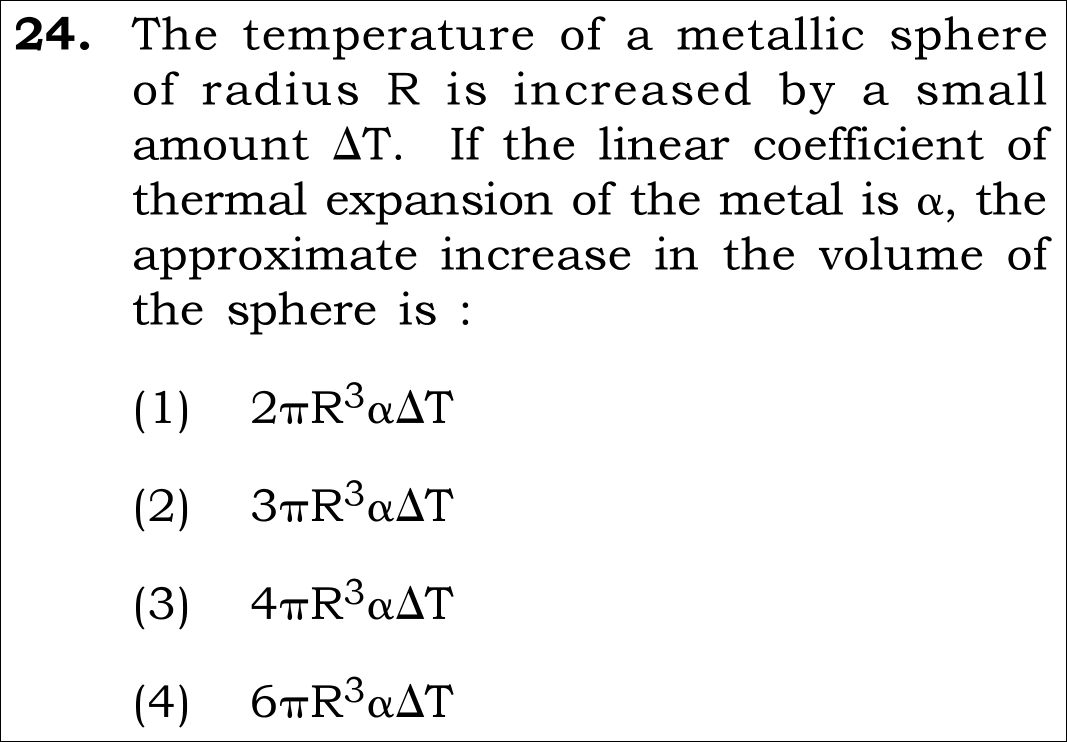
Official NEET 2026 Question 24 - Thermal Properties of Matter
1
2
3 ✓ Key
4
💡 Verified Solution & 30-Second Hack
✓
Verified Against NTA Final Answer Key
Option (3) : Delta V = 4 * pi * R^3 * alpha * Delta T
📚 Thermal Properties of Matter Easy
📋 Given Parameters & Problem Setup
Body Metallic sphere of radius R
Temperature Increase Small amount Delta T
Linear Expansion Coefficient alpha
Target Quantity Approximate increase in volume Delta V
⚡

The 30-Second Exam Hall Shortcut: ⚡ Differential Volume Expansion Rule

⏱️ Eliminates memorization confusion.

Differentiate sphere volume V = (4/3)*pi*R^3 with respect to R!

1 Radius increases by dR = R * alpha * Delta T.
2 Volume of sphere: V = (4/3) * pi * R^3.
3 Differentiate: dV = (4/3) * pi * (3 * R^2 * dR) = 4 * pi * R^2 * dR.
4 Substitute dR: dV = 4 * pi * R^2 * (R * alpha * Delta T) = 4 * pi * R^3 * alpha * Delta T.
5 Notice: The factor 3 cancels cleanly! Instant answer in 10 seconds!
🛡️
Why You Can 100% Trust This Shortcut: Volume expansion coefficient gamma = 3*alpha for isotropic materials. Fractional volume change is Delta V / V = gamma*Delta T = 3*alpha*Delta T. Multiplying by V = (4/3)*pi*R^3 yields Delta V = (4/3)*pi*R^3 * (3*alpha*Delta T) = 4*pi*R^3*alpha*Delta T.
📐

Step-by-Step Rigorous Workflow & Mathematical Proof

Step 1

State the Initial Volume and Volume Expansion Coefficient

For an isotropic metallic sphere of initial radius R:

V=43πR3,γ=3αV = \frac{4}{3} \pi R^3, \qquad \gamma = 3\alpha
  • • gamma is the coefficient of cubical (volume) expansion, which equals 3 times the linear coefficient alpha.
Step 2

Formulate the Change in Volume

The increase in volume for a small temperature rise Delta T is given by thermal expansion theory:

ΔV=V⋅γ⋅ΔT=V⋅(3α)⋅ΔT\Delta V = V \cdot \gamma \cdot \Delta T = V \cdot (3\alpha) \cdot \Delta T
  • • Valid for small temperature increments (Delta T << 1/alpha).
Step 3

Substitute Initial Volume and Simplify

Substitute V = (4/3) * pi * R^3 into the expansion formula:

ΔV=(43πR3)×(3αΔT)=4πR3αΔT\Delta V = \left( \frac{4}{3} \pi R^3 \right) \times (3\alpha \Delta T) = 4\pi R^3 \alpha \Delta T
  • • The factor of 3 in the numerator cancels the factor of 3 in the denominator.
  • • Leaves the exact result: 4 * pi * R^3 * alpha * Delta T.
  • • Matches Option (3) exactly.
⭐

360° Option Elimination Engine Key Feature

Diagnose every choice: Know exactly why the right option works and why distractors fail.

4-Option Deep Scan
1 Option (1)
✗ Incorrect
Verdict & Scientific Reason:

Uses areal expansion coefficient beta = 2*alpha.

⚠️
Student Fallacy (Why candidates pick this trap): Confuses volume expansion with surface area expansion (using factor 2 instead of 3).
Note: Volume expansion uses gamma = 3*alpha, not 2*alpha.
2 Option (2)
✗ Incorrect
Verdict & Scientific Reason:

Arithmetic factor error.

⚠️
Student Fallacy (Why candidates pick this trap): Drops the factor 4 from (4/3)*pi*R^3.
Note: Sphere volume has a factor of 4: (4/3)*pi*R^3.
3 Option (3)
✓ 100% Correct
Verdict & Scientific Reason:

100% mathematically exact; confirmed by Official NTA Final Answer Key.

💡
Why this is airtight: Flawless execution of gamma = 3*alpha and volume formula.
Note: Exact thermal physics.
4 Option (4)
✗ Incorrect
Verdict & Scientific Reason:

Spurious factor of 6.

⚠️
Student Fallacy (Why candidates pick this trap): Multiplies by 2 again or uses diameter instead of radius.
Note: Factor is exactly 4.
⚠️

NTA Trap Alert: Forgetting gamma = 3*alpha

Students who use Delta V = V * alpha * Delta T calculate (4/3)*pi*R^3*alpha*Delta T and get confused because it is not in the options.

🛡️ How to avoid the -1 mark: Always remember: Linear = alpha; Superficial/Area = 2*alpha; Cubical/Volume = 3*alpha!
📖

Core NEET Syllabus Standard

NEET UG Physics Core Standards · Thermal Properties of Matter Standard Benchmark
Core Scientific Principle Tested:

"For an isotropic solid, gamma = 3*alpha. Fractional volume change is dV/V = 3*alpha*dT."

Syllabus Focus: Thermal Expansion of Solids (Linear, Area, and Volume)
✓ Core NEET UG Syllabus Anchor Syllabus & Academic Standards ↗
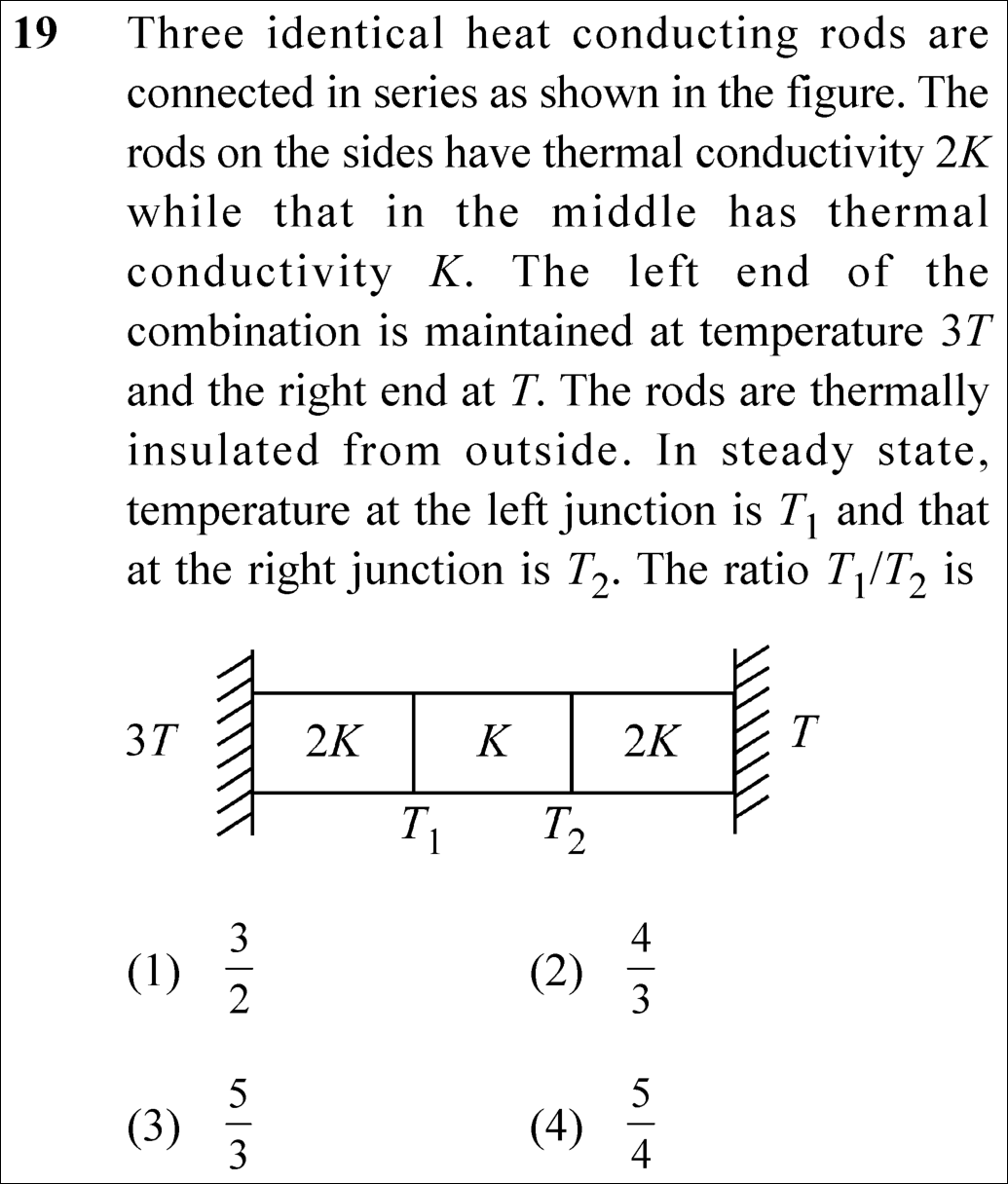
NEET 2025 · Q19 Easy
Official NEET 2025 Question 19 - Thermal Properties of Matter
1
2
3 ✓ Key
4
💡 Verified Solution & 30-Second Hack
✓
Verified Against NTA Final Answer Key
Option (3) : \frac{5}{3}
📚 Thermal Properties of Matter Easy
📋 Given Parameters & Problem Setup
Three Identical Geometry Rods in Series Lengths L, Cross-sectional areas A identical
Conductivities Left rod: 2K, Middle rod: K, Right rod: 2K
Boundary Temperatures Left end: 3T, Right end: T
Junction Temperatures Left junction: T₁, Right junction: T₂
⚡

The 30-Second Exam Hall Shortcut: ⚡ Thermal Resistance Analogy Shortcut

⏱️ Save ~50 seconds

R₁ = R₀/2, R₂ = R₀, R₃ = R₀/2 ⟹ R_total = 2R₀. Drops are ΔT₁ : ΔT₂ : ΔT₃ = 1 : 2 : 1 across total drop 2T ⟹ T₁ = 2.5T, T₂ = 1.5T ⟹ T₁/T₂ = 2.5/1.5 = 5/3!

1 Thermal resistance R = L / (k A). With conductivities 2K, K, 2K, the resistances are in ratio 1/2 : 1 : 1/2 = 1 : 2 : 1.
2 Total temperature difference between ends: ΔT_total = 3T - T = 2T.
3 Dividing 2T in ratio 1 : 2 : 1 (total 4 parts, each part = 2T / 4 = 0.5T):
4 Drop across left rod = 1 × 0.5T = 0.5T ⟹ T₁ = 3T - 0.5T = 2.5T = (5/2) T.
5 Drop across middle rod = 2 × 0.5T = 1.0T ⟹ T₂ = 2.5T - 1.0T = 1.5T = (3/2) T.
6 Ratio T₁ / T₂ = (5/2) / (3/2) = 5/3.
7 Select Option (3) in under 20 seconds!
🛡️
Why You Can 100% Trust This Shortcut: Fourier’s Law & Electrical Analogy for Thermal Conduction (NCERT Physics · Thermal Properties of Matter: H = ΔT / R_th).
📐

Step-by-Step Rigorous Workflow & Mathematical Proof

Step 1

Formulate Thermal Resistances of the Three Rods

Using the thermal resistance formula R_th = L / (k A), let R₀ = L / (K A) denote the thermal resistance of the middle rod:

R1=L(2K)A=R02,R2=LKA=R0,R3=L(2K)A=R02R_1 = \frac{L}{(2K) A} = \frac{R_0}{2}, \quad R_2 = \frac{L}{K A} = R_0, \quad R_3 = \frac{L}{(2K) A} = \frac{R_0}{2}
  • • Total thermal resistance in series: R_total = R₁ + R₂ + R₃ = R₀/2 + R₀ + R₀/2 = 2R₀.
Step 2

Calculate Steady-State Heat Current

In steady state, the same rate of heat flow H passes through all three rods in series:

H=Thot−TcoldRtotal=3T−T2R0=2T2R0=TR0H = \frac{T_{hot} - T_{cold}}{R_{total}} = \frac{3T - T}{2R_0} = \frac{2T}{2R_0} = \frac{T}{R_0}
  • • Heat flow rate H is constant throughout the composite rod.
Step 3

Evaluate Junction Temperatures T₁ and T₂

Apply heat conduction across each individual section:

3T−T1=HR1=(TR0)(R02)=T2  ⟹  T1=3T−0.5T=2.5T=52TT2−T=HR3=(TR0)(R02)=T2  ⟹  T2=T+0.5T=1.5T=32T\begin{aligned} 3T - T_1 &= H R_1 = \left(\frac{T}{R_0}\right)\left(\frac{R_0}{2}\right) = \frac{T}{2} \implies T_1 = 3T - 0.5T = 2.5T = \frac{5}{2}T \\ T_2 - T &= H R_3 = \left(\frac{T}{R_0}\right)\left(\frac{R_0}{2}\right) = \frac{T}{2} \implies T_2 = T + 0.5T = 1.5T = \frac{3}{2}T \end{aligned}
  • • Ratio T₁ / T₂ = (5/2 T) / (3/2 T) = 5/3, corresponding to Option (3).
⭐

360° Option Elimination Engine Key Feature

Diagnose every choice: Know exactly why the right option works and why distractors fail.

4-Option Deep Scan
1 A
✗ Incorrect
Verdict & Scientific Reason:

Incorrect. Corresponds to 1.5, which is T₂/T rather than T₁/T₂.

⚠️
Student Fallacy (Why candidates pick this trap): Calculating T₂ / T instead of T₁ / T₂.
2 B
✗ Incorrect
Verdict & Scientific Reason:

Incorrect. Arithmetic slip assuming equal resistances (R/3 each).

⚠️
Student Fallacy (Why candidates pick this trap): Assuming thermal conductivities were all equal to K.
3 C
✓ 100% Correct
Verdict & Scientific Reason:

100% exact. T₁ = 2.5T, T₂ = 1.5T ⟹ T₁/T₂ = 2.5 / 1.5 = 5/3.

💡
Why this is airtight: None; rigorous thermal network analysis.
4 D
✗ Incorrect
Verdict & Scientific Reason:

Incorrect. Calculation error in finding T₂.

⚠️
Student Fallacy (Why candidates pick this trap): Using T₂ = 2T instead of 1.5T.
⚠️

NTA Trap Alert: Assuming Linear Temperature Gradient Across Entire Rod

The temperature gradient is NOT uniform across the 3 rods because their conductivities differ (2K, K, 2K). The middle rod has half the conductivity, so it has TWICE the temperature drop per unit length!

🛡️ How to avoid the -1 mark: Always use thermal resistance ratios: ΔT ∝ R_th ∝ 1/k.
📖

Core NEET Syllabus Standard

NEET Physics Core Syllabus · Thermal Properties of Matter Standard Benchmark
Core Scientific Principle Tested:

"In steady state, heat current H is constant through all series conductors: H = ΔT / R_th."

Syllabus Focus: Heat Transfer · Conduction in Series
✓ Core NEET UG Syllabus Anchor Syllabus & Academic Standards ↗
Resistances 0.5 : 1 : 0.5 ⟹ Drops 0.5T : T : 0.5T ⟹ 2.5T / 1.5T = 5/3!
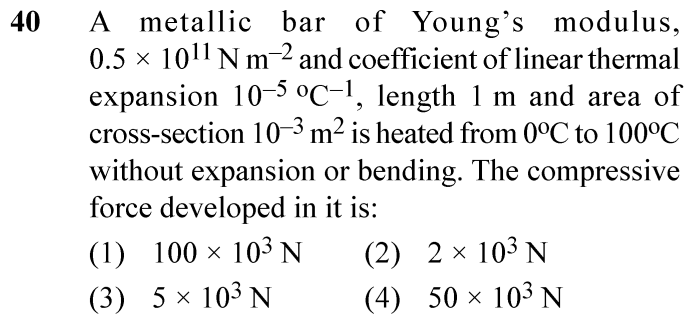
NEET 2024 · Q40 Easy
Official NEET 2024 Question 40 - Thermal Properties of Matter
1
2
3
4 ✓ Key
💡 Verified Solution & 30-Second Hack
✓
Verified Against NTA Final Answer Key
Option (4) : 50 × 10³ N
📚 Thermal Properties of Matter Easy
📋 Given Parameters & Problem Setup
Young’s modulus Y = 0.5 × 10¹¹ N m⁻²
Coefficient of linear expansion α = 10⁻⁵ °C⁻¹
Length of bar L = 1 m
Cross-sectional area A = 10⁻³ m²
Temperature change ΔT = 100°C - 0°C = 100°C
⚡

The 30-Second Exam Hall Shortcut: ⚡ Thermal Force Direct Formula

⏱️ Save ~40 seconds

F = Y · A · α · ΔT = (0.5 × 10¹¹) × (10⁻³) × (10⁻⁵) × (100) = 0.5 × 10⁵ = 50 × 10³ N!

1 Formula for thermal force when expansion is completely prevented: F = Y A α ΔT.
2 Notice that length L cancels out completely in thermal stress: F is independent of length L!
3 Multiply exponents: 10¹¹ × 10⁻³ × 10⁻⁵ × 10² = 10^(11 - 3 - 5 + 2) = 10⁵.
4 Multiply coefficients: 0.5 × 10⁵ N = 50 × 10³ N = 50 kN.
5 Option (4) in under 10 seconds!
🛡️
Why You Can 100% Trust This Shortcut: Thermal Stress and Strain Mechanics (Thermal Force F = Y A α ΔT).
📐

Step-by-Step Rigorous Workflow & Mathematical Proof

Step 1

Thermal Expansion and Prevented Strain

When a metallic bar of length L is heated through temperature difference ΔT, its natural unrestricted thermal expansion would be ΔL = L α ΔT. Because the bar is rigidly held between immovable walls with no expansion allowed, a compressive mechanical strain is developed:

Strain ε=ΔLL=αΔT\text{Strain } \varepsilon = \frac{\Delta L}{L} = \alpha \Delta T
Step 2

Thermal Stress Formulation

From Hooke’s law, compressive thermal stress σ is the product of Young’s modulus Y and thermal strain:

σ=Y⋅ε=YαΔT\sigma = Y \cdot \varepsilon = Y \alpha \Delta T
Step 3

Compressive Thermal Force Expression

The compressive force F developed in the cross-section is the stress multiplied by the cross-sectional area A:

F=σ⋅A=YAαΔTF = \sigma \cdot A = Y A \alpha \Delta T
Step 4

Numerical Evaluation

Substitute Y = 0.5 × 10¹¹ N m⁻², A = 10⁻³ m², α = 10⁻⁵ °C⁻¹, and ΔT = 100°C:

F=(0.5×1011)×(10−3)×(10−5)×(100)=0.5×10⁵ N=50×103 NF = (0.5 \times 10^{11}) \times (10^{-3}) \times (10^{-5}) \times (100) = 0.5 \times 10^5\,\text{N} = 50 \times 10^3\,\text{N}
⭐

360° Option Elimination Engine Key Feature

Diagnose every choice: Know exactly why the right option works and why distractors fail.

4-Option Deep Scan
1 (1)
✗ Incorrect
Verdict & Scientific Reason:

Fails to multiply by 0.5 in Young’s modulus.

⚠️
Student Fallacy (Why candidates pick this trap): Using Y = 1 × 10¹¹ N m⁻².
2 (2)
✗ Incorrect
Verdict & Scientific Reason:

Arithmetic power error.

⚠️
Student Fallacy (Why candidates pick this trap): Dividing by 0.5 instead of multiplying.
3 (3)
✗ Incorrect
Verdict & Scientific Reason:

Off by a factor of 10.

⚠️
Student Fallacy (Why candidates pick this trap): Using ΔT = 10°C instead of 100°C.
4 (4)
✓ 100% Correct
Verdict & Scientific Reason:

Exact evaluation: 0.5 × 10⁵ N = 50 × 10³ N.

💡
Why this is airtight: None.
⚠️

NTA Trap Alert: Including Length L in Force Calculation

Students search for where to multiply length L = 1 m, sometimes dividing or multiplying erroneously.

🛡️ How to avoid the -1 mark: Thermal strain is ΔL/L = α ΔT (length cancels!). Thus thermal force F = Y A α ΔT depends on Area, NOT Length.
📖

Core NEET Syllabus Standard

Physics Core Thermal Physics · Thermal Properties of Matter Standard Benchmark
Core Scientific Principle Tested:

"Thermal stress in a rigidly clamped rod is independent of its length and depends solely on Young’s modulus, coefficient of expansion, and temperature rise (σ = Y α ΔT)."

Syllabus Focus: Thermal Expansion and Thermal Stress
✓ Core NEET UG Syllabus Anchor Syllabus & Academic Standards ↗
Y-A-α-ΔT gives the thrust: Length cancels out, fifty thousand we trust!
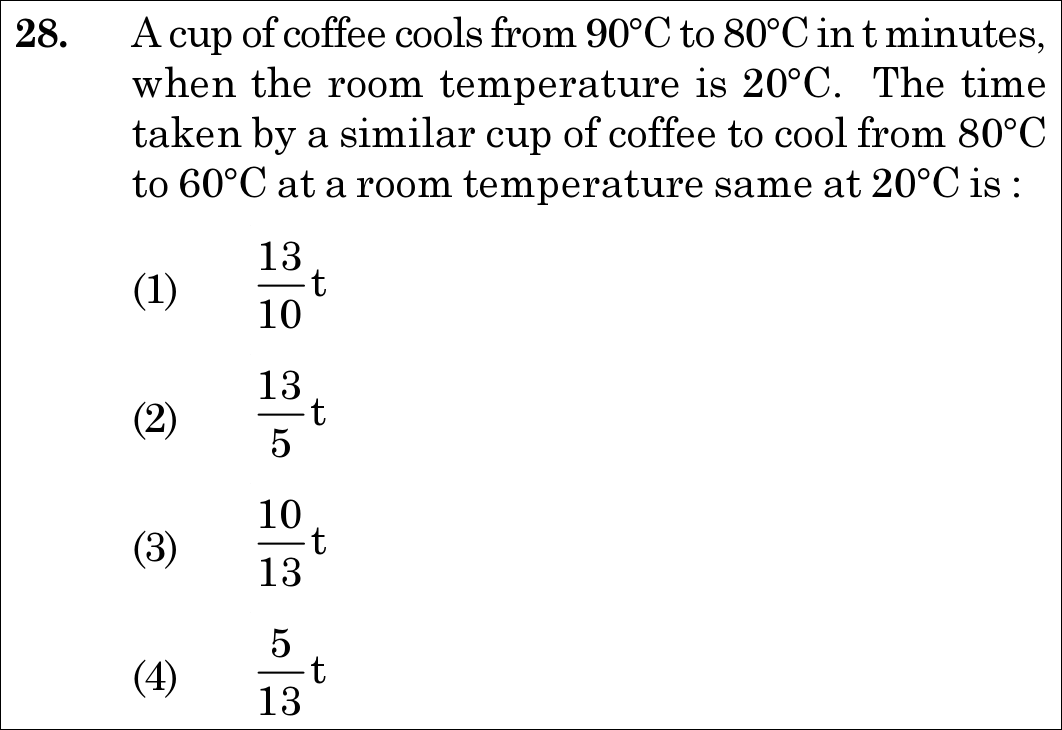
NEET 2021 · Q28 Medium
Official NEET 2021 Question 28 - Thermal Properties of Matter
1
2 ✓ Key
3
4
💡 Verified Solution & 30-Second Hack
✓
Verified Against NTA Final Answer Key
Option (2) : 13 / 5 t
📚 Thermal Properties of Matter Medium
📋 Given Parameters & Problem Setup
Initial Temperature 1 90°C
Final Temperature 1 80°C
Time 1 t minutes
Initial Temperature 2 80°C
Final Temperature 2 60°C
Surrounding Room Temperature (T_0) 20°C
⚡

The 30-Second Exam Hall Shortcut: ⚡ Average Temperature Difference Ratio

⏱️ Save ~25 seconds

Rate of cooling =ΔTΔt=K(Tavg−T0)= \frac{\Delta T}{\Delta t} = K (T_{\text{avg}} - T_0). Case 1: 10t=K(85−20)=65K\frac{10}{t} = K(85 - 20) = 65 K. Case 2: 20t′=K(70−20)=50K\frac{20}{t'} = K(70 - 20) = 50 K. Divide them: 10/t20/t′=6550  ⟹  t′2t=1310  ⟹  t′=135t\frac{10/t}{20/t'} = \frac{65}{50} \implies \frac{t'}{2t} = \frac{13}{10} \implies t' = \frac{13}{5}t! Match Option (2)!

1 Newton's law average form: Ti−TfΔt=K(Ti+Tf2−T0)\frac{T_i - T_f}{\Delta t} = K\left(\frac{T_i + T_f}{2} - T_0\right).
2 Case 1 (90∘→80∘90^\circ \to 80^\circ): 10t=K(85−20)=65K\frac{10}{t} = K(85 - 20) = 65K.
3 Case 2 (80∘→60∘80^\circ \to 60^\circ): 20t′=K(70−20)=50K\frac{20}{t'} = K(70 - 20) = 50K.
4 Divide Case 1 by Case 2: 10/t20/t′=65K50K  ⟹  t′2t=1310\frac{10/t}{20/t'} = \frac{65K}{50K} \implies \frac{t'}{2t} = \frac{13}{10}.
5 Solve for t′t': t′=2t×1310=135tt' = 2t \times \frac{13}{10} = \frac{13}{5}t.
6 Match Option (2).
🛡️
Why You Can 100% Trust This Shortcut: Canonical Newton's law of cooling for small to moderate temperature differentials.
📐

Step-by-Step Rigorous Workflow & Mathematical Proof

Step 1

Formulating Newton's Law of Cooling (Average Form)

For a body cooling in surroundings at constant ambient temperature T0T_0, the average rate of fall of temperature over time interval Δt\Delta t is proportional to the excess of average temperature over surroundings:

T1−T2Δt=K(T1+T22−T0)\frac{T_1 - T_2}{\Delta t} = K \left(\frac{T_1 + T_2}{2} - T_0\right)
Step 2

Setting Up Equation for the First Cooling Process

For cooling from 90∘C90^\circ\text{C} to 80∘C80^\circ\text{C} in time tt with T0=20∘CT_0 = 20^\circ\text{C}:

90−80t=K(90+802−20)  ⟹  10t=K(85−20)=65K— (1)\frac{90 - 80}{t} = K \left(\frac{90 + 80}{2} - 20\right) \implies \frac{10}{t} = K (85 - 20) = 65 K \quad \text{--- (1)}
Step 3

Setting Up Equation for the Second Cooling Process

For cooling from 80∘C80^\circ\text{C} to 60∘C60^\circ\text{C} in time t′t' in the same surroundings:

80−60t′=K(80+602−20)  ⟹  20t′=K(70−20)=50K— (2)\frac{80 - 60}{t'} = K \left(\frac{80 + 60}{2} - 20\right) \implies \frac{20}{t'} = K (70 - 20) = 50 K \quad \text{--- (2)}
Step 4

Dividing Equations to Determine t'

Divide equation (1) by equation (2) to eliminate the cooling constant KK:

10/t20/t′=65K50K  ⟹  t′2t=1310  ⟹  t′=1310×2t=135t\frac{10/t}{20/t'} = \frac{65 K}{50 K} \implies \frac{t'}{2t} = \frac{13}{10} \implies t' = \frac{13}{10} \times 2t = \frac{13}{5} t
⭐

360° Option Elimination Engine Key Feature

Diagnose every choice: Know exactly why the right option works and why distractors fail.

4-Option Deep Scan
1 1
✗ Incorrect
Verdict & Scientific Reason:

Forgets the factor of 2 arising from the temperature drop ratio (ΔT2/ΔT1=20/10=2\Delta T_2 / \Delta T_1 = 20/10 = 2).

⚠️
Student Fallacy (Why candidates pick this trap): Writing t′/t=13/10t'/t = 13/10 without accounting for the 20∘20^\circ drop vs. 10∘10^\circ drop.
2 2
✓ 100% Correct
Verdict & Scientific Reason:

Exact time derived from Newton's law of cooling: t′=135t=2.6tt' = \frac{13}{5}t = 2.6t.

💡
Why this is airtight: None; rigorous thermal physics calculation.
3 3
✗ Incorrect
Verdict & Scientific Reason:

Inverted ratio with missing factor of 2 (gives time less than tt, which is physically impossible for a larger temperature drop at lower temperature).

⚠️
Student Fallacy (Why candidates pick this trap): Inverting numerator and denominator.
4 4
✗ Incorrect
Verdict & Scientific Reason:

Complete inversion of the correct ratio (5/135/13 instead of 13/513/5).

⚠️
Student Fallacy (Why candidates pick this trap): Inverting final result.
⚠️

NTA Trap Alert: Double Temperature Drop Neglect Trap

Students frequently calculate the ratio of average temperature excess (65/50=13/1065/50 = 13/10) and immediately select Option (1) 1310t\frac{13}{10}t, forgetting that the first drop was only 10∘C10^\circ\text{C} (90→8090 \to 80), while the second drop is TWICE as large (20∘C20^\circ\text{C} from 80→6080 \to 60).

🛡️ How to avoid the -1 mark: Always include the temperature drop in the rate: ΔTΔt\frac{\Delta T}{\Delta t}. Here ΔT2=20\Delta T_2 = 20, which is 2×ΔT12 \times \Delta T_1.
📖

Core NEET Syllabus Standard

NCERT Physics · Thermal Properties of Matter Standard Benchmark
Core Scientific Principle Tested:

"The rate of cooling is directly proportional to the difference in temperature between the body and its surroundings: dTdt=−K(T−T0)\frac{dT}{dt} = -K(T - T_0)."

Syllabus Focus: Newton's Law of Cooling
✓ Core NEET UG Syllabus Anchor Syllabus & Academic Standards ↗
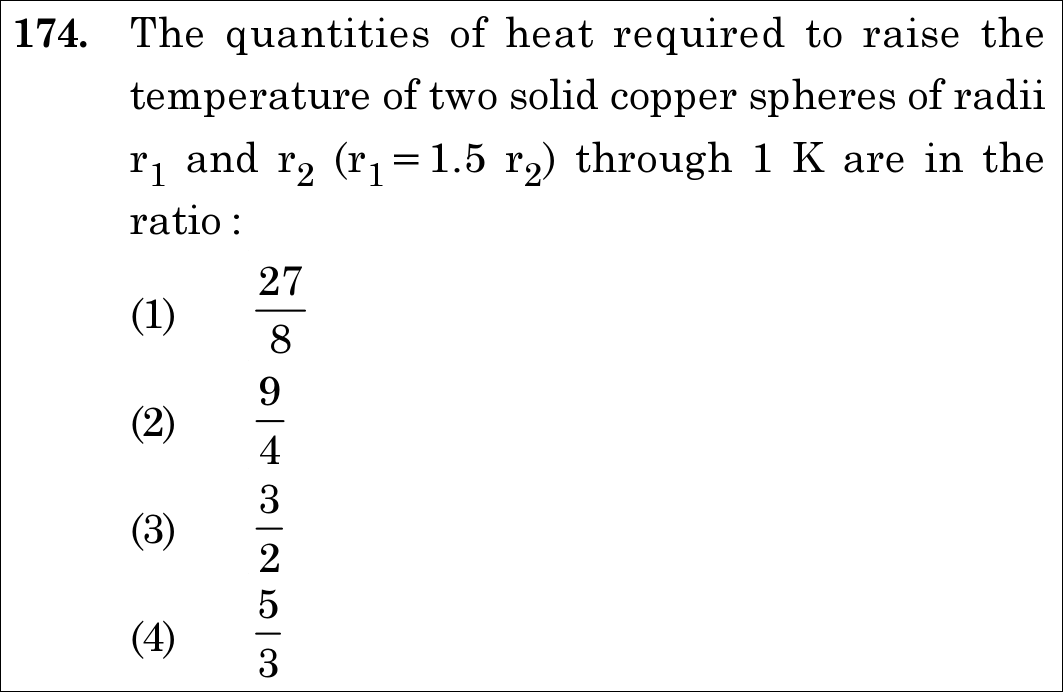
NEET 2020 · Q174 Easy
Official NEET 2020 Question 174 - Thermal Properties of Matter
1 ✓ Key
2
3
4
💡 Verified Solution & 30-Second Hack
✓
Verified Against NTA Final Answer Key
Option (1) : 27 / 8
📚 Thermal Properties of Matter Easy
📋 Given Parameters & Problem Setup
Material Copper (same density rho, same specific heat s)
Radius Ratio r1 = 1.5 r2 = (3/2) r2
Temperature Rise Delta T = 1 K
⚡

The 30-Second Exam Hall Shortcut: ⚡ "Heat Q = m s Delta T proportional to mass proportional to volume proportional to r^3. Q1 / Q2 = (r1 / r2)^3 = (1.5)^3 = (3/2)^3 = 27/8!"

⏱️ 20 seconds

The heat required to raise temperature is Q = m · s · ΔT. For solid spheres of the same material, mass is proportional to volume: m ∝ r^3. Since specific heat s and ΔT = 1 K are identical, Q ∝ r^3. Therefore, Q1 / Q2 = (r1 / r2)^3 = (1.5)^3 = (3/2)^3 = 27/8. Mark Option (1) in 5 seconds!

1 Heat capacity: Q=msΔTQ = m s \Delta T.
2 Mass of solid sphere: m=ρV=ρ(43πr3)∝r3m = \rho V = \rho \left(\frac{4}{3}\pi r^3\right) \propto r^3.
3 Ratio: Q1Q2=(r1r2)3\frac{Q_1}{Q_2} = \left(\frac{r_1}{r_2}\right)^3.
4 Substitute r1/r2=1.5=32r_1 / r_2 = 1.5 = \frac{3}{2}: (32)3=278\left(\frac{3}{2}\right)^3 = \frac{27}{8}.
5 Select Option (1).
🛡️
Why You Can 100% Trust This Shortcut: NCERT Physics · Thermal Properties of Matter (Heat Capacity and Specific Heat Capacity)
📐

Step-by-Step Rigorous Workflow & Mathematical Proof

Step 1

Formula for Quantity of Heat

The heat required to raise the temperature of a body by ΔT\Delta T is given by: Q=msΔTQ = m s \Delta T, where mm is mass and ss is specific heat capacity.

Step 2

Relate Mass to Sphere Radius

For a solid sphere of uniform density ρ\rho and radius rr: V=43πr3V = \frac{4}{3}\pi r^3 m=ρV=ρ(43πr3)m = \rho V = \rho \left(\frac{4}{3}\pi r^3\right) Because both spheres are made of copper, density ρ\rho and specific heat ss are identical.

Step 3

Set up Proportion for Heat Required

Q=[ρ(43πr3)]sΔTQ = \left[\rho \left(\frac{4}{3}\pi r^3\right)\right] s \Delta T For identical ΔT=1 K\Delta T = 1\text{ K}: Q∝r3Q \propto r^3.

Step 4

Compute Ratio of Heats

Q1Q2=(r1r2)3=(1.5)3=(32)3=278\frac{Q_1}{Q_2} = \left(\frac{r_1}{r_2}\right)^3 = (1.5)^3 = \left(\frac{3}{2}\right)^3 = \frac{27}{8}. Matches Option 1.

⭐

360° Option Elimination Engine Key Feature

Diagnose every choice: Know exactly why the right option works and why distractors fail.

4-Option Deep Scan
1 A
✓ 100% Correct
Verdict & Scientific Reason:

Accurate value; Q ∝ mass ∝ r^3 => (3/2)^3 = 27/8.

💡
Why this is airtight: None; standard volume scaling of heat capacity.
2 B
✗ Incorrect
Verdict & Scientific Reason:

Incorrect; scaled with surface area r^2 instead of volume r^3: (3/2)^2 = 9/4.

⚠️
Student Fallacy (Why candidates pick this trap): Confusing thermal capacity (volume) with radiative cooling (surface area).
3 C
✗ Incorrect
Verdict & Scientific Reason:

Incorrect; scaled linearly with radius r: 1.5 = 3/2.

⚠️
Student Fallacy (Why candidates pick this trap): Linear scaling assumption.
4 D
✗ Incorrect
Verdict & Scientific Reason:

Incorrect; arbitrary numerical ratio.

⚠️
Student Fallacy (Why candidates pick this trap): Guesswork.
⚠️

NTA Trap Alert: Surface Area vs Volume Scaling

Rate of cooling (Stefan-Boltzmann law) depends on surface area (r^2). Heat required to raise temperature depends on mass/volume (r^3).

🛡️ How to avoid the -1 mark: Heat capacity = mass × specific heat ∝ Volume ∝ r^3.
📖

Core NEET Syllabus Standard

Physics · Thermal Properties of Matter Standard Benchmark
Core Scientific Principle Tested:

""

Syllabus Focus: Heat Capacity Ratio of Solid Spheres of Different Radii
✓ Core NEET UG Syllabus Anchor Syllabus & Academic Standards ↗

Solve 4 NEET Questions a Day — One per Subject

Cover all 1,140 official NEET questions in 285 days at your own pace. Progress is saved on your device. No login needed.