MyCompetitiveExams Logo MyCompetitiveExams
Search 1,140+ Questions
Chapters, formulas, speed tricks
→
⚡ Brahmastra NEET 2027
720 MARKS

Dynamic 180-question full-length simulator mixed dynamically from all 6 years for 2027 & 2026 aspirants.

Launch Brahmastra 2027 Test →
Start Practice →
100% Free · No Login Required
🧪 Chemistry 📌 Standard Frequency (~1–2 Qs/Year)

NEET The s-Block Elements Previous Year Questions with Solutions

Complete repository of official NTA NEET questions for The s-Block Elements from 2020 to 2026. Every question includes 30-second elimination tricks, step-by-step NCERT solutions, option-by-option traps, and official answer keys.

6 Questions 3 Exam Years (2023, 2021, 2020) 3 Easy · 3 Medium · 0 Challenging
NEET 2023 · Q80 Medium
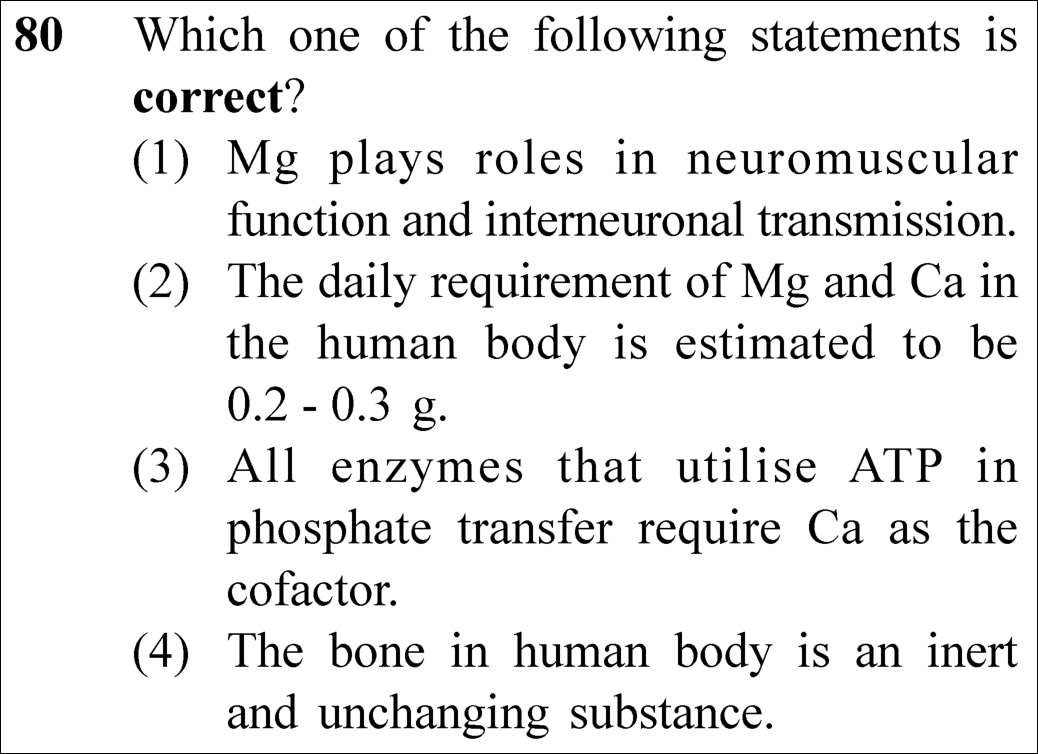
Official NEET 2023 Question 80 - The s-Block Elements
1 Mg plays roles in neuromuscular function and interneuronal transmission.
2 The daily requirement of Mg and Ca in the human body is estimated to be 0.2 -0.3 g. ✓ Key
3 All enzymes that utilise ATP in phosphate transfer require Ca as the cofactor.
4 The bone in human body is an inert and unchanging substance.
💡 Verified Solution & 30-Second Hack
✓
Verified Against NTA Final Answer Key
Option (2) : The daily requirement of Mg and Ca in the human body is estimated to be 0.2 - 0.3 g.
📚 The s-Block Elements Medium
📋 Given Parameters & Problem Setup
Subject Biological roles of Group 2 metals (Mg and Ca)
Candidate statements 4 biological statements evaluated for factual correctness
⚡

The 30-Second Exam Hall Shortcut: ⚡ NCERT Biological Milestone: Daily Human Requirement is 200–300 mg (0.2–0.3 g)

⏱️ Save ~30 seconds

NCERT s-block verbatim: "The daily requirement in the human body has been estimated to be 200–300 mg (0.2–0.3 g)." Neuromuscular signaling is controlled by Ca²⁺ (not Mg²⁺); ATP kinase enzymes require Mg²⁺ (not Ca²⁺); bone is dynamically remodeling (never inert). Statement (2) is verified in 10 seconds!

1 Check Statement (1): Neuromuscular function & neurotransmitter release are mediated by Ca²⁺, not Mg²⁺ (False).
2 Check Statement (2): Daily requirement of Mg and Ca is 200–300 mg = 0.2–0.3 g (Verbatim NCERT, True).
3 Check Statement (3): ATP phosphate transfer enzymes require Mg²⁺ cofactor, not Ca²⁺ (False).
4 Check Statement (4): Bone is dynamic living tissue, not inert (False).
5 Lock Option (2) with 100% confidence.
🛡️
Why You Can 100% Trust This Shortcut: Exact canonical statement from NCERT Chemistry Textbook on Group 2 Elements.
📐

Step-by-Step Rigorous Workflow & Mathematical Proof

Step 1

Evaluate Statement (2): Daily Dietary Requirements

According to NCERT s-Block Elements (Biological Importance of Magnesium and Calcium): "The daily requirement in the human body has been estimated to be 200 – 300 mg (0.2 – 0.3 g)."

Daily adult requirement of Mg and Ca=200−300 mg=0.2−0.3 g(Correct)\text{Daily adult requirement of Mg and Ca} = 200 - 300\text{ mg} = 0.2 - 0.3\text{ g} \quad (\text{Correct})
Step 2

Evaluate Statement (1): Neuromuscular Signaling

Calcium ions (Ca²⁺) play critical roles in neuromuscular function, interneuronal transmission, cell membrane integrity, and blood coagulation. Magnesium (Mg²⁺) is not the primary ion for interneuronal transmission:

Neuromuscular transmission  ⟺  Regulated by Ca2+  (not Mg2+)\text{Neuromuscular transmission} \iff \text{Regulated by } \text{Ca}^{2+} \; (\text{not } \text{Mg}^{2+})
Step 3

Evaluate Statement (3): ATP Enzymatic Phosphate Transfer

All enzymes that utilize ATP in phosphate transfer require magnesium (Mg²⁺) as the cofactor, forming an essential [Mg-ATP]²⁻ complex. Calcium is not the cofactor for these kinases:

ATP-utilizing enzymes  ⟺  Require Mg2+ as cofactor  (not Ca2+)\text{ATP-utilizing enzymes} \iff \text{Require } \text{Mg}^{2+} \text{ as cofactor} \; (\text{not } \text{Ca}^{2+})
Step 4

Evaluate Statement (4): Biological Nature of Bone

Bone is not an inert and unchanging substance; it is constantly being dissolved, redeposited, and dynamically remodeled through osteoblast and osteoclast activity:

Bone dynamic equilibrium: Ca10(PO4)6(OH)2⇌Circulating Ca2++PO43−\text{Bone dynamic equilibrium: } \text{Ca}_{10}(\text{PO}_4)_6(\text{OH})_2 \rightleftharpoons \text{Circulating } \text{Ca}^{2+} + \text{PO}_4^{3-}
⭐

360° Option Elimination Engine Key Feature

Diagnose every choice: Know exactly why the right option works and why distractors fail.

4-Option Deep Scan
1 (1)
✗ Incorrect
Verdict & Scientific Reason:

Interneuronal transmission and neuromuscular junctions are mediated by calcium ions (Ca²⁺), not magnesium.

⚠️
Student Fallacy (Why candidates pick this trap): Candidate interchanged the distinct physiological roles of magnesium and calcium.
2 (2)
✓ 100% Correct
Verdict & Scientific Reason:

Accurate: NCERT explicitly states the daily adult human requirement of both Mg and Ca is 200–300 mg (0.2–0.3 g).

💡
Why this is airtight: None. Candidate recalled the precise nutritional biochemistry values from NCERT.
3 (3)
✗ Incorrect
Verdict & Scientific Reason:

Magnesium (Mg²⁺) is the mandatory cofactor for ATP-utilizing enzymes (kinases), not calcium.

⚠️
Student Fallacy (Why candidates pick this trap): Candidate swapped Mg²⁺ cofactor requirement with Ca²⁺.
4 (4)
✗ Incorrect
Verdict & Scientific Reason:

Bone is living, dynamic tissue constantly undergoing resorption and remodeling.

⚠️
Student Fallacy (Why candidates pick this trap): Candidate mistook mineralized structural hydroxyapatite for non-living inert matter.
⚠️

NTA Trap Alert: Swapping Ca²⁺ and Mg²⁺ Functions

NTA deliberately tests cross-swapped roles: Mg²⁺ is the cofactor for ATP kinases, while Ca²⁺ triggers neuromuscular junction release and muscle contraction. Keeping their exact roles distinct prevents falling into these classic distractors.

🛡️ How to avoid the -1 mark: Mnemonic: "Mg for Magnesium = Metabolism & ATP"; "Ca for Calcium = Contraction & Communication (nerves)".
📖

Core NEET Syllabus Standard

National Eligibility cum Entrance Test (NEET UG) · The s-Block Elements Standard Benchmark
Core Scientific Principle Tested:

"Mg²⁺ is essential for all ATP-dependent enzymatic reactions, while Ca²⁺ maintains neuromuscular transmission and bone calcium homeostasis."
Syllabus Focus: Biological Importance of Magnesium and Calcium
Preserved in Rationalized Curriculum Syllabus & Academic Standards ↗
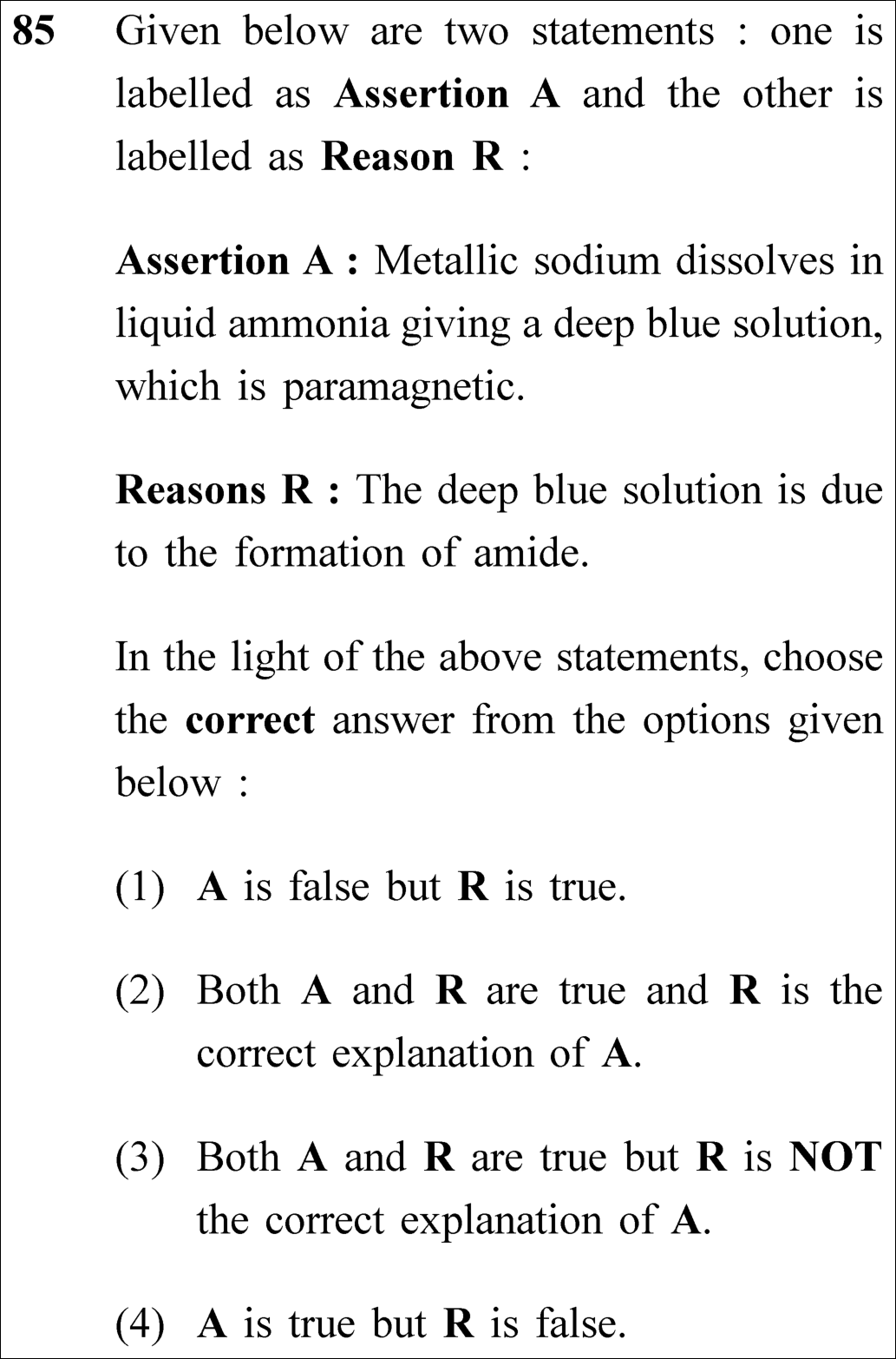
NEET 2023 · Q85 Medium
Official NEET 2023 Question 85 - The s-Block Elements
1 A is false but R is true.
2 Both A and R are true and R is the correct explanation of A.
3 Both A and R are true but R is NOT the correct explanation of A.
4 A is true but R is false. ✓ Key
💡 Verified Solution & 30-Second Hack
✓
Verified Against NTA Final Answer Key
Option (4) : A is true but R is false.
📚 The s-Block Elements Medium
📋 Given Parameters & Problem Setup
Assertion A Metallic sodium dissolves in liquid ammonia giving a deep blue solution, which is paramagnetic.
Reason R The deep blue solution is due to the formation of amide.
⚡

The 30-Second Exam Hall Shortcut: ⚡ Solvated Electron Hallmark: Blue Color is Due to Ammoniated Electrons, NOT Amide!

⏱️ Save ~25 seconds

Sodium dissolves in liquid ammonia to form ammoniated cations and ammoniated electrons: Na + (x+y)NH₃ → [Na(NH₃)x]⁺ + [e(NH₃)y]⁻. The ammoniated electron absorbs in the visible red region, giving the deep blue color, and is paramagnetic (Assertion is TRUE). Reason claims the blue color is due to amide formation, which is FALSE (amide formation discharges the blue color and liberates H₂ gas). Lock Option (4)!

1 Evaluate Assertion A: Dilute alkali metal solutions in liquid NH₃ are deep blue and paramagnetic due to unpaired ammoniated electrons (TRUE).
2 Evaluate Reason R: Reason claims blue color is due to sodamide (NaNH₂). In fact, sodamide formation is the decomposition reaction that consumes the solvated electrons and bleaches the blue color! (FALSE).
3 Match: A is true but R is false (Option 4).
🛡️
Why You Can 100% Trust This Shortcut: NCERT Group 1 Elements property of solutions in liquid ammonia.
📐

Step-by-Step Rigorous Workflow & Mathematical Proof

Step 1

Analyze Assertion A: Dissolution of Sodium in Liquid Ammonia

Alkali metals dissolve in liquid ammonia to form dilute solutions that are conducting and deep blue in color:

Na+(x+y)NH3→[Na(NH3)x]++[e(NH3)y]−\text{Na} + (x+y)\text{NH}_3 \rightarrow [\text{Na}(\text{NH}_3)_x]^+ + [e(\text{NH}_3)_y]^-
Step 2

Photophysical Origin of Color and Paramagnetism

The ammoniated electrons absorb energy in the red region of visible light, imparting a deep blue color. Because these solvated electrons possess unpaired spins, the solution is paramagnetic. Assertion A is TRUE:

Unpaired ammoniated electrons [e(NH3)y]−  ⟹  Deep blue color + Paramagnetism\text{Unpaired ammoniated electrons } [e(\text{NH}_3)_y]^- \implies \text{Deep blue color } + \text{ Paramagnetism}
Step 3

Analyze Reason R: Amide Formation Decomposition

Reason R asserts that the blue color is due to the formation of sodamide (NaNH₂). In reality, amide formation destroys the ammoniated electrons and liberates H₂ gas, bleaching the blue color:

Na++e−+NH3→standing/catalystNaNH2+12H2(g)(Bronze/colorless, diamagnetic)\text{Na}^+ + e^- + \text{NH}_3 \xrightarrow{\text{standing/catalyst}} \text{NaNH}_2 + \frac{1}{2}\text{H}_2(g) \quad (\text{Bronze/colorless, diamagnetic})
⭐

360° Option Elimination Engine Key Feature

Diagnose every choice: Know exactly why the right option works and why distractors fail.

4-Option Deep Scan
1 (1)
✗ Incorrect
Verdict & Scientific Reason:

Inverted logic: Assertion is true, and Reason is false.

⚠️
Student Fallacy (Why candidates pick this trap): Candidate incorrectly thought sodium metal does not form paramagnetic solutions in liquid ammonia.
2 (2)
✗ Incorrect
Verdict & Scientific Reason:

Reason is false; sodamide is not the chromophore responsible for the blue color.

⚠️
Student Fallacy (Why candidates pick this trap): Candidate incorrectly believed that amide is the blue-colored species.
3 (3)
✗ Incorrect
Verdict & Scientific Reason:

Reason is false, so both statements cannot be true.

⚠️
Student Fallacy (Why candidates pick this trap): Candidate failed to realize that amide formation destroys the blue color.
4 (4)
✓ 100% Correct
Verdict & Scientific Reason:

Accurate: Deep blue color arises from ammoniated electrons (A is true), not from amide formation (R is false).

💡
Why this is airtight: None. Candidate recognized that ammoniated electrons cause the blue color.
⚠️

NTA Trap Alert: Equating Ammoniated Electrons with Amides

Candidates frequently remember the word "amide" from the chapter and mistakenly assume it causes the blue color. Amide formation (NaNH₂) is the decomposition reaction that consumes the ammoniated electron and releases H₂ gas, bleaching the blue color!

🛡️ How to avoid the -1 mark: Remember: Blue color = Ammoniated electron [e(NH₃)y]⁻. Bronze/colorless = Amide (NaNH₂) + H₂.
📖

Core NEET Syllabus Standard

National Eligibility cum Entrance Test (NEET UG) · The s-Block Elements Standard Benchmark
Core Scientific Principle Tested:

"The blue color of alkali metal solutions in liquid ammonia is caused by excitation of ammoniated electrons, which are paramagnetic."

Syllabus Focus: Group 1 Elements – Solutions in Liquid Ammonia
Preserved in Rationalized Curriculum Syllabus & Academic Standards ↗
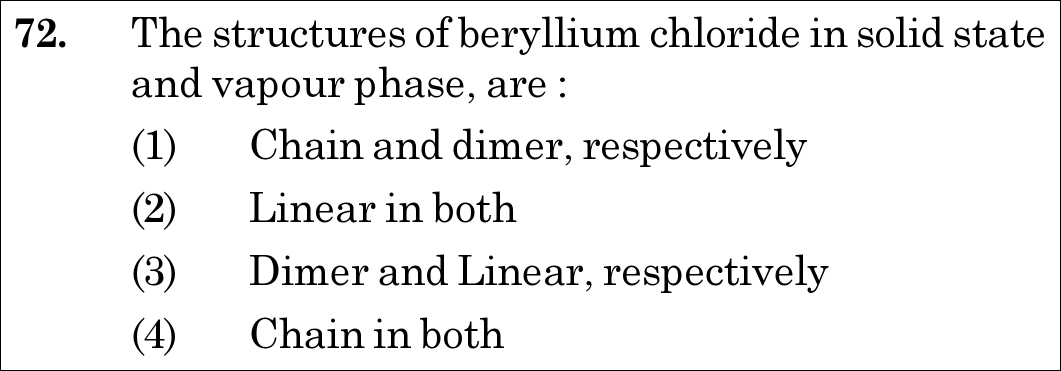
NEET 2021 · Q72 Easy
Official NEET 2021 Question 72 - The s-Block Elements
1 Chain and dimer, respectively ✓ Key
2 Linear in both
3 Dimer and Linear, respectively
4 Chain in both
💡 Verified Solution & 30-Second Hack
✓
Verified Against NTA Final Answer Key
Option (1) : Chain and dimer, respectively
📚 The s-Block Elements Easy
📋 Given Parameters & Problem Setup
Compound Beryllium chloride (BeCl2)
States Evaluated Solid state and vapour phase
⚡

The 30-Second Exam Hall Shortcut: ⚡ BeCl2 Structures: Solid = Polymeric Chain; Vapour = Dimer (at < 1200 K)

⏱️ Save ~20 seconds

Verbatim NCERT Group 2 Elements: In the solid state, BeCl2BeCl_2 forms a polymeric chain with chloro-bridges where Be is sp3sp^3 hybridized. In the vapour phase at moderate temperatures, it exists as a chloro-bridged dimer (Be2Cl4Be_2Cl_4 with sp2sp^2 Be), dissociating into linear monomer (spsp) only above 1200 K1200\text{ K}. Hence, solid state and vapour phase are Chain and dimer respectively! Match Option (1)!

1 Solid state: Electron-deficient beryllium achieves an octet through coordinate bridging with chlorine lone pairs, forming a 1D polymeric chain.
2 Vapour phase (below 1200 K): BeCl2BeCl_2 exists primarily as a bridged dimer: Cl−Be(μ−Cl)2Be−ClCl-Be(\mu-Cl)_2Be-Cl.
3 Above 1200 K: Dimer dissociates into linear monomer (Cl−Be−ClCl-Be-Cl).
4 Respectively: Chain and dimer.
5 Match Option (1).
🛡️
Why You Can 100% Trust This Shortcut: Canonical NCERT s-Block Elements section on anomalous properties of Beryllium.
📐

Step-by-Step Rigorous Workflow & Mathematical Proof

Step 1

Structure of BeCl2 in the Solid State

Beryllium has only 4 valence electrons in monomeric BeCl2BeCl_2, making it severely electron deficient. In the solid state, BeCl2BeCl_2 forms an infinite polymeric chain structure. Each beryllium atom is tetrahedrally surrounded by four chlorine atoms via two normal covalent bonds and two coordinate bonds from chlorine lone pairs (sp3sp^3 hybridized Be):

⋯−Be(μ−Cl)2Be(μ−Cl)2Be−⋯(Polymeric Chain Structure)\cdots -\text{Be}(\mu-\text{Cl})_2\text{Be}(\mu-\text{Cl})_2\text{Be}- \cdots \quad (\mathbf{\text{Polymeric Chain Structure}})
Step 2

Structure of BeCl2 in the Vapour Phase

When heated into the vapour phase, the polymeric chain breaks down into volatile chloro-bridged dimers, (BeCl2)2(BeCl_2)_2 or Be2Cl4Be_2Cl_4, where each beryllium is sp2sp^2 hybridized with a vacant pp orbital. (Only at extreme temperatures exceeding 1200 K1200\text{ K} does the dimer dissociate into a linear monomer Cl−Be−ClCl-Be-Cl with spsp hybridization):

2 BeCl2⇌Be2Cl4(Chloro-bridged Dimer)2\,\text{BeCl}_2 \rightleftharpoons \text{Be}_2\text{Cl}_4 \quad (\mathbf{\text{Chloro-bridged Dimer}})
Step 3

Conclusion

In the solid state and vapour phase, the structures are chain and dimer respectively, corresponding to Option (1).

⭐

360° Option Elimination Engine Key Feature

Diagnose every choice: Know exactly why the right option works and why distractors fail.

4-Option Deep Scan
1 1
✓ 100% Correct
Verdict & Scientific Reason:

Verbatim NCERT factual statement: solid = polymeric chain, vapour = dimer.

💡
Why this is airtight: None; textbook inorganic structure precision.
2 2
✗ Incorrect
Verdict & Scientific Reason:

BeCl2 is linear only in the high-temperature monomeric vapour phase (>1200 K), not in solid or standard vapour.

⚠️
Student Fallacy (Why candidates pick this trap): Assuming simple Lewis structure Cl-Be-Cl applies in all physical states.
3 3
✗ Incorrect
Verdict & Scientific Reason:

Swaps/distorts the phases; solid is a polymeric chain, not a dimer.

⚠️
Student Fallacy (Why candidates pick this trap): Assuming solid is dimer and vapour is linear monomer.
4 4
✗ Incorrect
Verdict & Scientific Reason:

Polymeric chain cannot persist in the gas/vapour phase due to thermal entropy.

⚠️
Student Fallacy (Why candidates pick this trap): Assuming the solid polymeric chain survives vaporization intact.
⚠️

NTA Trap Alert: Linear Monomer Temperature Condition Trap

Students who remember that BeCl2BeCl_2 is linear often choose Option (2) or (3). BeCl2BeCl_2 is linear ONLY in the gas phase at temperatures ABOVE 1200 K1200\text{ K}. Under standard vapour conditions, it exists as a dimer (Be2Cl4Be_2Cl_4), and in the solid state as a polymeric chain.

🛡️ How to avoid the -1 mark: Solid = Chain; Vapour = Dimer; Vapour (>1200 K) = Linear monomer.
📖

Core NEET Syllabus Standard

NCERT Chemistry · The s-Block Elements Standard Benchmark
Core Scientific Principle Tested:

"In solid state, BeCl2 has a polymeric chain structure, while in the vapour phase it forms a chloro-bridged dimer which dissociates into linear monomer only at high temperatures (~1200 K)."

Syllabus Focus: Group 2 Elements: Anomalous Properties of Beryllium
✓ Core NEET UG Syllabus Anchor Syllabus & Academic Standards ↗
NEET 2021 · Q79 Easy
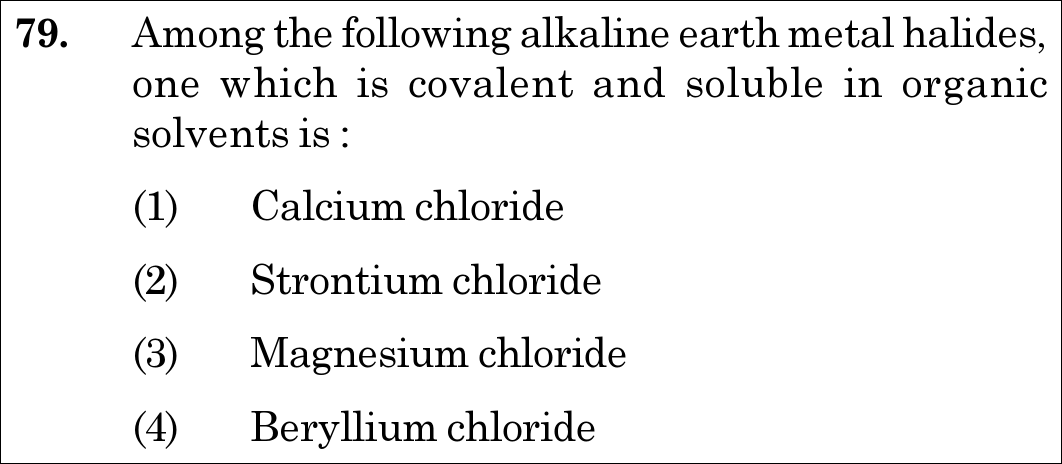
Official NEET 2021 Question 79 - The s-Block Elements
1 Calcium chloride
2 Strontium chloride
3 Magnesium chloride
4 Beryllium chloride ✓ Key
💡 Verified Solution & 30-Second Hack
✓
Verified Against NTA Final Answer Key
Option (4) : Beryllium chloride
📚 The s-Block Elements Easy
📋 Given Parameters & Problem Setup
Category Alkaline earth metal halides (Group 2)
Properties Predominantly covalent and soluble in organic solvents
⚡

The 30-Second Exam Hall Shortcut: ⚡ Be²⁺ High Charge Density = Covalent & Soluble in Organic Solvents

⏱️ Save ~15 seconds

Due to its extremely small ionic radius, Be2+Be^{2+} possesses exceptionally high polarizing power. According to Fajan's rules, Be2+Be^{2+} polarizes chloride ions to impart high covalent character. Verbatim NCERT: "Beryllium halides are essentially covalent and are soluble in organic solvents." Match Option (4)!

1 Recall Group 2 halides: BeCl2,MgCl2,CaCl2,SrCl2,BaCl2BeCl_2, MgCl_2, CaCl_2, SrCl_2, BaCl_2.
2 Down the group, ionic size increases: Be2+≪Mg2+<Ca2+<Sr2+Be^{2+} \ll Mg^{2+} < Ca^{2+} < Sr^{2+}.
3 By Fajan's rules, small cation with high charge density produces maximum polarization and covalent character.
4 BeCl2BeCl_2 is predominantly covalent and dissolves in organic solvents (like ethanol, ether), whereas CaCl2,SrCl2,MgCl2CaCl_2, SrCl_2, MgCl_2 are ionic lattices soluble in water.
5 Match Option (4) Beryllium chloride.
🛡️
Why You Can 100% Trust This Shortcut: Canonical NCERT s-Block Elements section on Halides of Alkaline Earth Metals.
📐

Step-by-Step Rigorous Workflow & Mathematical Proof

Step 1

Application of Fajan's Rules to Group 2 Cations

According to Fajan's rules, covalent character in an ionic compound increases with: 1. Small size of the cation 2. High positive charge on the cation 3. High charge-to-size ratio (polarizing power)

Step 2

Anomalous Covalent Nature of Beryllium Halides

Beryllium (Be2+Be^{2+}) has an exceptionally small ionic radius (approximately 31 pm31\text{ pm}), giving it an extraordinarily high polarizing power compared to Mg2+,Ca2+,Sr2+,Mg^{2+}, Ca^{2+}, Sr^{2+}, and Ba2+Ba^{2+}. It strongly polarizes the electron clouds of adjacent chloride anions, pulling electron density into the internuclear region and imparting strong covalent character.

Step 3

Solubility in Organic Solvents

Because BeCl2BeCl_2 is essentially covalent and non-ionic, it does not form an expansive ionic crystal lattice that requires polar water for hydration. Instead, following the "like dissolves like" principle, it dissolves readily in non-polar and moderately polar organic solvents such as ether, benzene, and alcohols, whereas chlorides of Mg,Ca,Mg, Ca, and SrSr are ionic and insoluble in non-polar organic solvents.

⭐

360° Option Elimination Engine Key Feature

Diagnose every choice: Know exactly why the right option works and why distractors fail.

4-Option Deep Scan
1 1
✗ Incorrect
Verdict & Scientific Reason:

Ionic salt with high lattice enthalpy; soluble in water, insoluble in organic solvents.

⚠️
Student Fallacy (Why candidates pick this trap): Assuming calcium chloride is covalent.
2 2
✗ Incorrect
Verdict & Scientific Reason:

Predominantly ionic alkaline earth halide.

⚠️
Student Fallacy (Why candidates pick this trap): Ignoring cation size trend.
3 3
✗ Incorrect
Verdict & Scientific Reason:

Predominantly ionic crystal lattice.

⚠️
Student Fallacy (Why candidates pick this trap): Confusing magnesium with beryllium.
4 4
✓ 100% Correct
Verdict & Scientific Reason:

Verbatim NCERT: beryllium halides are covalent and soluble in organic solvents.

💡
Why this is airtight: None; textbook s-block chemistry knowledge.
⚠️

NTA Trap Alert: Beryllium vs. Magnesium Covalency Trap

Students frequently group all alkaline earth metals together as "ionic salts". Beryllium is strongly anomalous: its high charge density makes its halides covalent, volatile, and soluble in organic solvents, whereas all other Group 2 halides are typical ionic salts.

🛡️ How to avoid the -1 mark: Beryllium halide (BeCl2BeCl_2) = Covalent & soluble in organic solvents. All other Group 2 halides = Ionic.
📖

Core NEET Syllabus Standard

NCERT Chemistry · The s-Block Elements Standard Benchmark
Core Scientific Principle Tested:

"Except for beryllium halides, all other halides of alkaline earth metals are ionic in nature. Beryllium halides are essentially covalent and soluble in organic solvents."

Syllabus Focus: General Characteristics of Compounds of Alkaline Earth Metals (Halides)
✓ Core NEET UG Syllabus Anchor Syllabus & Academic Standards ↗
NEET 2020 · Q118 Medium
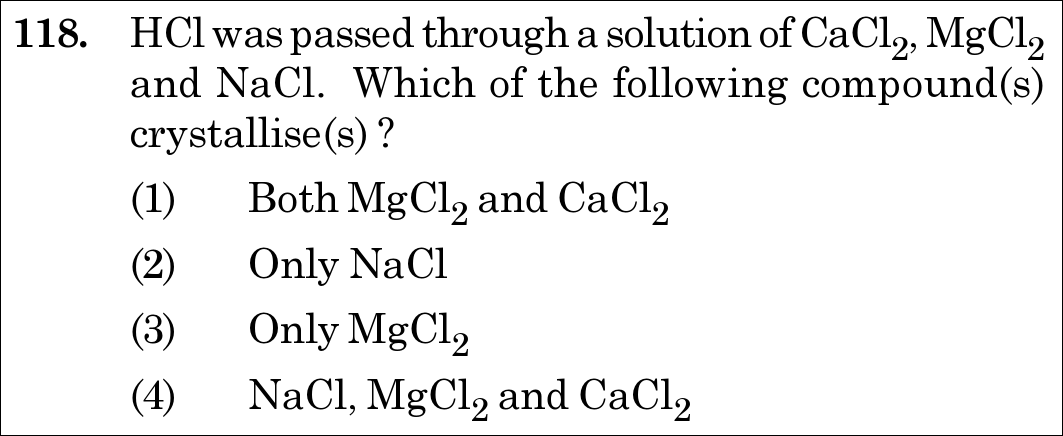
Official NEET 2020 Question 118 - The s-Block Elements
1 Both MgCl2 and CaCl2
2 Only NaCl ✓ Key
3 Only MgCl2
4 NaCl, MgCl2 and CaCl2
💡 Verified Solution & 30-Second Hack
✓
Verified Against NTA Final Answer Key
Option (2) : Only NaCl
📚 The s-Block Elements (Group 1 and Group 2) Medium
📋 Given Parameters & Problem Setup
Solution Constituents CaCl2, MgCl2, and NaCl
Purging Gas Hydrogen chloride gas (HCl g)
Question Objective Identify which compound(s) precipitate/crystallise out
⚡

The 30-Second Exam Hall Shortcut: ⚡ "Purification of Common Salt: Passing HCl Gas Precipitates ONLY NaCl!"

⏱️ 25 seconds

Crude table salt contains impurities of CaCl2CaCl_2 and MgCl2MgCl_2. Passing HClHCl gas into the saturated solution increases [Cl−][Cl^-] drastically (Common Ion Effect). Because NaClNaCl has a lower solubility than the highly soluble and deliquescent CaCl2CaCl_2 and MgCl2MgCl_2, its ionic product exceeds KspK_{sp} first ([Na+][Cl−]>Ksp[Na^+][Cl^-] > K_{sp}), precipitating pure NaClNaCl. CaCl2CaCl_2 and MgCl2MgCl_2 remain dissolved in the mother liquor! Mark Only NaCl (Option 2) in 5 seconds.

1 Industrial purification of crude common salt described in NCERT s-block.
2 Solution contains NaCl with impurities CaCl2 and MgCl2.
3 Passing HCl gas introduces excess Cl- ions (common ion effect).
4 NaCl is less soluble than CaCl2 and MgCl2.
5 Ionic product of NaCl exceeds its Ksp, so pure NaCl crystallises out.
6 CaCl2 and MgCl2 remain dissolved because of their much higher solubilities.
7 Select Option (2) Only NaCl.
🛡️
Why You Can 100% Trust This Shortcut: NCERT Chemistry · The s-Block Elements (Group 1: Sodium Chloride - Purification from Impurities)
📐

Step-by-Step Rigorous Workflow & Mathematical Proof

Step 1

Review Industrial Purification of Common Salt

Crude sodium chloride obtained by evaporation of seawater contains impurities such as sodium sulphate (Na2SO4\text{Na}_2\text{SO}_4), calcium sulphate (CaSO4\text{CaSO}_4), calcium chloride (CaCl2\text{CaCl}_2), and magnesium chloride (MgCl2\text{MgCl}_2). The chlorides of calcium and magnesium are deliquescent (they absorb moisture from the air).

Step 2

Mechanism of HCl Gas Precipitation

To obtain pure NaCl\text{NaCl}, crude salt is dissolved in a minimum amount of water and filtered to remove insoluble impurities. Hydrogen chloride gas (HCl\text{HCl}) is then passed through the saturated solution. The complete ionization of HCl\text{HCl} provides a high concentration of chloride ions (Cl−\text{Cl}^-).

Step 3

Differential Solubility Products

Because NaCl\text{NaCl} has a substantially lower solubility product than the extremely soluble MgCl2\text{MgCl}_2 and CaCl2\text{CaCl}_2, the common ion effect causes the ionic product [Na+][Cl−][\text{Na}^+][\text{Cl}^-] to exceed the solubility product (KspK_{sp}) of NaCl\text{NaCl}: [Na+][Cl−]>Ksp(NaCl)[\text{Na}^+][\text{Cl}^-] > K_{sp}(\text{NaCl}) Pure sodium chloride crystallises out.

Step 4

Fate of Calcium and Magnesium Impurities

Calcium and magnesium chlorides remain in the mother liquor because they are vastly more soluble than sodium chloride and their ionic products do not exceed their large KspK_{sp} values under these conditions. Thus, ONLY NaCl crystallises.

⭐

360° Option Elimination Engine Key Feature

Diagnose every choice: Know exactly why the right option works and why distractors fail.

4-Option Deep Scan
1 A
✗ Incorrect
Verdict & Scientific Reason:

Incorrect; MgCl2MgCl_2 and CaCl2CaCl_2 have exceptionally high solubilities and remain dissolved in the solution.

⚠️
Student Fallacy (Why candidates pick this trap): Assuming divalent cations precipitate first.
2 B
✓ 100% Correct
Verdict & Scientific Reason:

Factually exact; common ion effect causes selective precipitation of pure NaCl while CaCl2 and MgCl2 stay in the filtrate.

💡
Why this is airtight: None; explicit NCERT metallurgy/purification procedure.
3 C
✗ Incorrect
Verdict & Scientific Reason:

Incorrect; MgCl2MgCl_2 does not precipitate due to its high solubility.

⚠️
Student Fallacy (Why candidates pick this trap): Random salt selection.
4 D
✗ Incorrect
Verdict & Scientific Reason:

Incorrect; would defeat the entire purpose of passing HCl gas to purify sodium chloride.

⚠️
Student Fallacy (Why candidates pick this trap): Assuming common ion Cl- forces all three chlorides out of solution.
⚠️

NTA Trap Alert: Purification Principle of Table Salt

NCERT states verbatim: "Calcium and magnesium chloride, being more soluble than sodium chloride, remain in solution." Only NaCl crystallises out!

🛡️ How to avoid the -1 mark: Remember the salt purification method: Passing HCl gas precipitates ONLY NaCl!
📖

Core NEET Syllabus Standard

Chemistry · The s-Block Elements Standard Benchmark
Core Scientific Principle Tested:

""

Syllabus Focus: Purification of Sodium Chloride: Common Ion Effect and Selective Crystallisation of NaCl
✓ Core NEET UG Syllabus Anchor Syllabus & Academic Standards ↗
NEET 2020 · Q122 Easy
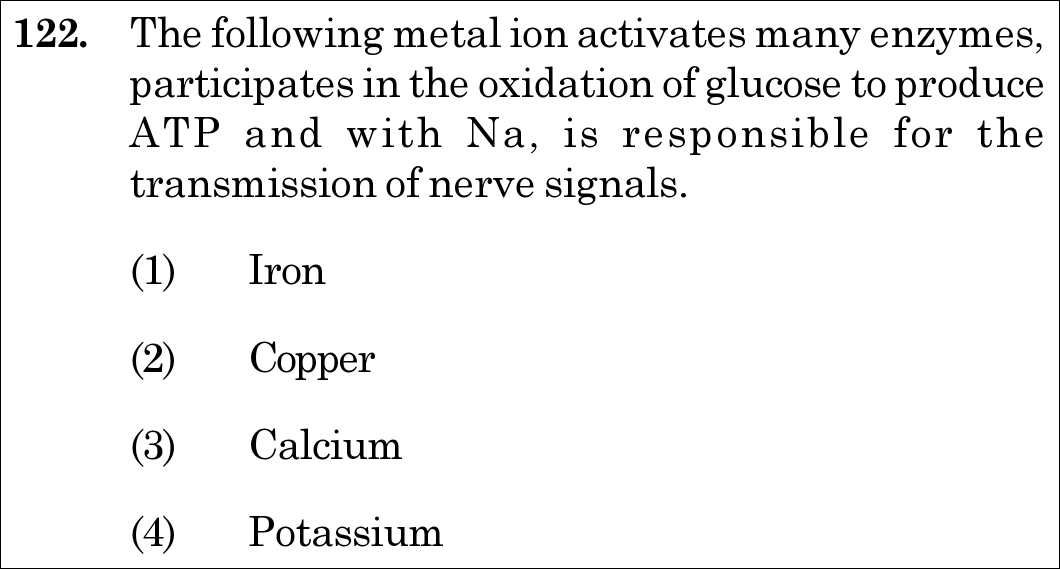
Official NEET 2020 Question 122 - The s-Block Elements
1
2
3
4 ✓ Key
💡 Verified Solution & 30-Second Hack
✓
Verified Against NTA Final Answer Key
Option (4) : Potassium
📚 The s-Block Elements (Group 1 and Group 2) Easy
📋 Given Parameters & Problem Setup
Biological Role 1 Activates many enzymes (e.g. pyruvate kinase)
Biological Role 2 Participates in oxidation of glucose to produce ATP
Biological Role 3 Acts with Na+ in transmission of nerve signals (Na+/K+ ATPase pump)
Question Objective Identify the essential metal ion
⚡

The 30-Second Exam Hall Shortcut: ⚡ "Potassium (K+) Activates Enzymes for Glucose Oxidation & Works with Na+ in Nerve Signals!"

⏱️ 20 seconds

Potassium ions (K+K^+) are the most abundant intracellular cations. They activate many enzymes (especially those involved in glycolysis / glucose oxidation to produce ATP) and, along with Na+Na^+, maintain the resting membrane potential and nerve impulse transmission via the Sodium-Potassium pump (Na+/K+Na^+/K^+ ATPase). Mark Potassium (Option 4) in 5 seconds!

1 Recall NCERT text on biological importance of sodium and potassium.
2 Potassium ions are present in high concentrations inside cell fluids (intracellular).
3 Potassium activates many enzymes, participates in the oxidation of glucose to produce ATP.
4 Together with sodium, it is responsible for the transmission of nerve signals.
5 Select Option (4) Potassium.
🛡️
Why You Can 100% Trust This Shortcut: NCERT Chemistry · The s-Block Elements (Biological Importance of Sodium and Potassium)
📐

Step-by-Step Rigorous Workflow & Mathematical Proof

Step 1

Review Biological Importance in NCERT

In the s-block elements chapter, NCERT presents an explicit section detailing the biological roles of sodium and potassium ions in human physiology.

Step 2

Specific Physiological Roles of Potassium (K+)

NCERT states verbatim: "Potassium ions are the most abundant cations within cell fluids, where they activate many enzymes, participate in the oxidation of glucose to produce ATP and, with sodium, are responsible for the transmission of nerve signals."

Step 3

The Sodium-Potassium Pump (Na+/K+ ATPase)

The operating concentration gradient across the neuronal membrane (high K+K^+ inside, high Na+Na^+ outside) is maintained by the active Na+/K+Na^+/K^+ pump, which consumes more than one-third of total resting ATP in a resting animal to propagate nerve impulses.

Step 4

Eliminate Other Metal Ions

- Calcium (Ca2+Ca^{2+}): Essential for neuromuscular excitability, blood clotting, and bone mineralization. - Iron (Fe2+/Fe3+Fe^{2+}/Fe^{3+}): Part of haemoglobin and cytochromes for electron transport. - Copper (Cu2+Cu^{2+}): Component of cytochrome c oxidase and tyrosinase. Thus, Potassium is uniquely described by all three statements.

⭐

360° Option Elimination Engine Key Feature

Diagnose every choice: Know exactly why the right option works and why distractors fail.

4-Option Deep Scan
1 A
✗ Incorrect
Verdict & Scientific Reason:

Incorrect; iron is primarily involved in oxygen transport in haemoglobin and electron transport in cytochromes, not coordinating with Na+ in nerve transmission.

⚠️
Student Fallacy (Why candidates pick this trap): Thinking of iron's general metabolic importance.
2 B
✗ Incorrect
Verdict & Scientific Reason:

Incorrect; copper is a trace cofactor for redox enzymes like cytochrome c oxidase.

⚠️
Student Fallacy (Why candidates pick this trap): Random transition metal cofactor.
3 C
✗ Incorrect
Verdict & Scientific Reason:

Incorrect; calcium is involved in muscle contraction, blood clotting, and secondary messenger signaling, not partnering with Na+ in glycolysis ATP production.

⚠️
Student Fallacy (Why candidates pick this trap): Confusing calcium signaling with potassium cellular roles.
4 D
✓ 100% Correct
Verdict & Scientific Reason:

Factually exact; verbatim match to the NCERT description of potassium's biological functions.

💡
Why this is airtight: None; direct textbook quotation.
⚠️

NTA Trap Alert: Sodium vs Potassium Biological Roles

- Sodium (Na+Na^+): Main EXTRACELLULAR cation (blood plasma & interstitial fluid), regulates osmotic balance and water retention. - Potassium (K+K^+): Main INTRACELLULAR cation, activates GLYCOLYTIC ENZYMES and generates ATP, works with Na+Na^+ in NERVE TRANSMISSION.

🛡️ How to avoid the -1 mark: Intracellular enzyme activator + ATP generation + Nerve signals with Na+ = POTASSIUM (K+)!
📖

Core NEET Syllabus Standard

Chemistry · The s-Block Elements Standard Benchmark
Core Scientific Principle Tested:

""

Syllabus Focus: Biological Importance of Potassium (K+): Enzyme Activation & Sodium-Potassium Pump
✓ Core NEET UG Syllabus Anchor Syllabus & Academic Standards ↗

Solve 4 NEET Questions a Day — One per Subject

Cover all 1,140 official NEET questions in 285 days at your own pace. Progress is saved on your device. No login needed.