MyCompetitiveExams Logo MyCompetitiveExams
Search 1,140+ Questions
Chapters, formulas, speed tricks
→
⚡ Brahmastra NEET 2027
720 MARKS

Dynamic 180-question full-length simulator mixed dynamically from all 6 years for 2027 & 2026 aspirants.

Launch Brahmastra 2027 Test →
Start Practice →
100% Free · No Login Required
⚡ Physics Moderate Frequency

NEET Properties of Bulk Matter Previous Year Questions with Solutions

Complete repository of official NTA NEET questions for Properties of Bulk Matter from 2020 to 2026. Every question includes 30-second elimination tricks, step-by-step NCERT solutions, option-by-option traps, and official answer keys.

1 Questions 1 Exam Years (2026) 0 Easy · 1 Medium · 0 Challenging
NEET 2026 · Q12 Medium
Official NEET 2026 Question 12 - Properties of Bulk Matter
1 ✓ Key
2
3
4
💡 Verified Solution & 30-Second Hack
✓
Verified Against NTA Final Answer Key
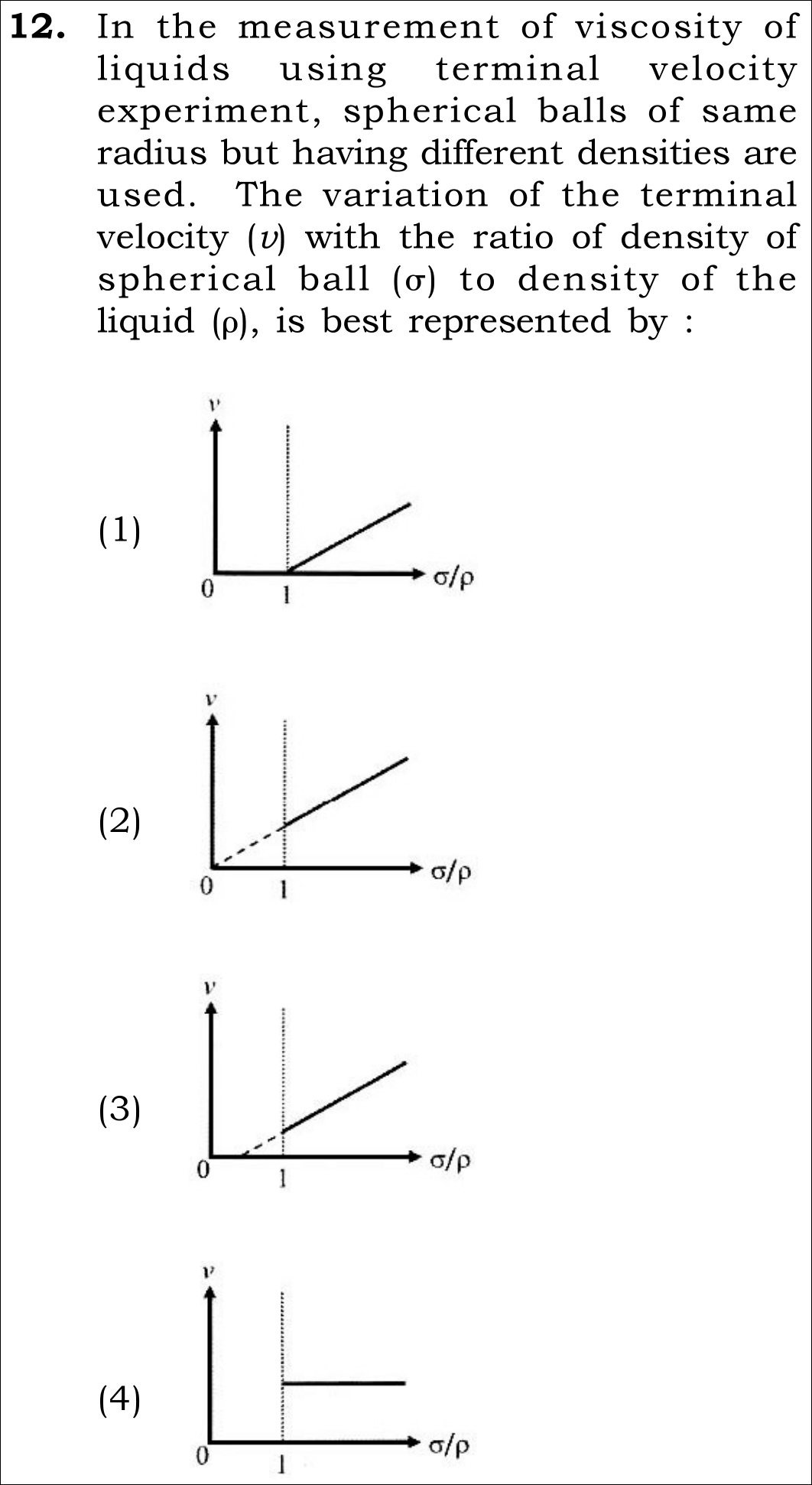
Option (1) : Graph (1): Line starts at sigma / rho = 1 on the horizontal axis and increases linearly
📚 Properties of Bulk Matter Medium
📋 Given Parameters & Problem Setup
Experiment Measurement of viscosity of liquids using terminal velocity
Spherical Balls Identical radius r, varying density sigma
Liquid Density rho (constant)
Variables to Plot Terminal velocity v vs density ratio (sigma / rho)
⚡

The 30-Second Exam Hall Shortcut: ⚡ Root Finding & Physical Cutoff Shortcut

⏱️ Bypasses complex algebraic plotting.

Find where terminal velocity equals zero!

1 Recall Stokes' Law terminal velocity: v_t = (2/9) * [r^2 * g / eta] * (sigma - rho).
2 Factor out liquid density rho: v_t = C * [(sigma / rho) - 1], where C = (2/9) * r^2 * g * rho / eta is positive.
3 Set v_t = 0 ==> (sigma / rho) - 1 = 0 ==> sigma / rho = 1.
4 Therefore, the graph MUST intersect the horizontal axis at exactly sigma / rho = 1.
5 For sigma / rho < 1, the sphere is less dense than the liquid, so buoyant force exceeds gravity; the ball floats and cannot fall downward.
6 Hence, v = 0 for sigma/rho <= 1, and increases linearly with slope C for sigma/rho > 1.
7 Look at the graphs: Only Graph (1) starts directly at (1, 0) on the axis. Solved in 15 seconds!
🛡️
Why You Can 100% Trust This Shortcut: Terminal velocity represents steady-state descent where Weight = Buoyant Force + Viscous Drag. At sigma = rho, Weight = Buoyancy, so net sinking force is zero and v_t = 0.
📐

Step-by-Step Rigorous Workflow & Mathematical Proof

Step 1

Formulate Dynamic Equilibrium for a Falling Sphere

When a sphere reaches terminal velocity v_t in a viscous medium, net downward acceleration is zero:

Fnet=W−FB−Fv=0  ⟹  mg−ρVg−6πηrvt=0F_{\text{net}} = W - F_B - F_v = 0 \implies m g - \rho V g - 6\pi \eta r v_t = 0
  • • Weight of sphere: W = sigma * V * g = sigma * (4/3 pi r^3) * g.
  • • Upthrust (Buoyant force): F_B = rho * V * g = rho * (4/3 pi r^3) * g.
  • • Stokes' viscous drag force: F_v = 6 pi eta r v_t.
Step 2

Express Terminal Velocity in terms of Density Ratio

Equate net gravitational force to viscous drag and solve for v_t:

vt=29r2gη(σ−ρ)=(2r2gρ9η)(σρ−1)v_t = \frac{2}{9} \frac{r^2 g}{\eta} (\sigma - \rho) = \left( \frac{2 r^2 g \rho}{9 \eta} \right) \left( \frac{\sigma}{\rho} - 1 \right)
  • • Let x = sigma / rho and constant k = (2 r^2 g rho) / (9 eta).
  • • Then v_t = k * (x - 1).
  • • This is a straight line equation of the form y = m(x - x_0) with x-intercept x_0 = 1.
Step 3

Analyze Physical Boundary Conditions and Graph Shape

Evaluate physical behavior across different density regimes:

vt=0forσρ≤1,vt∝(σρ−1)forσρ>1v_t = 0 \quad \text{for} \quad \frac{\sigma}{\rho} \le 1, \qquad v_t \propto \left(\frac{\sigma}{\rho} - 1\right) \quad \text{for} \quad \frac{\sigma}{\rho} > 1
  • • If sigma < rho, the ball floats upward (or remains at rest on the surface); falling terminal velocity is 0.
  • • At sigma / rho = 1, downward terminal velocity is exactly 0.
  • • For sigma / rho > 1, terminal velocity increases linearly with slope k.
  • • Matches Graph (1) perfectly, corresponding to Option (1).
⭐

360° Option Elimination Engine Key Feature

Diagnose every choice: Know exactly why the right option works and why distractors fail.

4-Option Deep Scan
1 Option (1)
✓ 100% Correct
Verdict & Scientific Reason:

Exact physical representation of Stokes' Law and Archimedes' principle; confirmed by Official NTA Key.

💡
Why this is airtight: Correctly identifies that terminal descent requires sigma > rho and starts at x = 1.
Note: Flawless experimental physics.
2 Option (2)
✗ Incorrect
Verdict & Scientific Reason:

Violates static equilibrium.

⚠️
Student Fallacy (Why candidates pick this trap): Assumes the ball would already fall with terminal speed even when its density equals liquid density.
Note: When sigma = rho, buoyancy completely balances weight; terminal sinking speed must be zero.
3 Option (3)
✗ Incorrect
Verdict & Scientific Reason:

Neglects buoyant upthrust completely.

⚠️
Student Fallacy (Why candidates pick this trap): Plots v_t proportional to sigma without subtracting liquid density rho.
Note: Buoyant force reduces net driving weight: net force is proportional to (sigma - rho), not sigma alone.
4 Option (4)
✗ Incorrect
Verdict & Scientific Reason:

Ignores dependence of driving weight on ball density.

⚠️
Student Fallacy (Why candidates pick this trap): Assumes terminal velocity is a fixed constant independent of sphere mass.
Note: Heavier spheres of the same size sink faster through viscous drag.
⚠️

NTA Trap Alert: Neglecting Buoyant Upthrust (The Origin Extrapolation Trap)

Students who forget Archimedes' principle assume v_t ~ sigma and pick Graph (3), which passes through the origin.

🛡️ How to avoid the -1 mark: Always remember: In any fluid motion, effective weight is ALWAYS (sigma - rho)*V*g. The driving term is (sigma - rho), so velocity is zero when sigma = rho.
📖

Core NEET Syllabus Standard

NEET UG Physics Core Standards · Mechanical Properties of Fluids Standard Benchmark
Core Scientific Principle Tested:

"Terminal velocity of a spherical body falling in a fluid: v_t = (2/9)*(r^2*g/eta)*(sigma - rho). Sinking occurs only when sigma > rho."

Syllabus Focus: Stokes' Law, Terminal Velocity, and Practical Measurement of Viscosity
✓ Core NEET UG Syllabus Anchor Syllabus & Academic Standards ↗

Solve 4 NEET Questions a Day — One per Subject

Cover all 1,140 official NEET questions in 285 days at your own pace. Progress is saved on your device. No login needed.