MyCompetitiveExams Logo MyCompetitiveExams
Search 1,140+ Questions
Chapters, formulas, speed tricks
→
⚡ Brahmastra NEET 2027
720 MARKS

Dynamic 180-question full-length simulator mixed dynamically from all 6 years for 2027 & 2026 aspirants.

Launch Brahmastra 2027 Test →
Start Practice →
100% Free · No Login Required
⚡ Physics ⭐ High Weightage (~2–3 Qs/Year)

NEET Moving Charges and Magnetism Previous Year Questions with Solutions

Complete repository of official NTA NEET questions for Moving Charges and Magnetism from 2020 to 2026. Every question includes 30-second elimination tricks, step-by-step NCERT solutions, option-by-option traps, and official answer keys.

12 Questions 6 Exam Years (2026, 2025, 2024, 2023, 2021, 2020) 7 Easy · 5 Medium · 0 Challenging
NEET 2026 · Q11 Medium
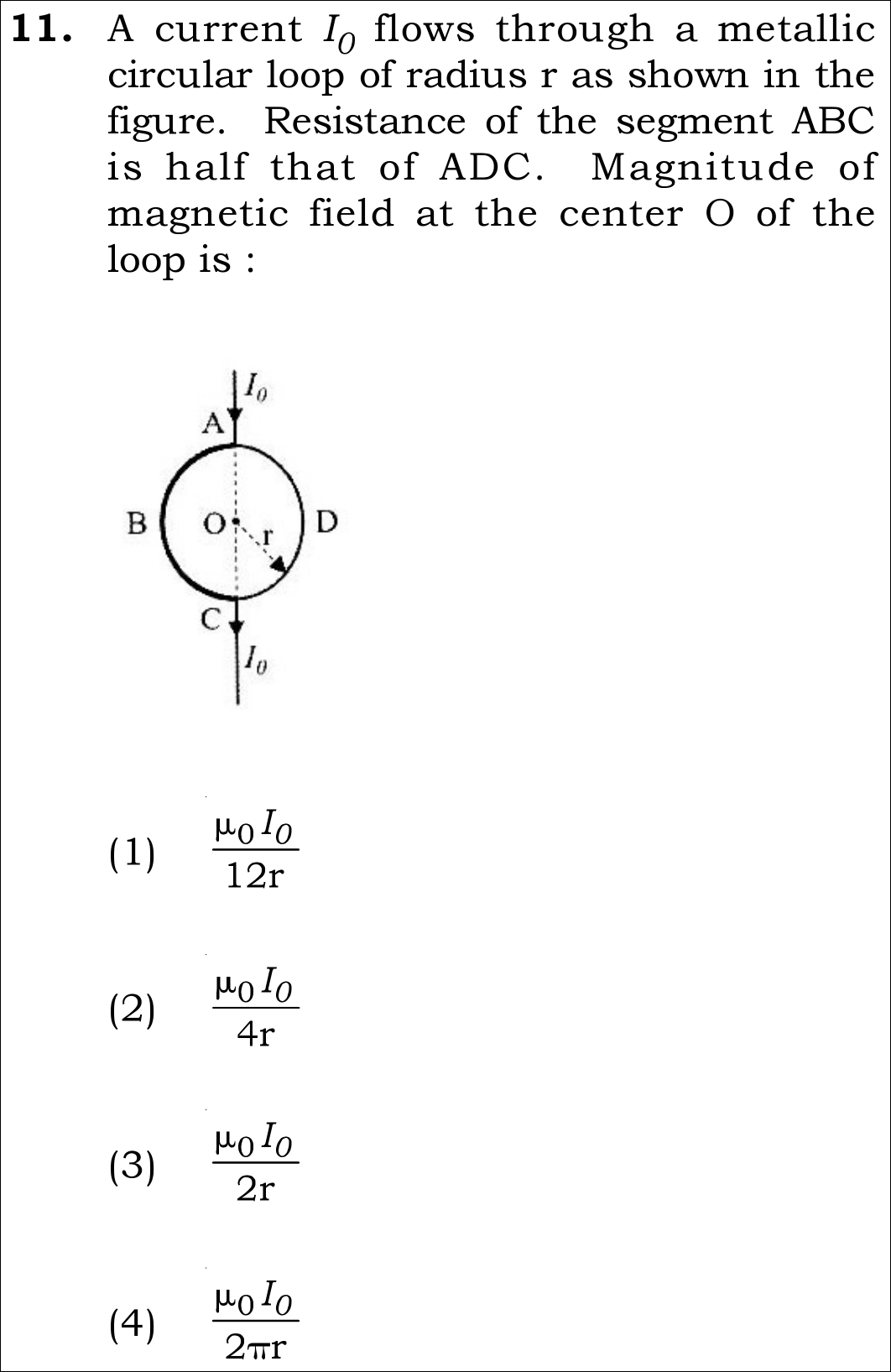
Official NEET 2026 Question 11 - Moving Charges and Magnetism
1 ✓ Key
2
3
4
💡 Verified Solution & 30-Second Hack
✓
Verified Against NTA Final Answer Key
Option (1) : B_net = mu_0 * I_0 / (12 * r)
📚 Magnetic Effects of Current Medium
📋 Given Parameters & Problem Setup
Total Current Entering I_0 at node A and exiting at node C
Loop Radius r meters
Geometry Two semicircular branches ABC and ADC spanning angle pi radians
Resistance Relation R_ABC = (1/2) * R_ADC
Target Field Net magnetic field at center O
⚡

The 30-Second Exam Hall Shortcut: ⚡ Current Splitting & Net Current Shortcut

⏱️ Saves 2 minutes versus calculating two separate vector integrals.

Find differential current flowing through the two semicircles

1 Branches ABC and ADC are in parallel. Potential difference V is identical across both.
2 Since R_ABC = R_ADC / 2, current is inversely proportional to resistance: I_ABC = 2 * I_ADC.
3 Total current I_0 splits as: I_ABC = (2/3) * I_0, and I_ADC = (1/3) * I_0.
4 By right-hand rule, branch ABC produces field INTO the page (x), while ADC produces field OUT OF the page (.).
5 Net effective current = I_ABC - I_ADC = (2/3 - 1/3) * I_0 = (1/3) * I_0.
6 Magnetic field from a semicircle: B = (1/2) * [mu_0 * I_net / (2r)] = (1/4) * mu_0 * [(1/3)*I_0] / r = mu_0 * I_0 / (12r). Done in 25 seconds!
🛡️
Why You Can 100% Trust This Shortcut: Biot-Savart Law states B = (theta / 2pi) * (mu_0 * I / 2r). For a semicircle (theta = pi), B = mu_0 * I / (4r). Since the two branches carry opposite circulating currents, their fields subtract vectorially: B_net = [mu_0 / (4r)] * (I_ABC - I_ADC).
📐

Step-by-Step Rigorous Workflow & Mathematical Proof

Step 1

Calculate Current in Each Semicircular Branch

Semicircular segments ABC and ADC are connected in parallel between nodes A and C:

V=IABCRABC=IADCRADCV = I_{ABC} R_{ABC} = I_{ADC} R_{ADC}
  • • Given R_{ABC} = \frac{1}{2} R_{ADC} \implies I_{ABC} = 2 I_{ADC}.
  • • Kirchhoff's Current Law at node A: I_{ABC} + I_{ADC} = I_0 \implies 2 I_{ADC} + I_{ADC} = 3 I_{ADC} = I_0.
  • • Therefore: I_{ADC} = \frac{1}{3} I_0, \quad I_{ABC} = \frac{2}{3} I_0.
Step 2

Determine Field Magnitudes and Directions at Center O

Use the Biot-Savart law for a circular arc spanning angle pi:

Barc=μ0I4πr⋅θ=μ0I4πr(π)=μ0I4rB_{\text{arc}} = \frac{\mu_0 I}{4\pi r} \cdot \theta = \frac{\mu_0 I}{4\pi r} (\pi) = \frac{\mu_0 I}{4r}
  • • Branch ABC (current flows A -> B -> C, clockwise): Magnetic field B_{ABC} points perpendicularly INTO the page (\otimes): B_{ABC} = \frac{\mu_0 (2/3 I_0)}{4r} = \frac{2\mu_0 I_0}{12r}.
  • • Branch ADC (current flows A -> D -> C, counter-clockwise): Magnetic field B_{ADC} points perpendicularly OUT OF the page (\odot): B_{ADC} = \frac{\mu_0 (1/3 I_0)}{4r} = \frac{\mu_0 I_0}{12r}.
Step 3

Superpose the Opposing Magnetic Fields

Subtract the smaller field from the larger field to obtain net magnitude:

Bnet=BABC−BADC=2μ0I012r−μ0I012r=μ0I012rB_{\text{net}} = B_{ABC} - B_{ADC} = \frac{2\mu_0 I_0}{12r} - \frac{\mu_0 I_0}{12r} = \frac{\mu_0 I_0}{12r}
  • • The net magnetic field points into the page with magnitude mu_0 * I_0 / (12r).
  • • Matches Option (1) exactly.
⭐

360° Option Elimination Engine Key Feature

Diagnose every choice: Know exactly why the right option works and why distractors fail.

4-Option Deep Scan
1 Option (1)
✓ 100% Correct
Verdict & Scientific Reason:

100% mathematically and physically exact; confirmed by Official NTA Final Answer Key.

💡
Why this is airtight: Correctly partitions parallel current in 2:1 ratio and subtracts semicircular contributions.
Note: Flawless execution.
2 Option (2)
✗ Incorrect
Verdict & Scientific Reason:

Uses full current I_0 in single semicircle.

⚠️
Student Fallacy (Why candidates pick this trap): Assumes the entire current I_0 flows through one branch while the other carries zero.
Note: Current must split across both parallel branches.
3 Option (3)
✗ Incorrect
Verdict & Scientific Reason:

Complete circle field without branch cancellation.

⚠️
Student Fallacy (Why candidates pick this trap): Uses full loop formula B = mu_0 * I / (2r) without dividing current or accounting for opposite directions.
Note: Two halves carry opposing currents.
4 Option (4)
✗ Incorrect
Verdict & Scientific Reason:

Straight wire formula confusion.

⚠️
Student Fallacy (Why candidates pick this trap): Applies Ampere's straight conductor formula instead of circular arc formula.
Note: Circular arcs have no pi in the denominator of their magnetic field.
⚠️

NTA Trap Alert: The Zero-Field False Cancellation Trap

Many candidates remember that "current entering and leaving a circular loop produces zero field at the center" — but that theorem ONLY holds when resistances are UNIFORM! When resistance is asymmetric (1:2), field does not cancel to zero.

🛡️ How to avoid the -1 mark: Check for symmetry: If R_1 = R_2, B = 0. If R_1 != R_2, currents are unequal and a non-zero net field remains!
📖

Core NEET Syllabus Standard

NEET UG Physics Core Standards · Moving Charges and Magnetism Standard Benchmark
Core Scientific Principle Tested:

"B = (mu_0 * I / 4pi * r) * theta. For parallel loop segments, net field depends on differential current Delta I = I_1 - I_2."
Syllabus Focus: Biot-Savart Law and Magnetic Field of Circular Arcs
✓ Core NEET UG Syllabus Anchor Syllabus & Academic Standards ↗
NEET 2026 · Q15 Medium
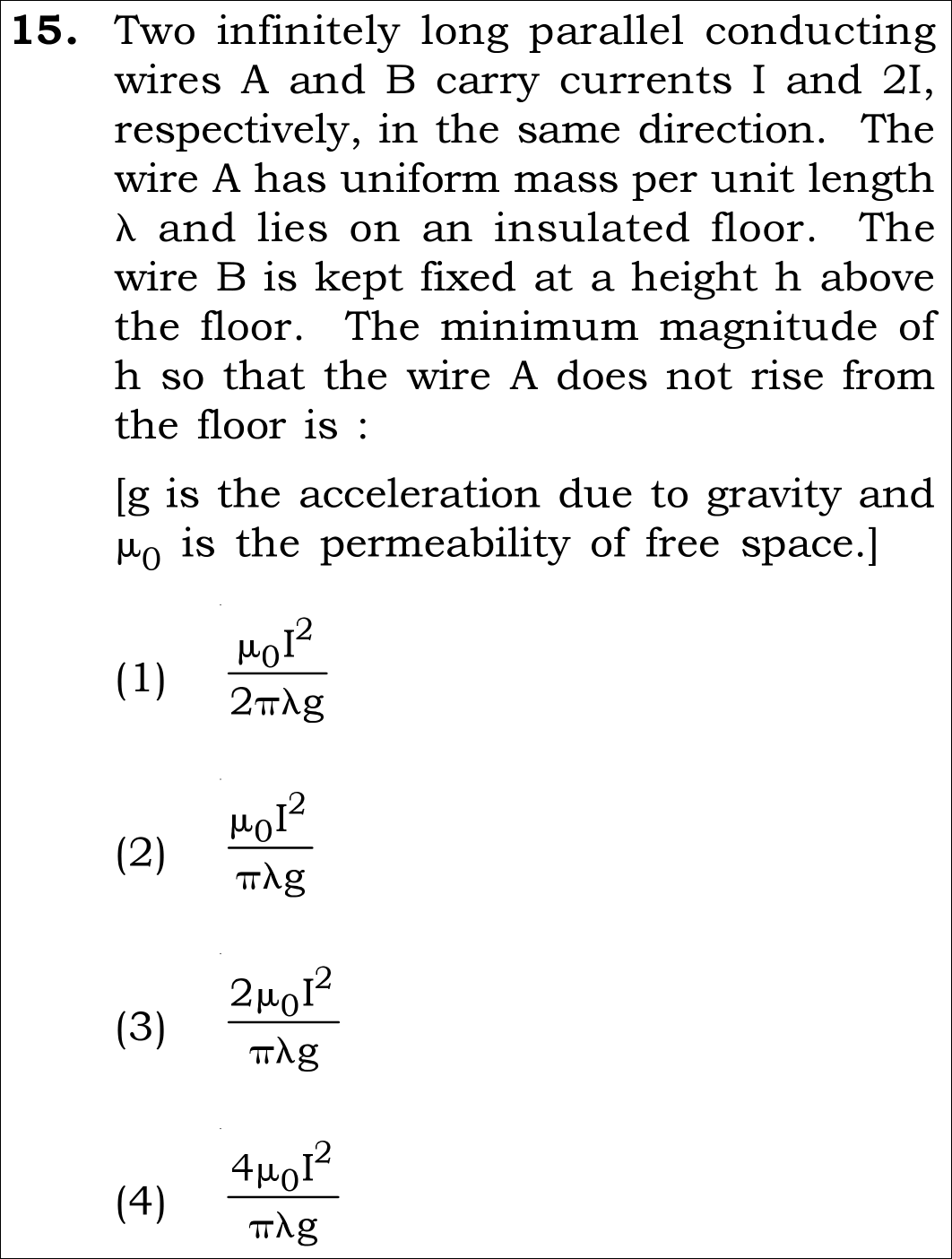
Official NEET 2026 Question 15 - Moving Charges and Magnetism
1
2 ✓ Key
3
4
💡 Verified Solution & 30-Second Hack
✓
Verified Against NTA Final Answer Key
Option (2) : h_min = mu_0 * I^2 / (pi * lambda * g)
📚 Magnetic Effects of Current Medium
📋 Given Parameters & Problem Setup
Wire A Current I (resting on insulated floor)
Wire B Current 2I (fixed at height h directly above wire A)
Current Directions Same direction (parallel currents)
Mass per unit length of Wire A lambda kg/m
Condition Wire A does not rise from the floor (Normal force N >= 0)
⚡

The 30-Second Exam Hall Shortcut: ⚡ Ampere Force Balance Shortcut

⏱️ Avoids vector integration.

Equate upward magnetic attraction to downward gravitational force

1 Parallel currents in the SAME direction ATTRACT each other.
2 Wire B pulls wire A upwards with magnetic force per unit length: F_m / L = mu_0 * I_A * I_B / (2pi * h).
3 Substitute currents: F_m / L = mu_0 * (I) * (2I) / (2pi * h) = mu_0 * I^2 / (pi * h).
4 Downward gravity per unit length: F_g / L = lambda * g.
5 For wire A to stay on the floor: F_m / L <= lambda * g ==> mu_0 * I^2 / (pi * h) <= lambda * g.
6 Rearrange for h: h >= mu_0 * I^2 / (pi * lambda * g). Solved in 25 seconds!
🛡️
Why You Can 100% Trust This Shortcut: Ampere's Force Law gives F/L = mu_0*I_1*I_2/(2pi*d). The factor of 2 in wire B's current (2I) exactly cancels the factor of 2 in the 2pi denominator, leaving pi in the denominator.
📐

Step-by-Step Rigorous Workflow & Mathematical Proof

Step 1

Determine the Nature and Magnitude of the Magnetic Force

According to Ampere's force law, two parallel conductors carrying currents in the same direction attract each other. The magnetic force per unit length exerted on wire A by fixed wire B is:

FmL=μ0IAIB2πh=μ0(I)(2I)2πh=μ0I2πh\frac{F_m}{L} = \frac{\mu_0 I_A I_B}{2\pi h} = \frac{\mu_0 (I)(2I)}{2\pi h} = \frac{\mu_0 I^2}{\pi h}
  • • Because wire B is situated vertically above wire A, this attractive magnetic force acts vertically UPWARDS on wire A.
Step 2

Set Up Vertical Force Equilibrium on Wire A

Two vertical forces act on wire A resting on the insulated floor:

∑Fy=N+FmL−λg=0  ⟹  N=λg−μ0I2πh\sum F_y = N + \frac{F_m}{L} - \lambda g = 0 \implies N = \lambda g - \frac{\mu_0 I^2}{\pi h}
  • • N is the normal reaction from the floor per unit length.
  • • Downwards gravitational force per unit length is lambda * g.
Step 3

Apply the Condition for Contact (Does Not Rise)

For wire A not to rise from the floor, normal reaction must be non-negative (N >= 0):

N≥0  ⟹  λg≥μ0I2πh  ⟹  h≥μ0I2πλgN \ge 0 \implies \lambda g \ge \frac{\mu_0 I^2}{\pi h} \implies h \ge \frac{\mu_0 I^2}{\pi \lambda g}
  • • The minimum permissible height is h_{min} = \frac{\mu_0 I^2}{\pi \lambda g}.
  • • Matches Option (2) exactly.
⭐

360° Option Elimination Engine Key Feature

Diagnose every choice: Know exactly why the right option works and why distractors fail.

4-Option Deep Scan
1 Option (1)
✗ Incorrect
Verdict & Scientific Reason:

Omitted factor of 2 in current 2I.

⚠️
Student Fallacy (Why candidates pick this trap): Assumes both wires carry current I, leaving a factor of 2 in the denominator.
Note: Wire B carries 2I, which cancels the 2 in 2pi.
2 Option (2)
✓ 100% Correct
Verdict & Scientific Reason:

100% scientifically exact; confirmed by Official NTA Final Answer Key.

💡
Why this is airtight: Correctly applies Ampere attraction and normal contact equilibrium.
Note: Exact physics.
3 Option (3)
✗ Incorrect
Verdict & Scientific Reason:

Extra factor of 2.

⚠️
Student Fallacy (Why candidates pick this trap): Forgot to divide by 2 from the 2pi denominator of the straight conductor field.
Note: Formula is mu_0*I_1*I_2 / (2pi*h), not mu_0*I_1*I_2 / (pi*h).
4 Option (4)
✗ Incorrect
Verdict & Scientific Reason:

Squared current multiplier.

⚠️
Student Fallacy (Why candidates pick this trap): Squares the current 2I to get 4I^2.
Note: Current product is I * 2I = 2I^2, not (2I)^2 = 4I^2.
⚠️

NTA Trap Alert: Current Product vs Current Squared Confusion

Students often calculate (2I)^2 = 4I^2 instead of I_1 * I_2 = I * 2I = 2I^2, leading to Option (4).

🛡️ How to avoid the -1 mark: Always write the distinct wire currents separately: I_1 = I and I_2 = 2I ==> I_1 * I_2 = 2I^2.
📖

Core NEET Syllabus Standard

NEET UG Physics Core Standards · Moving Charges and Magnetism Standard Benchmark
Core Scientific Principle Tested:

"Magnetic force per unit length between two parallel straight currents: F/L = mu_0 * I_1 * I_2 / (2pi * d). Parallel currents attract; antiparallel repel."

Syllabus Focus: Force Between Two Parallel Current-Carrying Conductors
✓ Core NEET UG Syllabus Anchor Syllabus & Academic Standards ↗
NEET 2025 · Q3 Easy
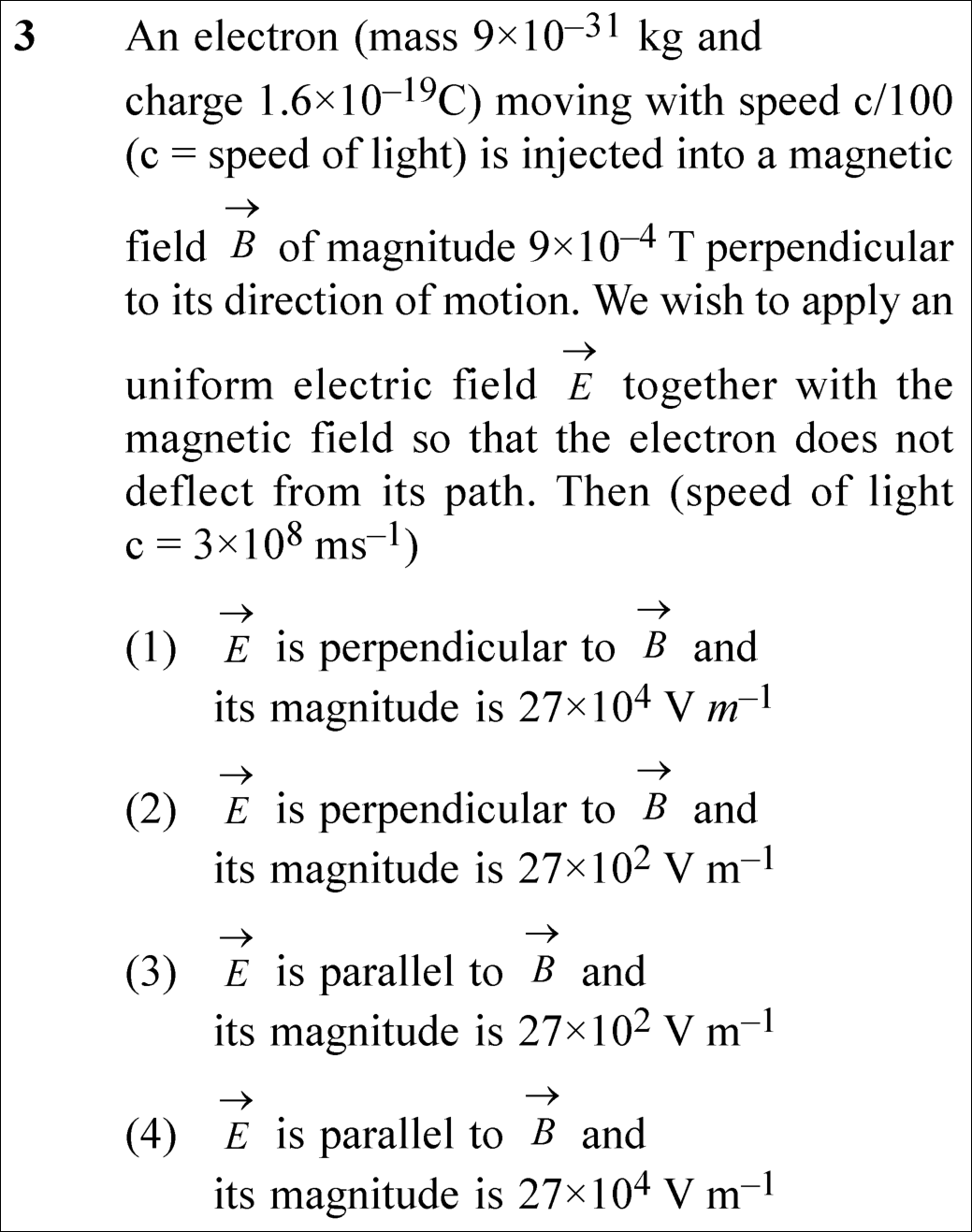
Official NEET 2025 Question 3 - Moving Charges and Magnetism
1
2 ✓ Key
3
4
💡 Verified Solution & 30-Second Hack
✓
Verified Against NTA Final Answer Key
Option (2) : \vec{E} \text{ is perpendicular to } \vec{B} \text{ and its magnitude is } 27 \times 10^2\text{ V m}^{-1}
📚 Moving Charges and Magnetism Easy
📋 Given Parameters & Problem Setup
Particle Electron (charge -e, mass m)
Speed (v) c / 100 = (3 × 10⁸) / 100 = 3 × 10⁶ m/s
Magnetic Field (B) 9 × 10⁻⁴ T (perpendicular to v)
Condition Undeflected straight-line motion
⚡

The 30-Second Exam Hall Shortcut: ⚡ Velocity Selector Perpendicular Rule

⏱️ Save ~40 seconds

Crossed Fields: E ⟂ B, and E = vB = (3 × 10⁶) × (9 × 10⁻⁴) = 27 × 10² V/m!

1 Recall velocity selector condition: Magnetic force F_B = q(v × B) must be canceled by electric force F_E = qE.
2 For forces to be collinear and opposite, electric field E must be perpendicular to both velocity v and magnetic field B (i.e. E ⟂ B).
3 Calculate magnitude: E = v B = (3 × 10⁶ m/s) × (9 × 10⁻⁴ T) = 27 × 10² V/m.
4 Instantly eliminate parallel options (3) & (4), then match magnitude to Option (2).
🛡️
Why You Can 100% Trust This Shortcut: Lorentz Force Law (NCERT Physics · Moving Charges and Magnetism: F = q(v × B)).
📐

Step-by-Step Rigorous Workflow & Mathematical Proof

Step 1

Lorentz Force Balance Condition

For the electron to travel without any deflection, the net Lorentz force acting on it must be zero:

F⃗net=q(E⃗+v⃗×B⃗)=0⃗  ⟹  E⃗=−(v⃗×B⃗)\vec{F}_{net} = q\left(\vec{E} + \vec{v} \times \vec{B}\right) = \vec{0} \implies \vec{E} = -(\vec{v} \times \vec{B})
  • • Because v and B are mutually perpendicular, the vector (v × B) is perpendicular to both v and B.
  • • Therefore, E must be strictly perpendicular to B.
Step 2

Magnitude Calculation

Equating the magnitudes of electric and magnetic forces gives the electric field magnitude required:

E=vB=(c100)B=(3×10⁶ m/s)×(9×10−4 T)=27×102 V/mE = v B = \left(\frac{c}{100}\right) B = \left(3 \times 10^6\text{ m/s}\right) \times \left(9 \times 10^{-4}\text{ T}\right) = 27 \times 10^2\text{ V/m}
  • • Thus, E ⟂ B with magnitude 27 × 10² V/m (2700 V/m).
⭐

360° Option Elimination Engine Key Feature

Diagnose every choice: Know exactly why the right option works and why distractors fail.

4-Option Deep Scan
1 A
✗ Incorrect
Verdict & Scientific Reason:

Incorrect. Power of 10 error; used v = c instead of c/100.

⚠️
Student Fallacy (Why candidates pick this trap): Forgetting to divide c by 100.
2 B
✓ 100% Correct
Verdict & Scientific Reason:

100% correct. E ⟂ B and E = (3 × 10⁶)(9 × 10⁻⁴) = 27 × 10² V/m.

💡
Why this is airtight: None; textbook velocity selector.
3 C
✗ Incorrect
Verdict & Scientific Reason:

Incorrect. If E were parallel to B, electric force would be perpendicular to magnetic force and could never cancel it.

⚠️
Student Fallacy (Why candidates pick this trap): Misunderstanding the vector nature of cross products in Lorentz force.
4 D
✗ Incorrect
Verdict & Scientific Reason:

Incorrect. Both direction (parallel) and magnitude (10⁴) are wrong.

⚠️
Student Fallacy (Why candidates pick this trap): Double mistake in orientation and speed scale.
⚠️

NTA Trap Alert: Parallel vs. Perpendicular Field Trap

Students often forget that crossed electric and magnetic fields MUST be mutually perpendicular (E ⟂ B ⟂ v) to achieve force cancellation. If E is parallel to B, the particle undergoes helical acceleration.

🛡️ How to avoid the -1 mark: Remember: Velocity Selector = CROSSED fields = E ⟂ B.
📖

Core NEET Syllabus Standard

NEET Physics Core Syllabus · Moving Charges and Magnetism Standard Benchmark
Core Scientific Principle Tested:

"Undeflected motion occurs when electric and magnetic forces are equal and opposite: E = vB with E ⟂ B."

Syllabus Focus: Motion in Combined Electric and Magnetic Fields
✓ Core NEET UG Syllabus Anchor Syllabus & Academic Standards ↗
Crossed Fields Cancel: E = vB and E ⟂ B!
NEET 2025 · Q12 Easy
Official NEET 2025 Question 12 - Moving Charges and Magnetism
1 ✓ Key
2
3
4
💡 Verified Solution & 30-Second Hack
✓
Verified Against NTA Final Answer Key
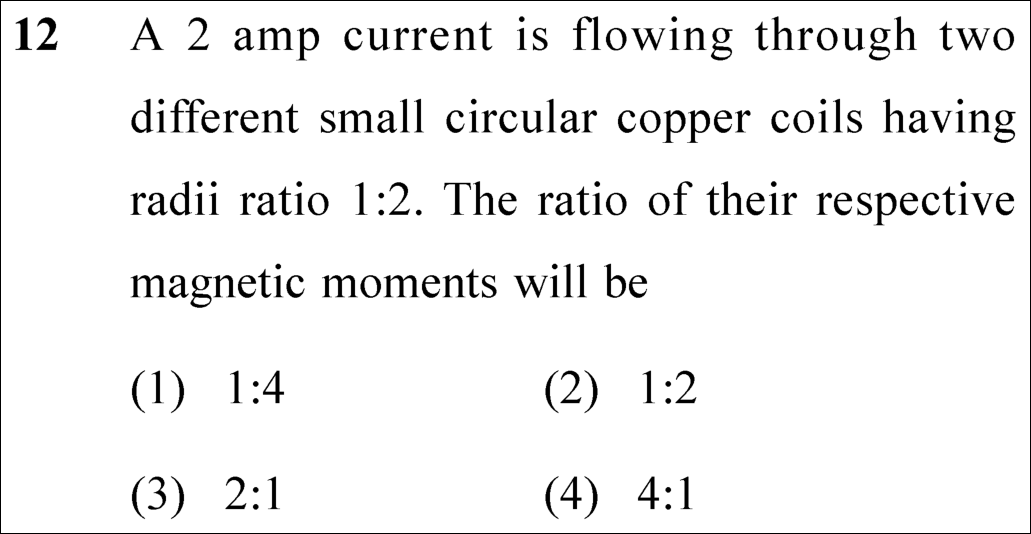
Option (1) : 1:4
📚 Moving Charges and Magnetism Easy
📋 Given Parameters & Problem Setup
Current in Coils (I) 2 A (identical for both coils)
Radii Ratio (r₁ : r₂) 1 : 2
⚡

The 30-Second Exam Hall Shortcut: ⚡ Area Scaling M ∝ r² Rule

⏱️ Save ~30 seconds

Magnetic Moment M = I · A = I (π r²) ⟹ M ∝ r² ⟹ M₁ / M₂ = (1/2)² = 1/4 = 1:4!

1 Recall formula: Magnetic dipole moment of a flat circular loop is M = I A.
2 Area of circle is A = π r².
3 Since current I is identical (2 A for both): M ∝ r².
4 Ratio: M₁ / M₂ = (r₁ / r₂)² = (1 / 2)² = 1 / 4.
5 Select Option (1) in under 5 seconds!
🛡️
Why You Can 100% Trust This Shortcut: Ampère’s Force Law (NCERT Physics · Moving Charges and Magnetism: F/L = μ₀ I₁ I₂ / (2πd)).
📐

Step-by-Step Rigorous Workflow & Mathematical Proof

Step 1

Formula for Magnetic Dipole Moment

The magnetic dipole moment M of a planar loop of area A carrying current I is defined as:

M=IA⃗  ⟹  M=I(πr2)M = I \vec{A} \implies M = I (\pi r^2)
  • • M is directly proportional to the enclosed area.
Step 2

Ratio Calculation

For two circular coils carrying the same current I = 2 A with radii r₁ and r₂:

M1M2=Iπr12Iπr22=(r1r2)2=(12)2=14\frac{M_1}{M_2} = \frac{I \pi r_1^2}{I \pi r_2^2} = \left(\frac{r_1}{r_2}\right)^2 = \left(\frac{1}{2}\right)^2 = \frac{1}{4}
  • • Thus the ratio of their respective magnetic moments is 1:4.
⭐

360° Option Elimination Engine Key Feature

Diagnose every choice: Know exactly why the right option works and why distractors fail.

4-Option Deep Scan
1 A
✓ 100% Correct
Verdict & Scientific Reason:

100% correct. M ∝ r² ⟹ (1/2)² = 1/4 = 1:4.

💡
Why this is airtight: None; direct quadratic scaling.
2 B
✗ Incorrect
Verdict & Scientific Reason:

Incorrect. Linear ratio r₁:r₂, forgetting that area depends on the square of the radius.

⚠️
Student Fallacy (Why candidates pick this trap): Assuming magnetic moment scales linearly with radius.
3 C
✗ Incorrect
Verdict & Scientific Reason:

Incorrect. Inverted linear ratio.

⚠️
Student Fallacy (Why candidates pick this trap): Inverting ratio and forgetting square.
4 D
✗ Incorrect
Verdict & Scientific Reason:

Incorrect. Inverted quadratic ratio (M₂:M₁ instead of M₁:M₂).

⚠️
Student Fallacy (Why candidates pick this trap): Calculating M₂ / M₁ instead of M₁ / M₂.
⚠️

NTA Trap Alert: Radius vs. Area Scaling Trap

Students frequently forget that area is proportional to r², selecting 1:2 instead of 1:4.

🛡️ How to avoid the -1 mark: Always remember: Magnetic moment is an AREA property (M = I · A ∝ r²)!
📖

Core NEET Syllabus Standard

NEET Physics Core Syllabus · Moving Charges and Magnetism Standard Benchmark
Core Scientific Principle Tested:

"Magnetic dipole moment of a circular current loop is M = I π r²."

Syllabus Focus: Circular Current Loop as a Magnetic Dipole
✓ Core NEET UG Syllabus Anchor Syllabus & Academic Standards ↗
Moment means Area: Area scales as r² ⟹ (1/2)² = 1:4!
NEET 2024 · Q34 Easy
Official NEET 2024 Question 34 - Moving Charges and Magnetism
1 ✓ Key
2
3
4
💡 Verified Solution & 30-Second Hack
✓
Verified Against NTA Final Answer Key
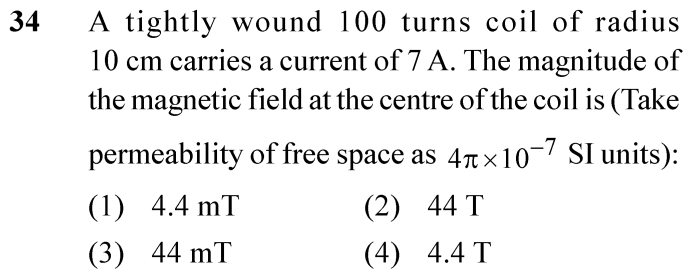
Option (1) : 4.4 mT
📚 Moving Charges and Magnetism Easy
📋 Given Parameters & Problem Setup
Number of turns N = 100
Radius of coil R = 10 cm = 0.1 m
Current in coil I = 7 A
Permeability of free space μ₀ = 4π × 10⁻⁷ SI units (take π ≈ 22/7)
⚡

The 30-Second Exam Hall Shortcut: ⚡ 22/7 Fraction Cancellation Hack

⏱️ Save ~45 seconds

B = μ₀NI / 2R -> [4 × (22/7) × 10⁻⁷ × 100 × 7] / (2 × 0.1) -> 7 cancels with 7 -> 88 × 10⁻⁵ / 0.2 = 4.4 × 10⁻³ T = 4.4 mT!

1 Standard formula for center of circular coil: B = μ₀ N I / (2 R).
2 Write μ₀ = 4π × 10⁻⁷ with π = 22/7 so the given 7 A current cancels the denominator 7!
3 Numerator = 4 × (22/7) × 10⁻⁷ × 100 × 7 = 4 × 22 × 100 × 10⁻⁷ = 88 × 10⁻⁵.
4 Denominator = 2 × R = 2 × 0.1 = 0.2.
5 B = 88 × 10⁻⁵ / 0.2 = 440 × 10⁻⁵ = 4.4 × 10⁻³ T = 4.4 mT.
6 Option (1) in under 15 seconds!
🛡️
Why You Can 100% Trust This Shortcut: Biot-Savart Law for Circular Current Loops (B_center = μ₀ N I / (2R)).
📐

Step-by-Step Rigorous Workflow & Mathematical Proof

Step 1

Biot-Savart Formula for a Circular Coil

The magnitude of the magnetic field B at the center of a flat circular coil consisting of N closely wound turns carrying steady current I is given by the Biot-Savart law:

B=μ0NI2RB = \frac{\mu_0 N I}{2 R}
Step 2

Substitution of Given Parameters

Substitute N = 100, I = 7 A, R = 10 cm = 0.1 m, and μ₀ = 4π × 10⁻⁷ T m/A:

B=(4π×10−7)×100×72×0.1B = \frac{(4\pi \times 10^{-7}) \times 100 \times 7}{2 \times 0.1}
Step 3

Fractional Simplification using π = 22/7

Using π = 22/7 enables exact cancellation with the current of 7 A:

B=4×227×10−7×7000.2=4×22×10−50.2=88×10−50.2B = \frac{4 \times \frac{22}{7} \times 10^{-7} \times 700}{0.2} = \frac{4 \times 22 \times 10^{-5}}{0.2} = \frac{88 \times 10^{-5}}{0.2}
Step 4

Numerical Evaluation in Millitesla

Dividing 88 by 0.2 gives 440:

B=440×10−5 T=4.4×10⁻³ T=4.4 mTB = 440 \times 10^{-5}\,\text{T} = 4.4 \times 10^{-3}\,\text{T} = 4.4\,\text{mT}
⭐

360° Option Elimination Engine Key Feature

Diagnose every choice: Know exactly why the right option works and why distractors fail.

4-Option Deep Scan
1 (1)
✓ 100% Correct
Verdict & Scientific Reason:

Exact evaluation: B = 4.4 × 10⁻³ T = 4.4 mT.

💡
Why this is airtight: None.
2 (2)
✗ Incorrect
Verdict & Scientific Reason:

Off by four orders of magnitude (44 T is an immense, laboratory-record magnetic field).

⚠️
Student Fallacy (Why candidates pick this trap): Unit conversion slip.
3 (3)
✗ Incorrect
Verdict & Scientific Reason:

Off by a factor of 10.

⚠️
Student Fallacy (Why candidates pick this trap): Misplacing the decimal point during 88 / 0.2 division.
4 (4)
✗ Incorrect
Verdict & Scientific Reason:

Confuses millitesla (mT) with tesla (T).

⚠️
Student Fallacy (Why candidates pick this trap): Ignoring the 10⁻³ factor.
⚠️

NTA Trap Alert: Unit Prefix Trap (mT vs T)

Options (1) and (4) differ solely by the prefix "m". Students frequently calculate 4.4 and overlook whether the unit is T or mT.

🛡️ How to avoid the -1 mark: A standard bench coil carrying 7 A produces a millitesla-range field (a few mT). 4.4 T requires superconducting MRI magnets!
📖

Core NEET Syllabus Standard

Physics Core Electromagnetism · Moving Charges and Magnetism Standard Benchmark
Core Scientific Principle Tested:

"The magnetic field at the center of a circular coil of N turns is B = μ₀NI / (2R)."

Syllabus Focus: Magnetic Field on the Axis and Center of a Circular Current Loop
✓ Core NEET UG Syllabus Anchor Syllabus & Academic Standards ↗
7 A kills the 7 in π: 88 divided by 0.2 gives 4.4 mT!
NEET 2023 · Q44 Easy
Official NEET 2023 Question 44 - Moving Charges and Magnetism
1
2
3
4 ✓ Key
💡 Verified Solution & 30-Second Hack
✓
Verified Against NTA Final Answer Key
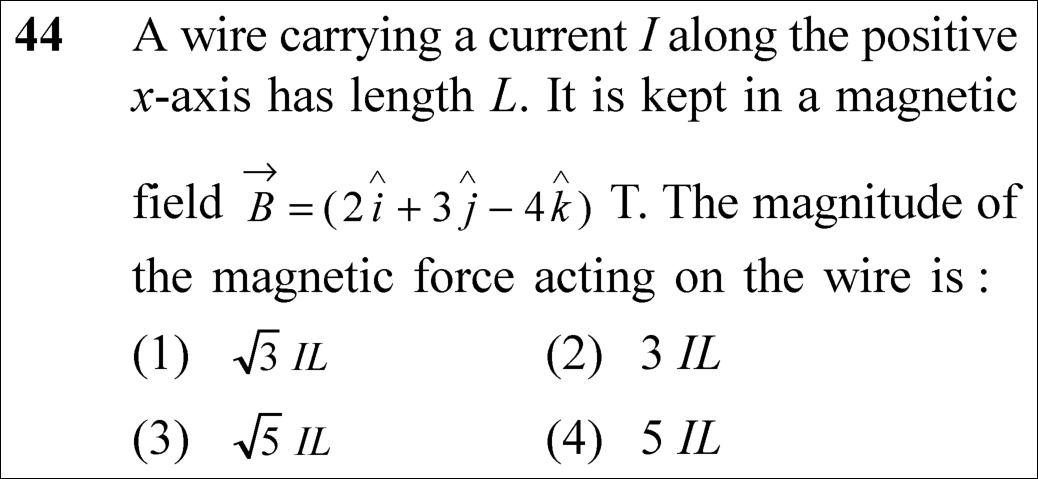
Option (4) : 5 IL
📚 Moving Charges and Magnetism Easy
📋 Given Parameters & Problem Setup
Current element vector (L⃗) L î (along positive x-axis)
Magnetic field vector (B⃗) (2î + 3ĵ - 4k̂) T
Formula for magnetic force F⃗ = I (L⃗ × B⃗)
⚡

The 30-Second Exam Hall Shortcut: ⚡ Vector Cross Product & 3-4-5 Triangle Hack

⏱️ Save ~40 seconds

î × î = 0, î × ĵ = k̂, î × k̂ = -ĵ. Thus F⃗ = IL [3k̂ - 4(-ĵ)] = IL (4ĵ + 3k̂). Magnitude = IL √(4² + 3²) = 5 IL in 15 seconds!

1 Express wire vector in Cartesian coordinates: L⃗ = L î.
2 Take vector cross product with B⃗ = 2î + 3ĵ - 4k̂:
3 - î × 2î = 0 (parallel component exerts zero force).
4 - î × 3ĵ = 3k̂.
5 - î × (-4k̂) = -4(-ĵ) = +4ĵ.
6 Net force vector: F⃗ = I L (4ĵ + 3k̂).
7 Calculate magnitude: |F⃗| = I L √(4² + 3²) = I L √(16 + 9) = I L √25 = 5 I L.
8 Directly choose Option (4) 5 IL!
🛡️
Why You Can 100% Trust This Shortcut: Magnetostatics · Lorentz Force on Conductors (Magnetic force on a straight conductor is F⃗ = I L⃗ × B⃗, perpendicular to both current and field).
📐

Step-by-Step Rigorous Workflow & Mathematical Proof

Step 1

Lorentz Force Law on a Current-Carrying Conductor

A straight wire of length vector L⃗ carrying a steady current I placed in a uniform magnetic field B⃗ experiences a total magnetic force given by the vector cross product:

F⃗=I(L⃗×B⃗)\vec{F} = I (\vec{L} \times \vec{B})
Step 2

Definition of Vectors in Unit Vector Notation

The wire carries current I along the positive x-axis, so its length displacement vector is directed entirely along î:

L⃗=L i^,B⃗=2 i^+3 j^−4 k^\vec{L} = L\,\hat{i}, \qquad \vec{B} = 2\,\hat{i} + 3\,\hat{j} - 4\,\hat{k}
Step 3

Evaluation of the Vector Cross Product

Using the cyclic right-handed rules for unit vectors (î × î = 0, î × ĵ = k̂, î × k̂ = -ĵ):

L⃗×B⃗=(L i^)×(2 i^+3 j^−4 k^)=L[2(i^×i^)+3(i^×j^)−4(i^×k^)]=L[0+3 k^−4(−j^)]=L(4 j^+3 k^)\begin{aligned} \vec{L} \times \vec{B} &= (L\,\hat{i}) \times (2\,\hat{i} + 3\,\hat{j} - 4\,\hat{k}) \\[6pt] &= L \left[ 2(\hat{i} \times \hat{i}) + 3(\hat{i} \times \hat{j}) - 4(\hat{i} \times \hat{k}) \right] \\[6pt] &= L \left[ 0 + 3\,\hat{k} - 4(-\hat{j}) \right] = L (4\,\hat{j} + 3\,\hat{k}) \end{aligned}
Step 4

Magnitude Calculation

The magnitude of the resultant force vector is:

∣F⃗∣=IL42+32=IL16+9=IL25=5IL|\vec{F}| = I L \sqrt{4^2 + 3^2} = I L \sqrt{16 + 9} = I L \sqrt{25} = 5 I L
⭐

360° Option Elimination Engine Key Feature

Diagnose every choice: Know exactly why the right option works and why distractors fail.

4-Option Deep Scan
1 (1)
✗ Incorrect
Verdict & Scientific Reason:

Arbitrary radical choice.

⚠️
Student Fallacy (Why candidates pick this trap): Candidate subtracted component squares incorrectly.
2 (2)
✗ Incorrect
Verdict & Scientific Reason:

Omitted the z-component (-4k̂) cross product.

⚠️
Student Fallacy (Why candidates pick this trap): Candidate considered only the ĵ component of the field.
3 (3)
✗ Incorrect
Verdict & Scientific Reason:

Square root of 5 arithmetic error.

⚠️
Student Fallacy (Why candidates pick this trap): Candidate added components without squaring properly.
4 (4)
✓ 100% Correct
Verdict & Scientific Reason:

Accurate force magnitude: √(4² + 3²) IL = 5 IL.

💡
Why this is airtight: None. Candidate executed cross product accurately.
⚠️

NTA Trap Alert: Including the Parallel B_x Component in Force Magnitude

The x-component of the magnetic field (2î) is PARALLEL to the wire (Lî). Since î × î = 0, parallel magnetic field produces ZERO magnetic force! Candidates who compute the total field magnitude |B| = √(2² + 3² + 4²) = √29 ≈ 5.38 IL commit this classic conceptual error.

🛡️ How to avoid the -1 mark: Remember: Only perpendicular components of magnetic field exert force on a current!
📖

Core NEET Syllabus Standard

National Eligibility cum Entrance Test (NEET UG) · Moving Charges and Magnetism Standard Benchmark
Core Scientific Principle Tested:

"Magnetic force is F⃗ = I(L⃗ × B⃗). Parallel field components produce zero force."

Syllabus Focus: Magnetic Force on a Current-Carrying Conductor
Preserved in Rationalized Curriculum Syllabus & Academic Standards ↗
NEET 2023 · Q47 Medium
Official NEET 2023 Question 47 - Moving Charges and Magnetism
1
2
3
4 ✓ Key
💡 Verified Solution & 30-Second Hack
✓
Verified Against NTA Final Answer Key
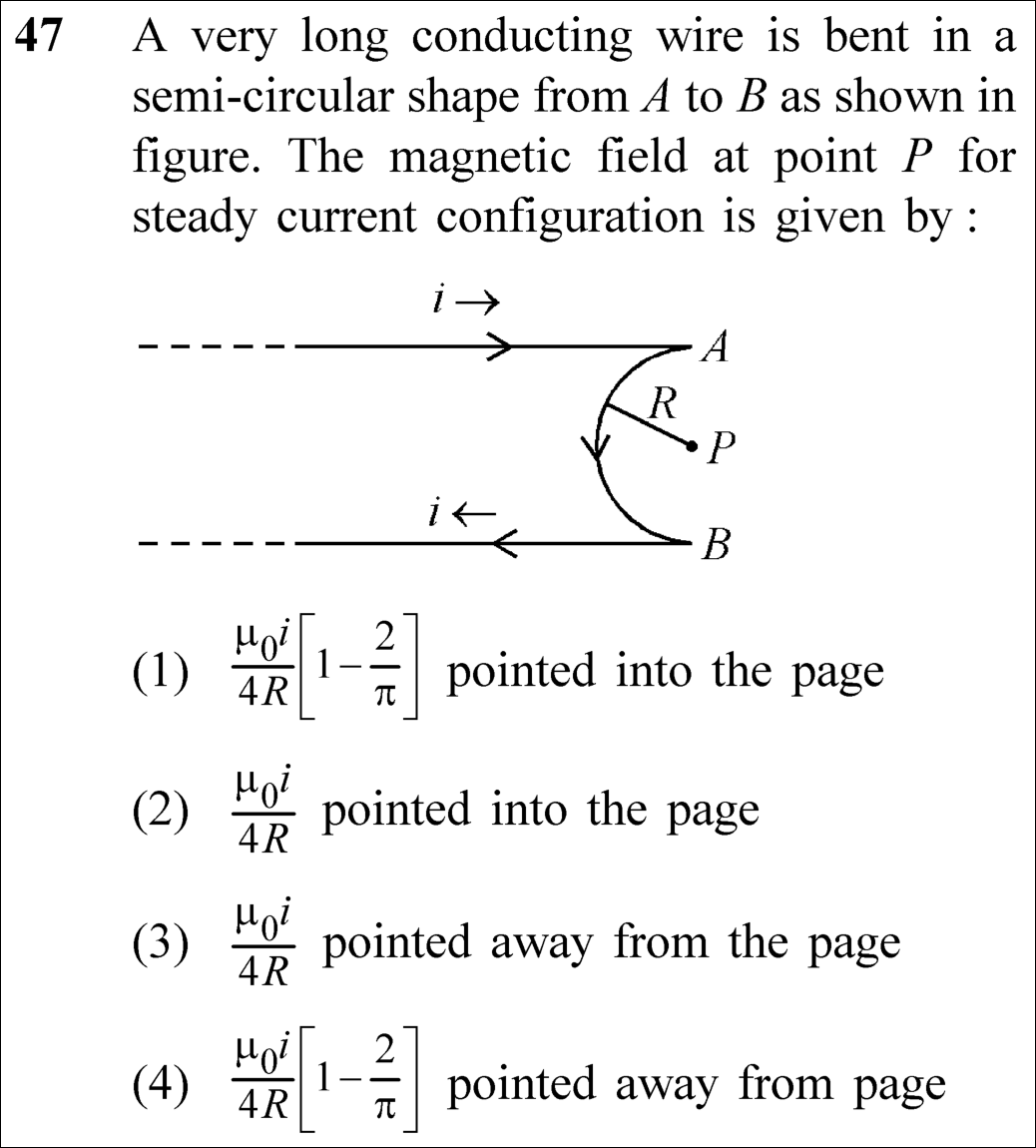
Option (4) : (μ₀ i / 4R) [1 - 2/π] pointed away from page
📚 Moving Charges and Magnetism Medium
📋 Given Parameters & Problem Setup
Current in conductor i
Radius of semicircular arc AB R (centered at observation point P)
Top straight segment Semi-infinite straight wire carrying current to the right
Bottom straight segment Semi-infinite straight wire carrying current to the left
⚡

The 30-Second Exam Hall Shortcut: ⚡ Biot-Savart Superposition & Direction Inspection

⏱️ Save ~60 seconds

Semicircular arc at center P: B_arc = μ₀i / (4R) ⊙ (out of page). Two semi-infinite straight wires: each is μ₀i / (4πR) ⊗ (into page) ⟹ B_straight = 2 × [μ₀i / (4πR)] = μ₀i / (2πR) ⊗. Net B = (μ₀i / 4R)[1 - 2/π] ⊙ (away from page) in 30 seconds!

1 Decompose the current geometry into three independent parts:
2 - Top semi-infinite straight wire ending at A.
3 - Semicircular arc AB of radius R centered at P.
4 - Bottom semi-infinite straight wire starting at B.
5 Arc field at center P: B_arc = (1/2) × (μ₀i / 2R) = μ₀i / 4R. By right-hand grip rule (current downwards along arc), thumb points OUT OF PAGE (⊙).
6 Top straight wire at distance R below its terminus: B₁ = μ₀i / (4πR) directed INTO PAGE (⊗).
7 Bottom straight wire at distance R above its terminus: B₂ = μ₀i / (4πR) directed INTO PAGE (⊗).
8 Total straight wire field: B_straight = B₁ + B₂ = μ₀i / (2πR) ⊗.
9 Subtract (since ⊙ and ⊗ oppose each other): B_net = B_arc - B_straight = (μ₀i / 4R) - (μ₀i / 2πR) = (μ₀i / 4R) [1 - 2/π].
10 Because 1 > 2/π (1 > 0.637), B_arc dominates ⟹ net direction is OUT OF PAGE (away from page).
11 Select Option (4)!
🛡️
Why You Can 100% Trust This Shortcut: Magnetostatics · Biot-Savart Law (Total magnetic field is vector sum of contributions from all current elements: B⃗ = ∮ dB⃗).
📐

Step-by-Step Rigorous Workflow & Mathematical Proof

Step 1

Magnetic Field Due to the Semicircular Arc (B_arc)

By the Biot-Savart Law, a circular loop of radius R carrying current i produces B = μ₀i / 2R at its center. A semicircle subtends an angle of π radians at center P, producing exactly half this value:

Barc=12(μ0i2R)=μ0i4R(⊙ directed out of the page)B_{\text{arc}} = \frac{1}{2} \left( \frac{\mu_0 i}{2R} \right) = \frac{\mu_0 i}{4R} \quad (\odot \text{ directed out of the page})
Step 2

Magnetic Field Due to the Top Semi-Infinite Straight Wire (B₁)

The top wire extends from x = -∞ to x = A at a perpendicular distance R above point P. By the standard Biot-Savart formula for a semi-infinite straight wire at an endpoint perpendicular distance R:

B1=μ0i4πR(⊗ directed into the page)B_1 = \frac{\mu_0 i}{4\pi R} \quad (\otimes \text{ directed into the page})
Step 3

Magnetic Field Due to the Bottom Semi-Infinite Straight Wire (B₂)

The bottom wire carries current i to the left from x = B to x = -∞ at a perpendicular distance R below point P. Applying the right-hand grip rule, its field at point P also points INTO the page:

B2=μ0i4πR(⊗ directed into the page)B_2 = \frac{\mu_0 i}{4\pi R} \quad (\otimes \text{ directed into the page})
Step 4

Vector Superposition of Opposing Fields

The arc field points out of the page (⊙), while the sum of both straight wire fields points into the page (⊗). Subtracting the opposing magnitudes:

Bnet=Barc−(B1+B2)=μ0i4R−2μ0i4πR=μ0i4R[1−2π]B_{\text{net}} = B_{\text{arc}} - (B_1 + B_2) = \frac{\mu_0 i}{4R} - \frac{2\mu_0 i}{4\pi R} = \frac{\mu_0 i}{4R} \left[ 1 - \frac{2}{\pi} \right]
Step 5

Direction of Resultant Field

Since π ≈ 3.1416, 2/π ≈ 0.637 < 1, the bracket [1 - 2/π] is strictly positive (+0.363). Therefore, the outward arc field dominates, and the net magnetic field points AWAY FROM (out of) the page.

B⃗net=μ0i4R[1−2π](pointed away from the page)\vec{B}_{\text{net}} = \frac{\mu_0 i}{4R} \left[ 1 - \frac{2}{\pi} \right] \quad (\text{pointed away from the page})
⭐

360° Option Elimination Engine Key Feature

Diagnose every choice: Know exactly why the right option works and why distractors fail.

4-Option Deep Scan
1 (1)
✗ Incorrect
Verdict & Scientific Reason:

Wrong direction: arc field is stronger than straight wire fields (1 > 2/π).

⚠️
Student Fallacy (Why candidates pick this trap): Candidate incorrectly assumed the straight wires dominate the arc.
2 (2)
✗ Incorrect
Verdict & Scientific Reason:

Omitted the straight wire contributions entirely and inverted direction.

⚠️
Student Fallacy (Why candidates pick this trap): Candidate forgot the two semi-infinite wires.
3 (3)
✗ Incorrect
Verdict & Scientific Reason:

Represents only the arc field, ignoring the straight wires.

⚠️
Student Fallacy (Why candidates pick this trap): Candidate calculated only the semicircular arc field.
4 (4)
✓ 100% Correct
Verdict & Scientific Reason:

Accurate magnitude and outward direction matching Biot-Savart Law and NTA final answer key.

💡
Why this is airtight: None. Candidate executed complete vector superposition.
⚠️

NTA Trap Alert: Directional Error: Not Knowing Whether 1 or 2/π is Greater

Since π ≈ 3.14, 2/π ≈ 0.64, which is LESS than 1. This means the arc field (pointing OUT) is larger than the straight wire fields (pointing IN). The net field must point OUT (away from the page). Choosing "into the page" (Option 1) is a common direction trap.

🛡️ How to avoid the -1 mark: Numerically compare: Arc factor is 1; Straight wires factor is 2/π ≈ 0.64. Since 1 > 0.64, Arc wins ⟹ Direction is OUT of page!
📖

Core NEET Syllabus Standard

National Eligibility cum Entrance Test (NEET UG) · Moving Charges and Magnetism Standard Benchmark
Core Scientific Principle Tested:

"Magnetic field at center of an arc is B = (θ/2π)(μ₀i/2R); for a semi-infinite straight wire at endpoint, B = μ₀i/(4πR)."

Syllabus Focus: Biot-Savart Law and Applications to Wires and Arcs
Preserved in Rationalized Curriculum Syllabus & Academic Standards ↗
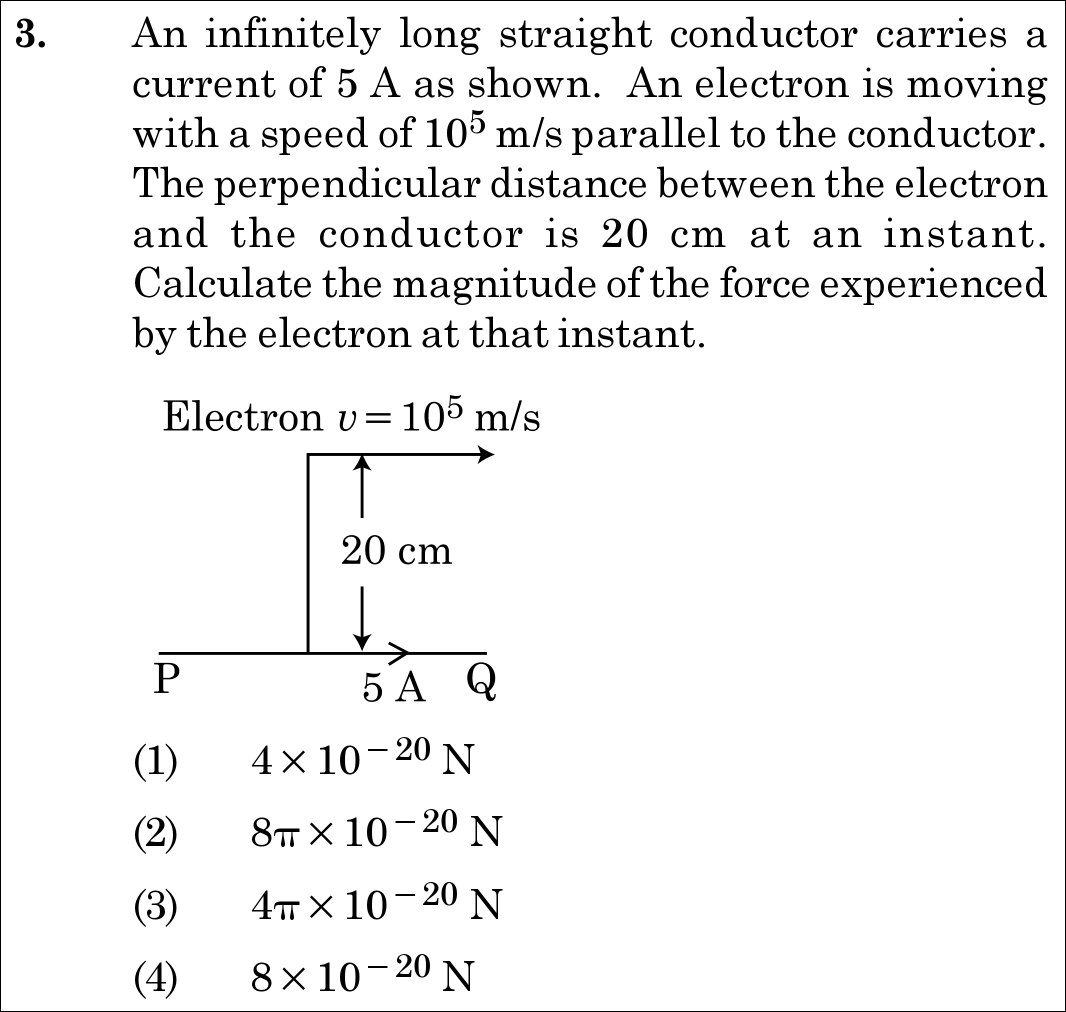
NEET 2021 · Q3 Easy
Official NEET 2021 Question 3 - Moving Charges and Magnetism
1
2
3
4 ✓ Key
💡 Verified Solution & 30-Second Hack
✓
Verified Against NTA Final Answer Key
Option (4) : 8 × 10^-20 N
📚 Moving Charges and Magnetism Easy
📋 Given Parameters & Problem Setup
Current in Wire (I) 5 A
Electron Speed (v) 10^5 m/s
Perpendicular Distance (r) 20 cm = 0.2 m
Elementary Charge (e) 1.6 × 10^-19 C
⚡

The 30-Second Exam Hall Shortcut: ⚡ 2-Step Lorentz Force: B = μ0 I / (2π r), F = q v B

⏱️ Save ~20 seconds

B=2×10−7×50.2=5×10−6 TB = \frac{2 \times 10^{-7} \times 5}{0.2} = 5 \times 10^{-6}\text{ T}. Force F=evB=(1.6×10−19)×(105)×(5×10−6)=8×10⁻²⁰ NF = e v B = (1.6 \times 10^{-19}) \times (10^5) \times (5 \times 10^{-6}) = 8 \times 10^{-20}\text{ N}! Instant 15-second calculation matching Option (4)!

1 Compute B from wire: B=μ0I2πr=(4π×10−7)(5)2π(0.2)=5×10−6 TB = \frac{\mu_0 I}{2\pi r} = \frac{(4\pi \times 10^{-7})(5)}{2\pi (0.2)} = 5 \times 10^{-6}\text{ T}.
2 Motion is parallel to wire, while B is perpendicular to the plane (θ=90∘\theta = 90^\circ).
3 Compute magnetic force: F=qvBsin⁡90∘=(1.6×10⁻¹⁹)(105)(5×10⁻⁶)F = q v B \sin 90^\circ = (1.6 \times 10^{-19})(10^5)(5 \times 10^{-6}).
4 F=8.0×10⁻²⁰ NF = 8.0 \times 10^{-20}\text{ N}.
5 Match Option (4).
🛡️
Why You Can 100% Trust This Shortcut: Canonical Biot-Savart law for infinite linear current and Lorentz force magnitude.
📐

Step-by-Step Rigorous Workflow & Mathematical Proof

Step 1

Calculating the Magnetic Field Produced by the Long Conductor

Using Ampere's circuital law / Biot-Savart law, the magnetic field at a perpendicular distance r=20 cm=0.2 mr = 20\text{ cm} = 0.2\text{ m} from a long wire carrying current I=5 AI = 5\text{ A} is:

B=μ0I2πr=4π×10−7×52π×0.2=2×10−7×50.2=5×10−6 TB = \frac{\mu_0 I}{2\pi r} = \frac{4\pi \times 10^{-7} \times 5}{2\pi \times 0.2} = \frac{2 \times 10^{-7} \times 5}{0.2} = 5 \times 10^{-6}\text{ T}
Step 2

Determining the Angle Between Velocity and Magnetic Field

By the right-hand thumb rule, for current flowing from P to Q (towards the right), the magnetic field above the wire points out of the page (k^\hat{k}). The electron moves parallel to the wire (i^\hat{i}). Therefore, v⃗⊥B⃗\vec{v} \perp \vec{B}, so θ=90∘\theta = 90^\circ and sin⁡90∘=1\sin 90^\circ = 1.

Step 3

Calculating the Magnitude of the Magnetic Force

The magnitude of the magnetic Lorentz force on the electron (q=1.6×10⁻¹⁹ Cq = 1.6 \times 10^{-19}\text{ C}) is:

F=∣q∣vBsin⁡90∘=(1.6×10⁻¹⁹ C)×(105 m/s)×(5×10−6 T)=8×10⁻²⁰ NF = |q| v B \sin 90^\circ = (1.6 \times 10^{-19}\text{ C}) \times (10^5\text{ m/s}) \times (5 \times 10^{-6}\text{ T}) = 8 \times 10^{-20}\text{ N}
⭐

360° Option Elimination Engine Key Feature

Diagnose every choice: Know exactly why the right option works and why distractors fail.

4-Option Deep Scan
1 1
✗ Incorrect
Verdict & Scientific Reason:

Result of an arithmetic factor of 2 error (using μ0/4π\mu_0 / 4\pi instead of μ0/2π\mu_0 / 2\pi).

⚠️
Student Fallacy (Why candidates pick this trap): Using the semi-infinite wire formula B=μ0I/4πrB = \mu_0 I / 4\pi r.
2 2
✗ Incorrect
Verdict & Scientific Reason:

Fails to cancel π\pi between μ0=4π×10−7\mu_0 = 4\pi \times 10^{-7} and the denominator 2π2\pi.

⚠️
Student Fallacy (Why candidates pick this trap): Forgetting that μ0/2π=2×10−7\mu_0 / 2\pi = 2 \times 10^{-7} without a leftover π\pi.
3 3
✗ Incorrect
Verdict & Scientific Reason:

Combines both the π\pi cancellation error and the semi-infinite wire error.

⚠️
Student Fallacy (Why candidates pick this trap): Double mathematical substitution error.
4 4
✓ 100% Correct
Verdict & Scientific Reason:

Exact numerical result of the Lorentz force calculation.

💡
Why this is airtight: None; rigorous electrodynamics calculation.
⚠️

NTA Trap Alert: Pi Retention and Distance Unit Conversion Trap

Students frequently forget to convert 20 cm20\text{ cm} into 0.2 m0.2\text{ m}, leading to power of 10 errors, or they fail to cancel π\pi from the denominator of μ0/2πr\mu_0 / 2\pi r.

🛡️ How to avoid the -1 mark: Use μ02π=2×10⁻⁷ T⋅m/A\frac{\mu_0}{2\pi} = 2 \times 10^{-7}\text{ T}\cdot\text{m/A} directly; convert 20 cm=0.2 m20\text{ cm} = 0.2\text{ m}.
📖

Core NEET Syllabus Standard

NCERT Physics · Moving Charges and Magnetism Standard Benchmark
Core Scientific Principle Tested:

"The magnetic force on a charge qq moving with velocity v⃗\vec{v} in field B⃗\vec{B} is F⃗=q(v⃗×B⃗)\vec{F} = q(\vec{v} \times \vec{B}), where B=μ0I2πrB = \frac{\mu_0 I}{2\pi r} for an infinite straight wire."

Syllabus Focus: Magnetic Force on a Moving Charge and Magnetic Field of Straight Conductor
✓ Core NEET UG Syllabus Anchor Syllabus & Academic Standards ↗
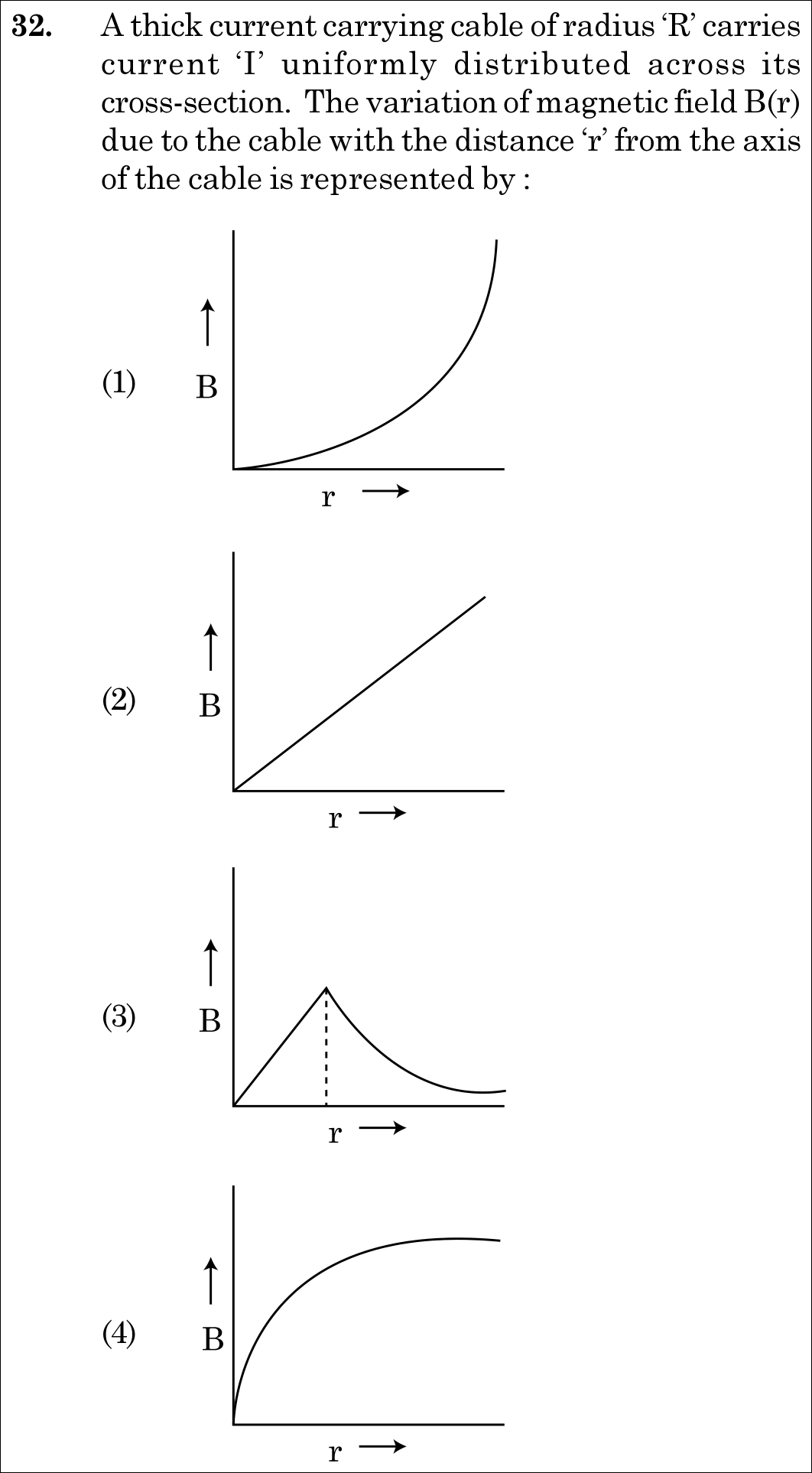
NEET 2021 · Q32 Easy
Official NEET 2021 Question 32 - Moving Charges and Magnetism
1
2
3 ✓ Key
4
💡 Verified Solution & 30-Second Hack
✓
Verified Against NTA Final Answer Key
Option (3) : Graph (3): Linear rise from origin inside (r <= R), hyperbolic decay outside (r >= R)
📚 Moving Charges and Magnetism Easy
📋 Given Parameters & Problem Setup
Cable Radius R
Current Distribution Uniformly distributed current I across cross-section
⚡

The 30-Second Exam Hall Shortcut: ⚡ Ampere's Law Signature: B ∝ r (Inside) and B ∝ 1/r (Outside)

⏱️ Save ~20 seconds

For uniform current density inside a thick cable: Bin∝rB_{\text{in}} \propto r (straight line passing through the origin up to r=Rr = R). Outside the cable, total current is constant, so Bout∝1/rB_{\text{out}} \propto 1/r (hyperbolic decay). Only Graph (3) displays this linear-increase followed by hyperbolic-decrease profile! Match Option (3)!

1 Inside (r≤Rr \le R): Enclosed current Ienc=I(r2/R2)I_{\text{enc}} = I (r^2 / R^2). By Ampere's law, B(2πr)=μ0I(r2/R2)  ⟹  B∝rB(2\pi r) = \mu_0 I (r^2 / R^2) \implies B \propto r (straight line).
2 Outside (r≥Rr \ge R): Enclosed current is total II. By Ampere's law, B(2πr)=μ0I  ⟹  B∝1rB(2\pi r) = \mu_0 I \implies B \propto \frac{1}{r} (hyperbolic curve).
3 At surface (r=Rr = R): Magnetic field attains its maximum value Bmax=μ0I2πRB_{\text{max}} = \frac{\mu_0 I}{2\pi R}.
4 Match Graph (3).
🛡️
Why You Can 100% Trust This Shortcut: Canonical Ampere's circuital law evaluation for solid cylindrical conductors.
📐

Step-by-Step Rigorous Workflow & Mathematical Proof

Step 1

Applying Ampere's Circuital Law Inside the Cable (r <= R)

Consider an Amperian loop of radius r≤Rr \le R concentric with the cable axis. Because current II is uniformly distributed over the cross-sectional area πR2\pi R^2, the current enclosed by the loop is:

Ienc=J⋅(πr2)=(IπR2)(πr2)=Ir2R2I_{\text{enc}} = J \cdot (\pi r^2) = \left(\frac{I}{\pi R^2}\right) (\pi r^2) = I \frac{r^2}{R^2}
Step 2

Finding the Magnetic Field Inside

By Ampere's circuital law ∮B⃗⋅dl⃗=μ0Ienc\oint \vec{B} \cdot d\vec{l} = \mu_0 I_{\text{enc}}:

Bin(2πr)=μ0I(r2R2)  ⟹  Bin=μ0Ir2πR2  ⟹  Bin∝rB_{\text{in}} (2\pi r) = \mu_0 I \left(\frac{r^2}{R^2}\right) \implies B_{\text{in}} = \frac{\mu_0 I r}{2\pi R^2} \implies \mathbf{B_{\text{in}} \propto r}
Step 3

Finding the Magnetic Field Outside the Cable (r >= R)

For an Amperian loop of radius r≥Rr \ge R, the entire current II is enclosed:

Bout(2πr)=μ0I  ⟹  Bout=μ0I2πr  ⟹  Bout∝1rB_{\text{out}} (2\pi r) = \mu_0 I \implies B_{\text{out}} = \frac{\mu_0 I}{2\pi r} \implies \mathbf{B_{\text{out}} \propto \frac{1}{r}}
Step 4

Identifying the Correct Graphical Representation

The field starts at 0 at the center (r=0r = 0), rises linearly with distance rr up to the surface r=Rr = R, where it reaches a peak value, and then decreases asymptotically as 1/r1/r for r>Rr > R. This corresponds uniquely to Graph (3).

⭐

360° Option Elimination Engine Key Feature

Diagnose every choice: Know exactly why the right option works and why distractors fail.

4-Option Deep Scan
1 1
✗ Incorrect
Verdict & Scientific Reason:

Falsely shows field increasing indefinitely with quadratic curvature.

⚠️
Student Fallacy (Why candidates pick this trap): Confusing enclosed area (pir2pi r^2) with field variation without dividing by circumference (2pir2pi r).
2 2
✗ Incorrect
Verdict & Scientific Reason:

Shows BproptorB propto r everywhere, ignoring that outside the cable the enclosed current no longer increases.

⚠️
Student Fallacy (Why candidates pick this trap): Extrapolating the internal field equation outside the conductor boundary.
3 3
✓ 100% Correct
Verdict & Scientific Reason:

Exact textbook graph showing B∝rB \propto r for r≤Rr \le R and B∝1/rB \propto 1/r for r≥Rr \ge R.

💡
Why this is airtight: None; canonical NCERT Ampere's law curve.
4 4
✗ Incorrect
Verdict & Scientific Reason:

Fails to show linear behavior inside the cable.

⚠️
Student Fallacy (Why candidates pick this trap): Confusing magnetic field profile with electrostatic potential curves.
⚠️

NTA Trap Alert: Solid vs. Hollow Cylinder Field Trap

For a hollow cylindrical pipe, B=0B = 0 inside and B∝1/rB \propto 1/r outside. For a SOLID cable carrying uniform current, BB is NOT zero inside—it increases linearly with rr (B∝rB \propto r).

🛡️ How to avoid the -1 mark: Solid cable   ⟹  Bin∝r\implies B_{\text{in}} \propto r. Hollow pipe   ⟹  Bin=0\implies B_{\text{in}} = 0.
📖

Core NEET Syllabus Standard

NCERT Physics · Moving Charges and Magnetism Standard Benchmark
Core Scientific Principle Tested:

"Inside a uniform wire, B=μ0Ir2πR2∝rB = \frac{\mu_0 I r}{2\pi R^2} \propto r; outside, B=μ0I2πr∝1rB = \frac{\mu_0 I}{2\pi r} \propto \frac{1}{r}."

Syllabus Focus: Magnetic Field Due to a Cylindrical Wire (Ampere's Circuital Law)
✓ Core NEET UG Syllabus Anchor Syllabus & Academic Standards ↗
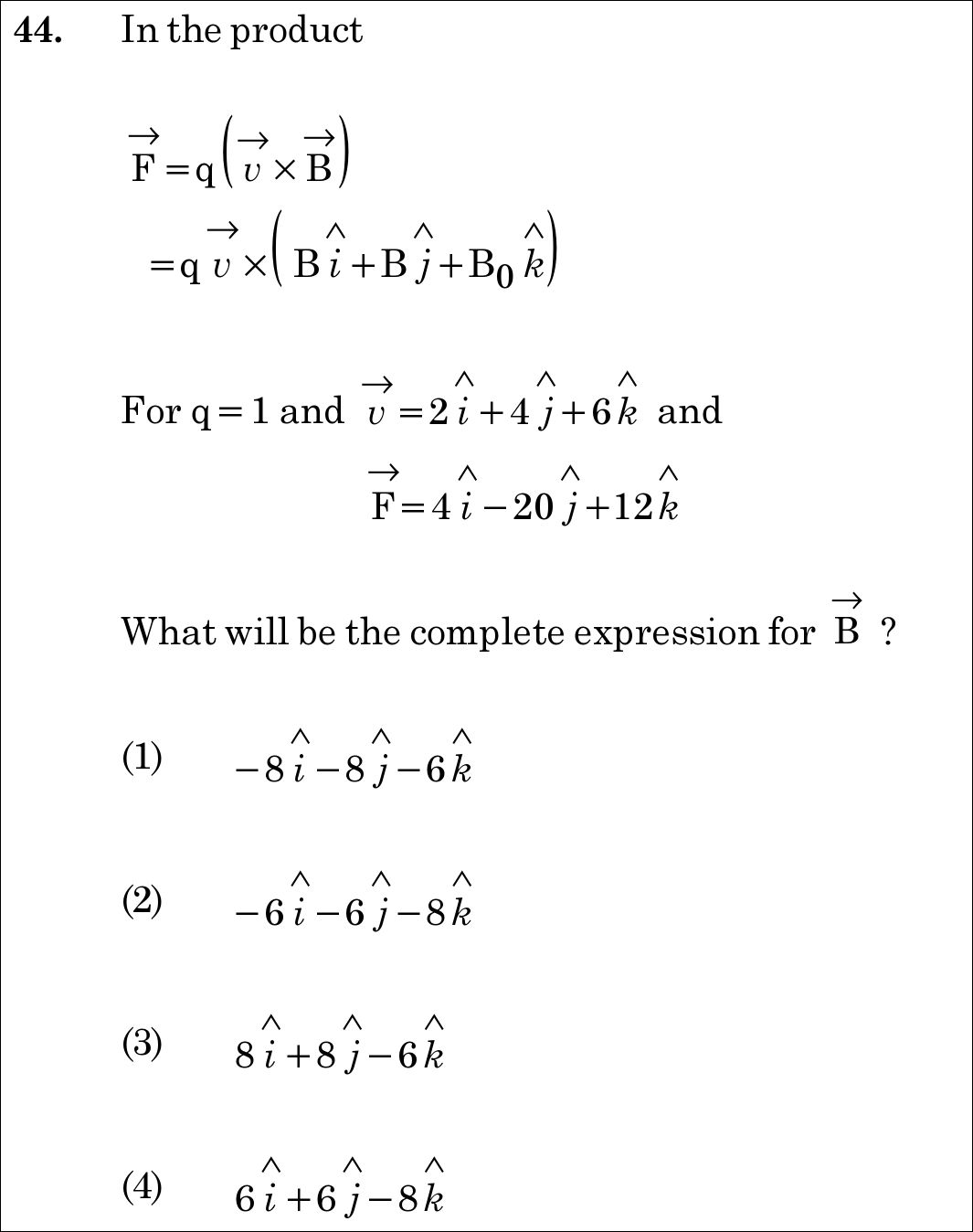
NEET 2021 · Q44 Medium
Official NEET 2021 Question 44 - Moving Charges and Magnetism
1
2 ✓ Key
3
4
💡 Verified Solution & 30-Second Hack
✓
Verified Against NTA Final Answer Key
Option (2) : -6i - 6j - 8k
📚 Moving Charges and Magnetism Medium
📋 Given Parameters & Problem Setup
Charge (q) 1 C
Velocity Vector (v) 2 i + 4 j + 6 k
Magnetic Field Form B i + B j + B_0 k
Force Vector (F) 4 i - 20 j + 12 k
⚡

The 30-Second Exam Hall Shortcut: ⚡ k-Component Inspection: (v × B)_z = 2B - 4B = -2B = 12   ⟹  \implies B = -6

⏱️ Save ~25 seconds

Inspect the k^\hat{k} component of v⃗×B⃗\vec{v} \times \vec{B}: (vxBy−vyBx)=(2)(B)−(4)(B)=−2B(v_x B_y - v_y B_x) = (2)(B) - (4)(B) = -2B. Since Fz=12F_z = 12, we immediately get −2B=12  ⟹  B=−6-2B = 12 \implies B = -6! So B⃗\vec{B} must begin with −6i^−6j^-6\hat{i} - 6\hat{j}. Only Option (2) has −6i^−6j^-6\hat{i} - 6\hat{j}! Instant 10-second inspection matching Option (2)!

1 Compute the k^\hat{k} component of v⃗×B⃗\vec{v} \times \vec{B}: vxBy−vyBx=2(B)−4(B)=−2Bv_x B_y - v_y B_x = 2(B) - 4(B) = -2B.
2 Equate to Fz=12F_z = 12: −2B=12  ⟹  B=−6-2B = 12 \implies B = -6.
3 Since the field has form B⃗=Bi^+Bj^+B0k^\vec{B} = B\hat{i} + B\hat{j} + B_0\hat{k}, the first two coefficients are both −6-6.
4 Look at the options: Only Option (2) has −6i^−6j^−8k^-6\hat{i} - 6\hat{j} - 8\hat{k}.
5 Match Option (2).
🛡️
Why You Can 100% Trust This Shortcut: Canonical vector cross product component evaluation.
📐

Step-by-Step Rigorous Workflow & Mathematical Proof

Step 1

Formulating the Magnetic Force Cross Product

For charge q=1q = 1, the magnetic force is F⃗=v⃗×B⃗\vec{F} = \vec{v} \times \vec{B}. Given v⃗=2i^+4j^+6k^\vec{v} = 2\hat{i} + 4\hat{j} + 6\hat{k} and B⃗=Bi^+Bj^+B0k^\vec{B} = B\hat{i} + B\hat{j} + B_0\hat{k}:

v⃗×B⃗=∣i^j^k^246BBB0∣\vec{v} \times \vec{B} = \begin{vmatrix} \hat{i} & \hat{j} & \hat{k} \\ 2 & 4 & 6 \\ B & B & B_0 \end{vmatrix}
Step 2

Expanding the Determinant

Expand along the top row:

v⃗×B⃗=i^(4B0−6B)−j^(2B0−6B)+k^(2B−4B)=(4B0−6B)i^−(2B0−6B)j^−2Bk^\vec{v} \times \vec{B} = \hat{i}(4 B_0 - 6 B) - \hat{j}(2 B_0 - 6 B) + \hat{k}(2 B - 4 B) = (4 B_0 - 6 B)\hat{i} - (2 B_0 - 6 B)\hat{j} - 2 B \hat{k}
Step 3

Comparing Components with the Given Force Vector

We are given F⃗=4i^−20j^+12k^\vec{F} = 4\hat{i} - 20\hat{j} + 12\hat{k}: 1. From the k^\hat{k}-component: −2B=12  ⟹  B=−6-2B = 12 \implies B = -6 2. From the i^\hat{i}-component: 4B0−6B=4  ⟹  4B0−6(−6)=4  ⟹  4B0+36=4  ⟹  4B0=−32  ⟹  B0=−84 B_0 - 6 B = 4 \implies 4 B_0 - 6(-6) = 4 \implies 4 B_0 + 36 = 4 \implies 4 B_0 = -32 \implies B_0 = -8 3. Verify the j^\hat{j}-component: $−(2B0−6B)=−[2(−8)−6(−6)]=−[−16+36]=−20(Matches Fy=−20)-(2 B_0 - 6 B) = -[2(-8) - 6(-6)] = -[-16 + 36] = -20 \quad (\text{Matches } F_y = -20)

Step 4

Assembling the Magnetic Field Vector

Substitute B=−6B = -6 and B0=−8B_0 = -8 into B⃗=Bi^+Bj^+B0k^\vec{B} = B\hat{i} + B\hat{j} + B_0\hat{k}:

B⃗=−6i^−6j^−8k^\vec{B} = -6\hat{i} - 6\hat{j} - 8\hat{k}
⭐

360° Option Elimination Engine Key Feature

Diagnose every choice: Know exactly why the right option works and why distractors fail.

4-Option Deep Scan
1 1
✗ Incorrect
Verdict & Scientific Reason:

Swaps BB and B0B_0 (B=−8,B0=−6B = -8, B_0 = -6).

⚠️
Student Fallacy (Why candidates pick this trap): Swapping coordinates in vector cross product.
2 2
✓ 100% Correct
Verdict & Scientific Reason:

Exact vector components: B=−6B = -6 and B0=−8B_0 = -8, yielding −6i^−6j^−8k^-6\hat{i} - 6\hat{j} - 8\hat{k}.

💡
Why this is airtight: None; rigorous vector determinant solution.
3 3
✗ Incorrect
Verdict & Scientific Reason:

Sign error on BB and swapped indices.

⚠️
Student Fallacy (Why candidates pick this trap): Sign inversion error.
4 4
✗ Incorrect
Verdict & Scientific Reason:

Sign error on BB (+6+6 instead of −6-6).

⚠️
Student Fallacy (Why candidates pick this trap): Flipping the sign of −2B=12-2B = 12.
⚠️

NTA Trap Alert: k-Component Sign Trap

The k^\hat{k} component is (2B−4B)=−2B(2B - 4B) = -2B. Setting −2B=12-2B = 12 requires B=−6B = -6. Students who mistakenly drop the minus sign write 2B=12  ⟹  B=+62B = 12 \implies B = +6, falling for Option (4).

🛡️ How to avoid the -1 mark: Watch the order: vxBy−vyBx=2(B)−4(B)=−2Bv_x B_y - v_y B_x = 2(B) - 4(B) = -2B.
📖

Core NEET Syllabus Standard

NCERT Physics · Moving Charges and Magnetism Standard Benchmark
Core Scientific Principle Tested:

"The magnetic force is given by the cross product F⃗=q(v⃗×B⃗)\vec{F} = q(\vec{v} \times \vec{B}), solved component-wise using vector determinant methods."

Syllabus Focus: Magnetic Force and Vector Cross Products
✓ Core NEET UG Syllabus Anchor Syllabus & Academic Standards ↗
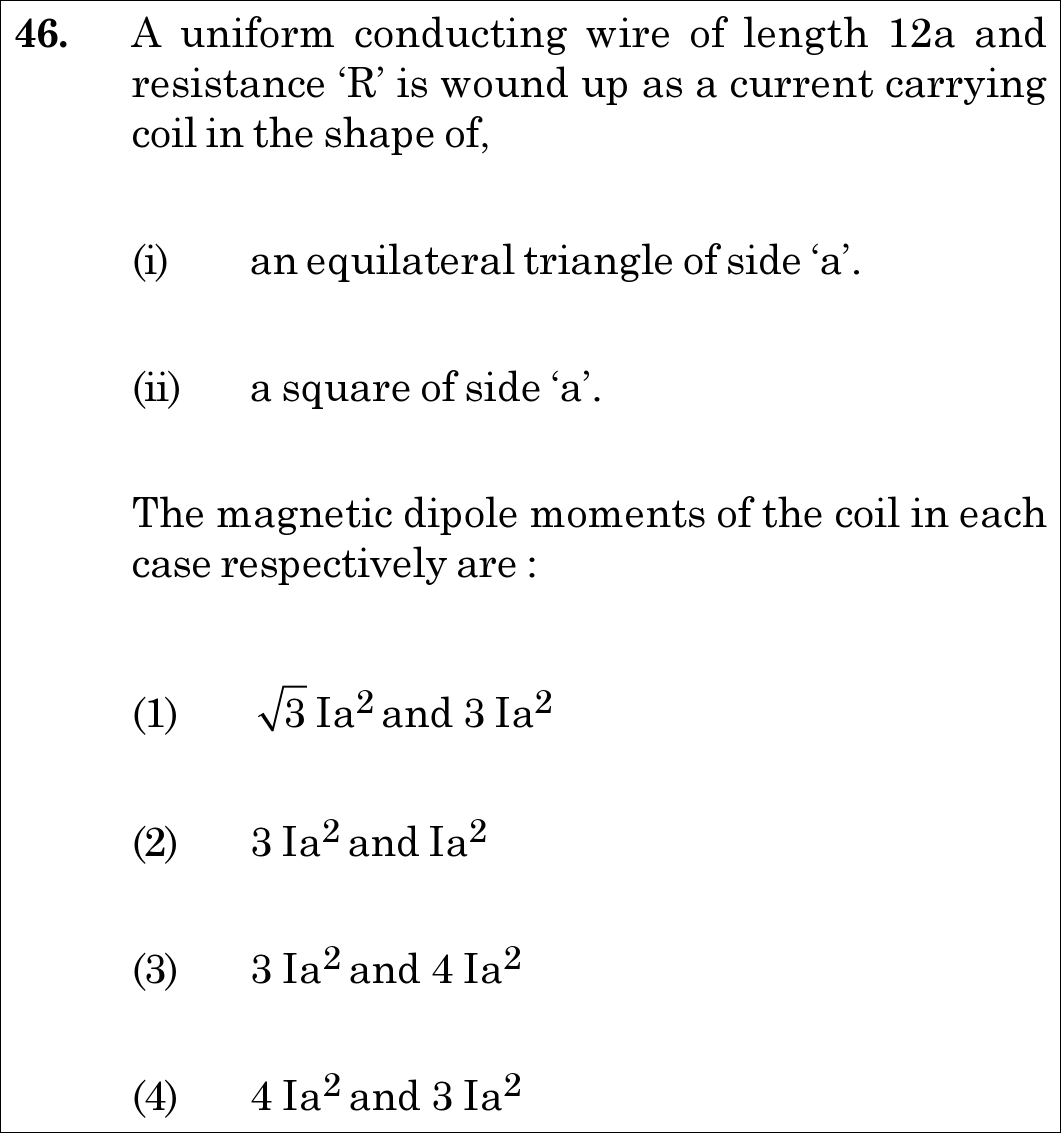
NEET 2021 · Q46 Medium
Official NEET 2021 Question 46 - Moving Charges and Magnetism
1 ✓ Key
2
3
4
💡 Verified Solution & 30-Second Hack
✓
Verified Against NTA Final Answer Key
Option (1) : √3 I a^2 and 3 I a^2
📚 Moving Charges and Magnetism Medium
📋 Given Parameters & Problem Setup
Total Length of Wire (L) 12 a
Current in Wire I
Coil (i) Shape Equilateral triangle of side a
Coil (ii) Shape Square of side a
⚡

The 30-Second Exam Hall Shortcut: ⚡ Turns × Area: N = L / Perimeter

⏱️ Save ~25 seconds

Triangle: Perimeter =3a  ⟹  N1=12a3a=4= 3a \implies N_1 = \frac{12a}{3a} = 4 turns. Area =34a2= \frac{\sqrt{3}}{4}a^2. M1=N1IA1=4×I×34a2=3Ia2M_1 = N_1 I A_1 = 4 \times I \times \frac{\sqrt{3}}{4}a^2 = \sqrt{3} I a^2. Square: Perimeter =4a  ⟹  N2=12a4a=3= 4a \implies N_2 = \frac{12a}{4a} = 3 turns. Area =a2= a^2. M2=N2IA2=3×I×a2=3Ia2M_2 = N_2 I A_2 = 3 \times I \times a^2 = 3 I a^2. Match Option (1)!

1 Total wire length is L=12aL = 12a.
2 Case (i) Equilateral triangle: perimeter per turn =3a= 3a. Number of turns N1=12a/3a=4N_1 = 12a / 3a = 4.
3 Area of triangle A1=34a2A_1 = \frac{\sqrt{3}}{4} a^2.
4 Magnetic moment M1=N1IA1=4⋅I⋅(34a2)=3Ia2M_1 = N_1 I A_1 = 4 \cdot I \cdot \left(\frac{\sqrt{3}}{4} a^2\right) = \sqrt{3} I a^2.
5 Case (ii) Square: perimeter per turn =4a= 4a. Number of turns N2=12a/4a=3N_2 = 12a / 4a = 3.
6 Area of square A2=a2A_2 = a^2.
7 Magnetic moment M2=N2IA2=3⋅I⋅a2=3Ia2M_2 = N_2 I A_2 = 3 \cdot I \cdot a^2 = 3 I a^2.
8 Respectively: 3Ia2\sqrt{3} I a^2 and 3Ia23 I a^2. Match Option (1).
🛡️
Why You Can 100% Trust This Shortcut: Canonical definition of magnetic dipole moment of planar current loop (M=NIAM = N I A).
📐

Step-by-Step Rigorous Workflow & Mathematical Proof

Step 1

Formula for Magnetic Dipole Moment of a Planar Coil

For a flat coil with NN turns, carrying current II and enclosing cross-sectional area AA, the magnitude of the magnetic dipole moment is:

M=NIAM = N I A
Step 2

Analyzing Case (i): Equilateral Triangle of Side a

The perimeter of one triangular loop of side aa is P1=3aP_1 = 3a. With total length L=12aL = 12a: - Number of turns: N1=L3a=12a3a=4N_1 = \frac{L}{3a} = \frac{12a}{3a} = 4 - Area of one equilateral triangle: A1=34a2A_1 = \frac{\sqrt{3}}{4} a^2

M1=N1IA1=4×I×(34a2)=3Ia2M_1 = N_1 I A_1 = 4 \times I \times \left(\frac{\sqrt{3}}{4} a^2\right) = \sqrt{3} I a^2
Step 3

Analyzing Case (ii): Square of Side a

The perimeter of one square loop of side aa is P2=4aP_2 = 4a. With total length L=12aL = 12a: - Number of turns: N2=L4a=12a4a=3N_2 = \frac{L}{4a} = \frac{12a}{4a} = 3 - Area of one square: A2=a2A_2 = a^2

M2=N2IA2=3×I×(a2)=3Ia2M_2 = N_2 I A_2 = 3 \times I \times (a^2) = 3 I a^2
⭐

360° Option Elimination Engine Key Feature

Diagnose every choice: Know exactly why the right option works and why distractors fail.

4-Option Deep Scan
1 1
✓ 100% Correct
Verdict & Scientific Reason:

Exact magnetic moments: M1=4×I×(3/4a2)=3Ia2M_1 = 4 \times I \times (\sqrt{3}/4 a^2) = \sqrt{3}Ia^2 and M2=3×I×a2=3Ia2M_2 = 3 \times I \times a^2 = 3Ia^2.

💡
Why this is airtight: None; rigorous geometry and magnetic moment analysis.
2 2
✗ Incorrect
Verdict & Scientific Reason:

Incorrect turn calculation for both coils.

⚠️
Student Fallacy (Why candidates pick this trap): Assuming single-turn coils with incorrect area.
3 3
✗ Incorrect
Verdict & Scientific Reason:

Swaps the number of turns and ignores 3/4\sqrt{3}/4 factor for triangle.

⚠️
Student Fallacy (Why candidates pick this trap): Using square area for triangle.
4 4
✗ Incorrect
Verdict & Scientific Reason:

Ignores the 34\frac{\sqrt{3}}{4} area factor of the equilateral triangle (4×Ia24 \times I a^2).

⚠️
Student Fallacy (Why candidates pick this trap): Forgetting to multiply by 34\frac{\sqrt{3}}{4} for equilateral triangle.
⚠️

NTA Trap Alert: Number of Turns Neglect Trap

Students frequently assume the coil has only 1 turn (N=1N = 1), calculating M1=34Ia2M_1 = \frac{\sqrt{3}}{4}Ia^2 and M2=Ia2M_2 = Ia^2. Total wire length is 12a12a, creating multiple full loops (N1=4,N2=3N_1 = 4, N_2 = 3).

🛡️ How to avoid the -1 mark: Always check total wire length: N=Total Length/PerimeterN = \text{Total Length} / \text{Perimeter}.
📖

Core NEET Syllabus Standard

NCERT Physics · Moving Charges and Magnetism Standard Benchmark
Core Scientific Principle Tested:

"The magnetic dipole moment of a coil of NN turns and area AA is M=NIAM = NIA."

Syllabus Focus: Magnetic Dipole Moment of a Current Loop
✓ Core NEET UG Syllabus Anchor Syllabus & Academic Standards ↗
NEET 2020 · Q172 Easy
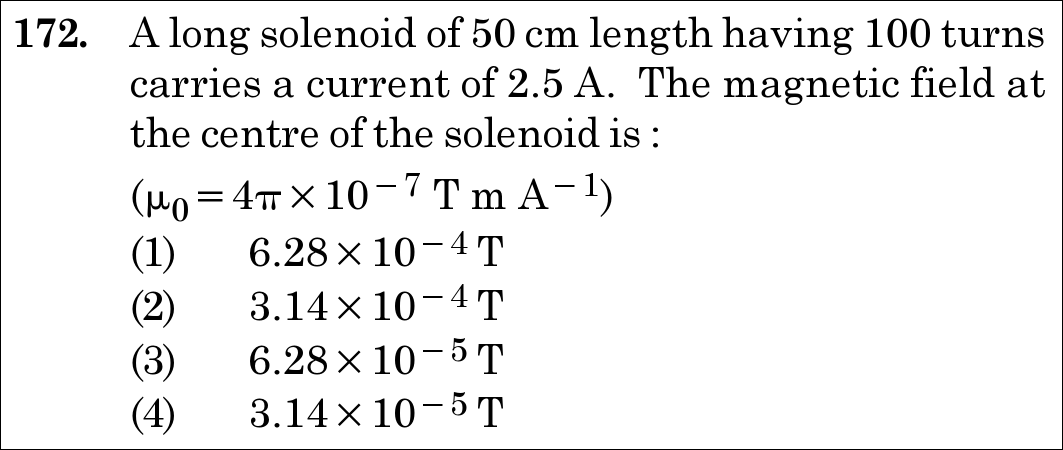
Official NEET 2020 Question 172 - Moving Charges and Magnetism
1 ✓ Key
2
3
4
💡 Verified Solution & 30-Second Hack
✓
Verified Against NTA Final Answer Key
Option (1) : 6.28 x 10^-4 T
📚 Moving Charges and Magnetism Easy
📋 Given Parameters & Problem Setup
Length of Solenoid (L) 50 cm = 0.5 m
Number of Turns (N) 100
Current (I) 2.5 A
Permeability (mu0) 4pi × 10^-7 T m A^-1
⚡

The 30-Second Exam Hall Shortcut: ⚡ "n = N/L = 100/0.5 = 200 turns/m. B = mu0 n I = 4pi × 10^-7 × 200 × 2.5 = 2000pi × 10^-7 = 2pi × 10^-4 = 6.28 × 10^-4 T!"

⏱️ 20 seconds

The magnetic field inside a long solenoid is B = mu0 · n · I. The turn density is n = N / L = 100 / 0.5 m = 200 turns/m. Substituting gives B = (4pi × 10^-7) × 200 × 2.5 = 4pi × 10^-7 × 500 = 2000pi × 10^-7 = 2pi × 10^-4 = 6.28 × 10^-4 T. Takes under 10 seconds!

1 Compute turns per unit length: n=NL=1000.5 m=200 m−1n = \frac{N}{L} = \frac{100}{0.5\text{ m}} = 200\text{ m}^{-1}.
2 Apply solenoid formula: B=μ0nIB = \mu_0 n I.
3 Substitute: B=(4π×10−7)×200×2.5=(4π×10−7)×500=2000π×10−7 TB = (4\pi \times 10^{-7}) \times 200 \times 2.5 = (4\pi \times 10^{-7}) \times 500 = 2000\pi \times 10^{-7}\text{ T}.
4 Simplify: B=2π×10−4=2×3.14×10−4=6.28×10−4 TB = 2\pi \times 10^{-4} = 2 \times 3.14 \times 10^{-4} = 6.28 \times 10^{-4}\text{ T}.
5 Select Option (1).
🛡️
Why You Can 100% Trust This Shortcut: NCERT Physics · Moving Charges and Magnetism (Magnetic Field of a Solenoid)
📐

Step-by-Step Rigorous Workflow & Mathematical Proof

Step 1

Formula for Magnetic Field of a Solenoid

By Ampere's circuital law, the magnetic field near the center inside a long current-carrying solenoid is uniform and given by: B=μ0nIB = \mu_0 n I, where nn is the number of turns per unit length.

Step 2

Convert Units and Calculate Turn Density

- Total turns: N=100N = 100 - Length: L=50 cm=0.5 mL = 50\text{ cm} = 0.5\text{ m} n=NL=1000.5=200 turns/mn = \frac{N}{L} = \frac{100}{0.5} = 200\text{ turns/m}.

Step 3

Calculate Magnetic Field

B=μ0nI=(4π×10−7 T m A−1)×(200 m−1)×(2.5 A)B = \mu_0 n I = (4\pi \times 10^{-7}\text{ T m A}^{-1}) \times (200\text{ m}^{-1}) \times (2.5\text{ A}) B=4π×10−7×500=2000π×10−7=2π×10−4 TB = 4\pi \times 10^{-7} \times 500 = 2000\pi \times 10^{-7} = 2\pi \times 10^{-4}\text{ T} Substitute π≈3.14\pi \approx 3.14: B=2×3.14×10−4=6.28×10−4 TB = 2 \times 3.14 \times 10^{-4} = 6.28 \times 10^{-4}\text{ T}.

Step 4

Match with Options

Matches Option 1.

⭐

360° Option Elimination Engine Key Feature

Diagnose every choice: Know exactly why the right option works and why distractors fail.

4-Option Deep Scan
1 A
✓ 100% Correct
Verdict & Scientific Reason:

Accurate value; B = mu0 n I = 4pi × 10^-7 × 200 × 2.5 = 6.28 × 10^-4 T.

💡
Why this is airtight: None; precise calculation.
2 B
✗ Incorrect
Verdict & Scientific Reason:

Incorrect; calculates the field at the end of the solenoid (B = 1/2 mu0 n I).

⚠️
Student Fallacy (Why candidates pick this trap): Using the end-of-solenoid formula instead of the center.
3 C
✗ Incorrect
Verdict & Scientific Reason:

Incorrect; forgot to convert 50 cm to 0.5 m, using L = 50 in the denominator.

⚠️
Student Fallacy (Why candidates pick this trap): Unit conversion error (cm to m).
4 D
✗ Incorrect
Verdict & Scientific Reason:

Incorrect; both used end formula and made centimeter unit conversion error.

⚠️
Student Fallacy (Why candidates pick this trap): Compound error of formula and units.
⚠️

NTA Trap Alert: Centimeters to Meters & Center vs End

Length must be in meters: 50 cm = 0.5 m (turn density n = 100/0.5 = 200, not 100/50 = 2). Also, center is B = mu0 n I, while end is 1/2 mu0 n I.

🛡️ How to avoid the -1 mark: Always convert dimensions to SI units (meters) before applying electrodynamic formulas.
📖

Core NEET Syllabus Standard

Physics · Moving Charges and Magnetism Standard Benchmark
Core Scientific Principle Tested:

""

Syllabus Focus: Magnetic Field at the Centre of a Long Solenoid
✓ Core NEET UG Syllabus Anchor Syllabus & Academic Standards ↗

Solve 4 NEET Questions a Day — One per Subject

Cover all 1,140 official NEET questions in 285 days at your own pace. Progress is saved on your device. No login needed.