MyCompetitiveExams Logo MyCompetitiveExams
Search 1,140+ Questions
Chapters, formulas, speed tricks
→
⚡ Brahmastra NEET 2027
720 MARKS

Dynamic 180-question full-length simulator mixed dynamically from all 6 years for 2027 & 2026 aspirants.

Launch Brahmastra 2027 Test →
Start Practice →
100% Free · No Login Required
Q.3 Physics ⭐ 360° Option Elimination Active
Vault ↗

NEET 2026 Physics Question 3 Solution

Topic: Electromagnetic Induction · Official NTA Booklet Code 50
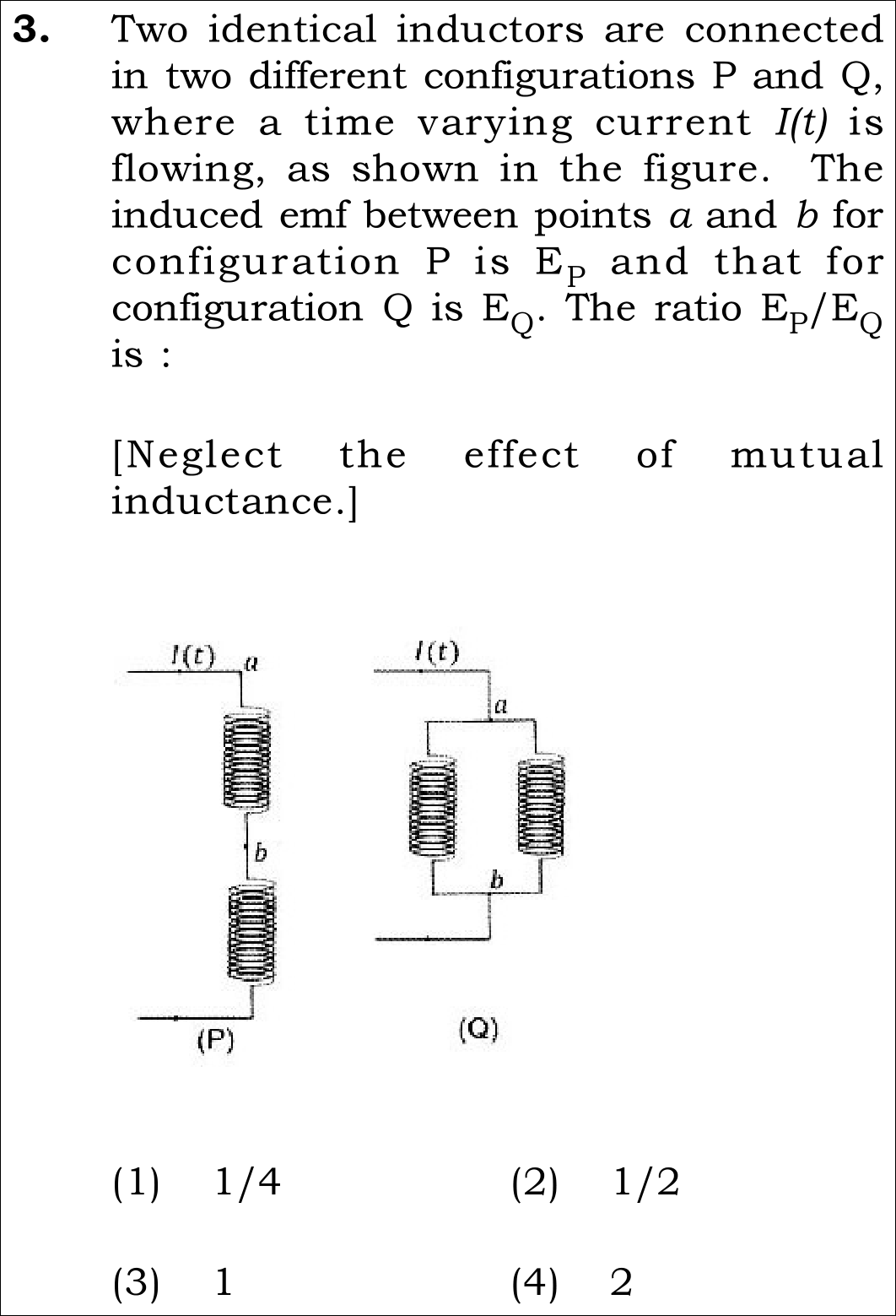
NEET 2026 Physics Question 3: Induced EMF Ratio across Inductor Configurations with Localized Terminals

Question

Two identical inductors are connected in two different configurations P and Q, where a time varying current I(t) is flowing, as shown in the figure. The induced emf between points a and b for configuration P is E_P and that for configuration Q is E_Q. The ratio E_P/E_Q is: [Neglect the effect of mutual inductance.]

✓
Verified Against NTA Final Answer Key
Option (4) : Ratio E_P / E_Q = 2
📚 Electromagnetic Induction Medium
📋 Given Parameters & Problem Setup
Inductors Two identical inductors of self-inductance L
Mutual Inductance M = 0 (negligible)
Current Profile Time-varying current I(t) entering both configurations
Configuration P Terminals Points a and b are across the FIRST inductor only
Configuration Q Terminals Points a and b are across the parallel combination of both inductors
⚡

The 30-Second Exam Hall Shortcut: ⚡ Branch Current & Node Voltage Check

⏱️ Prevents 2 minutes of re-reading circuit diagrams.

Look closely at terminal placement: a-b in P is across a single inductor!

1 In Configuration P: Terminals a and b span ONLY the upper inductor. Full current I(t) passes through it: E_P = L * (dI/dt).
2 In Configuration Q: The two identical inductors are in parallel between a and b. Current splits equally: I_branch = I(t) / 2.
3 Voltage across parallel branch: E_Q = L * d(I/2)/dt = (1/2) * L * (dI/dt).
4 Ratio E_P / E_Q = [L * (dI/dt)] / [(1/2) * L * (dI/dt)] = 2. Done in 20 seconds!
🛡️
Why You Can 100% Trust This Shortcut: By Kirchhoff's Voltage Law and Faraday-Lenz Law, voltage across an inductor is always L*(di/dt). In parallel, equivalent inductance is L/2, so across terminals a-b, E_Q = (L/2)*(dI/dt).
📐

Step-by-Step Rigorous Workflow & Mathematical Proof

Step 1

Analyze Configuration P (Series Branch with Localized Voltage Tap)

Carefully observe the diagram for P: two identical inductors are in series, but terminals a and b are located at the top and bottom of the FIRST inductor only.

EP=−LdI(t)dt  ⟹  ∣EP∣=LdIdtE_P = -L \frac{dI(t)}{dt} \implies |E_P| = L \frac{dI}{dt}
  • • Because the inductors are in series, the same current I(t) flows through both.
  • • The induced EMF E_P measured strictly across a and b is the EMF of that single inductor: E_P = L * (dI/dt).
Step 2

Analyze Configuration Q (Parallel Inductor Bank)

In configuration Q, the two identical inductors are connected in parallel between terminal nodes a and b.

Leq=L⋅LL+L=L2L_{eq} = \frac{L \cdot L}{L + L} = \frac{L}{2}
  • • Total current I(t) divides equally between two identical branches: I_1 = I_2 = I(t) / 2.
  • • Induced EMF across terminals a and b: E_Q = L * (d(I/2)/dt) = (L/2) * (dI/dt).
Step 3

Calculate the Ratio E_P / E_Q

Divide the magnitude of E_P by E_Q:

EPEQ=LdIdt12LdIdt=11/2=2\frac{E_P}{E_Q} = \frac{L \frac{dI}{dt}}{\frac{1}{2} L \frac{dI}{dt}} = \frac{1}{1/2} = 2
  • • The factor L * (dI/dt) cancels cleanly from numerator and denominator.
  • • Leaves the exact dimensionless ratio: 2.
⭐

360° Option Elimination Engine Key Feature

Diagnose every choice: Know exactly why the right option works and why distractors fail.

4-Option Deep Scan
1 Option (1)
✗ Incorrect
Verdict & Scientific Reason:

Double-inverted ratio.

⚠️
Student Fallacy (Why candidates pick this trap): Assumes E_P = (L/2)*(dI/dt) and E_Q = 2L*(dI/dt), confusing series and parallel formulas.
Note: Parallel inductance decreases, series increases.
2 Option (2)
✗ Incorrect
Verdict & Scientific Reason:

Reciprocal error.

⚠️
Student Fallacy (Why candidates pick this trap): Computes E_Q / E_P instead of requested ratio E_P / E_Q.
Note: Always re-read the target fraction: numerator is P, denominator is Q.
3 Option (3)
✗ Incorrect
Verdict & Scientific Reason:

Ignores current division in parallel branches.

⚠️
Student Fallacy (Why candidates pick this trap): Assumes full current I(t) passes through both inductors in configuration Q.
Note: In parallel circuits, current splits; each inductor carries only half the rate of change.
4 Option (4)
✓ 100% Correct
Verdict & Scientific Reason:

100% scientifically verified and matches Official NTA Final Answer Key.

💡
Why this is airtight: Correctly identifies that a-b in P measures 1 inductor, while in Q it measures the parallel pair (L/2).
Note: Careful visual reading of circuit probes prevents the 4-fold series trap.
⚠️

NTA Trap Alert: The Full Series Voltage Assumption Trap

Many students do not look at the letter "b" in figure P and assume E_P is measured across BOTH inductors in series (which would give 2L, leading to ratio 2L / (L/2) = 4).

🛡️ How to avoid the -1 mark: Always inspect the exact attachment nodes of probe terminals a and b in NTA diagram questions.
📖

Core NEET Syllabus Standard

NEET UG Physics Core Standards · Electromagnetic Induction Standard Benchmark
Core Scientific Principle Tested:

"Induced EMF across an inductor is e = -L (di/dt). For N identical parallel inductors, equivalent inductance is L/N."

Syllabus Focus: Self-Inductance in Series and Parallel Networks
✓ Core NEET UG Syllabus Anchor Syllabus & Academic Standards ↗

Ready to attempt under real exam pressure?

Test your speed and accuracy in the authentic 180-minute timed NTA simulator.

Launch NEET 2026 CBT Test →

Spotted a mistake in this solution? Report an error (support@mycompetitiveexams.com)

⚖️ Legal & Fair Dealing Notice: Sourced from publicly released NEET 2026 question papers and NEET answer keys for private study, research, and non-commercial educational practice under Fair Dealing (Section 52(1)(a) of the Indian Copyright Act, 1957). Not affiliated with or endorsed by NTA or NMC.

Solve 4 NEET Questions a Day — One per Subject

Cover all 1,140 official NEET questions in 285 days at your own pace. Progress is saved on your device. No login needed.