MyCompetitiveExams Logo MyCompetitiveExams
Search 1,140+ Questions
Chapters, formulas, speed tricks
→
⚡ Brahmastra NEET 2027
720 MARKS

Dynamic 180-question full-length simulator mixed dynamically from all 6 years for 2027 & 2026 aspirants.

Launch Brahmastra 2027 Test →
Start Practice →
100% Free · No Login Required
Q.11 Physics ⭐ 360° Option Elimination Active
Vault ↗

NEET 2025 Physics Question 11 Solution

Topic: Electromagnetic Induction · Official NTA Booklet Code 45
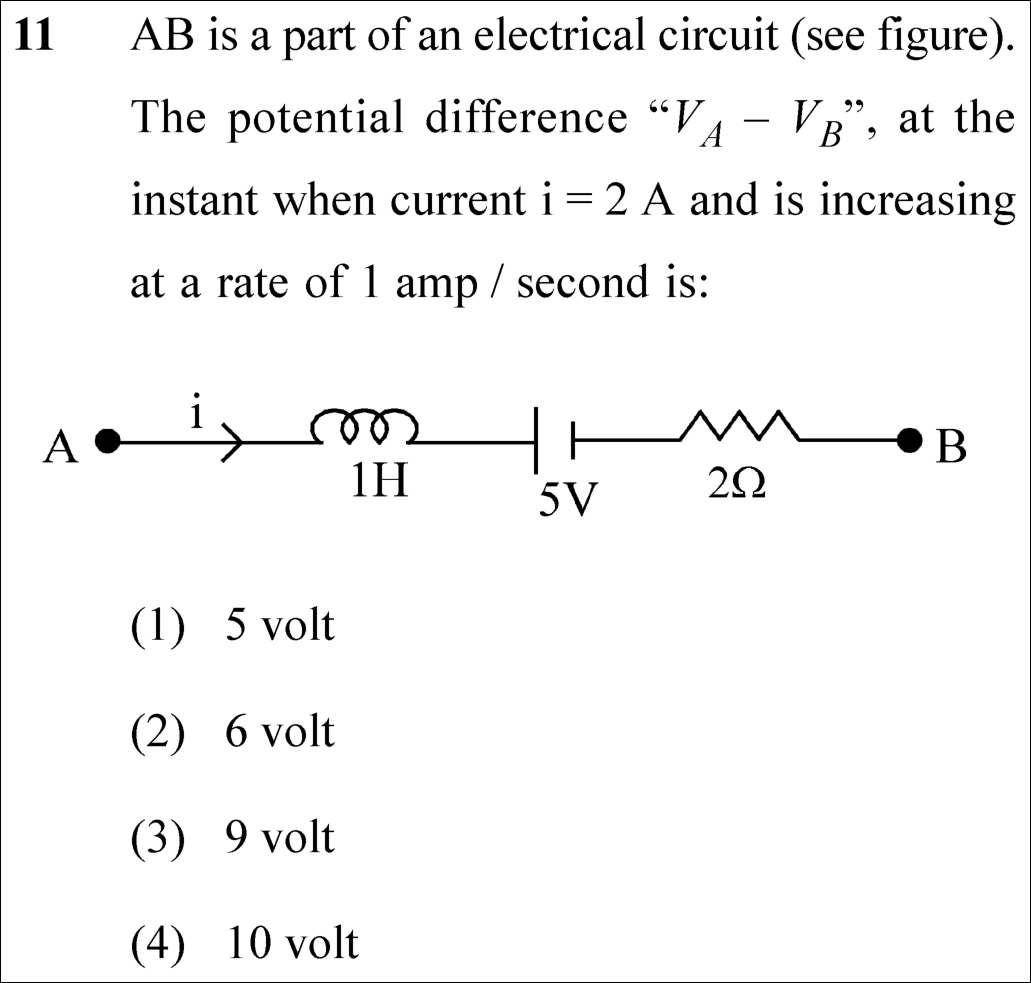
NEET 2025 Physics Question 11: Potential Difference Across an R-L-Battery Branch with Increasing Current

Question

AB is a part of an electrical circuit (see figure). The potential difference "V_A − V_B", at the instant when current i = 2 A and is increasing at a rate of 1 amp/second is:

✓
Verified Against NTA Final Answer Key
Option (4) : 10 volt
📚 Electromagnetic Induction Easy
📋 Given Parameters & Problem Setup
Branch Elements (A to B) Inductor L = 1 H, DC Battery E = 5 V, Resistor R = 2 Ω
Current (i) 2 A (directed from A to B)
Rate of Change of Current (di/dt) +1 A/s (increasing)
⚡

The 30-Second Exam Hall Shortcut: ⚡ Kirchhoff Potential Walkway

⏱️ Save ~40 seconds

V_A - L(di/dt) - E - iR = V_B ⟹ V_A - V_B = (1 × 1) + 5 + (2 × 2) = 1 + 5 + 4 = 10 V!

1 Walk from node A to node B along the direction of current.
2 Drop across inductor: -L(di/dt) = -1 × 1 = -1 V (current is increasing, so back EMF opposes current).
3 Drop across battery: Moving from long (+) plate to short (-) plate is a drop: -5 V.
4 Drop across resistor: Moving in current direction: -iR = -2 × 2 = -4 V.
5 Sum of potential drops: V_A - V_B = 1 + 5 + 4 = 10 V.
6 Pick Option (4) in under 15 seconds!
🛡️
Why You Can 100% Trust This Shortcut: Faraday-Lenz Law & Kirchhoff’s Loop Rule (NCERT Physics · Electromagnetic Induction: ε = -dΦ/dt).
📐

Step-by-Step Rigorous Workflow & Mathematical Proof

Step 1

Kirchhoff’s Voltage Rule Equation

Writing the potential step equation starting from point A and proceeding to point B:

VA−Ldidt−E−iR=VBV_A - L \frac{di}{dt} - E - i R = V_B
  • • Because di/dt > 0, the inductor develops an opposing back EMF with positive terminal facing A: drop = -L di/dt.
  • • The battery is traversed from its positive (long) plate to negative (short) plate: drop = -E = -5 V.
  • • The resistor is traversed in the direction of current flow: drop = -iR.
Step 2

Evaluate Numerical Values

Substitute the given values into the potential difference expression:

VA−VB=Ldidt+E+iR=(1 H)(1 A/s)+5 V+(2 A)(2 Ω)=1+5+4=10 VV_A - V_B = L \frac{di}{dt} + E + i R = (1\text{ H})(1\text{ A/s}) + 5\text{ V} + (2\text{ A})(2\,\Omega) = 1 + 5 + 4 = 10\text{ V}
  • • Potential difference V_A - V_B equals 10 volts, matching Option (4).
⭐

360° Option Elimination Engine Key Feature

Diagnose every choice: Know exactly why the right option works and why distractors fail.

4-Option Deep Scan
1 A
✗ Incorrect
Verdict & Scientific Reason:

Incorrect. Considers only battery EMF while ignoring inductive and resistive drops.

⚠️
Student Fallacy (Why candidates pick this trap): Ignoring dynamic impedance.
2 B
✗ Incorrect
Verdict & Scientific Reason:

Incorrect. Subtracts resistive drop: 5 + 1 - 4 = 2, or misses inductor.

⚠️
Student Fallacy (Why candidates pick this trap): Sign error in resistor drop.
3 C
✗ Incorrect
Verdict & Scientific Reason:

Incorrect. Forgets inductor back EMF (5 + 4 = 9 V).

⚠️
Student Fallacy (Why candidates pick this trap): Treating inductor as an ideal short circuit in DC steady state instead of transient di/dt.
4 D
✓ 100% Correct
Verdict & Scientific Reason:

100% correct. V_A - V_B = L(di/dt) + E + iR = 1 + 5 + 4 = 10 V.

💡
Why this is airtight: None; textbook circuit traversal.
⚠️

NTA Trap Alert: Inductor DC Steady State Assumption Trap

Students often assume an inductor behaves like a plain wire (0 V drop) because current is 2 A. But current is INCREASING at 1 A/s, creating an active induced back EMF of L di/dt = 1 V!

🛡️ How to avoid the -1 mark: Always check if di/dt is non-zero. If di/dt ≠ 0, inductor drop is L di/dt!
📖

Core NEET Syllabus Standard

NEET Physics Core Syllabus · Electromagnetic Induction Standard Benchmark
Core Scientific Principle Tested:

"Potential drop across an inductor carrying increasing current is L di/dt opposing current flow."

Syllabus Focus: Self-Induction and Induced EMF
✓ Core NEET UG Syllabus Anchor Syllabus & Academic Standards ↗
All Drops Add Up: 1V (inductor) + 5V (battery) + 4V (resistor) = 10 V!

Ready to attempt under real exam pressure?

Test your speed and accuracy in the authentic 180-minute timed NTA simulator.

Launch NEET 2025 CBT Test →

Spotted a mistake in this solution? Report an error (support@mycompetitiveexams.com)

⚖️ Legal & Fair Dealing Notice: Sourced from publicly released NEET 2025 question papers and NEET answer keys for private study, research, and non-commercial educational practice under Fair Dealing (Section 52(1)(a) of the Indian Copyright Act, 1957). Not affiliated with or endorsed by NTA or NMC.

Solve 4 NEET Questions a Day — One per Subject

Cover all 1,140 official NEET questions in 285 days at your own pace. Progress is saved on your device. No login needed.